$166B Tariff Refund: Corporations Get Paid, Consumers Get the Bill
TL;DR
- $166B Tariff Refund: Importers Get Paid, Consumers Get Nothing. Will any of that $166 billion in tariff refunds ever reach your wallet?
- Singapore's 2.2% CPI: A Band-Aid on Imported Inflation. Is Singapore's 2.2% inflation a genuine win or policy theater while energy costs silently compound?
- Shein's $27B Hong Kong IPO: A 72% Valuation Collapse Disguised as a Market Debut. Can Shein survive without the tariff loophole that made it cheap?
💰 The Great Tariff Sleight of Hand: Refunds Nobody Will See
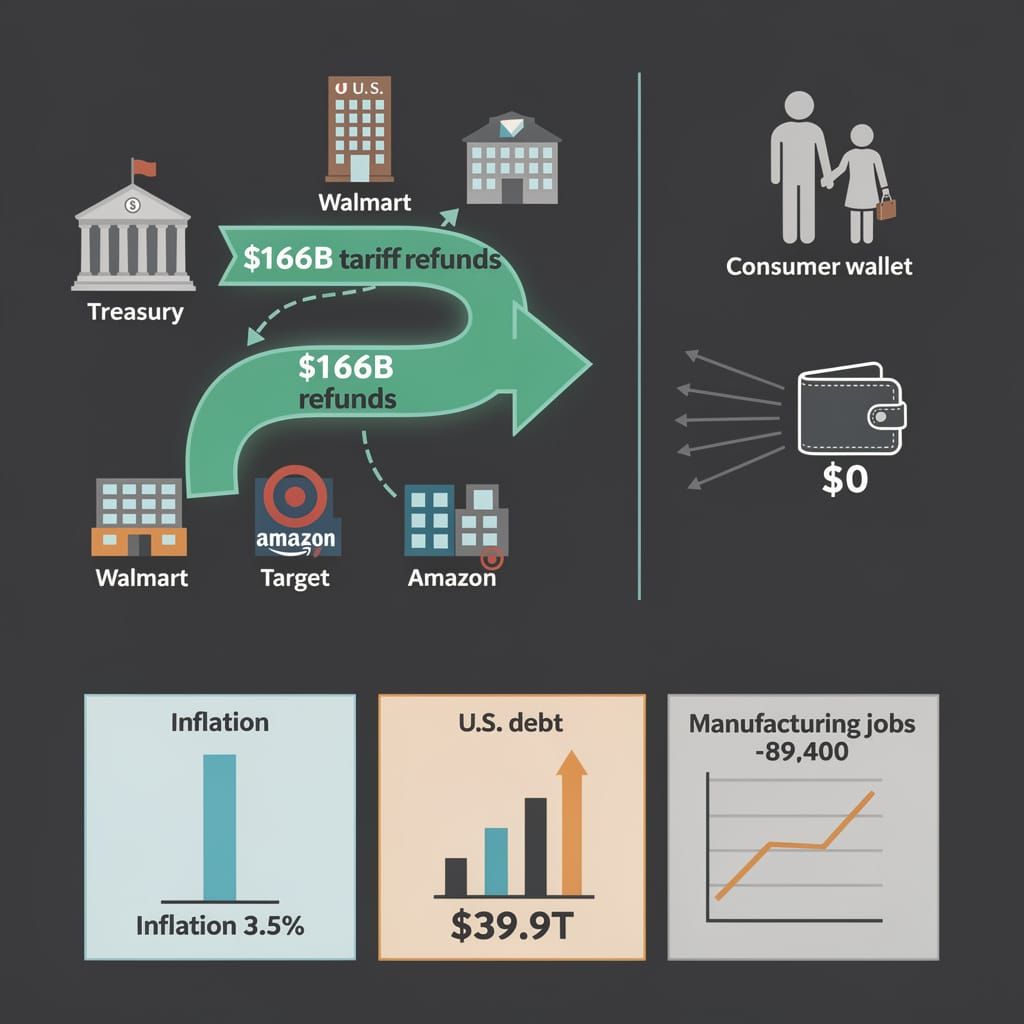
$166 billion in tariff refunds are heading back to Walmart, Target, and Amazon — not your wallet. 💰 That's enough to cover every U.S. household's grocery bill for three months. Instead, prices stay elevated, inflation runs at 3.5%, and 89,400 manufacturing jobs are gone. Importers get made whole. You get the bill — again. Does anyone actually believe these refunds trickle down to your checkout total?
The arithmetic is simple. Washington slaps a tariff, importers pay it, prices go up, consumers absorb the cost. On May 14–15, 2026, the Supreme Court declared Trump-era tariffs illegal under IEEPA and Section 201 — mandating refunds to the companies that fronted the tax. CBP's CAPE portal has since received over 126,000 refund applications, with an estimated $166 billion in pending refunds owed by the Treasury. The question nobody in the administration wants to answer: Does anyone believe that money ends up in your wallet?
The Mechanics of a Mirage
The causal chain is brutally clear:
- Section 301 tariffs collected from importers — companies like Walmart, Costco, Target, Home Depot.
- Court-ordered refunds flow back to those same importers — not to households, not to wage earners, not to the 89,400 manufacturing workers who lost their jobs during the tariff experiments.
- Retail pricing remains elevated because supply chains were permanently rewired, sourcing shifted, and labor exploited through expanded guest-worker programs.
The refund logic presumes that importers, having been made whole by the Treasury, will dutifully lower prices. Walmart did secure roughly $2.9–3 billion in tariff refunds per CFO John David Rainey during Q2 FY27 earnings, with CEO John Furner stating the funds would be reinvested into "customer experience and price leadership." The company expanded its rollback program from 7,200 items in Q1 to 11,000 in Q2. But Walmart's own sales data tells a different story: comparable sales growth slowed to 2.6% (vs. 4.1% in Q1), customer traffic dropped 1.5%, and the stock still declined 9% post-announcement. Target, receiving roughly $1 billion in refunds, pointedly declined to link its rebate to any price reduction. The benevolence assumption falters on first contact with reality.
What Has Actually Changed
| Metric | Pre-Tariff Baseline | Current (August 2026) |
|---|---|---|
| US National Debt | $34 trillion | $39.9+ trillion — surged $524.22B in six weeks, approaching $41.3T by FY2027 |
| Inflation (CPI) | ~2.5% | 3.5% and climbing — Dallas Fed estimates core inflation would have been 0.8 ppt lower without tariffs |
| Manufacturing Employment | Stable | Net 3,000 jobs added June 2026 — but only after earlier revisions cut gains to zero; ISM Employment Index at 49.7% indicates contraction |
| Tariff Policy | Predictable | Cap rate replacement, then lowered below 15%, then raised again — all within one month |
The pattern demonstrates not strategy but chaos. August 2: tariffs lowered below 15%. August 3: tariffs raised again. August 17: cap-rate replacement mechanism deployed. August 23: Section 301 refunds authorized. Policy instability isn't a bug — it is the only consistent feature.
Who Benefits, Who Absorbs
- Importers and retailers: Refund checks incoming, margins protected. Walmart's operating income rose ~30% YoY in Q2 FY27 even as the stock dropped 9% — markets apparently unimpressed.
- Consumers: Prices unchanged for most goods. Refunds do not reach them. Inflation runs 3.5%. Overemployment hits 5.5% as households take second jobs. The Kiel Institute confirms Americans bore 96% of the tariff burden.
- Manufacturing workers: 89,400 fewer positions than before the tariff cycle began. The June "recovery" of 3,000 jobs barely registers against accumulated losses.
- Taxpayers: National debt crossed $39.9 trillion as of August 14, 2026 — a $524.22B surge in six weeks — with interest servicing costs hitting $963B annually. The government borrows to refund tariffs.
State auditors Julie Blaha (Minnesota) and Mike Frerichs (Illinois) demanded refund transparency on May 14, 2026, after the Supreme Court ruling. Sen. Elizabeth Warren pressed Apple ($2.2 billion due), Amazon ($600 million due), and other retailers to disclose refund receipts. Kent Jones of Babson College notes tariff refunds have no mechanism to compel price reductions. Ben Parker of AEI observes that companies raising prices citing tariff costs have shown no inclination to reverse those increases.
The Structural Reality
The administration's trade policy operates as a transfer system:
Tariffs → Importers pay → Consumers pay higher prices → Courts order refunds → Importers receive checks → Prices stay high → Consumers continue paying
The missing feedback loop is enforcement. No agency audits whether refunded amounts translate to shelf prices. No statute compels pass-through. The Supreme Court ruling addresses who gets the money, not what happens after. A separate July 19, 2026 government-backed refund program for U.S. manufacturers operates by automated eligibility verification linked to customs filings — producing short-term cost savings for firms but no measurable improvement in household purchasing power.
Michael Poyker at Yale notes that refund mechanisms without pricing oversight effectively subsidize corporate margin recovery while households absorb the residual inflation.
What the Outlook Projects
- Q4 2026: Retailers report refund income in earnings calls. Inflation remains at 3.3–3.5%. No measurable price reduction on tariff-affected goods.
- H1 2027: Consumer confidence continues declining. Retail sales volumes drop as households adjust to sustained higher costs.
- Late 2027: Political pressure builds for pass-through legislation. No indication the current administration will support it.
The refund is real. The check is written. The question is whether you mistake a corporate balance-sheet adjustment for economic relief.
🌩️ The 2.2% "Victory Lap" That Isn't
Singapore's CPI hit 2.2% — below MAS's 2.3% projection. That's the "good news" you're supposed to buy. Q3 electricity tariffs rose 17% QoQ. A typical HDB household faces ~S$17 more monthly before GST. Core CPI at 1.6% means the gap is all imported energy — precisely what MAS's band tweak can't touch. The AI GDP narrative: 5.7% Q2 expansion, but Kuaishou's US$2.8B deal accounts for ~30% of total AI funding. The rest? ~US$28.7M per round on average. Concentration, not diversification. 2.2% isn't policy skill. It's a weather report ignoring the storm it helped create.
Singapore's headline CPI landed at 2.2% YoY in early August—below the 2.3% MAS projection. Some called it a win. The data doesn't support that.
The Band-Aid Approach
MAS tightened the Singapore dollar's exchange-rate band in late July—the second adjustment in four months. Modest, surgical, predictably insufficient.
- April 2026 band tightening: Analysts judged it too narrow to absorb import-price shocks. By June, HK Electric had raised fuel charges 34% amid Middle East conflict—a parallel energy-cost surge Singapore's own band couldn't deflect.
- July 2026 re-anchoring: Brent crude pushed past US$100/barrel the same day. Q3 electricity tariffs hit 31.91 cents/kWh (+17% QoQ). A typical HDB household now faces ~S$17.14 more monthly before GST.
- Core CPI at 1.6% (June) vs. 2.2% headline: The gap—0.6 percentage points—comes overwhelmingly from imported energy and shipping. Exactly the channels MAS's toolset struggles to control. Irish utility Pinergy raised rates ~10% in September citing identical wholesale volatility; the mechanism is global, and Singapore's band tweak doesn't interrupt it.
What 2.2% Actually Buys
Headline below forecast sounds reassuring. The components don't cooperate.
- Imported goods: Carrying persistent premiums. On June 22, Shell Singapore cut petrol by up to 4¢/litre after the US-Iran MOU reopened the Strait of Hormuz—yet prices remain elevated versus February 2024. Diesel held at S$4.22/litre. The "recovery" returned pump prices to pre-conflict levels, not pre-inflation levels.
- Buying power: Middle-income households feel the sharpest cost-of-living increase. MAS itself forecasts headline inflation at 2.5% through year-end, with core reaching 2.3% by July 2026.
- Productivity risk: Imported premiums compound costs for manufacturers outside the AI bubble, squeezing margins and stalling the productivity gains the economy relies on.
The AI Mirage
Q2 GDP expanded 5.7%, propelled by AI hardware exports. That number dominates headlines. The uncomfortable detail:
- 1.4 GW: Singapore's data-center capacity reached this milestone in July. But electricity costs sit at US$0.23/kWh, and heat stress threatens operations. The Sumatra–Singapore geothermal interconnection—tapping 2 GW—exists on paper but hasn't yet reduced LNG dependence.
- US$9.3 billion: Singapore-raised AI funding across 227 rounds by July. Kuaishou announced US$2.8B for Kling AI on July 3—that single deal accounts for ~30% of the total. The remaining 226 rounds average ~US$28.7 million each. Concentration, not diversification.
- 1.0°C: The GDP forecast revision on August 11—doubled to 4.5–5.5%—driven by less-severe U.S.-Iran conflict impact and oil inventory drawdowns. Translation: the upgrade depends on things not getting worse, not on structural resilience.
What MAS Won't Say
Policy remains constrained by the trade-weighted dollar mechanism. Tighter bands protect against imported inflation at the cost of export competitiveness. Looser bands do the reverse. There is no third option.
- Near term (H2 2026): Imported inflation persists. Electricity tariffs rose 17% QoQ in Q3; gas tariffs climbed 7.1%. CPI likely holds above 2% through year-end. Another band adjustment before Q1 2027 is probable.
- Medium term: If oil stays above US$100, expect cumulative macro debt to drift within the fiscal window. Government borrowing costs rise; fiscal headroom narrows.
- Sectoral impact: Export-dependent manufacturing outside of AI faces a margin squeeze. Import-competing domestic firms benefit slightly from a stronger SGD, but the net effect is negative. The Johor-Singapore RTS Link, operational January 2027, projects S$1.05B in annual consumer spending uplift and S$756M inflow recapture—but won't fix this quarter's import bill.
The 2.2% print isn't a policy success. It's a weather report that ignores the storm it helped create.
💀 Shein Lists in Hong Kong at $27B — and That's Somehow the Good News
Shein priced its Hong Kong IPO at $27B — down 72% from that $98.2B peak in April 2022. 💀 The same week the US killed the de-minimis loophole that made $10 dresses work. Q1 revenue barely grew 1.1%. Active customers hit 281M, but U.S. revenue dropped 14.3%. Volume isn't the problem — margin is. Can cheap Chinese goods survive without the tariff exemption that made them cheap?
The fast-fashion colossus once valued at $98.2 billion in private markets on April 2022 priced its Hong Kong IPO at roughly $27 billion. That is a 72% valuation collapse, dressed up as a market debut.
A Lifeline Dressed as a Tariff
The same week Shein hit the Hong Kong exchange, the United States killed the de-minimis import exemption for small packages — the legal loophole that let Shein ship $10 dresses from Chinese factories to American mailboxes duty-free. The end of that exemption — signed by President Trump in 2025 as part of a broader anti-subsidy push — removed a zero-tariff advantage that was central to the company's pricing model. Shein reported a $99 million net loss in Q1 2026, reversing a $395 million profit from Q1 2025. That swing includes a $328 million preferred-stock write-down tied to equity-value erosion, with tariff-driven margin compression widening the hole.
Short-term optics: Domestic Chinese sales tick up as tariff-free local channels gain relative appeal. But those gains will not replace the U.S. market. Shein's own data shows U.S. revenue fell 14.3% year-over-year to $2.04 billion in Q1 2026 — the first full quarter without the exemption. Meanwhile, active customers hit a record 281 million (+16% YoY), and the company processed over 1 billion orders, suggesting volume is not the problem; margin is.
The IPO Math Nobody Wants to Talk About
- 2020 private valuation: $15 billion
- April 2022 peak: $98.2 billion
- August 24, 2026 IPO: $27 billion market cap, raising HK$13.86 billion (~$1.77 billion) at HK$47.60–HK$49.50 per Class B share
That $1.77 billion will fund warehousing and supply-chain reconfiguration, not growth. The company's revenue growth slowed to 8% in 2025 ($41.8 billion from $38.7 billion), down from 20.7% the prior year. European compliance costs — a €3 fee per e-commerce import, plus fines under the EU's Digital Services Act and textile-waste directives — add approximately $3.42 per unit shipped, continuing to eat margins. The CSRC cleared the Hong Kong listing on July 10, 2026, but valuation expectations remain volatile — some analysts had pegged the IPO above $40 billion, making the $27 billion final figure a significant haircut.
Operational Gains Are Real, But Insufficient
Shein's on-demand manufacturing model enables inventory efficiency that rivals cannot match. The company can produce 5,000 units of a new design and restock within two weeks based on real-time data. That process generates less than half the unsold inventory of Zara or H&M.
Problem: Efficiency does not matter when your core market just erected a tariff wall that raised product costs by a range of 10–87.5% depending on category. The U.S. accounted for roughly 22.5% of Shein's revenue in Q1 2026 — down from an estimated 30% in 2025. UBS projects that share will fall below 20% by Q2 2027. Meanwhile, Shein's price increases implemented August 10, 2026 across Western markets triggered a 3% year-over-year decline in UK user engagement and a 39% drop in profitability.
The Real Question
Can a company that built its business on the combination of Chinese manufacturing costs and American tariff exemptions survive when one of those two legs is removed?
Shein's answer appears to be "diversify into third-party marketplace sales and hope European regulators go easy." The company's Q1 2026 revenue grew just 1.1% year-over-year — barely keeping pace with inflation. HSBC analysts project deeper markdowns in Q4 2026 unless revenue stabilizes above $38 billion annually. The company reported $32 billion in 2025 revenue — a figure that already reflects the growth slowdown.
Bottom Line
Shein is now a public company with a wounded business model, a $27 billion valuation that assumes a recovery that has not arrived, and a management team that spent two years insisting $98 billion was fair. Trading starts September 1 on the Hong Kong Stock Exchange. The listing clears the exchange's eligibility review. It does not clear the fundamental question of whether cheap Chinese goods can survive the collapse of the legal framework that made them cheap.


Comments ()