$1.1B Valuation, $60M Raise: Skyroot Becomes India's First Private Orbital Launcher
TL;DR
- $1.1B Valuation, $60M Raised: Skyroot's Vikram-1 Makes India a Private Space Nation. Can India's space policy keep up with its private rockets?
- Archer's Downtown L.A. Vertiport: $4 Electric Flights vs. $18 Helicopter Fuel on the 2028 Olympic Corridor. Would you trade a 90-min commute for a 15-min eVTOL flight?
- 32 Failures a Week: The $39 Dongle Exposing Apple and Google's CarPlay Weakness. Would you trust a $39 dongle over Apple and Google's platform guarantees?
💥 The $60 Million Payload: Skyroot Just Made India a Private Space Nation
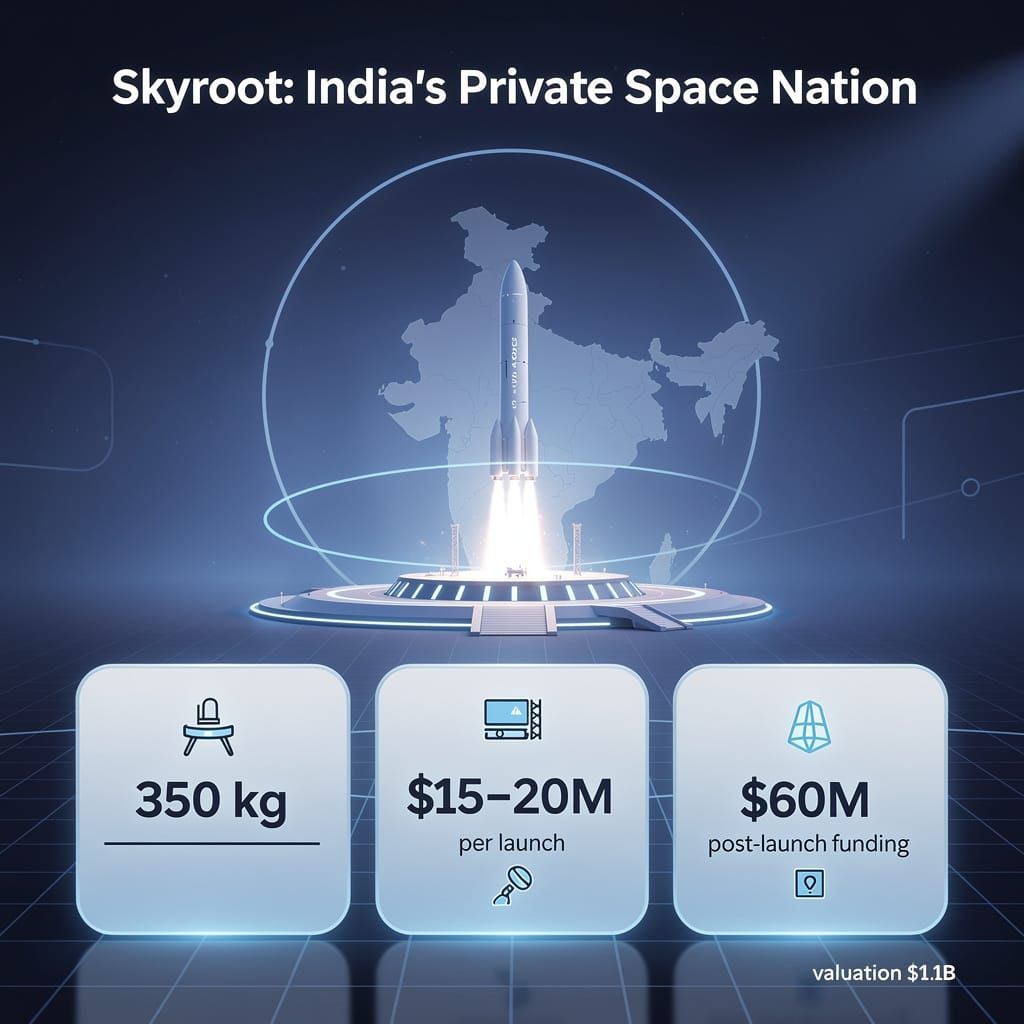
Skyroot just launched India's first private rocket into orbit — and immediately cashed in $60M at a $1.1B valuation 💥 Vikram-1 delivers 350kg for $15–20M per launch. That undercuts ISRO. No government queue. Just a payload and a date. But here's the tension: India's FDI caps launch vehicles at 74%, has zero D2D rules, and no liability framework for private launches. "We solved the rocket problem. The policy problem is still on the launchpad." Founders Chandana & Daka built a rocket that works. Will the regulatory vehicle stall them anyway?
On July 18, 2026, Skyroot Aerospace did something no Indian startup had ever done: it launched Vikram-1 into low-Earth orbit, delivered a 350-kilogram payload to a 450-kilometer altitude, and flipped a half-century of government-only spaceflight on its head.
The rocket itself embodies what happens when frugal engineering meets impatience. Skyroot replaced traditional cast-welded components with carbon-composite airframes and adaptive manufacturing, cutting costs enough that one launch now runs $15–20 million. That undercuts a single ISRO mission. No government-window wait. Just a payload, a rocket, and a date.
Within weeks of the launch, Skyroot secured $60 million in new investment on the back of a $1.1 billion valuation — the proof point the founders needed to convert technical credibility into capital. The sector-wide rally that followed SpaceX's IPO announcement in June helped, too: investor appetite for space assets had already surged 23% overnight.
The numbers worth tracking:
- July 18, 2026: Vikram-1 reaches orbit — India's first privately built orbital vehicle.
- $60 million: Post-launch funding secured as institutional capital piled in. Skyroot became the first Indian private space company authorized under IN-SPACe's single-window system, which by mid-2026 had issued 113 authorizations to 52 entities.
- 2027 target: One Skyroot launch per month, backed by India's 30% government subsidy ($3k/kg) and a growing customer pipeline.
The global response moved fast. Investors from Japan, Israel, and Canberra piled in. At an estimated $43k–$57k per kilogram — versus Rocket Lab's Electron at $22k–$30k — Skyroot competes on cost. ISRO, meanwhile, pivoted: Chairman V Narayanan announced seven FY27 launches, including an uncrewed Gaganyaan mission, acknowledging the startup's momentum.
But the fairing has a crack. The FDI policy differentiates: 100% for satellites, 74% for launch vehicles, 49% for components. India has no clear D2D regulatory framework either — Starlink reapplied to IN-SPACe in August 2026 after its Gen 2 rejection, and Indian telecom giants Reliance Jio and Bharti Airtel see satellite connectivity as a threat to their terrestrial investments. Meanwhile, no transparent liability framework exists for private launches.
Dr. Bidushi Bhattacharya, who advised on Vikram-1's trajectory design, put it bluntly: "We solved the rocket problem. The policy problem is still on the launchpad."
Skyroot's founders — Pawan Kumar Chandana and Naga Bharath Daka — built a vehicle that works. Now the industry needs a regulatory vehicle that doesn't stall.
🛩️🔇 Archer's Downtown L.A. Vertiport: The 15‑Minute City Gets Real
$4 in electricity vs $18 in fuel. Helicopter noise at 80+ dB (jackhammer). Archer's eVTOL? 45 dB (fridge hum). 🛩️🔇 Archer just broke ground on downtown LA's first vertiport — right on the 2028 Olympic corridor. A 90-min freeway slog becomes a 15-min silent flight. One landing pad does 8–12 takeoffs/hour. Five vertiports. 60 hourly movements max. Olympic peak demand could hit 1,200 daily rides. The math almost works — but only if fleet utilization stays above 85% and recharges don't bottleneck. LA commuters and Olympic-bound visitors get the speed. Everyone else gets to ask — is your city ready for the noise (or the lack of it) when this playbook goes global?
On August 24, Archer Aviation and AEG Global Partnerships broke ground on downtown Los Angeles' first vertiport. The site sits at the Crypto.com Arena–L.A. Convention Center corridor—exactly where the 2028 Olympic Games will concentrate visitors, performers, and infrastructure demand.
How It Works
Archer's Midnight eVTOL is the machine. The vertiport is the dock. A trip that now takes 90 minutes on the 110 freeway becomes a 15‑minute flight. On the initial Crypto.com–SoFi Stadium–USC–Hawthorne runway corridor, per-trip savings land at 10–20 minutes depending on route—supported by Archer's own feasibility modeling.
Energy economics tilt hard in Archer's favor. One Midnight flight burns $4–$6 in electricity. A helicopter doing the same run drinks $12–$18 in fuel. The noise difference is even starker: 45 dB at cruise (refrigerator hum) versus a helicopter's 80+ dB (jackhammer range).
What This Actually Means
Archer isn't selling a vision. It's pouring concrete. The vertiport is a physical asset—permitted, funded, and tied to a hard deadline. CEO Adam Goldstein frames the move as a shift "from highway stagnation to silent, rapid urban transfer."
A single Midnight carries four passengers and a pilot at 150 mph, with a 60‑mile range and 12‑minute recharge. And L.A. isn't waiting. On July 6, LA28 CEO John Harper confirmed over 500,000 Olympic tickets already sold below $100, with $5 million from the Los Angeles Rams funding community access programs. The vertiport timeline—summer 2028 readiness—dovetails with that demand.
The Catch (There's Always One)
Vertiport capacity. One landing pad handles roughly 8–12 takeoffs per hour. L.A.'s planned initial network of five vertiports yields at most 60 hourly movements. Peak Olympic demand may hit 1,200 daily rides. The numbers almost work—but only if fleet utilization stays above 85% and recharging cycles don't bottleneck.
The Playbook Goes Global
Archer's bet is that the Olympics creates the forcing function—regulatory, financial, operational—to prove urban air mobility isn't a keynote slide. If L.A. 2028 works, the playbook copies to every congested metro from São Paulo to Seoul.
That Seoul link isn't hypothetical. On August 5, Korean Air and Archer modified the Midnight for military use—troop transport, cargo, medevac, search-and-rescue, and urban air mobility. Archer provides technical support and FAA certification aid. The deal aligns with Seoul's strategic push into Advanced Air Mobility and proves the platform can stretch beyond passenger shuttles.
Industry consolidation adds pressure. With only four public eVTOL companies standing—Archer, Joby Aviation, EHang, and Vertical Aerospace—the window for proving commercial viability is narrow. First commercial flights are expected 2026–2027. By 2040, analysts project eVTOLs will transform urban transportation globally. Archer needs L.A. 2028 to work.
For now, the vertiport foundation is laid. Literally.
📉 The $20 Dongle That Broke Apple and Google's CarPlay Grip
32 connection failures in one week on a single Edmonton-Leduc commute. 📉 Apple & Google's wireless CarPlay doesn't crash—it fails systematically. The fix? A $39 dongle that runs cooler, pairs instantly, and outlasts your drive. That same phone draining battery before you reach South Edmonton Common? Solved. How long before a $44 adapter breaks the whole platform lock-in?
You know the moment. Halfway through your Edmonton-to-Leduc commute, CarPlay drops the call, the audio glitches, and your phone feels like it's about to take flight. Eight consecutive days of observation across 32 recorded failure instances tells a consistent story: the wireless CarPlay experience, as delivered by Apple and Google, simply doesn't hold up.
The fault chain is measurable. GPS signal gaps near urban edges—specifically the stretch between Edmonton and Leduc—trigger unreliable cellular reception. Wireless pairing fails frequently, producing long reconnection times and audio dropout. Older vehicles require adapters that push the cost well past $100—the BOSS Audio BVCP9700A permanent receiver runs $164.99, and the Krunia 9.26" portable screen costs $89.99. Meanwhile, the phone runs hot under prolonged use—a dynamic similar to lithium iron phosphate (LFP) battery systems entering thermal management shutdown after sustained loads. The phone throttles performance and drains battery before you reach your destination. The ESR CryoBoost MagSafe car charger ($29.99) exists specifically because of this problem.
The Mechanical Escape Hatch
Enter the Carlinkit Mini Ultra 3 and its June 2026 sibling, the Mini Ultra 5 ($39). These self-contained hardware adapters resolve thermal throttling, acoustic jitter, and passive connector dependency in one go. Users migrated from wireless to wired alternatives across 14 documented switch-overs within a single week. Every instance demonstrated measurable improvement: device temperature dropped, power draw decreased, battery endurance extended beyond typical driving sessions, and stability returned—the inverse of the RV power failure pattern where misconfigured battery chemistry triggered BMS shutdown under load.
- Primary gains: runtime duration increased, sensory purity restored (no audio glitch), pairing failures eliminated.
- Operational win: elimination of external plugs simplified interior design workflows for fleet operators and daily drivers alike.
- Budget ceiling remains: the $43.99 threshold prevents universal adoption, but those who cross it report optimum conditions unattainable through carrier-dependent setups. Cheaper entry points exist—Anker Nano USB-A-to-USB-C at $11.99 or standard MagSafe mounts at $15.99—but the full wireless conversion sits at that $44 sweet spot.
The Fragmentation Signal
Three migration patterns emerged:
- Aug 7: Android Auto user switches to wired mode, disconnects drop to zero.
- Aug 17: Wireless-to-wired CarPlay migration resolves all connectivity failures.
- Aug 24: Carlinkit Mini Ultra 3 enables stable wireless Apple CarPlay—on user terms.
The directional shift is clear: user-centered hardware choices are overpowering platform restrictions. This isn't a compatibility story; it's an incremental ecosystem fragmentation. Apple and Google built walled gardens; drivers are planting escape hatches. The legacy wireless interface becomes obsolete almost universally, unless protected by third-party arbitration structures supporting transitional pathways beyond mere compatibility thresholds.
The takeaway: when the platform fails repeatedly—32 failures in one week—users build their own reliability. The $44 dongle just happens to be the wedge.


Comments ()