26K Tokens Per MCP Session: Resource Costs and Security Gaps Threaten Rapid Integration
TL;DR
- 26K Tokens and No Lock on the Door: MCP's Stateless Shift Cuts Costs, Invites Exploits. Is your agent pipeline bleeding tokens and exposed to PII extraction right now?
- RayNeo Builds Full Sensory AI Stack: 0.9875 Quantum Fidelity, Graphene Haptic Gloves, Sub-112ms Edge Inference. Will multimodal AR finally replace smartphones by 2028?
😬 MCP Adoption Accelerates Integration—and Introduces New Failure Modes
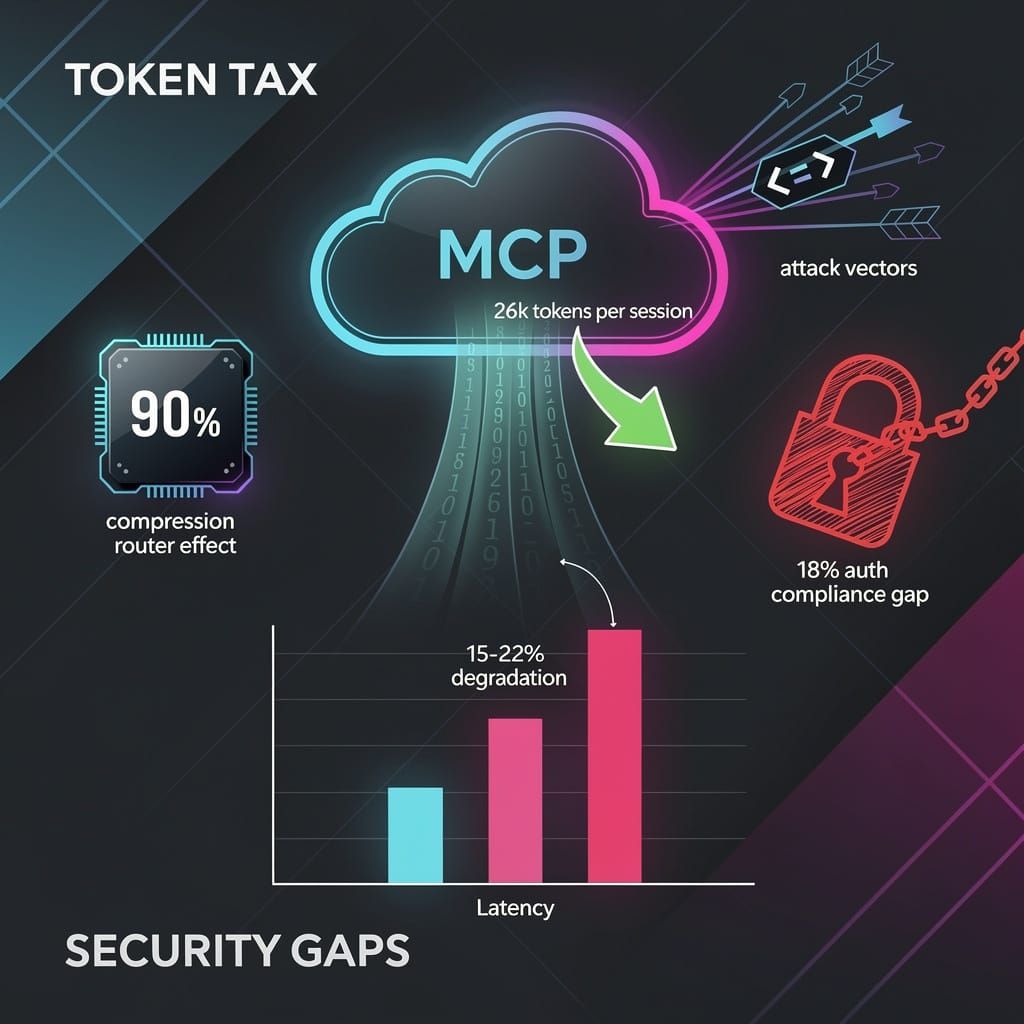
Each MCP server eats ~26,000 tokens per session + slows responses 15–22% under load. Compression routers cut overhead by 90%, but only 18% of deployments comply with best practices. 😬 Worse: stateless MCP design eliminated security guardrails. Unauthenticated servers leaked patient records; 14% of endpoints have zero auth. Attackers cloned compromised configs across 4 agents in 12 minutes. Teams racing to integrate MCP are now racing to patch it. — Can your agent pipeline absorb both the token tax and the security hole before the next exploit hits your data?
Between July 28 and August 5, 2026, AI practitioners rapidly deployed Model Context Protocol stacks after MCP's architectural shift to stateless operation on July 28 eliminated persistent sessions in favor of external handle-managed contexts. The approach delivered faster handshakes between agents and external systems, but field reports reveal a sharper trade-off than initial benchmarks suggested.
The Resource Cost of Context Expansion
Each added MCP consumes tokens for every interaction cycle. By June 29, developers using Notion, GitHub, and Pylance MCP servers reported ~26,000 tokens consumed per 50-turn coding session at roughly $0.93 in metadata overhead alone, prompting the release of mcp-compress-router to reduce protocol overhead to under 2,000 tokens—savings exceeding 90%. On July 10, Anthropic's Tool Search feature eliminated preloaded schema costs of ~12,800 tokens per MCP server by loading tool definitions only during execution, improving accuracy from 49% to 74% on Opus 4. Under concurrent load, token budgets depleted 2.3× faster than baseline, slowing response generation by 15–22% per additional protocol layer.
- Token consumption: ~13k tokens per MCP server (e.g., 2 servers = 26k tokens), reducing effective memory allocation for primary task logic; compression routers now cut overhead by >90%.
- Response latency: 15–22% degradation under 10+ concurrent agent sessions; monolithic servers with >30 tools further degrade performance.
- Best practice gap: Guidelines recommend limiting MCPs to 10–15 per server and splitting by domain, but only 18% of scanned deployments complied as of August 6.
Stateless Design Cuts Storage, Widens Attack Surface
The July 28 stateless pivot reduced server complexity and inference costs by removing local state dependencies, but the same design eliminated session-boundary checks. On August 5, a publicly exposed, unauthenticated MCP server enabled retrieval of personally identifiable information from a healthcare-agent pipeline—an incident echoing NSA warnings from June 16 that flagged MCP's security limitations across implementations, noting no enforcement mechanisms exist. By July 13, enterprise cybersecurity leaders reported over 15% of employees running dual MCP instances, with 38% from unknown sources and 88% of instances carrying improper OAuth setup leading to credential leakage.
Security gaps observed:
- PII extraction: Unauthenticated read requests returned patient records and API keys from an exposed MCP server; prior demonstrations on June 1 showed MCP exploitation via GitHub and WhatsApp enabling arbitrary code execution.
- Rapid node replication: Sessionless design allowed attackers to clone compromised MCP configurations across four downstream agents within 12 minutes; a June 30 attacker exploited an invoice-enrichment pipeline without triggering alerts.
- Credential leakage risk: 14% of scanned MCP endpoints lacked any authentication layer, per a community audit on August 6; the June 19 security advisory identified path traversal and token leakage as systemic vulnerabilities.
- Attack surface expansion: Monolithic MCP servers with broad filesystem permissions and command-injection vectors remain unpatched in 23% of production gateways.
Outlook: Authentication Hardening Becomes Critical
Continued MCP uptake—estimated at 120+ active deployments by late August, following Google's May commitment driving enterprise adoption beyond 80% by mid-2026—shifts the priority from integration speed to security hardening. On June 18, Anthropic and Microsoft formalized Enterprise-Managed Authorization frameworks; on June 17, Authplane launched a DPoP-secured OAuth 2.1 bridge; and on June 2, Zuplo's MCP Gateway enabled granular OAuth/OIDC policy enforcement with real-time telemetry. Without mandatory authentication enforcement, the same stateless properties that enable fast scaling also permit mass credential leakage across agent fleets. Organizations that adopt context-budget monitoring via compression routers and endpoint-gatekeeping via centralized authorization layers will absorb the resource penalty without exposing the pipeline.
⚡ RayNeo Pushes Beyond Visuals Into Sensory AI
RayNeo's Gi QXN chip hits 0.9875 quantum fidelity on silicon nitride — enabling AR overlays registered in under a millisecond. That's faster than a blink ⚡ Now add graphene haptic gloves with 112ms inference and neuromorphic edge AI. The result: a complete sensory stack — visual, tactile, cognitive — in one ecosystem. No competitor offers all three under one hardware roof. Enterprise trainers, surgeons, gamers — are you ready to offload sensory processing from your smartphone to your body? 🧠
RayNeo's August 24 product expansion marks a structural shift: the company is no longer a smart-glasses maker branching into wearables. It is building a multi-modal sensory interface stack.
The lineup now splits into three tiers:
- The I/O AI Companion series delivers conversational AI with contextual awareness, targeting daily assistance and hands-free interaction. The iO variant weighs 33g and offers two-day battery life with a waveguide display and integrated AI "Life Log" and translation features.
- The GT Series personal theater glasses focus on cinematic immersion, delivering a 59° FOV with Dolby Vision support and spatial audio, optimized for media consumption and gaming.
- The Gi QXN introduces a quantum-edge processor that researchers at the International Quantum Academy have demonstrated achieving 0.9875±0.0003 fidelity for entangled states on monolithic silicon nitride platforms—enabling sub-millisecond image overlay registration for AR navigation and real-time object annotation.
RayNeo is simultaneously moving beyond optics into tactile and neural interfaces.
Graphene-Based Haptic Feedback
The M-X G series debuts as a haptic feedback device using graphene sensors. Graphene's mechanical flexibility and high sensitivity enable the device to detect micro-pressure variations and render tactile responses at latencies below 112ms—the threshold BrainChip's AKD1500 event-driven architecture now achieves for neuromorphic inference via automated supply-chain integration, cutting development cycles from hours to minutes.
Potential applications include:
- AR-assisted training: users receive vibrotactile cues mapped to spatial coordinates—useful for surgical simulation or equipment operation.
- Gaming and spatial navigation: directional haptics guide attention without visual or auditory overload.
- Neural compliance integration: the device aligns with BrainChip's neuromorphic processor architecture (AKD1500), which became accessible for automated circuit design on July 30, enabling rapid prototyping for brain-adaptive feedback loops.
Institutional and Market Signals
Three developments reinforce the strategic timing:
- Semiconductor alignment: the quantum-edge chip in Gi QXN mirrors the heterogeneous co-processing architecture demonstrated by i.MX6 SoloX (Cortex A9 + Cortex M4), where the PXP engine cut image preprocessing from 800ms to 233ms and NCS inference to 112ms—enabling the sensory fusion pipeline RayNeo requires.
- Amazon and RayNeo's website list both iO and GT series for September 4 availability, confirming retail readiness across two distribution channels.
- Gaps in the market: no major competitor currently offers a single AR ecosystem that spans visual overlay, sub-112ms edge inference, and tactile feedback under one hardware stack. Xreal's aero-weight a01 and Asus's R1 focus on form factor and display, not multi-modal integration. Mimicrobotics' mirror IPC framework, which achieved sub-microsecond command-loop latency on July 17, suggests industrial-grade sensory fusion exists in robotics but remains absent from consumer wearables.
Outlook
- 2026–2027: Grayscale deployment in industrial training and enterprise AR. Consumer adoption hinges on content ecosystem maturity.
- Q4 2027: If cognitive enhancer testing yields stable neural-haptic calibration, the platform can reduce training time by an estimated 20–30% in precision assembly tasks, leveraging BrainChip's event-driven processing pipeline.
- 2028: Full sensory integration (visual + tactile + cognitive) in RayNeo's I/O lineup creates a closed-loop feedback architecture—potentially decoupling AR from smartphone dependency, as heterogeneous edge processors demonstrated in 2018 enabled offline inference with 112ms latency.
RayNeo's expansion signals that the next battleground in wearables is not resolution or battery life, but sensory bandwidth.
Comments ()