Critical Perl DBI Flaws: From Disclosure to Exploitation in Under 7 Days
TL;DR
- Two Critical Perl DBI Flaws Exploited in Under a Week — $450K Per Incident. Are you still running Perl DBI in production without patching?
- GPUBreach, GDDRHammer, GeForge: Encrypted Cloud GPU Workloads Leak Through Microarchitectural Cache Patterns — Rowhammer, IOMMU Bypass, Full System Takeover. Is your CISO still running encrypted workloads on shared GPUs?
💥 Perl's Ghost: Two Critical DBI Flaws Go From Disclosure to Exploitation in Under a Week
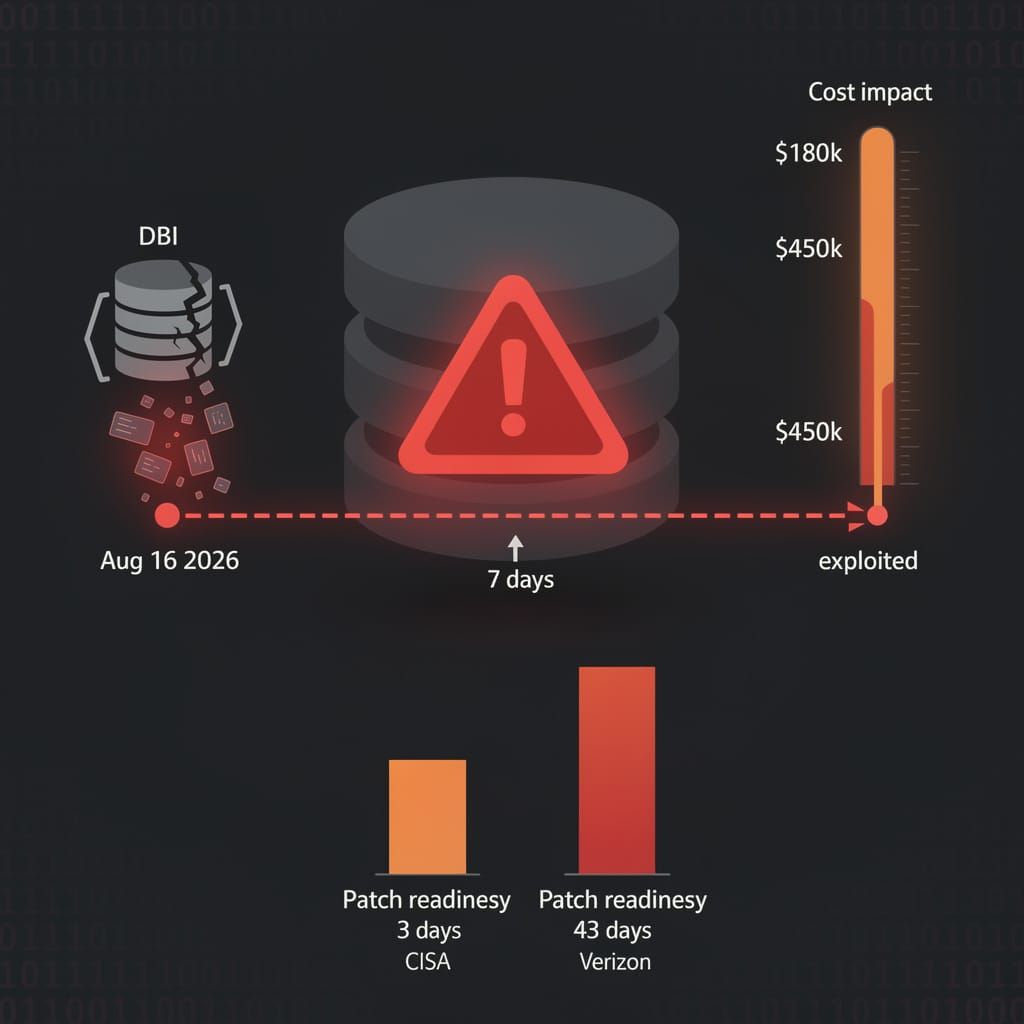
Two critical Perl DBI flaws went from disclosed to exploited in under 7 days. Because of course they did. 💥 CVE-2026-73193 is a heap out-of-bounds bug in DBI ≤ 1.651 on 32-bit builds. No SQL injection. No auth bypass. Just raw buffer mishandling letting attackers run arbitrary code. Patch availability is spotty. Remediation cost per incident? $180K–$450K when you factor forensics, downtime, and GDPR/HIPAA fallout. CISA wants patches in 3 days. Verizon says median is 43. Nobody's listening. 😬 Your legacy Perl stack isn't "too boring to attack" anymore — you running DBI in production?
Researcher Robert Rothenberg dropped two critical DBI vulnerabilities on August 16, 2026 — a gift for pentesters, a migraine for IT directors still running Perl in production, and a quiet terror for anyone managing user data. It took under seven days from disclosure to confirmed exploitation. Because of course it did. 💥
The mechanics: Both flaws stem from improper memory management in Perl's database abstraction layer. An attacker feeding malformed queries or database responses triggers a memory corruption condition — no SQL injection, no authentication bypass, just raw buffer mishandling enabling arbitrary code execution. CVE-2026-73193? A heap out-of-bounds bug affecting DBI ≤ 1.651 on 32-bit builds, disclosed August 15 — the day before Rothenberg's public drop. Standard OWASP Top 10? Not even on the list. Too boring to attack, they said.
Not that Rothenberg is new to this rodeo — earlier in 2026 he disclosed CVE-2026-46740 (May 26) and CVE-2026-8788 (June 4), both metric-injection flaws in Perl statsd plugins that let attackers corrupt telemetry via stdin, skewing analytics and triggering false alerts in cloud monitoring pipelines. The man treats the CPAN like a piñata. 🎉
The impact: Any web application or backend service using Perl DBI becomes a potential beachhead. That's a lot of legacy infrastructure silently exposing databases, authentication systems, and PII repositories to anyone who can craft a malformed packet. The vulnerability chain enables lateral movement from the application layer directly into database servers. Rothenberg's earlier work tells the same story: CVE-2026-15043 (July 14) revealed inverted ≤ and ≥ operators in DBI::SQL::Nano, silently breaking WHERE clause security. CVE-2026-14380 (July 7) enabled code injection through the Profile attribute, executing arbitrary commands as root via Gofer or ProxyServer brokers. The pattern isn't a bug — it's a feature cascade.
The response: Institutions running Perl stacks — academic registrars, government pension systems, healthcare claims processors — face an unenviable triage. Patch availability is spotty; many organizations rely on unsupported Perl environments. The remediation cost per incident? Estimated at $180,000–$450,000 when factoring forensic investigation, system downtime, and compliance fallout under GDPR, HIPAA, and state breach notification laws. Meanwhile, CISA's BOD 26-04 (June 10, 2026) mandates three-day patching for known exploited vulnerabilities on internet-exposed systems, but 43-day median remediation timelines from Verizon's 2026 DBIR suggest nobody's listening. 😬
Why this hurts: Perl DBI runs more enterprise middleware than anyone wants to admit. It's the duct tape behind CRM exports, ETL pipelines, and legacy reporting dashboards. Each compromised instance means data exfiltration risk, credential leakage, and regulatory penalties that compound faster than patch cycles can keep up.
The outlook: Expect exploit toolkits to incorporate these within weeks. Shops running Perl better audit their DBI call paths, isolate database-facing services, and pray the next disclosure cycle spares them. The real vulnerability? Treating abstraction layers as "too boring to attack." 😈
🎪 Hey, Your Encrypted Cloud GPU Just Leaked Everybody's Secrets. Again.
Your "encrypted" cloud GPU workload just leaked through microarchitectural cache patterns, Rowhammer, and IOMMU bypasses — GPUBreach, GDDRHammer, GeForge said so on Feb 23 🎪 Homomorphic encryption is a beautiful math problem and a catastrophic security model. Meanwhile, NVIDIA's PTX Kernel Factory (June 16) is making GPUs faster, denser, and harder to audit. Brave finally killed GPU fingerprinting (Aug 13). Continuous-group-key got standardized. Small wins. But the hard truth: if it runs on someone else's silicon, it's leaking. Loudly. And the "fix" arrives six months after the exploit goes mainstream. Your CISO still using shared GPUs for encrypted workloads? 💀
Here's the punchline: homomorphic encryption on shared GPUs is a beautiful math problem and a catastrophic security model—because microarchitectural cache patterns don't give a shit about your "computational noise." February 23—GPUBreach, GDDRHammer, and GeForge proved that your tenant data on someone else's silicon is about as private as a strip mall bathroom stall. Cache-timing attacks and Rowhammer read right through the noise masking, bypass IOMMU, corrupt page tables, hand attackers full system takeover. 🎪 Meanwhile developers are busy adopting advanced GEMM kernels and NVIDIA's PTX Kernel Factory (June 16) to automate GPU software generation, compressing kernel design cycles and removing specialist bottlenecks. Self-improving compute infrastructure—great for throughput, fantastic for widening the microarchitectural leak surface your tenant's encrypted workload is bleeding through.
🔑 Your Signal group chats might survive, though. By August 13, cryptographers standardized continuous-group-key agreement. Also on that date: Brave started phase-rolling updates that replace GPU vendor/renderer strings and inject randomized WebGL extensions—eliminating unique identifiers used in browser fingerprinting. Translation: sublinear private networking and your GPU's no longer tattooing a serial number across every site you visit. Not bad for a Tuesday.
The August 20 "We Fixed Privacy" Special
Researchers dropped a framework that separates physical presence from encrypted visibility. Sounds great until you read the fine print: inclusion signals get measurably weaker. The system attenuates the very signal it needs to be useful. It's not a trade-off—it's a tax on accuracy for the privilege of not being tracked. Meanwhile, on July 31, a separate proposal introduced transcript-aware privacy via MuSig2-H, addressing identity leaks through signed message logs but still leaking signer counts through observable sequences. Progress? Sure. Privacy theater? Also sure.
What this actually means for the enterprise:
- Cloud crypto: Google dropped HEIR—an open-source compiler that turns AI models into homomorphically encrypted ones. Real-time encrypted recommendations, fraud detection, hotword alerts. Low CPU latency. Unless you're running it on shared GPUs, where your microarchitectural leak surface just got a free pass—right as automated kernel factories make those GPUs more powerful and more opaque by the day.
- Data fusion in urban studies: Activity-separation methodology validated—fewer artifacts. Unless you care about actual inclusion metrics, in which case you just traded precision for privacy theater.
- Compliance departments everywhere: Your SOC 2 audit just got more expensive. India's B2B SaaS leaders are scrambling for automated SOC 2/ISO 27001 tools at ₹5k/month because the manual process is a nightmare.
The Bottom Line (Because Your CISO Isn't Reading This)
| Domain | What Broke | What It Costs You |
|---|---|---|
| Cloud crypto | GPUBreach, GDDRHammer, GeForge — GPU driver memory-safety bugs → root via page table corruption, IOMMU bypass | Your tenant's data, in the clear, via Rowhammer and timing |
| Group messaging | Continuous-group-key standardized (Aug 13) — solves scaling | But only if your key exchange isn't reusing old sessions |
| Browser privacy | Brave GPU-randomization rollout (Aug 13) — kills fingerprinting via vendor string randomization | Tracker stability drops; sites function mostly fine |
| Privacy modeling | Activity separation validated | At the cost of measurable inclusion signal weakening |
| Cryptography | MuSig2-H transcript-aware privacy (Jul 31) — blocks identity leaks from signed logs | Still leaks signer counts through observable sequences |
The future outlook is "continued refinement of quantum-resistant communication stacks and granular human-environment modeling." Which is consultant-speak for "we'll patch it in 2027, and in the meantime, stop trusting shared GPUs with encrypted workloads—especially as automated kernel factories make those GPUs faster, denser, and harder to audit."
One rule still holds: If it runs on someone else's silicon, assume it's leaking. Assume it loudly. And assume the "fix" arrives six months after the exploit goes mainstream. 🎯
—Because "we take security seriously" is the new "the check is in the mail."

Comments ()