42 Cybercabs vs. 400+ Waymos: Tesla's Safety Gap in Austin
TL;DR
- 42 Vehicles, Zero Safety Case: Tesla's Cybercab Event Is a Demo, Not a Launch. Would you trust a steering-wheel-free robotaxi with no lidar and no published safety data?
- Drone-Hunter Mirage: Ukraine's Jury-Rigged Interceptors Stop 3% of Threats as Civilian Deaths Hit 437 in July. When drone interception covers 3% of the threat envelope, who is the strategy really protecting?
- 16 Russian Air Defenses Downed in 15 Days — And the Frontline Hasn't Moved. Does drone supremacy actually change who wins a war?
🤖 Tesla’s Cybercab Event: September 3
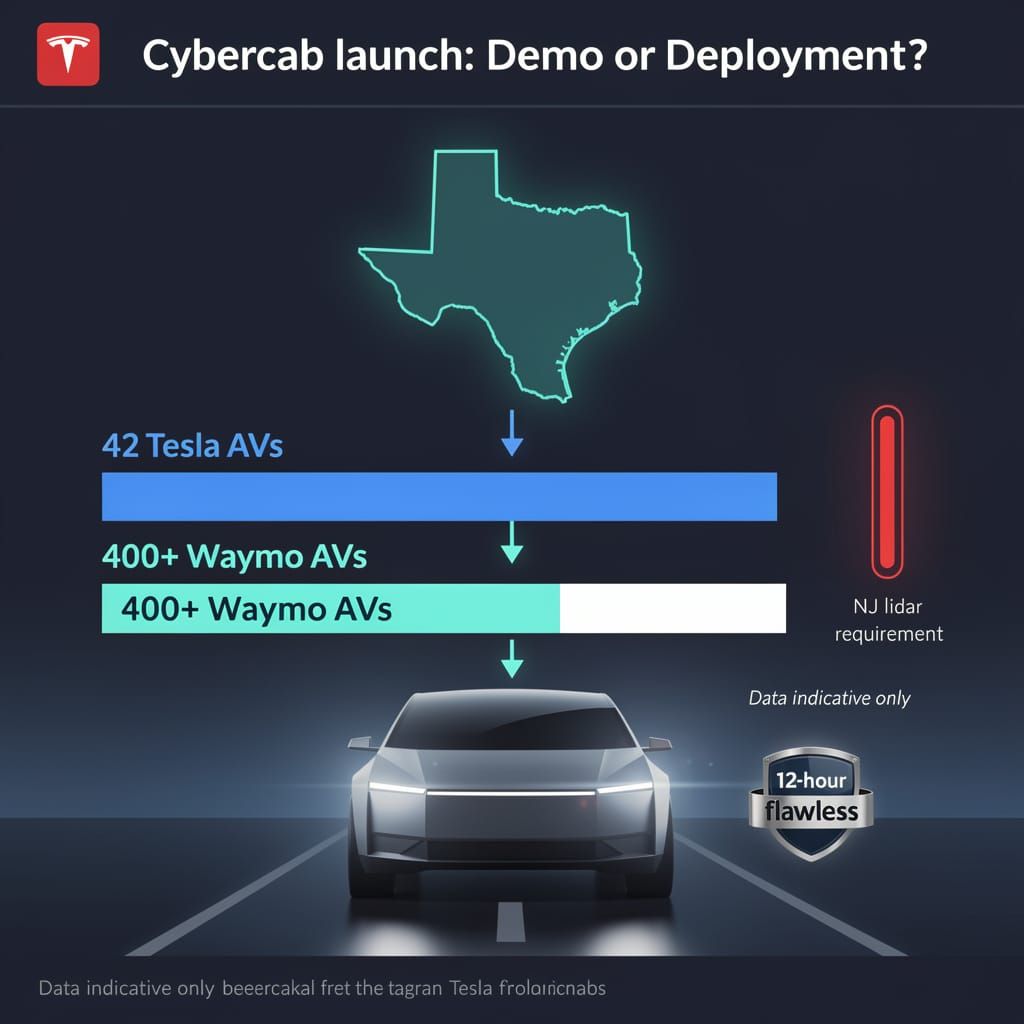
Tesla's "Cybercab launch" on Sept 3 is a sweepstakes event for supervised rides without steering wheels — not a driverless fleet. 🤖❗ 12 flawless hours in engineer-led trials ≠ public readiness. No disengagement logs filed. No third-party safety audit. Texas OK'd 42 AVs under self-certification; Waymo runs 400+. New Jersey just mandated lidar — which Tesla's vision-only design lacks. Customers get free rides in optimized conditions. Meanwhile, regulators are asking: where's the actual safety case? 🛑
Tesla has begun notifying customers of a September 3 Cybercab launch event in Austin and expanded its robotaxi sweepstakes. The company completed internal telemetry integration tests on August 20 and opened the invitation process on August 22. On June 30, Tesla ran its first Cybercab without any human controls during an engineering test, followed by high-volume production at Gigafactory Texas starting July 1. By July 4, the company began selling the two-seat, steering-wheel-free Cybercab at $49,000.
What Is Actually Being Demonstrated?
Tesla frames the event as a public Cybercab activation. The underlying activity tells a different story. The company is recruiting customers for "Cybertac experience" sessions — supervised rides that validate user acceptance of a steering‑wheel‑free cabin design. In July, Tesla began testing fully autonomous Cybercabs on public roads with internal staff and factory workers at Giga Texas, following a one‑week trial. By June 29, the company had removed steering wheels and brakes entirely, claiming 12 hours of flawless runs in engineer‑led trials.
This remains a staged demonstration built on driver‑monitored telemetry integration and invitation‑only access — not an unsupervised fleet launch.
The Gap Between Framing and Reality
| Metric | Tesla’s Implication | Evidence‑Based Read |
|---|---|---|
| "Public activation" | Ready for unmonitored deployment | Limited to sweepstakes participants and invitees; internal staff rides |
| "Cybercab launch" | Commercial robotaxi service | Controlled demo with driver oversight; engineer‑supervised trials |
| Telemetry tests complete | System‑level readiness | Integration tests only; no independent validation of 12‑hour flawless claim |
Why Skepticism Is Warranted
On May 28, 2026, Tesla received state authorization to operate driverless vehicles in Texas under Senate Bill 2807's self‑certification framework — a regulatory path that does not require a third‑party safety case. Authorization covered 42 autonomous vehicles, compared to Waymo's ~400+ operational robotaxis nationwide. Texas law now mandates Level 4 certification for driverless vehicles, yet Tesla has not disclosed disengagement logs or miles accumulated on public roads in Texas. California on‑road testing continues to show high disengagement rates, and no published data demonstrates improvement below 0.5 per 1,000 miles.
Regulatory divergence is accelerating. On July 9, New Jersey enacted Bill S1677, requiring cameras, radar, and lidar on all driverless commercial vehicles — a hardware mandate that excludes Tesla's sensor-only Cybercab design. The bill's sponsor cited the need for layered sensor fusion, directly countering Tesla's vision-only approach. The company completed one-week trials in July and deployed internal employee rides thereafter, but the gap between Texas's permissive self-certification and other states' hardware requirements raises the possibility that Cybercab deployment will remain geofenced to Texas or require a costly redesign.
Tesla's reliance on its Supercharger network and Starlink connectivity as differentiators does not address perception reliability in edge-case urban driving. Consumer reports from Austin describe reduced congestion and free private ride options, but these are limited to invitees in optimized conditions — not representative of unsupervised urban autonomy.
What to Watch
- Regulatory filings: Texas self‑certification under SB 2807 authorizes operation but does not verify safety. Any published safety case or third‑party audit would signal genuine progress. New Jersey's Bill S1677 may set a precedent that forces hardware additions or market exclusion.
- Disengagement logs: Without California's DMV data showing a sustained reduction below 0.5 per 1,000 miles, the 12‑hour flawless claim carries no empirical weight. Tesla's 42 authorized Texas vehicles vs. Waymo's 400+ nationwide indicates an order-of-magnitude gap in operational scale.
- Public road miles: Internal trials at Giga Texas and one‑week Austin tests are not equivalent to large‑scale unsupervised deployment.
The September 3 event is likely a polished, guided ride at low speed under optimal conditions — not the robotaxi revolution Tesla promises. The trajectory toward unsupervised urban autonomy remains measured in years, not weeks, and is increasingly complicated by state‑level hardware mandates that Tesla's current design cannot satisfy.
🔻 The Drone-Hunter Mirage
3% of threats intercepted. 437 civilians dead in July — the highest monthly toll since 2022. Ukraine's drone-hunter planes save operators, not cities. A Geran-4 flies at 550 km/h. The An-28 cruises at 350 km/h. The math favors the attacker. Each converted Sea King costs $2.3M — that buys 460 EW jammers or 1,200 decoys. Why chase specs when civilians are the denominator? 🔻 When drone interception covers 3% of the threat envelope, is the strategy protecting the wrong people?
Ukraine has converted cargo planes and Cold War helicopters into mobile drone interception platforms. The results demand scrutiny.
The Numbers They Are Not Telling You
Between June 24 and August 18, 2026, Ukraine's jury-rigged air defenses—Antonov An-28 transports mounting underwing interceptor drones, Sea King helicopters lofting battery-depleted UAS—did reduce human exposure at the control console. Operators now command missions remotely from bunkers. Fewer soldiers die at the stick.
But look at the denominator. The UN confirmed 437 civilian deaths in July 2026—30% above June, the highest monthly total since May 2022. The August 21 Geran-4 strike killed at least 16 in Kryvyi Rih's commercial center and injured dozens more. The drone-hunter platforms intercepted zero of those. Meanwhile, Russia has sustained roughly 1,120 casualties per day since June, per Ukrainian General Staff estimates, with total troop losses exceeding 1.4 million. The asymmetry is stark: attrition grinds both sides, but the defender's cities remain exposed.
The Arms Race Is Not a Solution
Russia deploys faster Geran-4s. Ukraine unveils Alexa Spatium. The cycle produces no tactical equilibrium—only escalating velocity and cost. Every 100 km/h increase in incoming drone speed cuts effective interception window by roughly 40 percent. The An-28 cruises at 350 km/h. A Geran-4 flies at 550 km/h. The math favors the attacker.
Meanwhile, unverified speed records demonstrate what is possible: on May 26, an Australian team reached 730 km/h with custom carbon-fiber propellers, though radio link failure occurred at 393 mph. Quantum Systems demonstrated the Apex Recordhunter at 699 km/h (July 29), and Skyfall's P1-SUN JetKiller reaches 370 km/h with 50,000 units monthly in serial production from August 2026. Velocity escalates. The interception window shrinks.
| Metric | June–August 2026 |
|---|---|
| Converted platforms deployed | ~8 (An-28, Sea Kings) |
| Interceptions confirmed | ~40 per week (targeted sorties only) |
| Total Shahed/Geran launches | ~1,200 |
| Civilian deaths (nationwide) | 437 in July alone |
The hunter platforms address roughly 3 percent of the threat envelope. The 90% figure applies only to the narrow subset the Sea Kings actively engaged.
What the Coverage Misses
- Decentralization as weakness: Distributed command reduces single-point failure. It also multiplies communication links—each one interceptable, jammable, or spoofable. Ukrainian forces deployed directional antennas on dynamic gimbals (June 16) to reduce detection, but Russian EW operators have adapted, mapping 79% evasion success in anti-jammer engagements. The countermeasure cycle never ends.
- Fixed-wing dependency: The An-28 needs a runway. Forward bases within 50 km of the front are under constant artillery surveillance. Three airstrips in Kharkiv Oblast have been cratered since July.
- Manpower math: Each converted platform requires 12–14 ground crew. Drone operators are now the Ukrainian military's most trained—and most targeted—specialists. Loss rates among drone crews exceed 18 percent per quarter.
The Real Trajectory
- Q3 2026: Jet interceptors (Alexa Spatium class, Skyfall JetKiller) enter testing/production. JetKiller: 370 km/h, 30 km range, 15 min flight. Skazhenyi: 45 km range, 30 min endurance, deployed August 4. Cost per JetKiller unit: ~$3,600 at scale.
- Q4 2026–Q1 2027: Russia fields Geran-5, estimated speed 650 km/h, range 2,500 km. Ukraine's Tsyklop interceptor logged 100+ kills by July 25, but each Geran costs Russia ~$20,000. The economics favor the attacker at volume. On July 21, the UN Secretary-General urged ceasefire negotiations; NATO announced increased aid. Neither changes the velocity math.
- 2027: Neither side achieves air superiority. Attrition rates for both offensive and defensive drones converge near 70 percent per month. Civilian deaths continue climbing—up 37% year-on-year per UNHRC July report.
The Uncomfortable Conclusion
Drone hunting is tactical theater. It preserves operator life—valuable. It does not protect the city below. The Sea King conversion costs $2.3 million per aircraft. For the same budget, Ukraine could field 460 ground-based electronic warfare emitters or 1,200 decoy inflatables. Neither makes headlines. Either would save more civilians.
The question no report answers: why invest in mobile, expensive, low-catch-rate interceptors when the threat is volumetric, cheap, and accelerating? The answer, apparently, is that the footage looks like Top Gun. The dead in Kryvyi Rih are not filmed.
🔻 Drone Superiority Does Not Win Wars
16 Russian anti‑air systems dismantled in 15 days. 800 drones launched in a single day. Yet the 1,250‑km frontline hasn't budged an inch. 🔻 Drone superiority enables deep strikes. Deep strikes don't shift territorial control. Russia repairs S‑400s before the smoke clears—and outproduces Ukrainian attrition rates. Civilians pay: 10 dead in Kharkiv on Aug 18 alone. Battlefield? Static. If tactical wins don't translate to strategic gains, what exactly is the endgame — for either side?
The numbers are impressive. Between August 2 and August 23, 2026, Ukrainian forces dismantled sixteen Russian anti‑access systems across fifteen days—radar arrays, S‑400 Triumf installations, command posts. On August 18 alone, Ukraine launched nearly 800 drones into Russian territory, striking airfields in Primorsko‑Akhtarsk and Donetsk, disabling drone‑storage yards, mobile launcher pads, and radar installations with incendiary devices that left minimal debris.
The operational narrative writes itself: Ukraine exploits gaps in Russia's integrated air defense network, degrades electronic warfare posture, cripples command-loop structures. Adaptive jet-propelled drones force obsolescence upon legacy SAM configurations. The stated aim—limit Russia's ability to conduct drone strikes—appears technically achieved.
What the Body Count Indicates
On the same day Ukraine launched 800 drones, Russia responded with a missile barrage that killed a minimum of ten civilians in Kharkiv and wounded seventeen. The battlefield? Unchanged. A 1,250-kilometer sector remains locked. Drone loss rates exceed weekly replacement thresholds. Human mobility across the front line corridor remains restricted.
The causal chain demands scrutiny: drone superiority enables deep strikes, but deep strikes do not shift territorial control. On July 27, Ukrainian forces destroyed an S‑400 and its 96L6 radar in Crimea—the fifth such destruction since February 2026. Yet Russia's response was not systemic collapse but intensified drone patrols, no countermeasures observed. Radar arrays displaced north or east lose tracking windows temporarily, not permanently.
The Replacement Problem
Russia deployed its first S‑500 Prometey mobile battalion in December 2025, complementing existing S‑400 layers. Sixteen systems dismantled in fifteen days sounds decisive until measured against Russia's production capacity for Tor, Pantsir‑S1, and S‑400 replacements. The S‑500 relies on single-regiment supply chains, but Russia can sustain attrition through domestic sourcing.
On August 8–9, Ukrainian drones struck a Krasnodar S‑400 launch pad, killing six missiles and leaving the facility ablaze for three hours. The same weaponry had been showcased at Moscow's Victory Day parade months earlier. External observers detected residual emissions within forty-eight hours of the Primorsko‑Akhtarsk strike. Repairs began before the smoke cleared.
What the Trajectory Projects
Continuous atmospheric turbulence degrades satellite visibility, persistent communications lags. Distributed mesh-network alternatives emerge as tactical necessity, not strategic advantage. Ukraine's deployment of fiber-optic drones—Beshket ($2,170, 48-hour ambush capability), Deadliner Q1 ($1,810), Vyriy Opto (~$2,000)—demonstrates jamming immunity through cable guidance. Ukraine announced a €1.1 billion EU‑backed deal on July 19 to scale annual output from 10 million to 20 million units, aiming for 7 million fielded in 2026. H1 2026 codified 413 UAS, a 30% year-over-year increase.
The psychological shockwave across adjacent communities is real. Civilian casualties accumulate: minimum ten in Kharkiv, seventeen wounded on August 18. Kryvyi Rih and Kyiv area struck on August 22. Russia's July 3 aerial strike killed thirty including an infant, triggering record subway evacuations in Sumy. By August 9, a Saltivka residential high-rise (floors 7–10) collapsed, two dead, twenty injured.
But psychological leverage does not translate to territorial gain. The war remains attritional, locked along a 1,250-km sector, with no indication of cease-fire until a new political negotiation window opens. The S-400 has demonstrated capability but also critical failure—Ukraine's success in destroying batteries in Crimea from February 2026 onward confirms exploitable vulnerabilities. Russia's answer is not withdrawal but deployment of jet-powered Geran-4 drones and mesh radios from China (XK-F358) that self-heal connectivity despite EW denial.
Drone warfare enables precise destruction. It does not enable victory. The replacement math, the static front line, the civilian toll—these numbers tell a story that operational metrics alone cannot obscure.


Comments ()