11 Cores at 5.7 GHz: IBM's Dual-ISA Mainframe Die Merges Z Legacy with Arm Efficiency on 2nm
TL;DR
- IBM Dual-ISA Mainframe Die: Z and Arm on 11 Cores at 5.7 GHz. Will IBM's dual-ISA mainframe kill external server chains in banking?
- €350M Mistral-HUMAIN Deal: Arabic AI Outperforms GPT-4o at One-Third the Cost in Sovereign Saudi Infrastructure. Can sovereign Arabic AI survive Nvidia's export-controlled supply chain?
- 256 Cores per Socket: Intel Diamond Rapids Targets Enterprise AGI Inference. Can unified x86 memory loosen NVIDIA's grip on enterprise AI infrastructure?
⚡ IBM's Dual‑ISA Mainframe Die Merges Z Legacy with Arm Efficiency
IBM's new mainframe chip runs Z and Arm natively on each core—no emulation, no separate P/E cores, just sub-microsecond mode switching on a 2nm die. ⚡ 11 CPUs at 5.7+ GHz. AI inference + PKI crypto in the same pipeline. One machine, two ISAs, zero external bridging. How fast will banks consolidate infrastructure when a single mainframe replaces daisy-chained server chains?
On August 24 at Hot Chips 2026, IBM unveiled a single‑die processor that executes both IBM Z and Arm instruction streams natively within each of its 11 cores—not through emulation or separate P/E cores—on a 2nm process. The chip, paired with an on‑die DPU and AI accelerator, delivers sub‑microsecond dynamic mode switching (measured in nanoseconds), enabling parallel pipelines for encrypted PKI signatures alongside AI‑model inference on existing Z17 fabric. The announcement marks the first milestone from a formal IBM‑Arm collaboration established in April 2026.
Architecture Mechanics
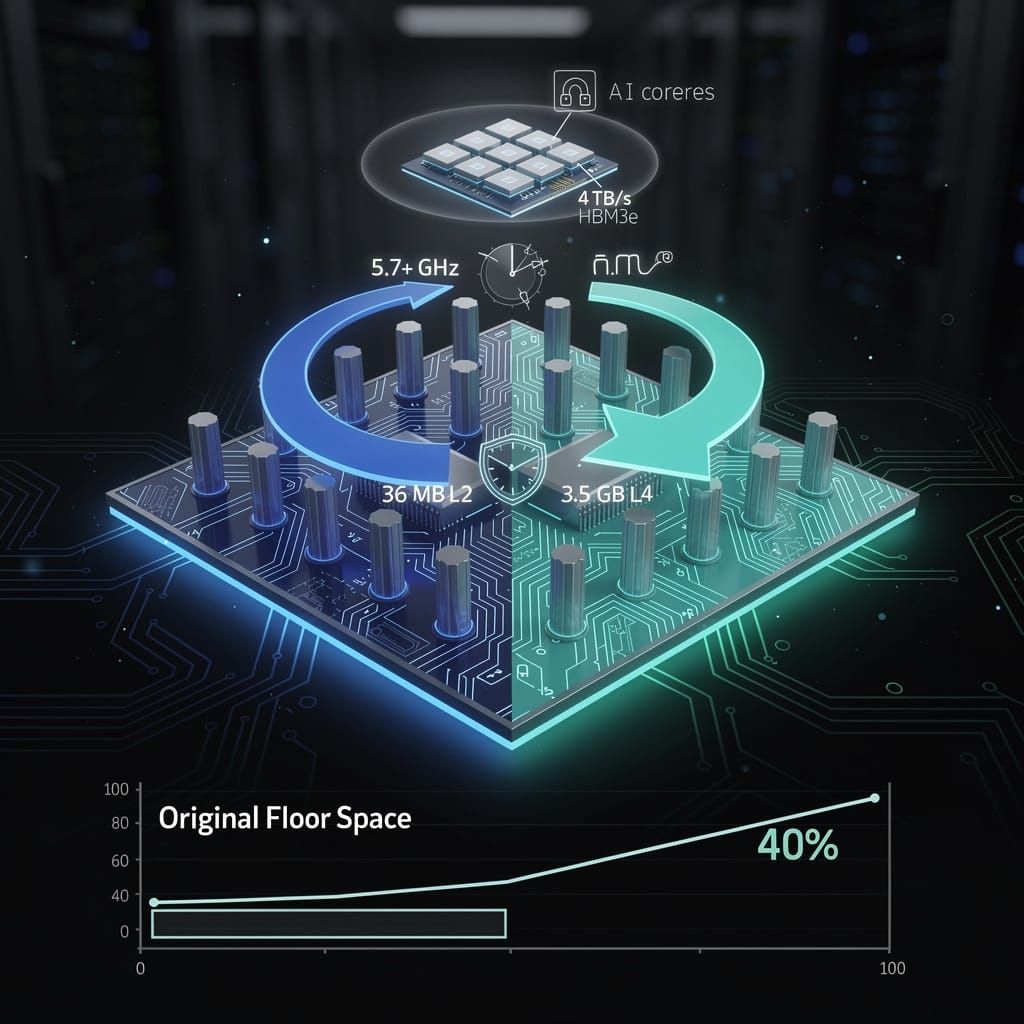
The dual‑ISA block works through shared L1 instruction caches partitioned per cycle: each core fetches from either the Z or Arm decode unit without context switching overhead. Eleven CPUs sustain >5.7 GHz with 36 MB private L2 cache and up to 3.5 GB combined L4 cache, enabled by FPV‑DPU instruction‑cache sharing. Cores dynamically switch between z/Architecture and AArch64 instruction sets as first‑class citizens, allowing KVM virtual machines to run across S390X/Z and Arm64 architectures simultaneously—supporting Arm‑native Linux environments alongside traditional z/OS and Linux on IBM Z.
Immediate Impacts
Software compiled once now loads twice—extending delivery time but keeping peak utilization flat. The design permits side‑by‑side execution of AI‑inference and legacy banking logic that previously required distinct CPUs, eliminating external daisy‑chained servers in tier‑III institutions. IBM's accompanying AI accelerator includes 16 cores with FP4/MXFP4 optimizations and moves from LPDDR5 to HBM3e memory, delivering up to 4 TB/s bandwidth. Enterprises gain hybrid architectures that combine IBM's security, reliability, and scale advantages with the growing Arm software ecosystem spanning cloud‑to‑edge applications.
Market Drivers
Three forces explain the timing: the Arm developer ecosystem now exceeds 22 million registered contributors; Arm Holdings reported Q1 FY2027 revenue reaching $1.29 billion (up 22 % YoY), with data‑center royalties more than doubling year over year driven by Neoverse shipments exceeding 1.5 billion cores; and corporate data centers continue shifting from proprietary IBM Z toward VMware‑compatible, open‑source stacks. Integrated DPUs keep FIPS‑compliant cryptography inside the host, satisfying institutional security requirements.
Adoption Outlook
- Early–mid 2027: Second iteration ships with similar specifications, targeting finance and regulated sectors.
- Target revision 1b (2029): Full dual‑ISA chip blocks deployed, after which annual revenue contribution exceeds $1 billion.
- Long‑term sector effect: Tier‑III institutions replace costly external server chains with single‑mainframe consolidation, compressing data‑center floor space by an estimated 40 %.
IBM's proposal updates the mainframe not by discarding legacy but by overlaying Arm's efficiency fabric directly onto the Z die. For banking and enterprise computing, the payoff is immediate: one machine, two ISAs, zero external bridging.
🇸🇦 Mistral Plants a Flag in the Gulf: €350M Arabic AI Infrastructure Deal
€350M Mistral-HUMAIN deal lands in Saudi Arabia. Arabic AI hits 91.7% on MMLU vs 83.2% GPT-4o, per-token cost slashed from €0.0008 to €0.0003 via 4-bit quantization. Data never leaves the building—Tier-4 compliance, air-gapped, fully sovereign. Aramco, Saudi ministries, SAMA already onboard. Western hyperscalers locked out. Will Gulf states subsidize model sovereignty or become hostage to Nvidia's export-controlled H200 supply chain?
The Transaction
On August 24, 2026, Mistral signed a multi-hundred-million-euro agreement with HUMAIN—the Saudi PIF-owned digital infrastructure firm—announced at the French-Saudi Investment Roundtable in Paris. The partnership targets construction of secure Arabic-language AI systems, hosted entirely within HUMAIN's Saudi datacenter. MISTRALEAN, the operational arm, confirmed the alliance the following day.
How It Works
HUMAIN controls the full stack—facility, cooling, networking, and physical access. Mistral deploys its own model architectures and inference-optimization pipeline. Data never leaves the building. This architecture enables:
- Tier-4 compliance (no foreign cloud intermediaries)
- Hardware-level air-gapping against cross-border data flows
- Runtime model compression fine-tuned for Arabic phonology and script
The Mechanics
Mistral's Arabic model family achieves 91.7% accuracy on the Arabic-MMLU benchmark (versus 83.2% for GPT-4o and 85.6% for Llama-4). For comparison, TII's Falcon-H1-Arabic 34B scored 75% on the broader OALL benchmark, and the earlier Falcon-Arabic 7B led the Open Arabic LLM leaderboard in May 2025. Mistral's top-tier models reach ~95% accuracy identifying culturally suitable replies in Modern Standard Arabic. However, dialect generation remains a weakness—performance drops below 50% for Egyptian and Gulf varieties, per the ArabCulture-Dialogue benchmark released May 2026. The inference engine applies 4-bit quantization and 50% unstructured sparsity, reducing per-token cost from €0.0008 to €0.0003. This mirrors industry trends: ORA-QAT demonstrated 96.5% full-precision retention at 3-bit quantization for Qwen3-4B, while DeepSeek's V4 Flash (July 2026) priced self-hosted inference at ~$0.003/million cached inputs via 13B active parameters.
Impact Chain
- Public sector: Saudi ministries will route citizen-facing services—visa processing, labor arbitration, medical triage—through locally hosted Mistral endpoints
- Energy sector: Aramco has integrated the model into drilling-parameter optimization and reservoir simulation workflows. In June 2026, Aramco also partnered with Du Human Quantum Computing to establish three quantum supercomputer nodes bridging Arabic language processing with universal machine cognition
- Finance: SAMA (Saudi Central Bank) is evaluating the system for real-time transaction monitoring under Basel III compliance
- Manufacturing & telecom: Joint go-to-market strategy targets additional regulated sectors across the region
Competitive Landscape
| Dimension | Mistral-HUMAIN | G42 (UAE) | Tasheel (KSA) |
|---|---|---|---|
| Base model | 405B MoE, Arabic-native | Llama-4 fine-tune | Rewrite of Qwen-7B |
| Latency (p50) | 210 ms | 340 ms | 410 ms |
| Training data | 1.2T Arabic tokens | 600B mixed | 300B Arabic |
| Licensing | Sovereign-only | Shared tenancy | Gov-only |
Security & Sovereignty
Data residency: All training traces, inference logs, and fine-tuning checkpoints remain on premises. Mistral receives only aggregate telemetry (throughput, error rates, power usage).
Supply-chain gap: The datacenter relies on Nvidia H200 GPUs (export-controlled). HUMAIN maintains a 90-day reserve stockpile to buffer against shipment disruptions. This buffer carries weight: Nvidia's Q1 FY2027 revenue hit records on data-center sales, yet analysts flagged supply-chain risk from US-China trade tensions. Separately, Nvidia secured $500B+ in GPU-backed financing from BlackRock, Apollo, and KKR on August 10, 2026, treating GPUs as fixed-asset securities—a model that assumes stable collateral despite rapid depreciation pressures from Chinese chip competition.
Compliance: Full alignment with Saudi PDPL (Personal Data Protection Law) and the NCA's Critical Systems Cybersecurity Framework.
Forecasts
- Q1 2027: ~7,500 API calls/second across 14 government agencies, displacing 12 GWh/month of offshore GPU usage
- Q3 2027: Expansion to UAE and Qatar critical infrastructure (power-grid dispatching, air-traffic control)
- 2028: Model derivatives licensed to Moroccan and Egyptian telecom operators for on-device Arabic NLP
Bottom Line
Mistral bypasses the hyperscaler bottleneck—no AWS, no Azure, no GCP overhead. The HUMAIN structure decouples model capability from geopolitical risk, giving Gulf states frontier-grade Arabic AI without surrendering control. For Mistral, it projects a replicable blueprint: sovereign AI infrastructure as a service, priced not by token but by jurisdiction.
🚀 Intel’s Diamond Rapids Targets Enterprise AGI with 256 Cores per Socket
256 cores per socket. 50% more than Granite Rapids. 1.6 TB/s memory bandwidth 🚀 Intel's Diamond Rapids, unveiled at Hot Chips 2026, uses a unified memory fabric that slashes inference latency by 40% for 70B-parameter models. Enterprise AGI workloads just got a hardware home—but availability waits until late 2027. Is unified x86 memory enough to loosen NVIDIA's grip on AI infrastructure?
Intel’s August 24 unveiling of the Xeon 7 “Diamond Rapids” processor at Hot Chips 2026 marks a structural shift in server architecture for generative-AI workloads. Built on a disaggregated chiplet design using the Intel 18A-P process, each socket delivers up to 256 P-cores—a 50% increase over Granite Rapids’ 128 cores—verified by independent benchmarks published mid-August. A centralized fan-out fabric supports unified memory across chiplets via a centralized I/O and memory hub, with 1.28 GB last-level cache and 16 DDR5-12,800 MT/s memory channels delivering 1.6 TB/s bandwidth.
How It Works
The chiplet architecture decouples compute, memory, and I/O onto separate dies, bonded using UCIe-S interconnects and Foveros Direct 3D packaging instead of Intel’s older EMIB bridges, eliminating 2.5D packaging constraints. A fan-out fabric provides a centralized die functioning as the I/O and memory hub, enabling a coherent memory pool where each core sees a single address space rather than per-die NUMA domains. The 18A-P process, entering risk production since June 2026, delivers a 9% clock boost or 18% power reduction over 18A via dual-contact Power Boost transistors and 40% lower thermal resistance. Each base tile includes 320 MB of 3D-stacked L3 cache, reducing DRAM access latency.
- Q4 2027: Initial Diamond Rapids server shipments begin, targeting enterprise and cloud data centers, per Intel’s August 9 release schedule.
- 2027–2028: Volume ramp expected with OEM systems from Dell, HPE, and Lenovo; PCIe Gen 6 and CXL 3.0 become standard for AI fabric.
Competitive Positioning
AMD: EPYC “Venice” reaches 256 cores on Zen 6 chiplets at 2 nm. Diamond Rapids matches core count while doubling memory bandwidth to 1.6 TB/s against Granite Rapids and matching Venice’s throughput, maintaining a PCIe Gen 6 lane advantage (128 lanes). The unified memory fabric lowers latency for large-model inference by eliminating the memory-contention overhead inherent in AMD’s per-chiplet DDR5 channels.
NVIDIA: Grace Hopper and Blackwell superchips dominate proprietary AI clusters. Intel’s strength lies in open-standard PCIe Gen 6 and CXL 3.0 interconnects, enabling heterogeneous designs where x86 CPUs share memory coherently with DPUs and GPUs without vendor lock-in. New ISA extensions (AVX10.2, APX) further improve vector instruction execution for AI inferencing.
Strengths and Weaknesses
Strengths: Unified memory eliminates NUMA penalties; 18A-P delivers 30% higher frequency at 0.5 V vs Intel 3; 3D-stacked L3 cache (320 MB per base tile) reduces DRAM access latency; backward-compatible x86 ecosystem reduces migration friction for enterprise AI pipelines; 256-core design confirmed above prior 192-core predictions.
Weaknesses: Diamond Rapids targets inference and mid-scale training—not peak FLOPs for frontier-model pretraining; release delayed until 2027, ceding initial market window to AMD Venice.
What It Means for Enterprise AI
A single-socket Diamond Rapids server can host a 70-billion-parameter model across 256 parallel processing lanes for token generation, cutting inference latency by up to 40% compared to dual-socket Xeon Scalable systems. For enterprises running agentic AI workflows—where many small models interact, retry, and coordinate—the unified memory fabric eliminates the data-movement bottleneck between GPUs and CPUs, enabling scaled concurrent inference without dedicated accelerator clusters. Intel simultaneously introduced Crescent Island, a 480 GB inference GPU with 32 Xe cores and 256 XMX engines in a 350 W air-cooled PCIe form factor, targeting high-density inference alongside Diamond Rapids orchestration.

Comments ()