90% Startup Failure Rate: AI-Driven Validation Shifts VC Focus to Data Over Vision
TL;DR
- 90% Failure Rate: AI-Driven Validation Now Critical for Global Tech Startups. Is AI-driven market validation actually reducing startup failure rates or just creating a data-obsessed culture?
- $70K AI-Driven Profit: Web Agency Founder Hedging Inflation via Luxury Asset Acquisition. Can lean AI automation realistically replace traditional ad spend for high-ticket agency growth?
- 92% Division Efficiency: SpudCell Synthetic Biology Risks Biological Privacy in USA. Could programmable synthetic cells like SpudCell lead to a new era of biological data theft and privacy leaks?
📉 The Validation Machine: AI Prompting Meets Prototype Panic
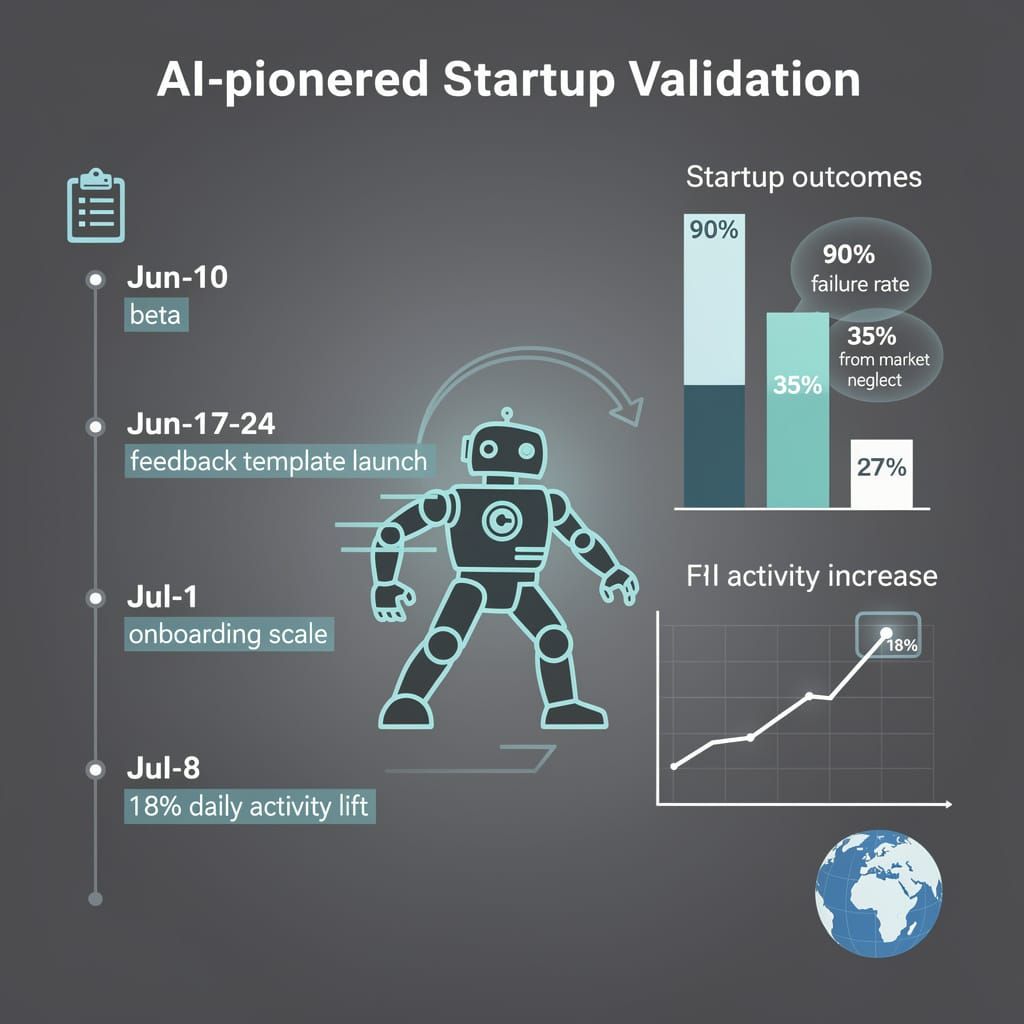
90% of startups fail due to poor validation—that's nearly every single one in a room of ten. 📉 Brutal. AI is now compressing feedback cycles from weeks to days to stop the bleed. But is data replacing vision for VCs? Founders: are you building for users or for the dataset?
Founders are currently obsessed with one thing: not building a product that nobody wants. The latest activity in the AI-assisted prototyping ecosystem indicates a shift toward aggressive, rapid-fire market validation. However, the stakes have never been higher; recent data reveals that 90% of startups fail due to a lack of idea validation, with roughly 35% of ventures collapsing specifically because they ignored actual market needs.
How does the feedback loop actually work?
The process relies on a tight causal chain of automated outreach and structured data collection. By utilizing AI prompt automation, founders can now solicit and synthesize validator inputs at a scale previously reserved for established firms. This removes the friction of manual outreach, enabling a continuous stream of beta testing and prototype refinement.
- June 10, 2026: Beta testing phase initiates via AI tools.
- June 17–24, 2026: Deployment of standardized feedback templates and the launch of a dedicated beta-seeker website.
- July 1, 2026: Invitation systems update to scale user onboarding.
- July 8, 2026: Milestone expansion reached, with daily activity tracking 18% higher than the six-month baseline.
This systemic approach to validation directly alters the risk profile of early-stage software development. When market-fit checks are integrated into the daily workflow, the probability of post-launch failure drops. Instead of guessing, founders use these automated hubs to pivot in real-time based on quantifiable user friction.
Engagement: Platform activity increases by up to 27% → higher density of user data. Product Risk: Continuous validation → lower probability of post-launch failure. Speed: AI-driven outreach → compressed feedback cycles from weeks to days.
While the auto-moderator functions as the central hub for this activity, the underlying driver is a desperate need for pre-investment proof. Following a 9.3% market sell-off in tech and financial sectors, VCs are no longer buying a vision; they are buying a validated data set. This shift forces founders to treat community engagement not as a marketing exercise, but as a core technical requirement.
Looking ahead, the infrastructure is primed for geographical scaling. Current trajectories project the expansion of these automated validation reaches into new global regions within the next two weeks, further commoditizing the way B2B and B2C startups verify their value propositions before spending a single dollar on full-scale production.
🏎️ The Luxury Tax of Efficiency
$70,000 profit in 30 days! 🏎️ This isn't a lottery win; it's the power of replacing gut-feelings with AI-driven client profiling. While corporate giants burn millions on AI, this lean agency is hedging against 12.6% luxury car inflation. High-ticket wins or tool-chain risk? Agency owners, is your tech stack paying for your ride?
Most agency founders treat their first big windfall like a lottery ticket, blowing it on a lifestyle they can't sustain. But when a web design founder dropped $70,000 on a Mercedes-Benz on July 6, 2026, it wasn't a lapse in judgment—it was a victory lap for a refined automation engine.
How do you buy a Benz without breaking the bank?
The shift happened on June 15, 2026, when the agency ditched manual prospecting for an AI-powered client assessment process. By replacing gut-feeling pitches with algorithmic profiling, the founder began closing deals ranging from $500 to $5,000 with zero traditional media spend.
This mechanical shift creates a specific causal chain: AI automation reduces lead-gen friction, which increases the volume of high-ticket contracts, which generates a surplus that exceeds operating costs. This arrives at a critical moment in the market. While Cox Automotive reports that U.S. auto sales declined 0.8% in Q2 2026, used luxury car prices surged by 12.6% annually by July 4, 2026. This makes a $70,000 cash acquisition a strategic hedge against aggressive automotive inflation.
The Financial Velocity
- June 2026: Deployment of AI assessment tools → rapid-turnaround proposals → $500–$5,000 per contract.
- July 2026: $70,000 net profit milestone → asset acquisition (Mercedes-Benz).
- August 2026 (Proj): Target cash flow surplus $>70,000$ → financing of secondary vehicle.
The Trade-off Scalability: AI-driven lead capture → eliminates reliance on expensive ad spend. Liquidity: Direct capital reinvestment → accelerates wealth accumulation cycles from quarterly to semi-annual. Risk: High reliance on specific SaaS toolchains → vulnerability to token-based billing spikes and vendor lock-in.
This transition demonstrates a move from volume-based optimism to asset-focused leverage. By treating the business as a self-reinforcing monetization system, the founder has shortened the horizon for wealth accumulation. However, the broader ecosystem is volatile. While giants like Uber burned through their entire 2026 AI budget in four months and Microsoft terminated global Claude Code licenses due to spiraling costs, the founder's lean, automated model avoids the corporate "token trap." For now, the engine is humming, and the car is paid for.
🧬 The Lab-Grown Glitch: SpudCell and the End of Biological Privacy
92% division efficiency! 🧬 SpudCell is a chemically synthesized organism that replicates like a pro—basically a biological hard drive. It's a total privacy nightmare. If biology becomes programmable, your data could literally divide and conquer. 😱 Could your DNA be the next hacked server? How do you feel about bio-data in your region?
Forget the silicon chip; the new hard drive is a lipid vesicle. Between July 1 and July 3, 2026, Kate Adamala’s team at the University of Minnesota unveiled SpudCell, a chemically synthesized organism that doesn’t just mimic life—it replicates it. By housing a 90kb plasmid-based genome in a lipid vesicle and utilizing membrane-bound protein aggregates to mimic cytoskeletal reorganization, the team achieved a 92% division efficiency.
How do you build a cell from scratch?
The process relies on a strict causal chain of chemical availability and engineered feedback. Researchers supplied synthetic nucleotides and lipid vesicles to provide the structural raw materials, utilizing external "feeder" vesicles to deliver nutrients.
Instead of traditional Darwinian mutation, the team used genetic tuning to increase $\alpha$HL enzyme output. This created a selective environment where the T7Max allele dominated within just five generations. The result is a system capable of growth, gene amplification, and binary fission via membrane pinching, validating that core life processes are replicable constructs.
Why should we care?
While the academic win is clear, the intersection of synthetic biology and data is where things get messy. The ability to program biology means we are moving toward "programmable biology," where organic structures can be used for scalable biomanufacturing and pharmaceutical delivery. However, this creates a critical vulnerability: if synthetic cells engineered to carry data payloads that divide autonomously render traditional data sanctuaries obsolete.
The Fallout:
- Data Security: Programmable biology → high risk of unauthorized biological data replication and bio-data theft.
- Bio-Ethics: Multi-generational proliferation → necessity for new ethical norms and mandatory screening of synthetic materials to contain synthetic organisms.
What happens next?
Industry projections indicate a rapid shift toward autonomous synthetic replicators. This evolution is already prompting a defensive reaction from tech leaders; OpenAI, Anthropic, and Google DeepMind have urged Congress to implement stricter regulations on synthetic DNA sales to mitigate bioweapon risks.
- 2026–2027: Integration of minimal biosynthetic pathways to achieve autonomous metabolism, eliminating the need for feeder vesicles.
- 2028: Projected full deployment of autonomous synthetic replicators for specialized computation and sustainable polymer fabrication.
As these organisms move from the petri dish to the real world, the priority shifts from "can we build it" to "can we stop it from copying our passwords." The biological memory race has begun, and our current security protocols are essentially screen doors in a hurricane.



Comments ()