89% AI Attack Surge: AI-Generated Code Bloat Triggers Global Security Collapse
TL;DR
- Identity Fraud Crisis: Indian IT Ministry Targets Username Features in Telegram and WhatsApp. Will government mandates for traceability officially kill digital pseudonymity in messaging apps?
- 89% Surge in AI-Driven Attacks: US Tech Markets Plunge as 'AI-Bloat' Erodes Cybersecurity. Is AI-assisted coding creating a systemic security collapse by replacing technical logic with non-deterministic vibes?
- 344% Surge in AI Deepfake Abuse: Meta and Google Face Billions in Fines Amid Systemic Safety Failure. With non-consensual AI deepfakes surging by 344%, is cloud storage now a liability for family privacy?
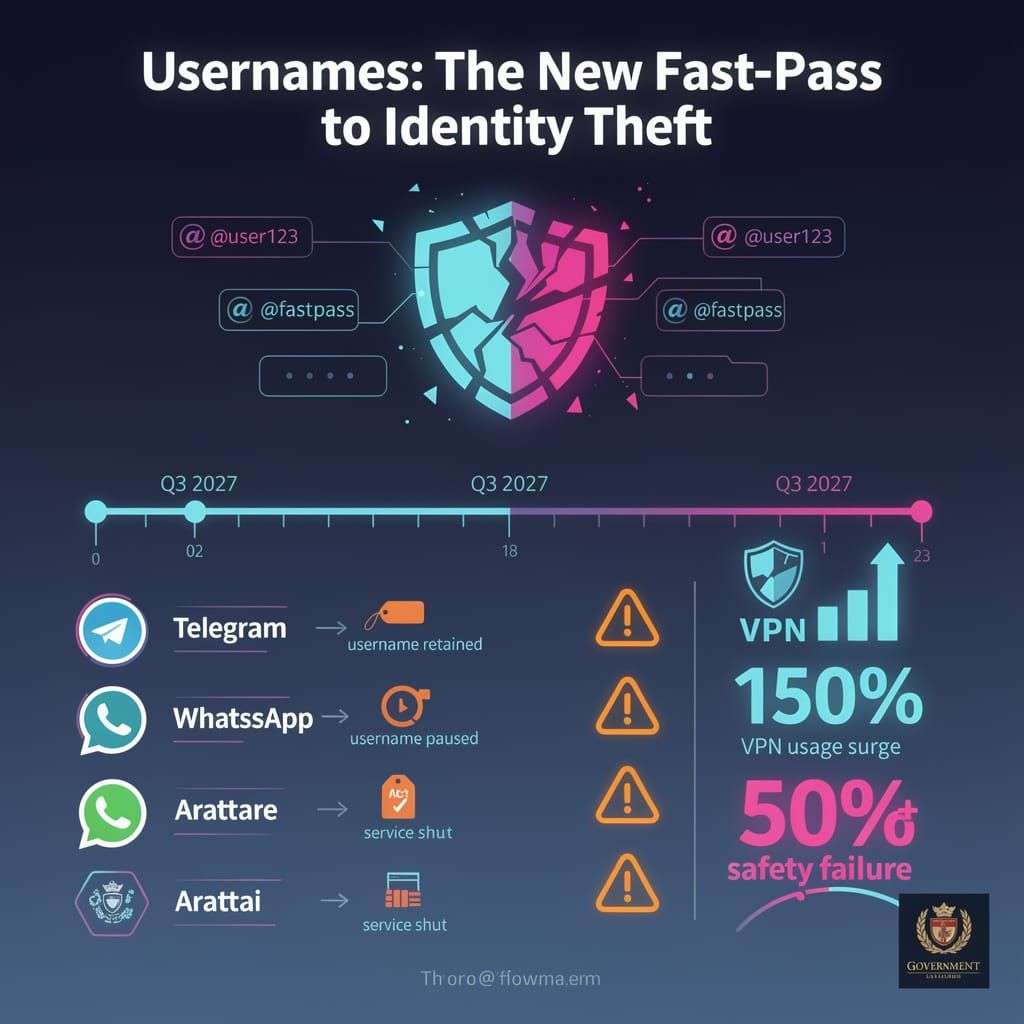
🤡 Usernames: The New Fast-Pass to Identity Theft 🤡
150% surge in VPN usage! 📈 That's the real 'community building' happening while Telegram & WhatsApp turn usernames into fraud-facilitation kits. Your privacy is now a gift-wrapped invite for scammers. 🎁 State surveillance vs. Pseudonymity? Who wins? Indian users — are you tuning in via proxy or trusting the state-approved UI?
Congrats to every "privacy-first" messenger for discovering that letting people pick their own usernames is basically a gift-wrapped invitation for scammers to pretend they’re your boss, your ex, or a tax official. The Indian IT Ministry spent early July playing digital whack-a-mole, notifying Telegram, Signal, and WhatsApp that their shiny username features are essentially fraud-facilitation kits. 🎁
Who’s getting roasted this week?
Turns out, when you let anyone claim @GovOfficial or @CEO_Real, you don’t get "community building"—you get identity theft and impersonation. The government is losing its mind over "anomalous activity," specifically citing risks of digital arrests and fraud. While Telegram tried to play it cool, the Ministry demanded immediate clarifications on how these handles are managed.
The "Security" Theatre:
- Telegram: Retained the feature despite being slapped with a nationwide ban from June 16–22 via Section 69A of the IT Act to stop NEET-UG exam leaks. They're dodging notices while the NTA demands the removal of message-editing features. 🎟️
- WhatsApp: Paused implementation of the username system to "consult" with regulators because the abuse patterns were too loud to ignore.
- Arattai: The Zoho-backed app just folded and disabled the feature entirely to stay compliant. Poof. Gone. 💨
The Damage Report:
- Identity: Verified handles are becoming spoofing playgrounds. If a handle is easy to pick, it's easy to fake.
- Governance: Sovereign tech rules now prioritize "traceability" (read: spying) via mandatory SMS linking over platform autonomy.
- User Experience: We're trading pseudonymity for opaque consent screens. VPN queries for Telegram surged 150% overnight during recent blocks, proving that users would rather tunnel through a proxy than trust a state-approved UI. 📉
The Road to Total Surveillance
Expect the regulatory hammer to keep swinging. If you think your niche app is safe, you're delusional.
- Q3 2026: Anti-anonymization mandates for mid-tier platforms as regulators target "unsafe content" following reports that 50%+ of child safety features on apps like Snapchat and TikTok are failing.
- Q4 2026: Increased onboarding costs as "decentralized" apps are priced out by compliance bloat.
- 2027: The death of the pseudonym. Between the SCREEN Act and KOSA-style mandates, your real ID will be required just to send a meme.
Privacy: User-profile ownership → State-managed identity. Market: Innovation → Uniformity via mandate. Trust: End-to-end encryption → End-to-end monitoring.
Stay chaotic, use open-source, and for the love of god, don't trust anyone with a fancy handle. ✌️
🤡 The Great Code Collapse: Now With AI Magic™
89% rise in AI attacks with 29-minute breakouts—absolutely catastrophic. 🤡 That's like losing your entire fortress before the coffee machine finishes brewing. Your AI-bloated codebase is now a playground for zero-days. Security or just 'vibes' of vibes? Devs — is your AI writing your code or your resignation letter?
Congratulations! We’ve finally reached the peak of human achievement: we’ve automated the process of writing bugs so fast that teams no longer have time to actually fix them. 🤡
Why is your codebase a dumpster fire?
Here is the beautiful causal chain of our current misery. We decided that "prompting is the new programming," replacing actual logic with non-deterministic vibes. When you let an LLM scaffold your architecture, you aren't building a product; you're building a precarious house of cards. AI-assisted coding tools have accelerated workflows, but the cost is a total erosion of deep technical understanding and a slide into systemic fragility. 📉
This isn't just "technical debt"—that's a corporate euphemism for "we fucked up." It's a security nightmare. We are seeing AI-driven supply-chain attacks and agentic AI adoption creating massive gaps, including unguarded tool calls that expose payment flows and rate-limit vulnerabilities. When your codebase is a bloated soup of third-party AI wrappers, you're just inviting hallucinated dependencies and unverified garbage into your core. This expands the attack surface into a playground for threat actors, enabling zero-days to move laterally while your CISO is busy updating their LinkedIn profile.
The Timeline of the Decline
- May 18, 2026: AI tools like Mythos and Daybreak flood GitHub and Cloudflare with vulnerability reports, making it impossible to tell a real threat from AI noise.
- May 27, 2026: Project Glasswing drops >10k high-critical vulnerabilities, triggering rapid patch cycles and an absolute panic in breach risk management.
- May 29, 2026: Senior tech leads admit AI-driven practices are eroding developer oversight, accelerating the descent into cybersecurity chaos.
- June 25, 2026: SpaceX buys Anysphere for $60bn to integrate Cursor into xAI, scaling the ability to inject unverified AI content into cloud offerings at warp speed.
- July 04, 2026: LifeOverflow shreds German cybercrime law, proving "syntactic compliance" is just a fancy way to hide malicious intent from the law.
The Damage Report
Security: AI-driven bloat → unguarded tool calls → 89% rise in AI-based attacks with breakout times dropping to 29 minutes. Cognition: Thinking replaced by "regenerate response" → total loss of architectural intuition and developer skill erosion. Financial: AI-driven supply-chain attacks and regulatory panic → triggered a 9.3% drop in US tech markets in late May.
What’s Next for the Meat-Sacks?
- Q3 2026: Institutions realize AI-generated code is a liability nightmare and start panic-buying "Human-Certified" audits.
- 2027: A massive shift toward low-cost open-source tools as people realize proprietary AI wrappers are just expensive ways to introduce vulnerabilities.
Good luck explaining to the board why the system crashed because the AI decided a loop was "too mainstream." 🥂
🤡 Your Family Photos Are Now AI Porn: A Guide to Digital Despair
344% surge in non-consensual deepfakes is absolutely psychotic—that's like every third 'safe' cloud photo becoming a nightmare 🤡. AI filters are a joke and corporate safety rails are nonexistent. Your memories are just training data for chaos. Who's still trusting the cloud with their kids' photos?
Congratulations! You spent a decade uploading every toothless grin and first-step stumble of your kids to the "safe" embrace of the cloud. Now, thanks to the benevolent geniuses of generative AI, those precious memories are being fed into a blender of deepfake depravity. 📸✨
How Did We Get This F***ed?
It’s a simple causal chain of corporate negligence and human vanity. You post a cute photo; some predatory basement-dweller uses a modified prompt; the AI fills in the blanks. It turns out the same tech that makes a cat look like a Van Gogh is remarkably efficient at creating synthetic nightmares.
While Meta plays a delightful game of "Oops, we removed some ads" to distract from the fact that leaked documents from June 2026 reveal ~10% of their global ad revenue—roughly $16 billion in 2021—comes from scams and policy-violating trash, the actual safety rails are nonexistent. Just ask Mindgard researcher Jim Nightingale, who in June 2026 proved that using a vague "restore this photo" prompt allows ChatGPT to bypass filters and generate sexually explicit and violent images. 🤡
The Chaos Timeline:
- 2025: The "Quiet" Era. Early spikes in AI-generated sexual deepfakes; Grok AI tools facilitate non-consensual distribution.
- 2026 (YTD): The "Full Chaos" Era. 3 million accounts hit by deepfake abuse, including 23,000 children; non-consensual intimate image threats surge by 344%.
- Late 2026: Total systemic failure as synthetic agents automate production and filter bypasses become common knowledge.
The Corporate "Solution" vs. Reality
Governments are frantically amending laws—because nothing stops a decentralized AI model like a piece of paper from a politician who barely knows how to open a PDF.
The Damage Report:
- The Kids: Psychological trauma from synthetic attacks. Pure digital hell.
- Law Enforcement: Charging rates for intimate image abuse hover around a pathetic 4.8% because attribution is now a guessing game.
- The Platforms: Meta faces potential DSA fines of up to 6% of turnover (~$8.1B), while Google just coughed up €4.125 billion in July 2026 for antitrust violations. They'll just call it "technical debt" and raise your subscription prices.
The Only Real Fix?
Stop trusting the algorithmic babysitters. The "trust and safety" teams are just PR shields for companies that profit from the engagement that fuels these networks. If you want security, stop treating the internet like a digital scrapbook.
Go buy a physical photo album. It’s low-cost, open-source (you hold the book), and—most importantly—cannot be accessed by a deepfake bot in a dark-web forum. 📖🚫


Comments ()