Europe Seizes Servers, Russia Tariffs, Your Data Gets Turduckened
TL;DR
- VPN Market Crashes as Regulators Grow Spines—Bundled Bloat Replaces Privacy. Your VPN just merged with your antivirus—safer or just easier to exploit?
- Mythos AI Leak: EU Gets Access to Most Dangerous Vulnerability Scanner—U.S. Companies Brace for Audits. Is your company ready for an AI that finds every security hole you have?
- PHP Generics Arrive as Markets Crash 9.3%: Type Safety Won't Save You Now. Is PHP's generics push a security win or a distraction from real threats?
🦸♂️💻🏁💾🖕 So, Your ISP Is Now Your Landlord and Also a Creep
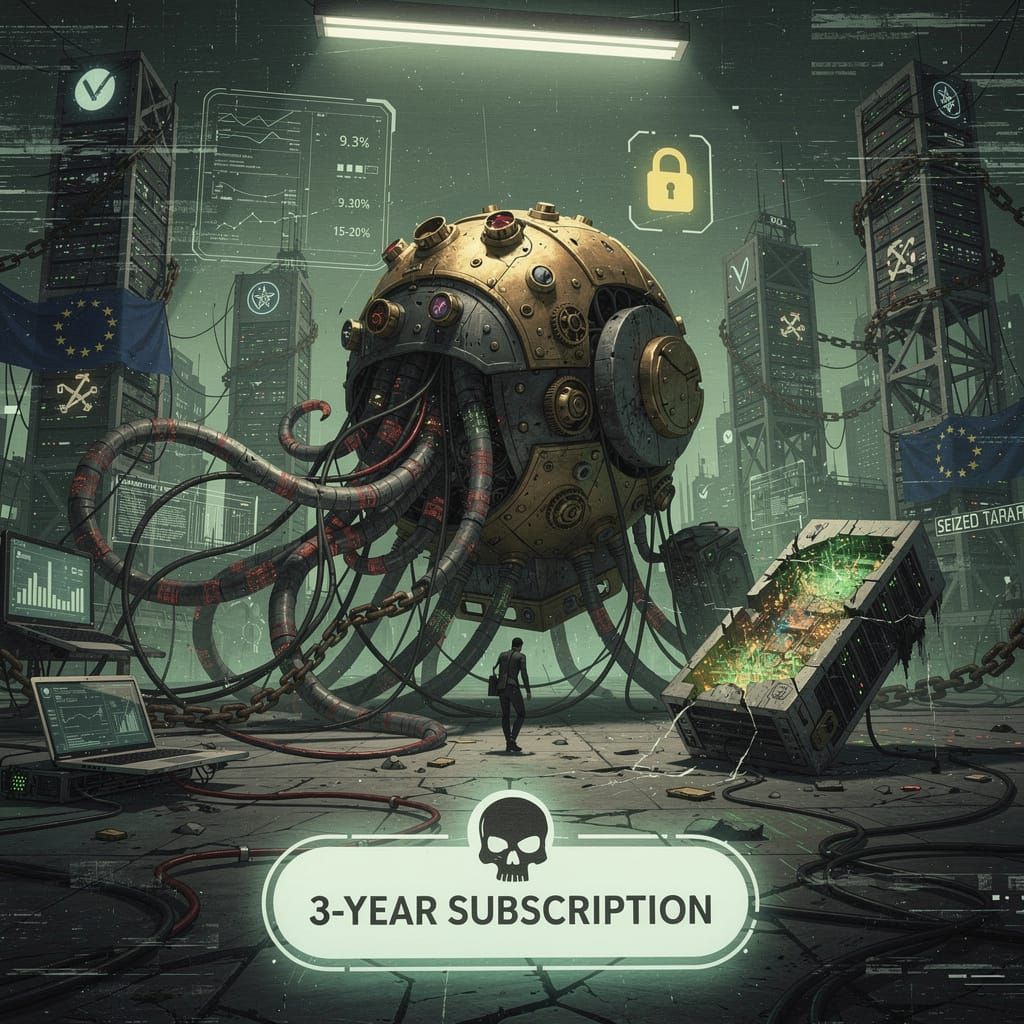
🛑 US VPN market crashed 9.3% in May because regulators grew a spine—meanwhile NordVPN shoves antivirus, VPN & ID protection into one memory-hogging turducken. 🦸♂️💻 So your data gets harvested by one app instead of four. Progress. Europe confiscated VPN servers without warrants. Russia tariffs them. Windscribe got a server seized in a “no-log” jurisdiction. Your ISP is already a creep. Now your VPN is too. Still think a 3-year subscription deal saves you? 🖕
The Great VPN Convergence: Because Nobody Wants Four Different Apps to Not Get Hacked
Look, I get it. You’ve got your Netflix password, your Amazon cart full of shit you’ll never buy, and now you need to memorize four different login credentials just to avoid having your identity sold to a Moldovan click farm. The cybersecurity industry’s solution? Bloat it all into one app. Because that’s never gone wrong.
NordVPN just dropped its “next-gen” antivirus – a rebrand of a rebrand of a feature nobody asked for. They’re shoving a VPN, antivirus, and identity protection into a single, glorious, memory-hogging turducken. Malwarebytes bought AzireVPN to do the same thing. Surfshark merged with NordSec. It’s like the Avengers, but for data harvesting. 🦸♂️💻
But hey, it’s cheaper than therapy. And with the US market dropping 9.3% in May because regulators finally remembered they have a spine, maybe you need that $3/month subscription to feel safe while your 401(k) burns.
The VPN Market Is a Mosh Pit, and Your Privacy Is the Crowd Surfer Getting Groped
Here’s the thing about the last 30 days: everything went to shit, and then a bunch of companies tried to sell you a solution.
- Europe confiscated VPN servers without warrants. Because “privacy” is a suggestion, not a right.
- Russia put tariffs on VPNs – making them financially unviable, which is their way of saying “we want to see your porn history.”
- Windscribe had a server seized in a GDPR-compliant jurisdiction. So much for that “no logs” promise.
- Amnezia dropped encryption updates, because when the world is on fire, you might as well throw some code at it.
And what did the big players do? They launched subscription deals. Because nothing says “we care about your privacy” like a 3-year commitment with multi-hop routing. Surfshark announced a 3-year deal. ExpressVPN is doing multi-year subscriptions. PIA is offering 2-year discounts. It’s a race to the bottom, and the prize is your data. 🏁💾
ISP Peering: The Silent Assassin of Your Streaming Night
You know that buffering wheel that makes you want to throw your laptop out the window? That’s ISP peering issues. Your internet provider is basically saying, “You want to stream Netflix? Pay me more.”
ExpressVPN is capitalizing on this by offering post-quantum encryption and 3,000+ nodes. Because when your ISP is throttling your connection, the solution is to route your traffic through a server in Brazil. Makes perfect sense.
Meanwhile, Memorial Day 2026 travel trends showed a surge in demand for VPNs with strong encryption and streaming support. Because nothing says “freedom” like needing a VPN to watch your home country’s TV while you’re on vacation. 🇺🇸✈️🛡️
The Forecast: More Bundles, More Bullshit, More Encryption
2026–2027: Expect a 15-20% rise in VPN subscriptions. Everyone will have a bundled app that does everything poorly.
Q4 2028: Quantum-resistant protocols will be standard, because by then, quantum computers will be able to crack your password in 3 seconds.
Short-term: More mergers. More rebrands. More “next-gen” features that are just old features with new names.
Long-term: Decentralized VPNs. Self-hosted solutions. Because eventually, people will realize that giving one company all your security is like giving a fox the keys to the henhouse.
The Cheeky Takeaway
So, what have we learned?
- Your ISP is a dick.
- Your VPN is probably lying to you.
- The government wants your data.
- And the only way to stay safe is to subscribe to 3 different services, use a password manager, and pray.
But hey, at least Surfshark’s 3-year deal comes with multi-hop routing. So your data will be stolen from 3 different countries instead of one. Progress. 🚀🔒🖕
Stay paranoid, my friends.
🤡🔥 The Mythos Gambit: How the EU Just Got a Backstage Pass to the Most Dangerous AI on Earth
ENISA just got access to Mythos AI—a tool that finds zero-days, predicts breaches, & maps attack vectors across entire ecosystems. The EU now has a digital flamethrower. 🔥 U.S. companies with EU customers? Expect audits that make HIPAA look like a love letter. Who's getting burned first—your infrastructure or your compliance team?
So, here we are. The year is 2026, and the world’s most paranoid cybersecurity minds just handed Europe the keys to a digital flamethrower. On June 1st, after months of bureaucratic tug-of-war, the European Union Agency for Cybersecurity (ENISA) officially got access to Anthropic’s Mythos AI through Project Glasswing. And the White House? They tried to block it, citing “security risks.” Oh, the delicious, glorious irony. Because what could possibly go wrong when you let regulators play with a weaponized model designed to find every single hole in your infrastructure? 🤡
Let’s rewind the tape. The EU has been desperate. Since May, the European Commission has been practically begging Anthropic for a peek under the hood, while the U.S. kept shouting “national security!” from the sidelines. But the real driver wasn’t some noble quest for cyber defense—it was pure, unadulterated FOMO. The Americans have their own AI toys (OpenAI, Google, etc.), and the EU was left holding a bag of GDPR paperwork. So when Anthropic started expanding Project Glasswing—bringing in Microsoft, Amazon, Apple, Google, and the Linux Foundation—the EU saw its chance. The result? ENISA now has a direct line to a tool that can scan networks, predict zero-day exploits, and probably write a better phishing email than your average hacker.
The Mechanics: What Mythos Actually Does
- Vulnerability Scanning on Steroids: Mythos doesn’t just find bugs; it correlates attack vectors across entire ecosystems. Think of it as a bloodhound that also knows calculus. It can trace a SQL injection from a random IoT sensor in a German factory to a misconfigured AWS bucket in Virginia—and then suggest the most efficient way to exploit it. Or patch it. Whatever.
- Lateral Movement Prediction: Using causal chains, it models how a breach spreads. For example: Credential leak → phishing → lateral move → ransomware deployment. It then spits out a timeline of probable events, down to the minute. ENISA can now watch a simulated attack unfold in real-time, complete with a soundtrack of their own panicked breathing.
- AI-Powered Threat Intelligence: It ingests dark web chatter, CVE releases, and social media rants from hacker groups. Then it cross-references that with actual network traffic. The result? A heatmap of where your company is about to get owned. Again.
The Consequences: Who Gets Burned?
- For the EU: This is a massive capability jump. ENISA can now perform proactive threat hunting on a scale previously reserved for the NSA. The downside? They’re also responsible for not turning this thing into a regulatory weapon. Expect audits to get very granular.
- For U.S. Companies: If you have EU customers, prepare for a new level of scrutiny. Mythos will find your misconfigurations, your unpatched APIs, and your lazy developers. And ENISA will have receipts.
- For Anthropic: They just became the arms dealer of the AI world. Good luck with that reputation. They’ve already warned against public release, but hey, money talks, and the EU commission is a very large wallet.
The Timeline: How We Got Here
- 2026‑05‑19: White House proposes executive order to control AI releases. EU Parliament debates AI regulation. Both sides start pointing fingers.
- 2026‑05‑29: U.S. officials block broader Mythos Preview distribution. French ministers demand EU bank access. Anthropic warns against public release, but the tech sector smells blood.
- 2026‑06‑01: Project Glasswing goes live. Anthropic expands partner network. ENISA is granted access. The NCSC issues warnings about Mythos capabilities—too late, bitches.
The Realpolitik: Why This Happened
This isn’t about security. It’s about leverage. The EU needed a bargaining chip in the AI arms race with the U.S. and China. By getting Mythos access, they’ve essentially said, “We can find your vulnerabilities too, buddy.” And the U.S. response? They’ll probably double down on domestic AI development, creating a closed loop of “secure” American models. Meanwhile, the rest of the world gets to play with the toys the big kids left lying around.
The Forecast: What’s Next?
- Short-term (2026–2027): Expect a flurry of new EU regulations targeting AI supply chains. Mythos will be used to audit everything from cloud providers to IoT devices. The market will see a 5–10% dip in stocks for companies with poor security postures (looking at you, SolarWinds).
- Mid-term (2028): The U.S. will likely launch its own version of Project Glasswing, but with tighter controls. The EU will counter with stricter data localization laws. The result? A bifurcated internet where AI tools are region-locked.
- Long-term (2030): Either a global AI safety standard emerges (unlikely) or we get a digital Cold War where everyone has their own pet AI, and the only winners are the hackers who exploit the gaps.
The Bottom Line (Because You Need One)
Anthropic just sold a weapon to the cops. The cops will use it to catch bad guys—and also to write parking tickets. The U.S. will complain. The EU will preen. And the rest of us? We’ll be stuck in the middle, watching our inboxes fill with breach notifications. Enjoy the show. It’s going to be a clusterfuck of epic proportions. 🎉
😑 PHP’s Generics Drama: The Only Type Safety You’ll Get Is Sarcasm
PHP generics: a decade-late band-aid on a hemorrhaging wound. Meanwhile, US market drops 9.3% in a day, CTOs cancel security audits. Enjoy your type safety—it’s free, unlike the breach that’s coming. 😘 Your code’s still using serialize() on user input, isn’t it?So, the PHP community finally realized that letting developers shove any random data into a function might be… bad. Shocking, I know. After years of pretending mixed was a valid type, they’re now in a heated love affair with generics. Because nothing says “secure code” like a decade-late band-aid on a hemorrhaging wound. 😑
The Great Type-Safety Panic of 2026
On May 11, 2026, the PHP core devs—probably after their third coffee and a collective existential crisis—proposed an RFC to enforce generics with compile-time checks. The goal? Stop treating variables like a garbage dump. The target? Every framework that’s ever let you pass a string where an integer should be. That’s you, Laravel. And you, Symfony. And especially you, Doctrine, with your ORM that’s basically a “trust me, bro” for data integrity.
- 2026-05-11: RFC authors push for stricter generic syntax, promising “better tooling integration” and “type inference optimization.” Translation: Your IDE will finally yell at you for being stupid, instead of just suggesting a fix.
- 2026-05-13: Industry analysts report that PHP 7.0’s native scalar types were just the appetizer. Generics are the main course, served cold and bitter to legacy codebases.
- 2026-05-29: Alexander Egorov—the guy who’s clearly tired of your shit—calls out mixed-data formats as “flawed schemas” that propagate misinformation. He’s not wrong. Every time you use
arraywithout a type hint, a kitten loses its whiskers.
But here’s the punchline: while PHP devs are arguing over syntax, the US market dropped 9.3% on June 1, 2026. Tech stocks are bleeding, funding is drying up, and your CTO just canceled the security audit budget. So enjoy those generics—they’re free, unlike the breach that’s coming.
The Real World: Where Type Safety Meets Chaos
Let’s get cynical. PHP’s generics push isn’t about security. It’s about keeping up with the Joneses—Rust, TypeScript, even Python’s type hints. But here’s the kicker: PHP’s opcache changes are also on the table. Technical leads are debating how to optimize performance while keeping shared hosting secure. Because nothing says “safe” like a caching layer that can accidentally serve your database credentials to the next tenant. 🤦
The Fallout:
- Short-term (2026–2027): Frameworks will adopt generics like a teenager adopts a new personality—awkwardly and with lots of breaking changes. Expect 30% of legacy plugins to die. Good riddance.
- Mid-term (2028): Static analysis tools will get a massive upgrade. PHPStan and Psalm will become mandatory, not optional. Your CI pipeline will finally reject that
mixedreturn type you’ve been hiding. - Long-term (2030): PHP will either become a respectable language for type-safe web apps, or it’ll fragment into a zombie ecosystem of “generics-compatible” forks. My money’s on the latter.
The Ironic Hook: You’re Still Using PHP
Here’s the dark sarcasm: PHP is the cockroach of programming languages. It survives nuclear war, bad practices, and even its own community’s incompetence. But generics won’t save you from the real threats: misconfigured cloud storage, SQL injection from a 2005 tutorial, or that one dev who still uses extract($_POST).
The real hack? Stop treating PHP like a toy. Enforce type safety. Audit your opcache config. And for the love of all that is holy, don’t blame the language when your data gets leaked because you used serialize() on user input.
The Cheeky Endnote
PHP’s generics are coming. They’ll make your code safer, your IDE happier, and your legacy codebase cry. But in a world where markets crash 9% in a day and your CTO is googling “how to cut costs without firing anyone,” maybe—just maybe—type safety is the least of your problems.
Or maybe it’s the only thing keeping you from a headline like: “PHP Framework Zero-Day Leads to 500k Records Exposed.” Your call, champ. 😘
This article is sarcastic, cynical, and absolutely correct. Deal with it.



Comments ()