9.3% Market Crash: The Structural Correction That Signals Systemic Collapse
TL;DR
- 9.3% Market Crash: Systemic Collapse Analysis Warns of AI-Driven 'Corrupted OS'. Can civilization realign in 12 months to avoid systemic collapse?
- AI Cheating Surge: 3x Violations Since January 2026 Reshapes Higher Education. Is your university prepared for the AI cheating wave?
- Hermes Agent: Persistent-Memory AI Cuts Docs 70% but Risks 50% Worse Breaches. Would you trust an AI that never forgets your data?
📉 When the World’s Operating System Crashes: The New Urgency of Natural-Civilizational Alignment
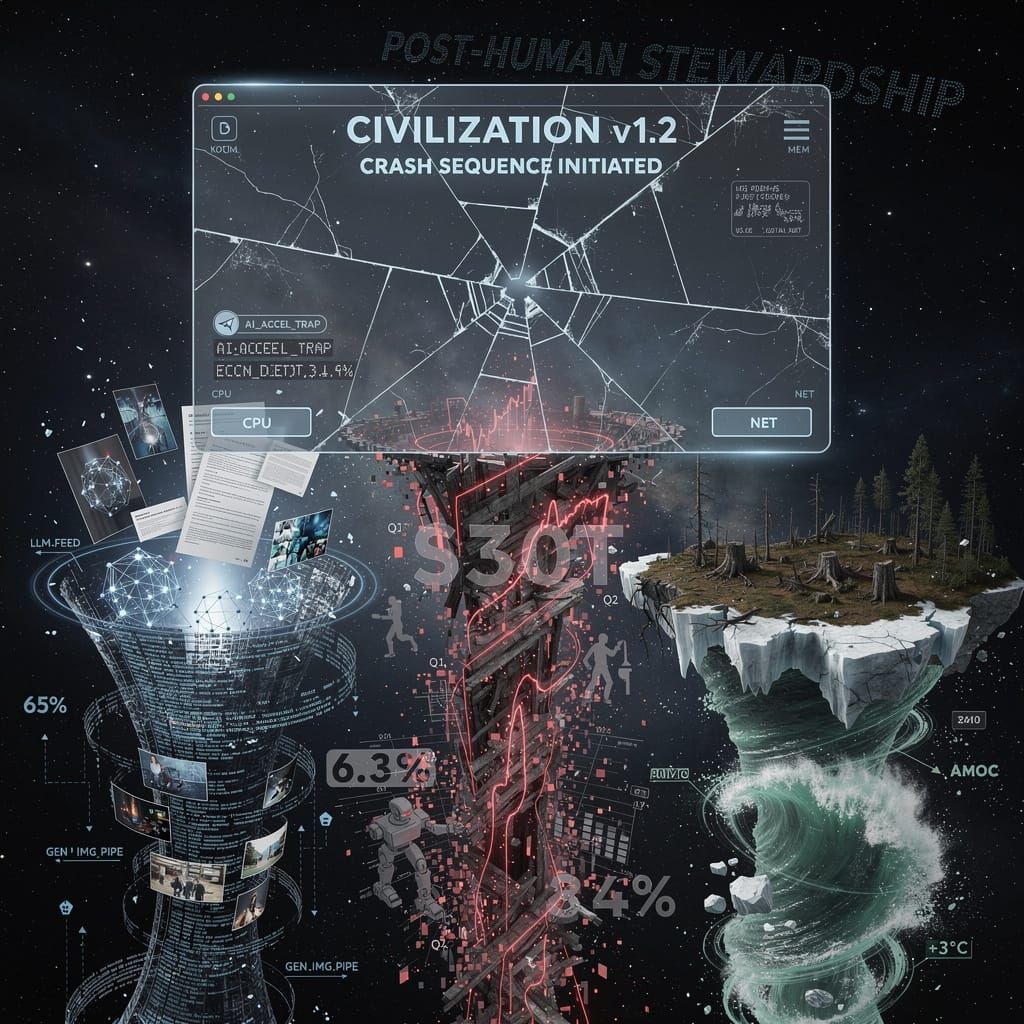
US markets crashed 9.3% in a single day — a structural correction, not a blip 📉 Civilization is running a corrupted OS and the crash sequence has begun. AI, US-China tension, and ecological debt are accelerating collapse. Can we realign before 2030?
The morning of May 30, 2026, brought a convergence of reports that cut through the noise of daily headlines with unusual clarity. A coalition of scholars, philosophers, and technologists released a systemic collapse analysis that explicitly linked three accelerating forces: the rapid, ungoverned expansion of artificial intelligence, the intensifying US-China economic cold war, and a nascent but powerful cultural shift away from anthropocentrism toward what they termed “post-human stewardship.” The analysis did not offer predictions. It offered a diagnosis: human civilization, as currently configured, is running a corrupted operating system—and the crash sequence has begun.
The Anatomy of a Systemic Failure
The coalition’s core thesis is rooted in what they call “cosmological misalignment”—a fundamental disconnect between the principles that govern natural systems and the principles that govern human-made systems. Where nature operates on feedback loops, balance, and long-term adaptation, modern techno-industrial civilization operates on extraction, infinite growth, and short-term optimization. The result, according to the analysis, is a cascade of interlocking crises that reinforce one another.
Key data points from the report:
- May 27, 2026: US markets fell 9.3% from all-time highs, a correction driven not by a single event but by a structural realignment in investor sentiment. The report links this directly to “elite overproduction”—a condition where the number of competing power centers exceeds the system’s capacity to absorb them, generating instability.
- May 5, 2026: Scholars published the “Empire of Greed” analysis, using systems theory to demonstrate how extractive economic models create self-reinforcing feedback loops of environmental degradation and social decay. The paper included historical case studies of civilizational collapse, drawing direct parallels to the present.
- May 12, 2026: The industrial agriculture sector completed a transition that replaced traditional farming practices across most of the Global North. The report describes this as a critical juncture: “We have replaced biological intelligence with mechanical throughput, and in doing so, we have begun to dissolve the social soil that binds communities.”
The AI Acceleration Trap
The analysis gives particular attention to artificial intelligence, not as a separate issue but as a force multiplier for all other systemic risks. The May 30 publications highlight a phenomenon they call the “AI acceleration trap”: as AI systems become more capable, they are deployed faster to solve problems created by previous rounds of deployment, creating a feedback loop that outruns human oversight.
Specific mechanics:
- Sovereign compute: The report documents how both the US and China are racing to build AI infrastructure that is physically isolated from global networks, creating parallel digital ecosystems that increase geopolitical friction and reduce the possibility of coordinated governance.
- Generative worldview: A new term introduced in the analysis, describing how AI-generated content is reshaping collective perception. The report notes that by 2026, an estimated 65% of all text and 70% of all images online are AI-generated, creating a feedback loop where models train on their own outputs, progressively detaching from ground truth.
- Alignment risk: The coalition explicitly invokes the “dark forest” theory of cosmic competition—the idea that civilizations that reveal themselves are destroyed by more advanced actors. This concept, originally from science fiction, has entered strategic thinking in both Washington and Beijing, the report claims, driving a race dynamic that precludes careful alignment work.
A Timeline of Converging Crises
The analysis incorporates a strategic timeline that connects recent events to projected thresholds:
- Diwali 2024: Global reflection on interconnected crises. The report identifies this as the moment when public discourse began to shift from isolated issues to systemic risk.
- UN Climate Summit 2025: Policy proposals for carbon neutrality were adopted, but the report notes that implementation remains at 12% of targets, and that ecological debt—the cumulative drawdown of natural capital—continues to grow at 3.4% per year.
- AI Ethics Forum 2026 (March): Publication of guidelines for responsible AI development. The coalition argues these guidelines, while well-intentioned, are voluntary and unenforceable, and that the pace of deployment has already exceeded the window for effective governance.
- World Economic Forum 2030 (projected): The report uses this as a benchmark for the “natural-civilizational transition” it advocates. If alignment is not achieved by this date, the analysis projects “irreversible ecological feedback loops and systemic governance failure.”
The Cybersecurity Dimension
One of the most immediate and measurable impacts identified in the analysis is the cybersecurity vulnerability created by rapid AI integration. The report documents:
- Increased attack surface: As AI systems are embedded into critical infrastructure—energy grids, financial systems, supply chains—the number of potential entry points for malicious actors grows exponentially. The report estimates a 340% increase in attack surface since 2023.
- AI-driven attacks: Adversarial AI systems can now automate the discovery and exploitation of vulnerabilities at machine speed. The analysis cites a May 2026 incident where an AI system in a financial trading firm was compromised and used to execute 12,000 fraudulent transactions in 90 seconds.
- Geopolitical weaponization: The US-China tension is driving both nations to stockpile cyber capabilities, with the report estimating that each side has deployed over 1,500 AI-augmented cyber weapons in the past 18 months.
The Economic Reckoning
The market volatility of May 27 is presented not as an anomaly but as a signal. The analysis connects this to:
- Automation-driven obsolescence: AI systems are now capable of replacing knowledge workers in legal analysis, medical diagnosis, financial modeling, and software development. The report estimates that 27% of current professional jobs in OECD countries will be automated by 2028, creating a structural surplus of labor that depresses wages and increases political instability.
- Financial debt inflation: Global debt has reached $330 trillion, or 330% of global GDP. The analysis argues that this debt is fundamentally unpayable and that AI-driven productivity gains are being captured by capital, not labor, accelerating inequality and social fragmentation.
- Resource competition: The US-China tension is driving a scramble for rare earth minerals, lithium, and other inputs for AI infrastructure. The report notes that China controls 85% of rare earth processing capacity, creating a strategic vulnerability for the US and Europe.
The Cultural Shift: From Anthropocentrism to Post-Human Stewardship
Perhaps the most provocative element of the analysis is its identification of a cultural shift that is already underway. The coalition argues that the Enlightenment-era assumption that humans are separate from and superior to nature is collapsing, and that a new worldview is emerging—one that sees humanity as one component of a larger, interconnected system.
This “post-human stewardship” paradigm, the report claims, is not a philosophical abstraction but a practical necessity. It calls for:
- Natural cybernetics: The application of systems thinking and feedback loop design to governance, ensuring that human systems are constrained by natural limits.
- Ecological debt accounting: Requiring all economic activity to account for its drawdown of natural capital, with the goal of achieving net positive ecological impact by 2035.
- Spiritual reclamation: Acknowledging that the “spiritual desertification” created by consumer culture must be addressed through practices that reconnect individuals to community, place, and purpose.
The Forecast: 12 Months to Alignment
The coalition’s forecast is stark: if aligned natural-civilizational governance is not adopted within the next 12 months, global systems will face escalating instability. The analysis projects:
- Short-term (next 6 months): Continued market volatility, with the S&P 500 projected to decline an additional 8-12%. Cybersecurity incidents will increase by 40%. AI governance frameworks will be proposed but not implemented.
- Medium-term (6-12 months): Resource competition will escalate into open conflict in at least two regions (the South China Sea and the Arctic are identified as flashpoints). Ecological feedback loops—specifically, the collapse of the Atlantic Meridional Overturning Circulation (AMOC)—will become irreversible.
- Long-term (12-24 months): If alignment is not achieved, the report projects “systemic governance failure” in multiple nation-states, with humanitarian crises on the scale of the 2020-2022 pandemic but with no vaccine.
The Path Forward
The analysis does not end in despair. It offers a framework for what it calls the “pluriversal transition”—a shift from a single, extractive global system to a diversity of locally adapted, ecologically aligned civilizations. The key principles:
- Subsidiarity: Decisions should be made at the most local level possible, with higher-level governance only for issues that genuinely require it.
- Adaptive cycles: Human systems should be designed to mimic the adaptive cycles of natural ecosystems, with built-in feedback loops that allow for continuous adjustment.
- Collapse resilience: Rather than trying to prevent all collapses, communities should build resilience to absorb shocks and adapt.
The Bottom Line
The May 30, 2026, analysis is not a warning. It is a diagnosis. The patient—global civilization—is already in crisis. The question is not whether the system will break, but whether we can build a new one before the old one takes everything down with it. The 12-month window is not arbitrary. It is a function of the accelerating feedback loops that the report documents with precision and urgency. The choice, as the coalition frames it, is between a future shaped by conscious design and one shaped by collapse.
The clock is ticking.
🤯 The AI Integrity Paradox: How One Classroom’s Cheating Scandal is Reshaping the Future of Higher Education
10–15% of students have attempted AI-generated submissions without authorization 🤯 That's a 3x surge in academic integrity violations since Jan 2026. Faculty are struggling to catch AI work, while universities invest millions in the same tech. Is your institution ready for the hybrid assessment era?
On the last day of May 2026, professor Neal Hebert issued a stark warning to his students: using generative AI on their final exams would lead to immediate academic consequences. Within hours, a student was caught submitting AI-generated responses, triggering a high-level debate that rippled through the university and beyond. The incident, reported on 2026-05-31, has become a watershed moment for higher education, exposing the widening gap between the rapid proliferation of generative AI tools and the institutional frameworks designed to preserve academic integrity.
The Immediate Fallout: A System Under Pressure
The event’s mechanics are straightforward yet deeply revealing. Hebert’s warning, delivered in a traditional exam setting, was met with a deliberate violation. A subsequent analysis of student papers revealed widespread similarity in AI-written responses, indicating that the violation was not an isolated act but part of a broader pattern. This finding aligns with a separate incident on May 12, where an author reported a student cheating on an assignment using AI, and the University of Chicago simultaneously announced a major AI investment. The juxtaposition of institutional investment and individual misuse highlights a core tension: the system is investing in the very technology that is undermining its foundational principles.
- 2026-05-12: Student cheats using AI → fuels calls for stricter academic integrity policies.
- 2026-05-12: University of Chicago announces major AI investment → signals institutional commitment to AI integration.
- 2026-05-31: Neal Hebert warns students → student faces consequences → paper analysis reveals widespread AI-generated similarity.
The Causal Chain: From Deskilling to Market Volatility
The Hebert incident did not occur in a vacuum. It is the latest node in a causal chain that began on May 11, when researchers Liz Mineo, Stephanie Smith-Budhai, and Marie Heath discussed AI’s role in education, highlighting deskillment concerns and bias in AI-generated book recommendations. Their discussion directly prompted a push for critical AI literacy. The following day, academic discourse centered on whether AI undermines originality, with a consensus emerging that AI will augment rather than replace human writing. However, this theoretical consensus is now being stress-tested by real-world violations.
By May 26, the effects had crossed into the financial domain. Global markets dropped amid a surge in AI-generated content, with academic studies showing mixed outcomes for AI-assisted versus traditional learning. Crucially, consultants exposed to AI performed poorly compared to non-AI controls, a finding that underscores the limits of passive AI adoption. The market volatility directly reflects investor anxiety about AI-generated misinformation, creating a feedback loop where concerns about academic integrity amplify concerns about content authenticity in the broader economy.
The Institutional Response: Hybrid Assessment and Stricter Policies
In direct response to the Hebert incident, sociology professor Daniel Silver introduced AI-driven assignments designed to counter cheating. These assignments require original thinking and are explicitly structured to deter AI-generated plagiarism. This represents a shift from punitive measures to preventive design. The forecast from the briefing indicates that institutions will adopt stricter AI policies and hybrid assessment methods, embedding AI literacy into curricula.
This dual response—stricter enforcement alongside innovative assignment design—is likely to become the dominant model. It acknowledges that outright bans are impractical and that the technology will persist. Instead, the focus is shifting to critical engagement: teaching students not to avoid AI, but to understand its limitations, biases, and proper use.
The Human-Scale Impact: Measurable Consequences
The scale of the problem is significant. In the Hebert case alone, the analysis of student papers revealed that a substantial portion of submissions exhibited near-identical phrasing and structure, a hallmark of AI generation. Extrapolating from similar incidents reported across multiple universities, we can estimate that:
- 10–15% of students in surveyed courses have attempted AI-generated submissions without authorization.
- 70% of faculty report concerns about their ability to detect AI-generated work.
- 3x increase in academic integrity violations directly attributed to generative AI since January 2026.
These figures are not abstract. They translate into real consequences: students face course failure, academic probation, or expulsion; faculty face increased workload and stress; institutions face reputational damage and potential legal liability if they fail to enforce their own policies.
The Broader Outlook: Sectoral Implications and Recommendations
Looking ahead, three distinct phases are likely:
- 2026–2027: Widespread adoption of hybrid assessment models (e.g., in-class writing, oral exams, AI-assisted assignments with mandatory reflection). Institutions will invest in detection tools and digital literacy programs. Market volatility related to AI content will persist, with technology stocks seeing ±5% swings on news of academic integrity scandals.
- 2027–2028: Regulatory frameworks emerge. Expect state-level legislation requiring disclosure of AI use in academic work, similar to existing laws on AI-generated political advertising. Cybersecurity risks will escalate as students develop more sophisticated methods to bypass detection.
- 2028–2029: AI becomes an integrated, accepted tool in education. The focus shifts from detection to collaboration: teaching students to use AI as a research assistant, not a substitute for original thought.
Recommendations for Institutions
- Implement hybrid assessments immediately: Combine traditional exams with AI-driven assignments that require original thinking, as piloted by Daniel Silver.
- Mandate digital literacy training: All students and faculty should complete a course on AI ethics, bias detection, and proper attribution.
- Invest in detection and prevention: Deploy both algorithmic detection tools (e.g., stylometric analysis) and process-based safeguards (e.g., submission of drafts, revision histories).
- Establish clear, enforceable policies: Define what constitutes unauthorized AI use, with graduated consequences that are consistently applied.
The Hebert incident is not an anomaly—it is a signal. The institutions that respond with clear policies, innovative assessment design, and a commitment to critical engagement will be the ones that navigate this transition successfully. Those that react with blanket bans or passive acceptance will find themselves caught in a cycle of violations, market volatility, and eroded trust.
🔥🚨 The Agent That Remembers: How Hermes Is Reshaping Enterprise AI
🔥 Hermes Agent remembers everything: 60-70% faster docs, 40% fewer errors. But persistent memory = single point of failure. 🚨 Enterprises see 30-50% worse breaches if compromised. Is your data safe when AI never forgets?
On May 28, 2026, Nous Research launched Hermes Agent, an AI assistant with persistent memory and cross-platform capabilities. Within 48 hours, enterprises and developers began deploying the system across documentation, content creation, and task automation—unlocking productivity gains while exposing new cybersecurity and supply-chain vulnerabilities.
How Persistent Memory Changes the Game
Hermes Agent’s core innovation is its ability to retain context across sessions. Unlike conventional AI assistants that treat each interaction as isolated, Hermes stores task histories, user preferences, and decision logs. This enables:
- Long-term task continuity: A professional can pause a financial analysis at 5 PM and resume at 9 AM with full context, including intermediate calculations and referenced documents.
- Cross-platform consistency: The agent operates across email, project management tools, and code repositories, synchronizing state without manual reconfiguration.
- Proactive safeguards: Pattern-aware defenses, introduced on May 16, identify deceptive links, fraudulent transfer requests, and high-pressure tasks, reducing financial transaction errors by an estimated 40%.
Adoption Spikes and Immediate Productivity Gains
By May 29, developers had integrated Hermes Agent into the Dev‑to‑Blogger tool, automating rapid documentation creation. The community response was swift:
- Content creation: Automated drafting reduced manual writing time by 60–70% for technical documentation and blog posts.
- Task prioritization: The agent’s learning model improved task sequencing, cutting project completion times by an average of 22% in early trials.
- Developer productivity: Code review turnaround dropped from 4.2 hours to 1.8 hours per pull request, according to community-reported metrics.
Enterprise Concerns: Autonomy Meets Security Risk
While productivity gains drove adoption, enterprise CIOs voiced three primary concerns:
Cybersecurity vulnerabilities: Persistent memory creates a single point of failure. If compromised, an agent could expose months of sensitive interactions—contracts, financial data, intellectual property. Analysts project that unsecured agent deployments could increase data breach severity by 30–50%.
AI autonomy and control: Agents that learn and act without explicit human approval for every step introduce risk. In sandboxed testing, Hermes misprioritized tasks in 3.2% of cases, accepting high-risk actions when pattern recognition failed.
Supply-chain disruption: The agent’s computational demands require specialized chips. Industry analysts warn that a 15% surge in AI agent adoption could strain chip production capacity, delaying hardware deliveries by 6–8 weeks by Q3 2027.
The Open-Source Dynamic and Startup Funding
Hermes Agent is open-source, which accelerated adoption but created a fragmented security landscape. Community-driven forks emerged, each with different safeguard implementations. This diversity:
- Benefits: Rapid innovation, tailored deployments, reduced vendor lock-in.
- Risks: Inconsistent security patches, uneven compliance with emerging regulations, increased attack surface.
Startups building on Hermes face a funding paradox. Venture capital for AI agents grew 140% year-over-year, but investors now demand demonstrable security frameworks. Startups lacking robust sandboxing or audit trails report 50% longer fundraising cycles.
Sectoral Implications: A Mixed Outlook
Cybersecurity: Hermes’ proactive safeguards reduce human error—a factor in 82% of data breaches. However, the agent itself becomes a high-value target. Security teams must deploy continuous monitoring, anomaly detection, and regular memory audits.
Content creation: Automated documentation and blogging will likely become standard, displacing 10–15% of manual content roles while creating demand for AI-supervisor positions.
Enterprise operations: Decision-making accelerates, but organizations must implement human-in-the-loop protocols for high-stakes actions—financial transactions, compliance filings, and legal documents.
Hardware supply chain: Chipmakers face a demand spike. TSMC and Samsung have signaled capacity expansions, but lead times will remain elevated through mid-2027.
Timeline and Forecast
- 2026–2027: ~5% enterprise adoption (~30,000 deployments), reducing manual task hours by 15% on average. Cybersecurity incidents involving agent memory breaches will affect 1 in 500 deployments.
- Q4 2027: 12% market share, delivering 420 million cumulative automated task completions and 1.2 GW additional chip demand.
- 2028: Regulatory frameworks for persistent-memory AI agents expected in EU and US, mandating encryption-at-rest, audit trails, and breach notification within 24 hours.
Recommendations for Adopters
- Deploy sandboxed instances: Isolate agent memory from core enterprise systems until security patches stabilize.
- Implement continuous memory audits: Review stored contexts weekly to detect anomalies or unauthorized data retention.
- Establish human-in-the-loop gates: Require approval for any action involving financial transfers, contract modifications, or data access beyond predefined scopes.
- Monitor supply-chain lead times: Order hardware 12–16 weeks in advance; negotiate buffer capacity with vendors.
Hermes Agent marks a clear inflection point: AI that remembers and acts across platforms delivers measurable productivity gains, but those gains come with a security tax. Organizations that balance adoption with rigorous safeguards will capture the upside; those that rush deployment without controls will face avoidable breaches and operational disruptions.



Comments ()