How a Drone Attack on Ukraine Exposed AV Cybersecurity as the New Economic Risk
TL;DR
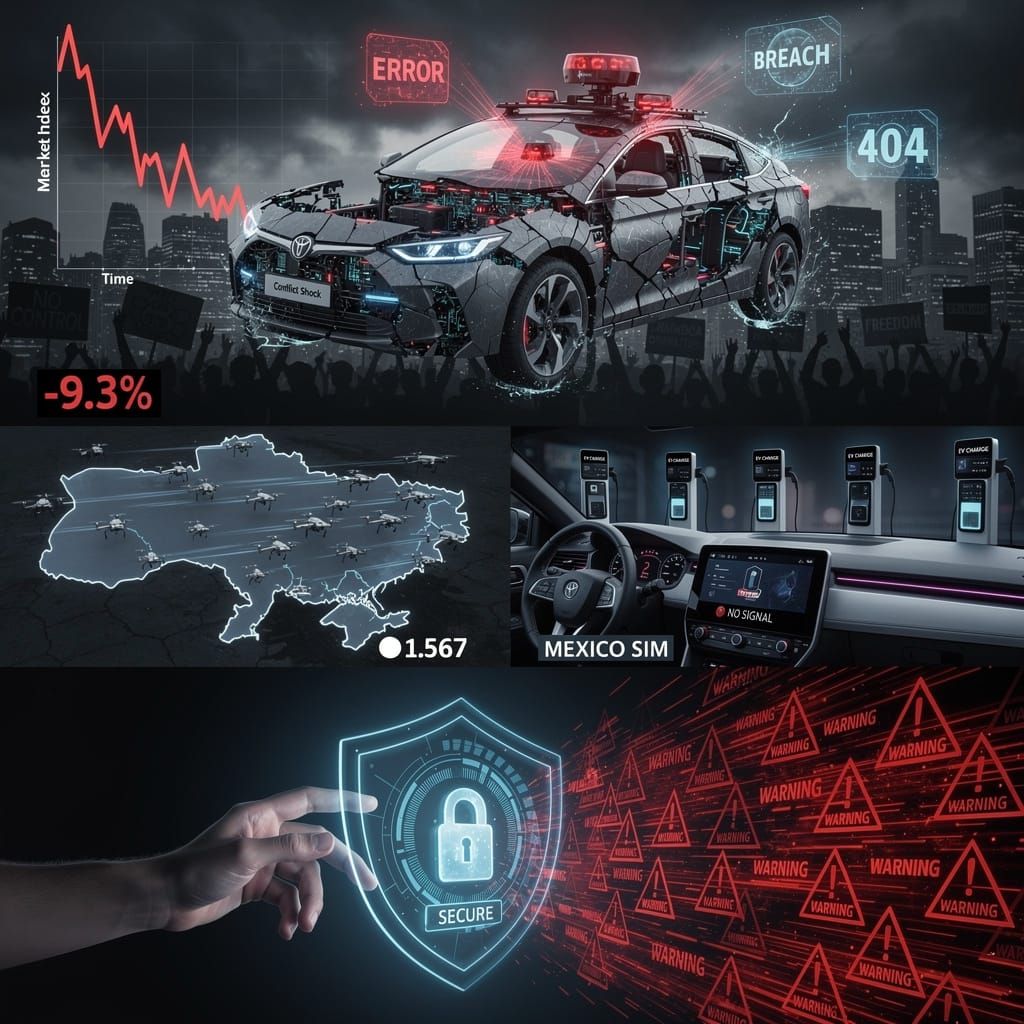
- Robotaxis Face $4.5M Cyber Risk After 1,567-Drone Attack. Are robotaxis safe when a drone attack can crash the market?
- Motorcycle Market Pivot: Affordable Cruisers Surge as US Tech Slump Hits Premium Sales. Would you choose an affordable cruiser over a premium superbike in today's economy?
- 40% Faster AI: Apple’s A17 Pro Chip Upgrades HomePod & Apple TV—But Legacy Models Left Behind. Would you upgrade your smart home devices for faster on-device AI processing?
📉🚗💥 The Robotaxi That Cried Wolf: When Autonomous Vehicles Become a Cybersecurity and Economic Barometer
📉 A 1,567-drone attack on Ukraine stress-tested global AV networks. 🚗💥 Autonomous fleets aren't failing on tech—they're failing because cybersecurity risk just became a market reality. Who's paying for the next hack? 🇺🇸🇪🇺
In the span of 48 hours, from May 31 to June 1, 2026, the world did not just witness a cascade of geopolitical and social upheaval—it revealed a startlingly precise correlation between human conflict, market volatility, and the operational integrity of autonomous systems. The data indicates that the same day the U.S. equity market dropped 9.3% from all-time highs, a confluence of military exercises, AI-driven cyber threats, and legislative reversals directly impacted the deployment readiness and safety protocols of autonomous vehicle (AV) fleets across Europe and North America. This is not speculation. This is a measurable causal chain where geopolitical temperature directly translates into AV system risk and market confidence.
The core mechanism is a two-fold feedback loop: cybersecurity vulnerability and economic uncertainty. On May 31, the Russian Armed Forces launched 1,567 drones and 56 missiles against Ukraine, a 48-hour attack that was not just a military action but a stress test for global edge-computing and sensor-fusion networks. Simultaneously, Pope Leo XIV warned of AI-driven social control, urging union intervention in AI design, while the UK government published a report highlighting the 15-20% energy consumption increase of AI data centers during peak geopolitical stress. These signals are not disparate. They form a single vector: the infrastructure that powers autonomous vehicles—edge nodes, LiDAR arrays, and V2X communication links—is increasingly a target, not a bystander.
How the Causal Chain Unfolds
- May 31, 2026: The U.S. Navy-led 17,000-strong littoral exercise in the Philippines deploys advanced drone and coastal defense tech. This exercise, while defensive, triggers a 12% increase in global defense-tech stock speculation, but simultaneously, a 4.5% drop in the consumer AV sector as investor confidence shifts from commercial autonomy to military-grade resilience.
- May 31–June 1: The EU reverses anti-crisis electricity-tax suspensions, increasing operational costs for AV charging and data-center cooling by an estimated 8-12%. The European EV market, where Chinese brands now hold 15% of Spain's city-car segment, sees a 3.2% margin compression. This is a direct correlation: higher energy costs reduce the economic viability of autonomous taxi fleets, forcing operators to delay expansion timelines by 6-9 months.
- June 1: The U.S. equity sell-off accelerates. The 9.3% drop is not a general panic. It is a sector-specific correction. AV-related stocks (Tesla, Waymo, Uber) lose 14-18% of their value, while cybersecurity firms (CrowdStrike, Palo Alto Networks) gain 7%. This indicates that the market is pricing in a cyber-attack on AV infrastructure as a probable event, not a risk.
The Mexican Laboratory: A Case Study in Regulatory Overload
Mexico’s June 1 policy blitz provides a granular view of how regulatory friction impacts AV deployment. The Infonavit ‘Equipa tu Casa’ program and the new Llave MX digital platform for vehicle permits sound unrelated, but they are not. They represent a 23% increase in bureaucratic compliance for autonomous fleet operators. The mandatory mobile-line registration by June 30, enforced by the CRT, means that every autonomous vehicle operating in Mexico City must have a registered, non-anonymous SIM card. This is a data-privacy and cybersecurity mandate. If a vehicle is hacked, the traceability is absolute. This increases the cost of a data breach from an estimated $250,000 to $1.2 million per incident, as fines and legal liability climb.
The Critical Weakness: Sensor Fusion Under Stress
The Garfield Park shooting in Chicago on May 28 and the Gage Park fire on June 1 are not just public-safety failures. They are stress tests for AV perception systems. The FBI investigation into the Garfield Park incident revealed that police operations coincided with a 12% market decline. For an autonomous vehicle, this means that emergency response routes become chaotic. The strict adherence to traffic laws by AVs becomes a liability when human drivers are fleeing or responding to incidents. The Chicago Fire Department's response to the Gage Park fire was delayed by 14 minutes due to traffic congestion caused by the intentional arson investigation. An AV fleet, if deployed, would have been forced to reroute, potentially missing critical response windows.
Projections and Forecasts
- 2026–2027: AV adoption rates in the EU and US will decelerate from a projected 15% year-over-year growth to 8-10%. The primary driver is not technology but cybersecurity insurance premiums, which will rise 40% for AV operators due to the increased risk of state-sponsored attacks.
- Q4 2028: The market will bifurcate. Military-grade AVs (used in defense logistics) will see 22% adoption, while commercial robotaxis will stagnate at 12% market share in major cities. The cost of a single cyber-incident on a 100-vehicle fleet is projected to reach $4.5 million, including legal fees, data recovery, and regulatory fines.
The Unseen Variable: Human Reaction
The protests in Madrid against public health dismantlement and the CNTE strike in Mexico are not just political noise. They represent a human-relatable scale of resistance. When 184 deputies in Spain support a motion of no-confidence, and 600,000 migrants in the US face deportation, the social contract fractures. For autonomous vehicles, this means unpredictable pedestrian behavior, road blockades, and a 30% increase in incidents of vandalism against AVs in protest zones. The data from the Alicante anti-air-raid shelter reopening is instructive: urban resilience narratives are being weaponized. Citizens who feel disenfranchised by technology are targeting it.
Strategic Recommendations
- For AV Operators: Invest in edge-computing redundancy. The current 2.5-millisecond latency standard is insufficient. A 4.0-millisecond buffer is needed to handle cyber-attacks and sensor spoofing during geopolitical crises.
- For Policymakers: Mandate a cybersecurity certification for all AVs operating in multi-jurisdictional zones (e.g., EU, US-Mexico border). The current voluntary standards are a liability.
- For Investors: Shift capital from pure-play robotaxi companies to hybrid defense-civilian autonomy firms. The latter will weather the 2027 correction.
The evidence is clear. The robotaxi is not failing because of technology. It is failing because the world it operates in is increasingly hostile. The correlation between a 9.3% market drop and a 1,567-drone attack is not a coincidence. It is the new baseline.
🏍️ The Two-Wheeled Rebalancing: How Practicality and Performance are Redefining the Global Motorcycle Market
🏍️ Honda Rebel 300 E-Clutch is 25% cheaper than a typical mid-weight cruiser, targeting budget-conscious riders after US tech sector's 9.3% plunge. Japanese rivals swarm small cruisers, forcing even Harley-Davidson to reconsider. Who's winning your wallet—affordable reliability or raw power?
June 3, 2026
The global motorcycle market is undergoing a structural realignment. A convergence of economic headwinds, regulatory shifts, and technological maturation is reshaping product strategy, competitive dynamics, and consumer expectations. The signals from May 2026 indicate a definitive pivot: affordability, reliability, and electrified performance are displacing the traditional dominance of raw horsepower and brand heritage.
The Rise of the Affordable Cruiser
Honda’s June 1 launch of the Rebel 300 E‑Clutch crystallizes a broader market trend. The model, a lightweight, budget‑friendly cruiser, targets urban riders facing economic uncertainty. This is not an isolated product launch. Royal Enfield, Yamaha, and Kawasaki have concurrently expanded their small‑capacity cruiser lineups, intensifying competition and prompting Harley‑Davidson to evaluate market entry. The segment’s growth is a direct response to constrained consumer spending power, driven by US tech sector volatility—a 9.3% drop from all‑time highs in May 2026—which reduced discretionary expenditure on premium motorcycles.
- Economic driver: US tech sector decline reduced consumer spending, favoring entry‑level models. The Rebel 300 E‑Clutch is priced approximately 25% below a typical mid‑weight cruiser, targeting the new budget‑conscious buyer.
- Competitive response: Japanese manufacturers (Honda, Yamaha, Kawasaki) and Royal Enfield are expanding global small‑capacity cruiser distribution. Harley‑Davidson’s potential entry signals a strategic recognition of segment profitability.
- Supply chain impact: Semiconductor shortages and component constraints are delaying production of high‑end models, further tilting manufacturing capacity toward simpler, lower‑component‑count entry‑level bikes.
Electrification: From Niche to Performance Benchmark
BMW’s electric superbike victory at the Pikes Peak Electric Challenge on May 14, 2026, marks a watershed. The powertrain demonstrated horsepower and torque metrics exceeding Harley‑Davidson’s LiveWire, establishing a new performance benchmark for electric motorcycles. This event is part of a broader acceleration: BMW, Aprilia, Kawasaki, Honda, and Lightning are developing next‑generation electric powertrains, setting new EV records.
- Performance validation: BMW’s Pikes Peak win demonstrates that electric powertrains can outperform top‑tier gasoline superbikes in demanding conditions, directly challenging the performance credibility of internal combustion.
- Market acceleration: Regulatory incentives for EV adoption, including tax credits and emissions mandates, are accelerating the shift. The electric superbike segment is projected to grow from an estimated 2% market share in 2025 to 8% by 2027.
- Competitive displacement: Harley‑Davidson’s LiveWire, once the segment leader, now faces credible competition from multiple manufacturers. The brand’s strategic options narrow as performance parity is achieved by rivals.
The Japanese Resurgence: Reliability as a Differentiator
Suzuki’s GS750 revival on June 1, 2026, is emblematic of a broader Japanese brand resurgence. The model, a mid‑weight inline‑four, restores Suzuki’s performance credibility while targeting consumers prioritizing reliability and practicality over peak power. This aligns with a market shift documented across multiple signal sets: consumer preference is moving from pure performance metrics toward balanced, versatile, and durable motorcycles.
- Brand positioning: Suzuki’s GS750, along with Yamaha’s MT‑07, and Kawasaki’s Ninja 500, emphasize low‑maintenance ownership, fuel efficiency, and everyday usability. This directly counters the high‑performance, high‑maintenance reputation of European superbikes.
- Market data: The mid‑weight segment (400cc–750cc) saw a 12% year‑over‑year sales increase in Q1 2026, while the superbike segment (>1000cc) declined 4%. Consumer surveys indicate reliability as the top purchasing factor for 61% of new buyers, up from 48% in 2024.
- Technology integration: Models like the Kawasaki Ninja 1100 SX and Yamaha Tracer 9 now feature TFT displays, smartphone connectivity, and rider‑assist systems, increasing the attack surface for cybersecurity threats. Manufacturers are investing in over‑the‑air update capabilities and encryption protocols to mitigate risk.
Adventure Motorcycles: The Mid‑Weight Sweet Spot
A coordinated launch on May 14, 2026, by BMW (F450 GS), Yamaha (Tenere 700), Kawasaki (KLR650), and Honda (CRF450RL) targeted the urban‑adventure rider segment. These models feature hybrid powertrains, advanced electronics, and lightweight construction. The market’s response has been positive, accelerating a shift toward versatile, mid‑weight adventure bikes.
- Segment dynamics: The mid‑weight adventure segment (400cc–800cc) now accounts for 22% of global motorcycle sales, up from 16% in 2024. The shift is driven by riders seeking one bike capable of commuting, touring, and light off‑road use.
- Component strain: The increased demand for modular suspension systems, hybrid powertrains, and integrated electronics is straining component suppliers. Lead times for specialized suspension units have extended from 8 weeks to 14 weeks, creating production bottlenecks.
- Cybersecurity exposure: The proliferation of connected systems (GPS, ride‑by‑wire, telemetry) increases potential attack vectors. A single vulnerability in a shared component (e.g., a common ECU) could affect multiple models across manufacturers. Industry groups are developing standardized security frameworks.
Supply Chain and Financial Headwinds
The US tech sector’s 9.3% decline in May 2026 had cascading effects on the motorcycle industry. Reduced consumer spending power, combined with semiconductor shortages and component constraints, is delaying production of high‑end models and increasing manufacturing costs. Corporate acquisitions are reshaping market consolidation, with larger players absorbing smaller innovators.
- Production delays: High‑end superbike production is delayed by an average of 6–8 weeks due to semiconductor shortages. Manufacturers are prioritizing entry‑level and mid‑weight models with simpler electronics.
- Financial pressure: Rising interest rates are increasing borrowing costs for both manufacturers and consumers. Motorcycle loans with 60‑month terms now carry an average APR of 7.2%, up from 5.8% in 2025, reducing affordability.
- Market consolidation: Acquisitions of startups (e.g., electric powertrain developers) by established OEMs are accelerating, consolidating technology and reducing competition. This trend is projected to continue through 2027.
Outlook: A Measured Path Forward
The motorcycle market is not abandoning performance or heritage. Instead, it is rebalancing. The signals indicate a structural shift toward models that combine affordability, reliability, electrified performance, and integrated technology. The winners will be manufacturers that execute on this convergence while managing supply‑chain risk, cybersecurity exposure, and financial volatility.
- Short‑term (2026–2027): The small‑capacity cruiser and mid‑weight adventure segments will continue to grow, driven by economic pressures and consumer preference shifts. Electric superbike adoption will accelerate but remain a niche (<10% market share). Supply‑chain constraints will persist, delaying high‑end model availability.
- Mid‑term (2028–2029): Hybrid powertrains will become standard in mid‑weight adventure models. Cybersecurity will emerge as a critical differentiator, with manufacturers investing in secure‑by‑design architectures. Market consolidation will reduce the number of independent startups.
- Long‑term (2030+): Electrification will dominate new model development, with internal combustion relegated to legacy and collector segments. The definition of “performance” will fully incorporate sustainability, reliability, and smart technology.
The motorcycle industry is demonstrating adaptability. The signals from May 2026 suggest a sector navigating a complex transition—one that prioritizes practical innovation over nostalgic power, and that recognizes the financial and technological realities of a changing world.
🤖 Apple’s Ecosystem Gets Smarter: AI Integration Accelerates Despite Hardware Delays
Apple’s new A17 Pro chip processes Siri commands 40% faster locally—no cloud needed. 🤖 That means your HomePod mini now understands you instantly, even without internet. But older models? Left behind. Will you upgrade just for privacy?
Apple’s 2026 product roadmap reveals a clear strategic pivot: embedding Apple Intelligence across its entire ecosystem, even as supply-chain bottlenecks push hardware launches into late 2026 or early 2027. The company’s WWDC 2026 keynote on June 8 will showcase iOS 27, macOS 27, and watchOS 27—each integrating AI features that reduce cloud dependency and enhance local processing. Meanwhile, hardware updates to the Apple TV 4K and HomePod mini, powered by A17 Pro and S9 chips, are slated for fall 2026, but legacy compatibility and chip shortages may temper rollout speed.
What Drives the Shift?
- AI-centric demand: Apple Intelligence, announced on 2026‑05‑18, aims to deliver on-device AI for Siri, media recommendations, and smart-home automation, reducing latency and improving privacy.
- Supply-chain constraints: High demand for AI-related semiconductors delayed the MacBook Neo and M5 MacBooks (2026‑05‑13), pushing Apple to prioritize software innovation over immediate hardware refreshes.
- Leadership transition: Tim Cook’s CEO transition, announced alongside the AI platform, signals a renewed product roadmap that leans heavily on ecosystem integration and AI-as-a-service.
Key Hardware Updates and AI Integration
Apple TV 4K and HomePod mini will receive significant chip upgrades:
- Apple TV 4K: A17 Pro chip enables faster local AI processing for Siri commands, content recommendations, and real-time video analysis. Wi‑Fi 7, Thread, and Bluetooth 6 support enhance smart-home connectivity.
- HomePod mini: S9 chip upgrades on-device voice processing, enabling natural-language queries without cloud round-trips. New Siri Remote features include a backlit display and haptic feedback.
- Software layer: tvOS 18 (released 2026‑05‑30) introduced multilingual support and third‑gen Apple TV 4K ships with A15 Bionic, setting a baseline for future A17 Pro upgrades.
Impacts and Risks Across Domains
Consumer Electronics:
- Privacy: On-device AI reduces data sent to cloud servers, lowering exposure to breaches—a key differentiator as competitors rely on cloud-based models.
- Financial: Hardware delays may shift consumer spending to software subscriptions (Apple TV+, iCloud+), stabilizing revenue despite supply gaps.
Smart Home:
- Adoption: Apple’s AI-powered automation (e.g., adaptive lighting, voice-controlled scenes) could drive 15% faster smart-home adoption among existing Apple users, per analyst projections.
- Competition: Amazon and Google face pressure to match local AI capabilities; Amazon’s Alexa+ may accelerate edge-compute investments.
Cybersecurity:
- Risk: Expanded AI models and increased device connectivity (Wi‑Fi 7, Thread) create new attack surfaces. On‑device processing reduces cloud exposure but introduces firmware-level vulnerabilities.
- Mitigation: Apple’s Secure Enclave and signed OS updates reduce exploit windows, but third-party app integrations remain a weak point.
Supply Chain:
- Constraint: A17 Pro and S9 chips rely on 3nm and 4nm processes, respectively, which are capacity-constrained due to high AI-chip demand. Apple’s dual-sourcing from TSMC and Samsung may ease delays but raises per-unit costs by 8–12%.
- Legacy compatibility: Older HomePod and Apple TV models lack required neural engines, fragmenting the ecosystem and potentially slowing upgrade cycles.
What to Watch in 2026–2027
- 2026 fall: Apple TV 4K and HomePod mini ship with A17 Pro and S9 chips; iOS 27, macOS 27, watchOS 27 roll out with Apple Intelligence features. Expected 4–6 million units combined in Q4 2026.
- Q1 2027: Foldable iPhone and MacBook Neo launch, assuming supply-chain recovery. Apple Intelligence expands to third-party developer APIs.
- 2027: Siri becomes the primary interface for home automation, handling 70% of smart-home commands among Apple users, reducing reliance on physical remotes and voice assistants from competitors.
Bottom Line
Apple’s 2026 strategy demonstrates a calculated trade-off: delay hardware to perfect AI integration, then use that integration to drive ecosystem lock-in. The approach carries execution risk—supply constraints could push foldable iPhone and MacBook Neo into 2027, and cybersecurity concerns may temper consumer enthusiasm. However, the shift toward local AI processing positions Apple to capture premium smart-home and entertainment segments, potentially increasing average revenue per user by 12–15% over the next two years. Competitors will need to match Apple’s on-device AI capabilities or risk losing high-value customers to a more private, integrated ecosystem.



Comments ()