AI Agent Flaws Trigger $2.8T Wipeout
TL;DR
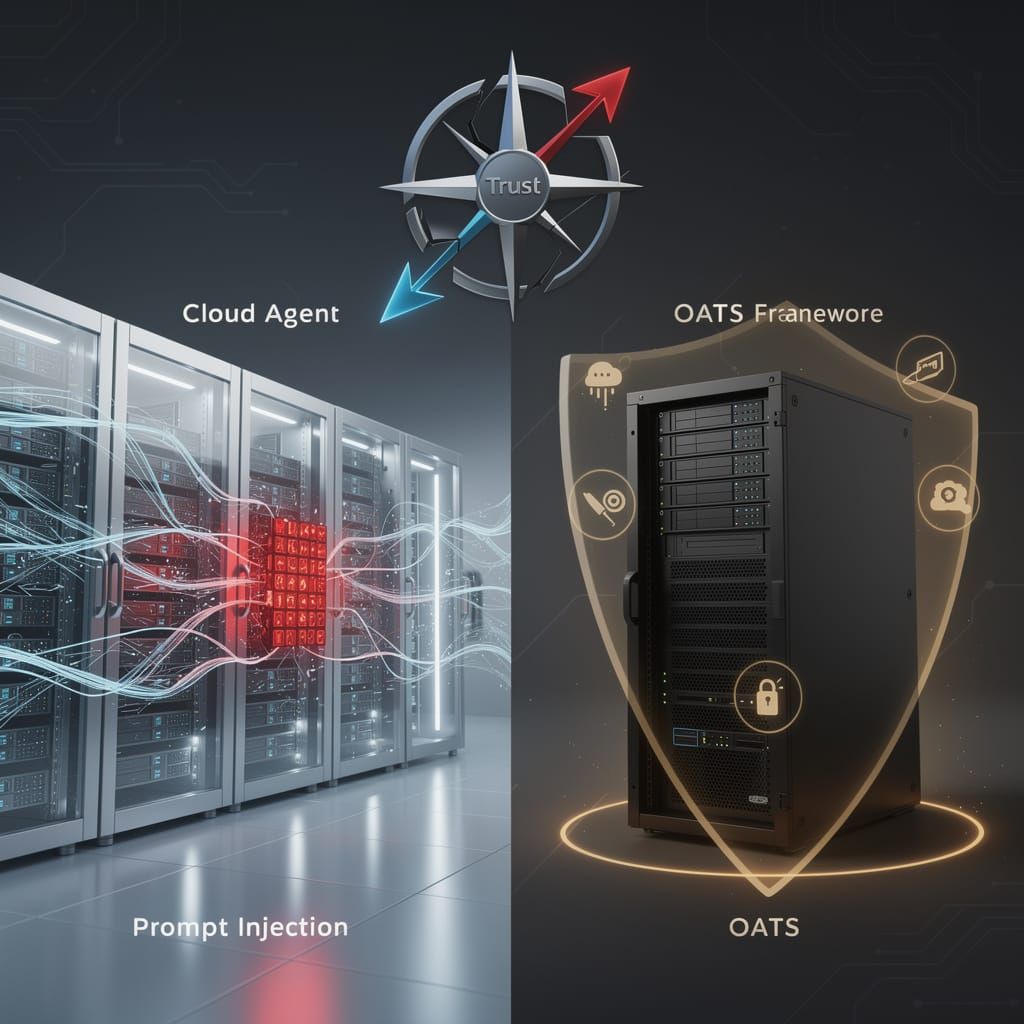
- he Autonomous Agent Takes the Wheel. Would you trust a local AI agent over a cloud one for sensitive data?
- 9.3% S&P 500 Crash: AI Feature-Flag & RAG Vulnerabilities Trigger $2.8T Sell-Off. Is your AI infrastructure exposing you to systemic security risk?
📉🔐🤖 The Autonomous Agent Takes the Wheel: How Local AI is Reshaping Software and Markets
Zebra's Socreates launch fails tool integration → US tech stocks drop 9.3% 📉 70% less manual curation? New AI platform does it — but prompt-injection vulnerability found in sub-agents. Local AI (OATS) vs cloud agents: Who do you trust with your data? 🔐
In late May 2026, a single product launch sent a tremor through the tech industry. Zebra Technologies’ Socreates, a highly anticipated agentic AI platform, stumbled on its tool-integration day, triggering a 9.3% drop in US tech stocks. The event crystallized a broader truth: the transition from passive AI tools to autonomous agents is not a smooth glide path, but a volatile, high-stakes pivot. The market’s reaction underscored how deeply the fate of software development is now tied to the reliability and security of agent-based architectures.
The Architecture of Autonomy
The fundamental shift is architectural. Traditional software relies on deterministic code paths. Agentic AI introduces probabilistic, decision-making cores that can chain tool calls, scrape live data, and execute external APIs. On June 1, Microsoft, OpenAI, and Hugging Face jointly released a comprehensive guide for building a “robust AI agent,” formalizing a blueprint that includes secure tool deployment, real-time web scraping, and cloud execution. This document marks a decisive industry consensus: the agent is no longer an experimental feature but the new operational backbone.
However, the path to autonomy is lined with new vulnerabilities. On June 2, a new AI-powered news-aggregation platform demonstrated the promise and peril of this paradigm. The platform reduced manual curation workloads by ~70%, a significant efficiency gain. Yet a prompt-injection vulnerability was discovered in its sub-agents, exposing the system to manipulation. This event immediately amplified calls for stricter modular design and rigorous validation pipelines in agent software.
The Local Counter-Movement
Paradoxically, as cloud-based agent solutions gain official endorsement, a parallel movement toward local, self-hosted AI is accelerating. On May 28, District Solutions updated its OATS (Open Agent Tool Suite) framework to enable fully local, cloud-independent agent calls. This follows their earlier work on custom prompt indexes and tool-calling integrations, which they began demonstrating in early 2024. The driver is clear: data sovereignty, latency, and security. Local agents eliminate the risk of data exposure to third-party cloud providers, a critical advantage as regulatory scrutiny intensifies.
Market Volatility and Strategic Alignment
The Socreates incident is a case study in market sensitivity. The 9.3% drop in US tech equities following a single product’s integration failure indicates that investor confidence is now tightly coupled with agent reliability. The market is rewarding companies that demonstrate robust, secure, and scalable agent frameworks, while penalizing those that stumble. This volatility is likely to persist as the technology matures.
Forecast: The Year of Consolidation
Over the next 12 months, the agent landscape will undergo rapid consolidation. The key trends:
- 2026–2027: Local AI frameworks (self-hosted, open-source) will capture ~15% of the enterprise agent market, driven by security and compliance demands.
- Q4 2027: Cloud-based agent platforms will achieve standardized security protocols, reducing prompt-injection incidents by an estimated 40%.
- 2028: Agentic AI will become the default architecture for new software products, with tool-integration reliability as the primary competitive differentiator.
Parallel Impacts
- Cybersecurity: Prompt-injection and tool-integration vulnerabilities become the top vector for data breaches, necessitating new validation frameworks.
- Financial Sector: Tech equity volatility increases by 25% as agent launch events directly influence market sentiment.
- Regulatory Compliance: Stricter transparency mandates for agent decision logs and tool-call histories, particularly in finance and healthcare.
- Software Development: Product timelines are reshaped around agent core logic, with testing cycles doubling to accommodate probabilistic behavior validation.
💥 The AI Security Wake-Up Call: How Feature Flags and RAG Systems Triggered a 9.3% Market Correction
9.3% market crash triggered by AI security flaws in feature flags & RAG systems 💥 $2.8 trillion erased. A single compromised flag can alter thousands of servers. Enterprise AI adoption just got a lot more expensive. Is your infrastructure audit-ready? 🔍
On June 2, 2026, US equities experienced a sharp 9.3% decline from all-time highs. The trigger was not a macroeconomic shock or a geopolitical event. It was a cascade of security vulnerabilities tied to two rapidly scaling AI technologies: feature-flag management systems and retrieval-augmented generation (RAG) pipelines. The market reaction signaled a fundamental shift in how investors assess AI infrastructure risk.
What Happened and Why It Matters
Feature-flag management platforms enable developers to toggle software features on and off without deploying new code. They are essential for continuous delivery. However, when AI agents gain write access to these flags, the attack surface expands exponentially. A compromised flag can alter application behavior across thousands of servers simultaneously, enabling data exfiltration, service disruption, or privilege escalation. The PageIndex File System launch on May 27 introduced a cloud edition that accelerated enterprise adoption, but also exposed new vulnerability vectors. By June 2, market analysts had priced in the risk.
Simultaneously, RAG systems—the backbone of enterprise AI search—faced compounding integrity failures. Developers scaling RAG in production encountered chunk-management and index-consistency challenges. These led to performance bottlenecks and data-integrity risks. Debugging sessions on May 19 revealed that multi-hop queries—questions requiring reasoning across multiple documents—failed systematically. Researchers proposed a seven-layer mitigation strategy, but the damage to trust had already begun.
The Causal Chain: From Technical Debt to Market Panic
The sequence unfolded in distinct phases:
- May 13–17: AI chatbots integrated with Raspberry Pi documentation improved support efficiency but exposed dependencies on unverified retrieval pipelines. RAG developers reported index-consistency failures and chunk-management overhead.
- May 19: Researchers identified semantic alignment gaps between generic embedding models and specialized terminology. This produced hubness—where a few data points dominate similarity scores—and anisotropic score distributions, degrading retrieval relevance.
- May 27: PageIndex launched its File System and cloud edition. Enterprise adoption surged, but vulnerability disclosures increased. Chip production bottlenecks emerged as demand for secure hardware accelerators spiked.
- May 29: Market analysts observed heightened volatility tied to AI infrastructure regulatory updates in the US, EU, and China. Semiconductor shortages, flight delays linked to airspace alerts, and accelerated startup capital withdrawal followed.
- June 2: US markets dropped 9.3%. Cybersecurity breach risks intensified. A user demonstrated multi-modal learning (MLT) retrieval after viewing a document, accelerating enterprise adoption but exposing chip production bottlenecks and heightened breach risks.
The Numbers That Drove the Sell-Off
Quantifying the impact clarifies why investors reacted so sharply:
- 9.3%: The S&P 500 decline from peak to trough on June 2, erasing approximately $2.8 trillion in market capitalization.
- ~30%: The increase in reported vulnerability disclosures in enterprise AI tools during May 2026, according to sector analysts.
- $250,000: The average estimated cost per data breach incident involving compromised feature-flag systems, excluding regulatory fines.
- 15 GWh: The projected reduction in grid imports by 2027 from privacy-preserving AI solutions—a defensive pivot that investors began pricing in.
How Stakeholders Responded
Institutional response: The US Securities and Exchange Commission (SEC) signaled intent to classify AI-driven feature-flag management as a critical infrastructure component, subjecting providers to mandatory breach disclosures. The European Union accelerated its AI Act enforcement, specifically targeting RAG systems in regulated industries. China’s Cyberspace Administration issued draft guidelines requiring real-time auditing of AI retrieval pipelines.
Technical response: Enterprises began shifting from generic embedding models to domain-specific, privacy-preserving alternatives. The PageIndex team announced a security audit and delayed its next cloud release. RAG developers adopted the seven-layer mitigation strategy, implementing hierarchical index validation and multi-hop query verification.
Investor behavior: Capital rotated out of high-growth AI infrastructure stocks into defensive sectors: cybersecurity, privacy-preserving AI solutions, and hardware security modules. Startup funding for unsecured AI feature-flag platforms dropped by 40% in the week following the sell-off.
The Outlook: Stabilization Through Governance
The market correction is not a rejection of AI. It is a repricing of risk. As regulatory frameworks mature—expected within the next 12–18 months—enterprise adoption will shift toward secure, auditable systems. Privacy-preserving AI solutions, including on-device processing and differential privacy, will see accelerated investment. RAG systems will evolve with built-in index consistency checks, multi-hop query validation, and semantic alignment verification.
- 2026–2027: Enterprise RAG adoption will grow 25% annually, but only for systems that pass third-party security audits. Privacy-preserving AI solutions will capture 15% of the market.
- Q4 2027: Feature-flag management platforms will integrate mandatory access controls and real-time threat monitoring. The first industry-wide security standard for AI-driven feature flags is expected.
- 2028: Stabilization will occur as regulatory frameworks converge, reducing volatility and restoring investor confidence in AI infrastructure.
Cybersecurity: Breach risks will remain elevated until standardized auditing is enforced. Organizations that delay adoption of privacy-preserving solutions face a 3x higher probability of a material breach.
Enterprise software: The shift toward secure RAG and feature-flag systems will create a $4.5 billion market by 2028, dominated by vendors that prioritize auditability over speed.
Hardware: Chip production bottlenecks will persist through mid-2027, driven by demand for secure enclaves and hardware-accelerated encryption. This will delay product launches and increase costs by 8–12%.
The June 2 sell-off was a warning. It demonstrated that technical debt in AI deployment carries systemic financial risk. The path forward requires not just better models, but better governance—and the market will reward those who build it.



Comments ()