89% Traffic Drop in Spain: AI-Driven Search Shift Risks Publisher Blackout
TL;DR
- 89% Traffic Drop: AI Search Shifts Hubs to Semantic Attribution in Europe. How is the shift from keyword SEO to AI-driven semantic attribution affecting your website's organic traffic?
- 1 Million Token Grounding: Google NotebookLM Redefines Data Reliability in US Federal Workflows. How does the shift toward source-bound AI and 1-million-token grounding affect professional data reliability and audit trails?
- 70% OpEx Cut: Aria Systems and ServiceNow Launch Agentic AI for North American Telcos. Can agentic AI architectures realistically reduce telecommunications operating expenses by 70% while maintaining regulatory compliance?
📉 The Shift Toward Semantic Attribution in AI Search
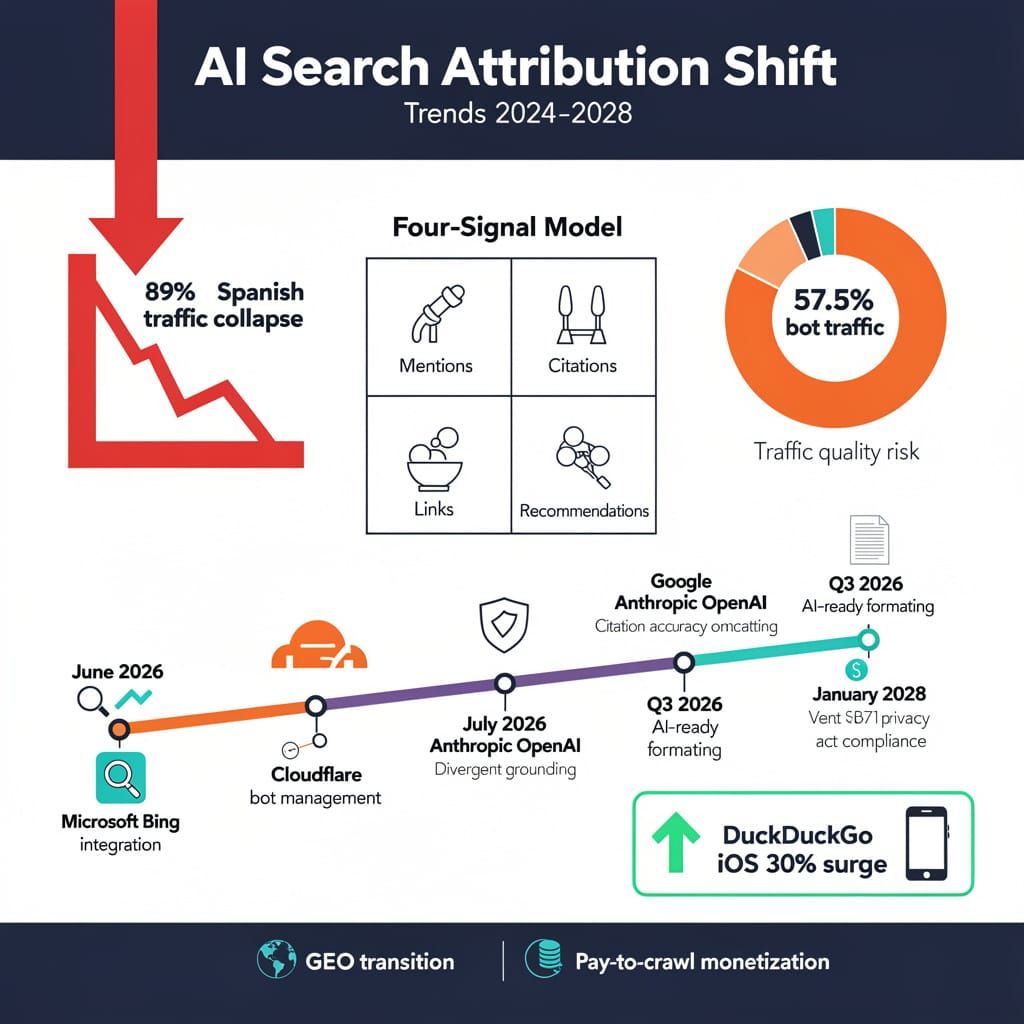
89% traffic collapse for Spanish news sites is staggering—nearly a total blackout 📉. Bot traffic now exceeds human traffic globally. Will pay-to-crawl models save publishers or kill organic reach? Publishers — How is your regional traffic holding up?
Microsoft integrated the AI Performance Report into Bing Webmaster Tools on June 22, 2026. This update provides publishers with channel-specific citation metrics, detailing query intent, topic classification, and citation share across Microsoft Copilot, Bing, and partner integrations. The rollout indicates a transition from keyword-based indexing toward a system that prioritizes semantic readiness and attribution transparency.
How Does AI Source Selection Differ?
Comparative tests demonstrate that Google, OpenAI, and Anthropic employ divergent grounding mechanisms. Visibility varies based on internal weighting of authority and retrieval-augmented generation (RAG) strategies. This fragmentation is intensified by Cloudflare's June 4 introduction of AI-powered bot-management APIs to control how AI agents access data, following reports that bot traffic now exceeds human traffic globally.
Simultaneously, Bing adjusted its crawling strategies on June 4, 2026, favoring relevance scores derived from AI-generated queries. This shift arrives as publishers face severe organic traffic erosion; news sites in Spain recorded an 89% decline in January 2026, while Italy saw a 76% drop. To mitigate this, a new Four-Signal Model emerged on June 22, measuring brand presence via mentions, citations, linked sources, and active recommendations.
Sectoral Impacts
- Publishers: granular citation data $\rightarrow$ enables precise tracking of AI-driven traffic acquisition.
- SEO Practitioners: transition to Generative Engine Optimization (GEO) $\rightarrow$ shifts focus from keyword ranking to contextual relevance.
- Search Engines: 57.5% of HTTP traffic now bot-driven $\rightarrow$ results in a transition toward pay-to-crawl monetization models.
What Is the Outlook for Attribution?
As publishers adapt, the correlation between semantic optimization and citation frequency projects to strengthen. However, the transition remains volatile. Google’s May 2026 rollout of the Intelligent Search Box—which prioritizes AI-generated responses—led to a 30% weekly surge in DuckDuckGo iOS installs as users sought AI-free, privacy-centric alternatives.
- July 2026: Estimated increase in citation accuracy as publishers implement the first wave of recommended optimizations.
- Q3 2026: Shift toward standardized "AI-ready" formatting across content management systems to maintain authority.
- 2028 Projection: Full implementation of the Vermont Data Privacy and Online Surveillance Act (SB71) on January 1, 2028, mandating strict compliance for entities handling data of 35,000+ residents and integrating real-time attribution analytics into digital marketing compliance.
📚 Grounding Intelligence: The Rise of Source-Bound AI
1 million tokens: a massive digital library in one prompt 📚. Zero hallucinations thanks to source-grounding. While GPT-5.4 struggles with fabricated data, NotebookLM anchors every claim to your own files. Efficiency or over-reliance? US Federal agencies — how will this change your documentation workflow?
Google shifted the AI landscape on June 8, 2026, with the launch of an upgraded NotebookLM. This evolution emphasizes source-grounded intelligence over general-purpose Large Language Models (LLMs). By restricting responses to user-uploaded documents—supporting up to one million tokens—NotebookLM creates a closed-loop system. This architecture enables synthesis without external internet calls, which results in the elimination of hallucinations by anchoring outputs to specific source data.
How does grounding improve reliability?
Source-binding mechanisms create a verifiable audit trail for every claim. This reliability is critical as systemic instabilities persist; for example, reports from April 2026 indicated that GPT-5.4 generated fabricated financial figures, while AI-generated code volume surged 65% by June 19, 2026, causing a 91% spike in pull request review times.
NotebookLM addresses these gaps by integrating Gemini 3.5 and Antigravity, adding code execution and 100+ new software skills. This enables the automation of RFP responses by integrating lead intake via Google Forms and generating real-time executive summaries, which directly cuts procurement cycle times. Furthermore, the CiteVQA benchmark monitors attribution accuracy to ensure models correctly cite their sources.
Performance Metrics:
- Accuracy: Microsoft Research reports a 40% reduction in citation errors compared to standalone models.
- Efficiency: Integrated workflows reduce research session durations by 30%.
- Validation: Use of HalBench v2.3 allows for honesty testing across open LLMs to offset synthetic bias.
Sectoral Impacts
Government: US federal agencies increased AI use cases by 70% (3,611 active/planned deployments) by June 17, 2026, driving demand for "Sovereign AI" to keep data within national boundaries. Finance: Market volatility remains high; the S&P 500 dropped 10% on June 6, 2026, wiping $1.8 trillion in value amid concerns that rising AI expenses undermine workforce-reduction strategies. Cybersecurity: Closed-loop processing mitigates "unguarded tool calls," though the expansion of AI attack surfaces increases the risk of data breaches during enterprise transitions. Business: A shift toward "contextual intelligence" is emerging, as linking models to enterprise knowledge graphs rather than raw text reduces token costs and enables measurable ROI.
Adoption Timeline
- May 2026: Launch of Gemini 3.5 Flash; SpaceX files S-1 for mid-June IPO with Anthropic partnership.
- June 2026: Upgrade of NotebookLM with Gemini 3.5 and Antigravity; launch of automated RFP and contract review tools.
- Q3–Q4 2026: Expansion into US federal workflows for verified documentation and sovereign data control.
- Mid-2027: Projected dominance in enterprise knowledge management systems via source integrity.
The convergence of source-bound AI and high-performance infrastructure indicates a transition from generative creativity to professional-grade precision, where provenance enables scalability.
📉 The Rise of the Agentic Business Support System
70% cost reduction is staggering—equivalent to nearly erasing the entire service overhead for some users 📉. Agentic AI is replacing manual billing with algorithmic efficiency. Efficiency vs. Human Oversight? Tier 1 ISPs — how will this reshuffle your local market?
On June 18, 2026, Aria Systems and ServiceNow launched an integrated Agentic Business Support System for North American telecommunication providers. This platform consolidates fragmented CRMs, billing engines, and workflow managers into a unified interface, enabling API synchronization between legacy billing systems and an Agentic Core engine. This architecture automates dynamic pricing rules and transaction processing, shifting the competitive advantage from network scale to algorithmic efficiency.
Does AI-Driven Automation Reduce OpEx?
The shift toward agentic AI architectures demonstrates a direct correlation between automated workflow synchronization and cost reduction. By replacing manual billing and service management, the system reduces the total cost of service by approximately 70% for participating customers. Specifically, Tier 1 ISPs report operating expenditure (OpEx) reductions exceeding 65%.
This trend mirrors a broader enterprise pivot toward "unified intelligence stacks." Freshworks and iQor recently integrated to launch the Freddy AI Agent Studio to improve incident resolution, while Dell introduced OpenClaw AI agents to transform workforce skills. Further acceleration is evidenced by the integration of AI-ready data platforms, such as MongoDB Atlas on AWS, reducing time-to-market for AI applications by 80% in banking and healthcare. This convergence indicates a systemic transition from pilot AI projects to production-grade, outcome-based metrics.
Operational Impacts:
- Financial: >65% reduction in OpEx for Tier 1 ISPs $\rightarrow$ lower overhead and increased margin flexibility.
- Retention: $\sim$15% decrease in customer churn $\rightarrow$ higher lifetime value (LTV) per subscriber.
- Performance: Faster incident resolution $\rightarrow$ reduced system downtime and improved client satisfaction.
Scaling the Agentic Model
Investor confidence in ServiceNow (NOW) is stabilizing despite a 48% drop in share price over the past 52 weeks. Market analysts identify a bullish recovery potential toward $200–$250 per share, driven by subscription revenues that rose 19% YoY to $3.67 billion. The Agentic Core’s ability to calibrate service levels and pricing simultaneously enables providers to replace rigid legacy contracts with self-optimizing offerings.
This evolution is supported by new educational benchmarks, such as the Saras AI Institute’s Advanced AI Engineer Certificate launched June 22, 2026, which prepares professionals to deploy these production-grade systems.
- Q3 2026: Initial integration for Tier 1 North American ISPs, focusing on billing and CRM unification.
- Q4 2026: Projected fiber-to-home subscriptions reaching 42%, accelerating the need for automated provisioning.
- 2027 Projection: Systematic adoption of self-optimizing pricing engines, reducing manual adjustments by an estimated 80%.
This structural shift occurs amid a tightening regulatory environment. As the FCC manages spectrum auctions and lawmakers discuss AI chatbot regulation for children, the transition to proactive agentic systems requires strict adherence to emerging compliance frameworks to avoid the operational risks associated with rapid AI adoption.



Comments ()