630GB Data Breach: Tata Electronics Leak Exposes Apple and Tesla Blueprints
TL;DR
- CVE-2026-20230: Cisco Unified CM Critical RCE — Legacy WebDialer Flaw Triggers Global Enterprise Risk. Is your enterprise network still running deprecated services that act as open doors for hackers?
- 630GB Leak: Tata Electronics Breach Exposes Apple and Tesla Specs. How can a 630GB leak at Tata Electronics impact the global supply chain for Apple and Tesla?
- 4X Attack Velocity Increase: IBM and OpenAI Launch $5B Project Lightwell to Counter Rapid Breaches. Can a $5 billion AI project actually fix enterprise security when attackers breach systems before patches are even written?
🤡 Patch Now or Cry Later: The Cisco Unified CM Circus
20 days of ignoring patches is a goldmine for hackers. That's basically a free vacation for every threat actor on the planet 🤡. A deprecated 'zombie' feature turned enterprise VoIP into a public playground. Patched yet, or are you still hosting the party? Corporate IT — is your phone system now a botnet?
Imagine spending millions on "enterprise-grade" infrastructure only to find out you left the vault open because someone forgot to kill a zombie feature from a decade ago. Welcome to CVE-2026-20230, where Cisco Unified CM basically handed hackers the keys to your corporate VoIP system. 🤡
Why is your phone system a playground?
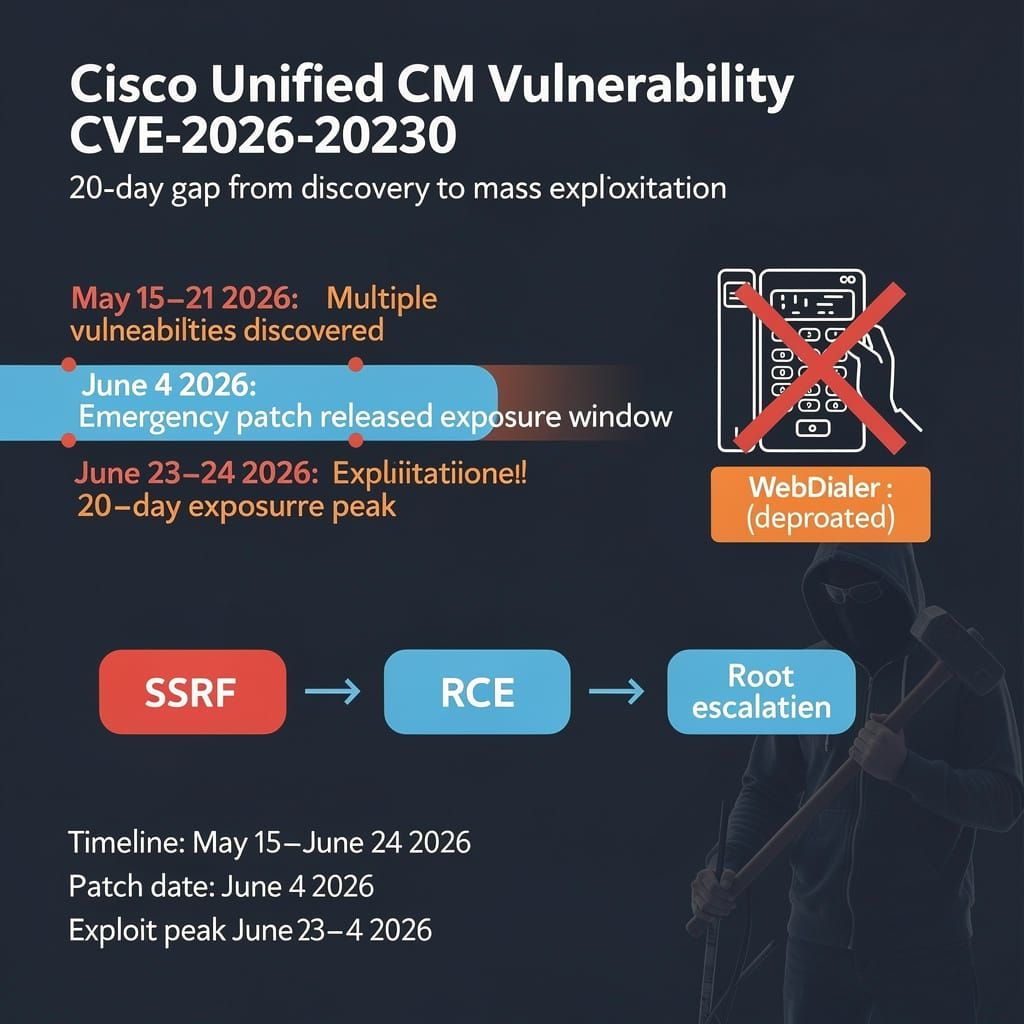
Here is the deal: Cisco dropped a critical patch on June 4. Most admins treated that alert like a Terms and Conditions agreement—they ignored it. Then, the point-of-concept (PoC) exploit code hit the wild, and by June 23, bad actors were treating servers like a free vending machine.
The punchline? They used WebDialer—a deprecated piece of junk—to execute Server-Side Request Forgery (SSRF) attacks. This enables unauthenticated remote code execution (RCE), file writes, and root escalation. Basically, the "security" was a screen door, and the hackers had a sledgehammer. 🔨
The Disaster Timeline:
- May 15–21, 2026: Cisco's bad month starts with SD-WAN auth bypass (CVE-2026-20182) and unauthorized site-admin access (CVE-2026-20223).
- May 25, 2026: Nx Console extension breach exposes thousands of repos, turning the supply chain into a dumpster fire.
- June 4, 2026: Emergency patch for CVE-2026-20230 released. The "Please disable WebDialer" plea goes out.
- June 23–24, 2026: Active exploitation peaks as hackers realize the 20-day patch gap is a goldmine.
- September 2026: Scheduled release of 14SU6 and 15SU5 patches, assuming your network hasn't already been deleted.
The "Oopsie" Metrics:
- Attack Vector: SSRF via WebDialer $\rightarrow$ unauthenticated RCE/file writes $\rightarrow$ root privilege escalation.
- Scope: Impacts Unified CM, Secure Workload, and SD-WAN systems.
- Corporate Fail: A critical RCE flaw existed in a deprecated service that admins simply forgot to turn off.
The Reality Check
This isn't some sophisticated AI super-attack; it is a basic failure of digital hygiene. Relying on legacy services is like keeping a rusted padlock on your vault and wondering why the money is gone. If you haven't disabled WebDialer or updated your firmware, you aren't "managing risk," you are just hosting a free party for threat actors. 🥂
The Fix: Review your Admin console, kill the WebDialer service, and apply the updates. Now. Or just enjoy the silence when your entire phone system decides to identify as a botnet. 💅
🤡 The 630GB Paperweight: Tata, Apple, and the Art of Getting Pwned
630GB of blueprints leaked! This catastrophic failure is like leaving your vault open in a hurricane 🤡. Apple and Tesla specs now public. Who needs a firewall when you have 'digital transformation'? JLR revenue tanked to £14m. Your supply chain is a sieve — is your data actually safe?
Imagine spending billions to diversify your supply chain away from China, only to realize your security posture is a screen door in a hurricane. Welcome to June 2026, where Tata Electronics discovered that "digital transformation" is just corporate-speak for "letting the hackers in for free." 🤡
Who F***ed Up This Time?
On June 23, the extortionists at World Leaks played Santa, delivering 630GB of corporate secrets to the dark web. The loot? Over 200,000 files including iPhone component specs, Tesla Model 3/Y drawings, and NV-36 charge port controller details. Tata Electronics provided the convenient side-door for this masterpiece of incompetence.
The "Oops" Sequence:
- June 22: World Leaks dumps the data. Apple and Tesla's crown jewels are now public reading.
- June 23: Tata finally detects the incident and activates "response protocols" (reading the manual while the house burns).
- Post-Crash: Tata claims operations are "unaffected." Sure. Your factory is humming, but your blueprints are being auctioned in real-time. 📉
Why This Is a Total Clusterfuck
This isn't a freak accident; it's a contagion. This breach follows a brutal wave of attacks where World Leaks bagged 1.4TB from Nike and hit Dell. Even worse, Tata’s subsidiary, Jaguar Land Rover (JLR), is currently in a death spiral. JLR's revenue cratered from £2.5bn to a pathetic £14m after a major cyber-attack halted operations, compounded by 25% US tariffs.
The Damage Report:
- IP Theft: iPhone/Tesla specs leaked $\rightarrow$ accelerated competitive pressure.
- Total Meltdown: JLR operational halt $\rightarrow$ revenue collapse to £14m.
- Systemic Failure: Exposure of admin credentials and API keys across the ecosystem $\rightarrow$ effortless lateral movement for attackers.
The "Professional" Outlook
- Short-Term: Apple and Tesla "investigate internally" (panic in private) while Tata pretends the fire is just a "warm glow."
- Mid-Term: Forced spending on governance because the "trust us" model failed spectacularly.
- Long-Term: Chip manufacturing bottlenecks as Western firms realize their data is just floating in the cloud.
Comparison: The Reality Check Corporate Security: Expensive firewalls $\rightarrow$ Zero-day gaps $\rightarrow$ 630GB leaks. Real Security: Open-source audits $\rightarrow$ Hardened kernels $\rightarrow$ Actually knowing who is on your network.
Congrats, Tata. You didn't just diversify the supply chain; you diversified the hackers' portfolios. 🥂
💀 Oh Look, Another AI Savior for Your Leaky Enterprise 🤡
4X faster attacks. Absolutely brutal. 💀 Hackers now exfiltrate data in just 72 minutes—roughly the time it takes your CISO to find the 'mute' button on Zoom. 📉 Project Lightwell is a $5B bet to fix the mess. Will AI save the cardboard empire? Finance & Gov — How long until your 'secure' cloud is actually yours?
Imagine the sheer, unadulterated joy of realizing your codebase is a dumpster fire, only to find out a hacker discovered it a week ago. That’s the standard corporate experience: waking up to a ransom note because some intern left an S3 bucket open while the CISO was at a golf retreat. But wait! IBM and OpenAI have decided to play digital janitor for the Fortune 500. 🗑️
Can AI Actually Fix Your Shitty Code?
On June 22, 2026, IBM joined OpenAI’s Daybreak Cyber Partner Program—essentially outsourcing their brain to a company planning a Q4 2026 IPO by rebranding ChatGPT as a "superapp." They launched Project Lightwell, a $5 billion bet on unified open-source security. Using IBM Consulting Advantage, this thing stares at your network in real-time. It finds the holes before your exhausted security team finishes their first coffee, all without touching your precious spaghetti code. 🍝
Meanwhile, IBM is playing the "reliability" card. On June 19, they dropped new Z software tools (zSecure Detection and Secret Manager), bragging about 99.999999% uptime. Because nothing says "we're safe" like a mainframe that refuses to die while the app layer is screaming in agony.
The "Efficiency" Breakdown
The Stakes: Markets already tanked 9.3% on June 2nd due to geopolitical chaos and AI IPO jitters. We're not just leaking passwords; we're leaking market cap. 📉
- Attack Velocity: Unit 42 reports a 4X YoY acceleration; attackers now move from initial access to data exfiltration in just 72 minutes.
- Detection Gap: While Verizon's 2025 median detection took 16 hours, ESET MDR hit a 6-minute MTTR. Google’s new Triage agent slashed analysis time from 30 minutes to 60 seconds.
- Vulnerability Window: Mandiant notes the mean time to exploit vulnerabilities has dropped to -7 days. Basically, you're breached before the patch is even written.
- Initial Access: 65% of breaches now start with identity-based techniques. Your "strong" passwords are a joke.
The Roadmap to Total Automation
- Q3 2026: Expansion of federated AI-security services across regulated whales (Finance, Energy, Gov).
- 2027 Projection: Full-scale displacement of manual vulnerability scanning for high-budget clients.
IBM is selling a high-tech smoke detector for a building made of cardboard. It won't stop the fire—especially when Anthropic’s models are scanning for vulnerabilities and state-sponsored hackers are breaching water infrastructure—but it tells you you're burning down a lot faster than before. 🔥
Stay thirsty, keep it open-source, and for the love of god, change your passwords. ✌️

Comments ()