47% Price Drop: Robotic Lawnmowers Hit Mass Market in 2026
TL;DR
- 47% Price Drop: Robot Lawnmower War Hits Global Markets. Are aggressive price cuts and AI integration making autonomous lawn mowers a mass-market reality?
- 92% Success Rate: Physical AI and Soft Robotics Transform Dexterity in Italy and Global Industry. How will the shift to low-cost, high-dexterity robotic setups disrupt professional R&D and industrial automation?
- FSD v14 Oceania Rollout: Tesla Scales Autonomy Amid HW4 Architecture Hurdles. How does Tesla's FSD v14 rollout in Oceania balance hardware upgrades with vehicle-specific software delays?
📉 Precision Mowing: The 2026 Summer Price War
47% price cuts. Staggering discounts now equal nearly half the cost of entry 📉. Massive AI navigation breakthroughs are crashing costs to hit the mass market. Willing to trade data privacy for a robot lawn? Homeowners — is your yard ready for total autonomy?
Robot lawn mower manufacturers are executing aggressive pricing strategies as the 2026 Prime Day window opens. This shift indicates a transition from luxury early-adopter products to mass-market penetration, enabled by rapid iterations in AI navigation and a systemic move from gas to battery-powered equipment.
How is the Market Shifting?
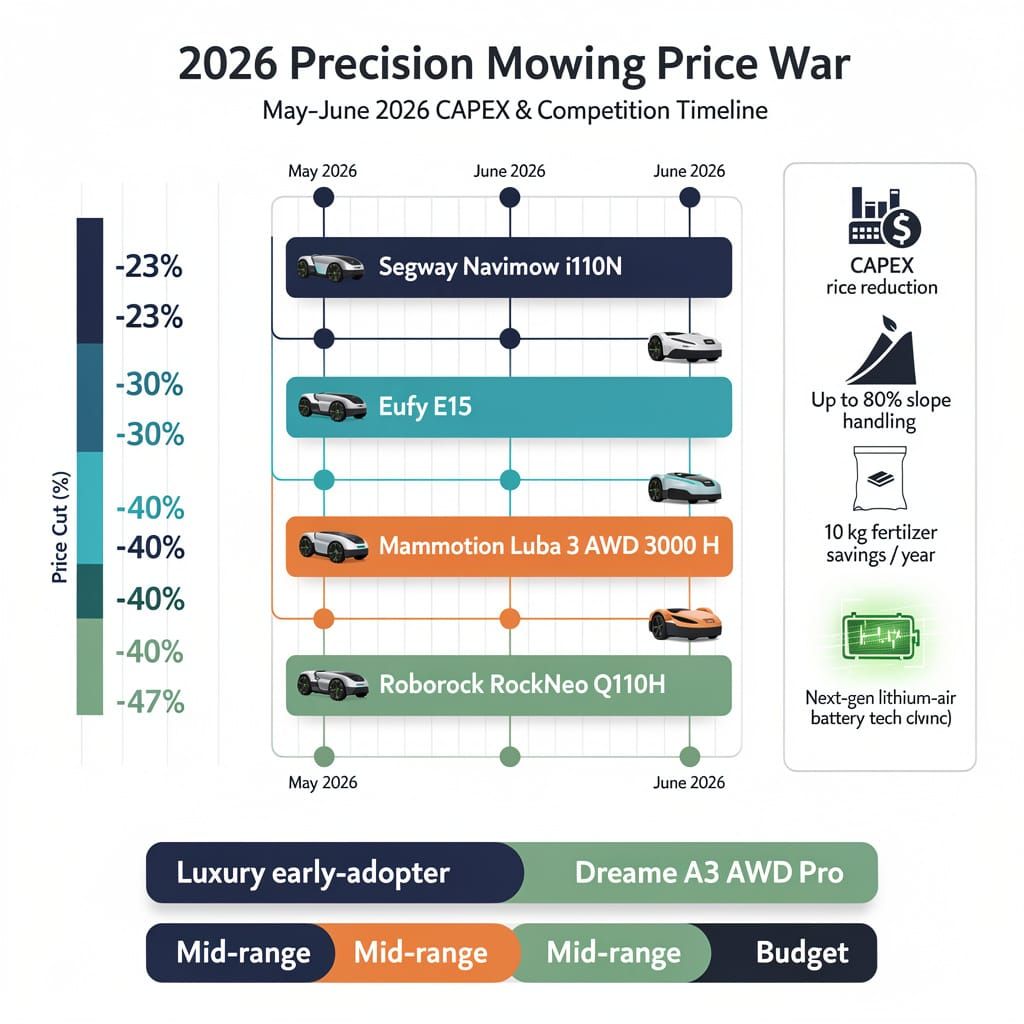
Competitive discounting began in Q2, with Segway offering a 23% price cut on the Navimow i110N on May 14. This trend accelerated through May, with Eufy slashing the price of the E15 by 47% on May 29. By June, the market entered a high-frequency discount cycle. On June 19, Mammotion positioned the Luba 3 AWD 3000 H at $2,499, but the entry of the Dreame A3 AWD Pro on June 22—supported by an $800 discount—created immediate price pressure.
In response, Mammotion expanded promotions across its Luba 3 AWD, Yuka Mini 2, and Spin O E1 lines. Concurrently, new entrants like Roborock launched the RockNeo Q110H at $1,299 on June 10, utilizing RTK/VSLAM navigation to capture the mid-range segment. These causal chains of competitive discounting result in a significant reduction in CAPEX for consumers, lowering the barrier to autonomous yard maintenance.
Current Market Dynamics
- Mammotion: Broad portfolio discounts $\rightarrow$ protects market share; Luba 3 now handles 80% slopes.
- Dreame/Roborock: Aggressive subsidies $\rightarrow$ accelerates adoption of VSLAM and RTK systems.
- Eufy/Segway: Deep markdowns (up to 47%) $\rightarrow$ expands AI navigation to budget segments.
- Innovation: Integration of FlowCut mulching and chemical byproduct irrigation (Airseekers Tron).
What is the Outlook for 2026?
Manufacturers are pivoting toward feature parity in navigation—specifically LiDAR, RTK, and VSLAM—to justify tiered pricing. This convergence is driving a shift toward sustainable turf management, with reports indicating a reduction of 10kg of chemical fertilizer per lawn annually. However, this expansion coincides with broader tech sector volatility, as catalysts like CATL's lithium-air battery progress and Audi-BASF's biodegradable battery alliance shift the supply chain toward circular economies.
- June 2026: Prime Day triggers the first significant price erosion of the 2026 model cycle.
- Q3 2026: Intensified competition as brands synchronize hardware releases to capture late-summer demand.
- Q4 2026: Transition toward ecosystem bundling, pairing mowers with autonomous edging and garage attachments.
Competitive Analysis Navigation: LiDAR/GPS fusion $\rightarrow$ enables centimeter-level precision and boundary-free mobility. Sustainability: Gas-to-battery shift $\rightarrow$ aligns with EU ESG targets and recycled cobalt chemistry. Risk: Increased connectivity $\rightarrow$ elevates cybersecurity vulnerabilities and data-sharing risks. Economics: $800+ discounts $\rightarrow$ shortens the ROI period for labor replacement.
🤖 Convergence in Dexterity: The Evolution of Robotic Manipulation
20 people down to 1! Radical efficiency in robotics R&D sees research teams shrink as low-cost $4,570 setups emerge 🤖. Sim-to-Real AI now enables 92% success in delicate tasks. Is this the end of expensive lab monopolies? ABB & IIT lead the charge — how will this accelerate tech in your region?
Recent demonstrations across academic and industrial sectors indicate a transition from rigid mechanical gripping to adaptive, bio-mimetic sensing. While the Italian Institute of Technology (IIT) has focused on octopus-inspired soft robotics, a parallel trend in "Physical AI" is enabling traditional industrial arms to achieve similar levels of dexterity through sensor fusion and machine learning.
How does sensing replace centralized computation?
Bio-mimetic systems, such as the IIT soft robotic arm, utilize a decentralized architecture. The arm employs 10 artificial suckers with LEDs and phototransistors that translate mechanical strain into electrical signals, enabling real-time tactile perception without high-latency central processing.
Simultaneously, industrial leaders are shifting toward "Sim-to-Real" transfer. ABB Robotics' Physical AI Toolchain and collaborations with PSYONIC integrate human prosthetic data into robotic arms to enhance fine motor control. This convergence of soft hardware and AI-driven control allows robots to manipulate delicate objects—ranging from glass bottles to thin cards—with human-like precision.
Performance Capabilities
- Soft Systems: 500 g max payload; constant accuracy over 300 cycles.
- Industrial AI: 0.8 m/s precision in 3D macro movement; 92% success rate across trials.
- Efficiency: Independent manipulation rigs now consume <3W during active 4-hour sessions.
Sectoral Impacts
- Industrial: Modular designs and Physical AI enable safer handling of fragile components in automotive and packaging lines.
- Medical: High-sensitivity fingertips and soft actuators demonstrate potential for minimally invasive surgery and assistive devices.
- Academic: Low-cost setups (~$4,570) reduce research team requirements from 20 people to solo operators, democratizing robotics R&D.
Development Timeline
- May 2026: XELA Robotics demonstrates autonomous card pickup using advanced robotic fingertips.
- June 11–23, 2026: IIT unveils optoelectronic soft arms capable of operating in both water and air.
- June 16–19, 2026: ABB and Epson showcase Physical AI toolchains and modular automation suites at Automate 2026.
- Late 2026: Projected incremental gains in automation maturity within six months due to collaborative robot (cobot) development.
- 2031: Projected integration of these tactile sensors into humanoid systems for wet-condition operation.
This trajectory demonstrates that robotic dexterity is no longer limited by rigid hardware. The integration of decentralized sensing and adaptive AI enables precise manipulation in unstructured environments, moving robotics beyond laboratory simulations into critical infrastructure and biomedical engineering.
🚗 Scaling Autonomy: Tesla Deploys FSD v14 in Oceania
33% speed boost! Massive jump in Smart Summon speed as Tesla drops FSD v14 in Oceania 🇦🇺🇳🇿. While HW4 gains high-fidelity autonomy, Model Y L owners are left waiting due to chassis gaps. Efficiency vs. Architecture? Tesla users in Australia—how's your drive?
Tesla expanded its Supervised Full Self-Driving (FSD) v14 rollout to Australia and New Zealand on June 3, 2026. In collaboration with Microsoft and Nvidia, Tesla is deploying version 14.3.3 to Hardware 4 (HW4) vehicles to align Oceanic software standards with North American capabilities. This update integrates reinforcement-learning techniques to improve decision-making and interaction with emergency vehicles, particularly in rain and snow.
Why the Model Y L Delay?
Despite the rollout, Tesla delayed FSD v14 for Model Y L owners in Oceania. The delay stems from the vehicle's unique physical architecture, including a longer wheelbase and 2-2-2 cabin layout. These dimensions require distinct software optimization and separate validation paths to ensure perception parity with standard HW4 chassis.
Deployment Timeline
- May 17, 2026: FSD v14.3.3 released with 33% speed boost to Actual Smart Summon and new driver-monitoring profiles.
- June 3, 2026: FSD v14 launched for HW4 users in Australia and New Zealand; FSD v14 Lite debuts for HW3 owners in North America.
- June 23, 2026: Initiation of broader Supervised FSD v14 rollout for AI4 vehicles in Oceania.
- Late 2027: Forecasted full adoption of FSD v14 across Oceanic markets.
System Impacts
- Technical: HW4 integration enables higher sensor fidelity $\rightarrow$ smoother autonomy and improved spatial awareness.
- Hardware: HW3 constraints limit full autonomy $\rightarrow$ "Lite" version adds reverse, gear-shifting, and destination-parking.
- Safety: Enhanced eye-tracking and reduced driver-monitoring demands $\rightarrow$ lower alert fatigue and better focus verification.
- Legal: US and Chinese lawsuits totaling potential $14.5B liability $\rightarrow$ heightened regulatory scrutiny of FSD marketing claims.
This phased deployment marks a transition to proprietary AI4 hardware. While HW4 users gain immediate functionality, HW3 owners rely on FSD v14 Lite to bridge the hardware gap. Simultaneously, Tesla is pivoting its hardware strategy, as seen in the June 17 launch of the 2026 Model Y Performance, which prioritizes a 17% range increase (reaching 306mi total) over track-specific features.
However, the expansion faces headwinds. Concurrent with the Oceania launch, Tesla encountered reports of FSD non-compliance in Denmark and a $243M Miami jury award for an Autopilot crash. These events, alongside a 9.3% dip in share price in late May 2026, indicate a growing tension between aggressive global scaling and the requirement for transparent safety metrics.

Comments ()