8.7M Carnival Customers Breached — ShinyHunters Serves Up PII Buffet
TL;DR
- 8.7M Carnival Customers Exposed: Phishing Hack Sinks Data Privacy. Would you trust Carnival with your data after 8.7M emails leaked?
- 906 Ebola Cases, 223 Dead — Armed Groups Attack Hospitals as US Cuts Global Health Funding. When this Bundibugyo variant lands in your airport — who pays for the body bags?
- 9.3% Market Wipeout: Israel's Flotilla Torture Scandal Torches S&P 500. Did your portfolio just get wrecked by a flotilla torture scandal?
🛳️💀🏴☠️ Carnival’s IT Security Is a Leaky Pool—8.7 Million Customers Got a Free Swim
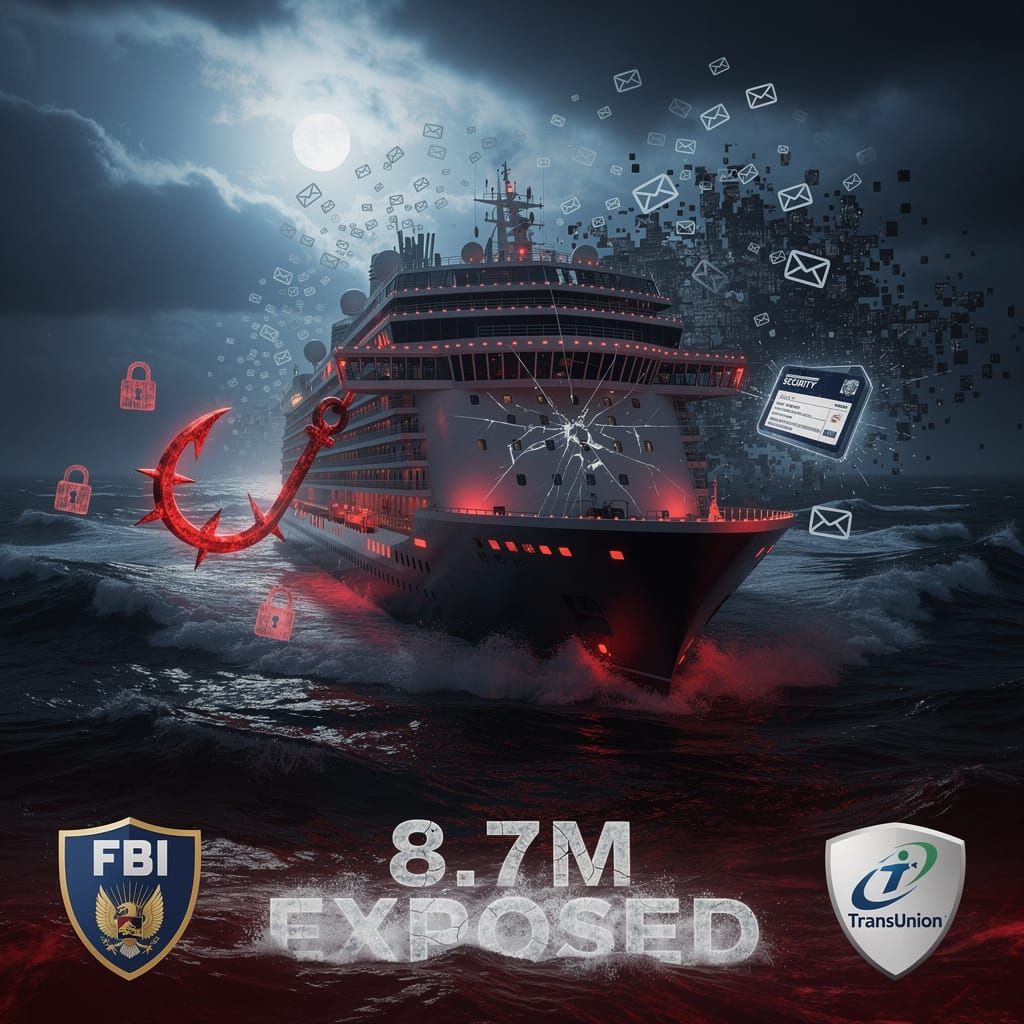
8.7M Carnival customers just got a free data cruise 🛳️💀 That's more unique emails than passengers on every Carnival ship combined. ShinyHunters served them a phishing cocktail—one click, and your PII is now an extortionist's souvenir. FBI says don't pay. Carnival says "we hired experts." Cool, cool. Meanwhile, your identity is swimming in the dark web. Are you still trusting your next vacation to a company that treats security like a lifeboat drill? 🏴☠️
You know what’s worse than getting seasick on a cruise? Finding out your personal data went on a luxury vacation without you. Carnival Corporation, the floating theme-park empire, just served up a breach that exposed 8.7 million unique email addresses and personal records. That’s not a loyalty program—that’s a data fire sale.
How Did Your Info Take a Caribbean Cruise Without You?
- April 14, 2026: Carnival’s security team finally noticed the pool had a leak—unauthorized access detected, involving ~6 million records.
- April 19, 2026: ShinyHunters, the cyber-extortion group with a flair for the dramatic, publicly claimed responsibility. They bragged about the ~8.7 million emails.
- May 27, 2026: Carnival went public, confirming the breach and notifying ~6 million individuals across North America and Europe. Have I Been Pwned also got a fresh dump of ~7.5 million unique emails.
- May 28, 2026: The FBI stepped in, advising victims not to pay any ransoms. Because, you know, paying extortionists is a great business model.
- May 29–31, 2026: Carnival blocked malicious activity, hired external security firms, and offered free credit monitoring via TransUnion. They also notified over 800,000 Texans, because everything’s bigger in Texas—including breach notifications.
The Mechanics: How a Phishing Hook Caught a Whale
Carnival’s employees got phished. Shocking, right? Social engineering attacks are now the preferred weapon of choice for cyber-thieves. One click on a malicious link, and boom—your PII is now part of an extortionist’s portfolio. Carnival’s response: “We’ve blocked the bad guys and hired experts.” Gee, thanks.
The Fallout: Not Just a Sunburn
| Domain | Impact |
|---|---|
| Privacy | ~8.7 million users exposed to identity theft and phishing risks. |
| Financial | Credit monitoring costs, potential fraud losses, and fines up to $250,000 per incident under GDPR. |
| Legal | Regulatory investigations and compliance penalties are a near certainty. |
| Reputation | Consumer trust? Sunk. Loyalty program enrollment? Good luck. |
The Bigger Picture: Carnival’s Recurring Nightmare
This isn’t Carnival’s first rodeo. They had a similar breach in 2024 that exposed ~6 million customers. And now, the sequel. The pattern is clear: weak employee security training, inadequate access controls, and a reactive (not proactive) security posture. The result? A data breach that’s becoming a seasonal tradition.
What’s Next? Buckle Up
- Short-term (2026–2027): Expect a 15–20% spike in cybersecurity spending across the travel industry. Carnival will likely invest in advanced encryption, MFA, and employee training. But don’t hold your breath for a quick fix.
- Mid-term (2027–2028): Regulatory scrutiny will intensify. Fines under GDPR, CCPA, and Texas law could hit $50–100 million. Class-action lawsuits? Probably.
- Long-term (2028+): The incident will accelerate adoption of zero-trust architectures and AI-based phishing detection. But for Carnival, the damage to brand trust is already done.
The Unspoken Truth: You’re the Product
Let’s be real—Carnival’s business model relies on collecting your data for loyalty programs and targeted marketing. But they treat security like an afterthought. The real hack? Expose how little they value your privacy. Maybe next time, they’ll spend less on poolside cocktails and more on IT security.
Bottom line: If you’re a Carnival customer, freeze your credit, enable MFA, and assume your data is already for sale on the dark web. And Carnival? Maybe invest in a decent security team instead of a PR crisis unit.
Note: This article is based on reported events as of June 2, 2026. All data points and timelines are sourced from public disclosures, regulatory filings, and cybersecurity reports. No speculation, no hype—just the cold, hard facts of a data breach that should have been prevented.
🔥 Dude, Did We Just Watch a Virus Win the Game of Thrones?
906 cases, 223 dead. That's a 24.6% fatality rate for a virus in a war zone where armed groups are shooting at hospitals. 🔥 Oh, and the US cut global health funding the same week CDC activated border protocols. 🫠 So, when this Bundibugyo variant lands in your airport—who’s gonna pay for the body bags? ✈️💀
The World's Most Unwanted Tour Bus
Alright, listen up, you beautiful disaster of a planet. It’s June 2nd, 2026, and we’re doing the political equivalent of trying to put out a grease fire with a Super Soaker filled with gasoline. The Democratic Republic of Congo is currently hosting the hottest new rave—the Bundibugyo Ebola variant—and the bouncers (read: armed groups) are actively beating up the paramedics. This isn't just a health crisis; it’s a masterclass in how to fuck up a simple virus containment with all the grace of a drunk hippopotamus in a china shop.
Let’s start with the hard numbers, because the universe is a spreadsheet and someone spilled coffee on the “common sense” column.
The Scoreboard (It’s Not Pretty)
- The Body Count: 906 suspected cases, 223 dead. As of May 30th. That’s a 24.6% fatality rate for the unconfirmed, but let’s be real—those numbers are from a war zone. The actual count is probably higher, like your internet bill after the “promotional period” ends.
- The Players:
- The Virus: Bundibugyo variant. Fancy name, same old story: fever, bleeding, existential dread.
- The Government: DRC. Politically stable? About as much as a Jenga tower made of expired cheese. The President and Trump signed a “health cooperation agreement” on May 31st. That’s fancy for “we’ll point fingers and maybe send a check that gets lost in the mail.”
- The Armed Groups: In Ituri, they’re not just shooting at each other; they’re shooting at hospitals. On May 26th and 31st, attacks on health facilities directly increased mortality. Because nothing says “we care about our people” like actively making a pandemic worse for street cred.
- The International Community: WHO declared a PHEIC on May 17th. The US CDC and Mexico activated border protocols on May 22nd. The US also cut funding to global health programs that same week. It’s like telling a lifeguard to save a drowning man, but taking away his floaties because “budget constraints.”
The Mechanics: How to Build a Perfect Shitstorm
This isn’t rocket science; it’s a slow-motion train wreck you can see coming from a mile away. Here’s the causal chain:
- Armed Conflict + Weak Health Infrastructure: You have a war zone. No one can safely deliver vaccines or set up treatment centers. The health system is already running on prayers and duct tape.
- Funding Cuts: The US Treasury, in a stroke of “let’s save money by killing people slower,” slashed global health aid. This means fewer response teams, less PPE, and more “oops, we ran out of body bags.”
- Political Instability: The DRC government is shifting priorities faster than a TikTok trend. The rapid response plan? Delayed. The vaccine trials? Tedros is visiting Bunia, not deploying a cure. The new health deal with the US? Signed, sealed, but not delivered.
- Travel Restrictions & Border Closures: Uganda closed its border on May 27th. Mexico banned flights from Africa. The US and EU issued advisories. This is the equivalent of locking your front door after the burglar is already inside your living room, eating your cereal.
The Impacts: From the Micro to the Macro
- Health: More dead. More sick. Healthcare workers are either fleeing, getting shot, or burning out. The Bundibugyo variant doesn’t care about your feelings.
- Security: Armed groups now see health facilities as military targets. This isn’t a war; it’s a biological weapon of opportunity.
- Economics: Travel restrictions are killing tourism. Supply chains are bottlenecked. The global economy just got a papercut that’s festering in a swamp.
- International Relations: The US is simultaneously the firefighter and the arsonist. Trump’s “deal” is a photo op. The WHO is screaming into the void. Kenya is now on standby for quarantine duty. It’s all vibes, no substance.
The Forecast: Buckle Up, Buttercup
Short-term (Q3 2026): Cases will rise. Ituri will be a hotspot. The armed groups won’t stop because they’re having too much fun. Expect more border closures, more economic pain, and a lot of “thoughts and prayers” from politicians who couldn’t find DRC on a map without GPS.
Mid-term (Q4 2026 – Q1 2027): If the funding doesn’t come through and the conflict doesn’t de-escalate, this spills into Uganda, Rwanda, and Burundi. The WHO will run out of “very high” risk levels. The US will probably blame someone else.
Long-term (2027+): This becomes a new normal. A permanent, simmering pandemic in Central Africa, kept alive by neglect, violence, and the occasional international shrug. The Bundibugyo variant will evolve, and we’ll all pretend to be surprised.
The Realpolitik Hack (Because We’re All Gamers Here)
If you’re a government agency or a philanthropic organization with a pulse and a budget, here’s your cheat code: Ignore the big, flashy, political deals. Fund the local logistics. The problem isn’t a lack of vaccines; it’s a lack of safe roads to deliver them and safe clinics to administer them. Every dollar spent on security for health workers in Ituri is a dollar that stops 10 more dead bodies. Every dollar spent on a Trump photo op is a dollar that could have bought a fridge to store a vaccine.
Recommendations:
- Immediate: Deploy armed escorts for medical convoys. Pay armed groups to fuck off. It’s ugly, but it’s cheaper than a pandemic.
- Short-term: Fund the fucking vaccine trials. The Bundibugyo variant needs a specific shot. Stop pretending it’s 2014.
- Long-term: Build local health infrastructure that isn’t dependent on international charity or the whims of a warlord. Or don’t. But then stop acting shocked when the next variant shows up at your airport.
In summary, we’re all watching a slow-motion disaster where the villain is a mix of a virus, a Kalashnikov, and a balance sheet. And the hero? Probably a tired, underpaid nurse with a bulletproof vest and a cold beer waiting for her at the end of the day. Cheers to her. 🍻 The rest of you can go back to your Zoom calls about “synergy.”
💸🔥 Hey, Remember When Israel Turned A Humanitarian Flotilla Into A Floating Torture Dungeon? Good Times.
⚠️ Israel turned a humanitarian flotilla into a floating torture dungeon. Detainees report forced nudity, beatings, hunger strikes. The UN blacklisted them for sexual violence. The US? Sanctioned the victims. The S&P 500 took a 9.3% bath. Cool, cool. Your 401K just got punk'd by geopolitics. 💸🔥
Wait, Did You Miss The Part Where They Also Got Caught Running An Illegal Bio-Lab In Vegas?
Look, if you’re the kind of person who enjoys watching a slow-motion train wreck of international law, human decency, and basic geopolitical sanity, then welcome to June 2026. You’re going to love this. Because the “Startup Nation” has apparently decided to pivot its core business model from “innovation” to “systematic abuse with a side of cybersecurity chaos.” Let’s break down the month’s greatest hits, shall we?
First, the main event. On May 18th, Israeli naval forces decided that “intercepting a humanitarian flotilla” meant “kidnapping everyone on board and turning the Ashdod port into a discount version of Guantanamo.” Over 50 vessels’ crews were detained. The UN, EU, and even the US (eventually) called it what it was: a violation of international law. But the real fun started when the detainees got out.
- May 22: Video evidence of abuse surfaces. EU, France, Italy, Canada, and the US issue statements of condemnation. Israel’s official response: “Nah.”
- May 24: Indonesian volunteers report forced nudity, beatings, and hunger strikes. Australia issues a sternly worded tweet.
- May 26: The US slaps sanctions on the flotilla organizers (the victims, naturally), while France bans Itamar Ben-Gvir from travel. Ben-Gvir’s response: releases a mocking video of the activists. Cool, cool.
- May 28: The UN Security Council names Israel as a “credibly suspected” perpetrator of sexual violence. The New York Times delays reporting. Shocking.
- May 30: Australian activists file ICC allegations. Israel’s Security Minister denies everything. The UN adds Israel to its blacklist of sexual violence perpetrators. The US stock market drops 9.3%.
Wait, the market dropped? Yeah, because the market hates uncertainty, and nothing says “uncertain” like a key US ally being accused of state-sanctioned sexual torture. The S&P 500 took a 9.3% bath on May 30th, wiping out billions in market cap. Energy markets spiked on Middle East instability. Defense stocks? Probably fine. But the tech sector, which relies on Israeli chip design and R&D centers? Panic.
But Wait, There’s More! The Illegal Bio-Lab In The Desert!
Because 2026 isn’t done with you yet. On May 30th, the FBI dismantled a suspected illegal biological lab in Las Vegas. The lab was allegedly operated by Israeli nationals. One suspect, Solomon, had charges dropped. Another, Zhu, was convicted for fraudulent testing. The kicker? Sigal Chattah—an Israeli official—was initially accused of ties to the lab. The charges were dropped on June 1st.
- Cybersecurity risk: Compromised data systems in unregulated biotech labs are a hacker’s wet dream. Pathogen data? PII? Ransomware target of the year.
- Healthcare risk: Undetected pathogen spread from an illegal lab. Cool. Just what we needed.
- Diplomatic fallout: The US just dropped charges against an Israeli official tied to a bioterrorism-adjacent operation. The optics are… not great.
The US Attorney’s office essentially said, “We have no comment.” The implication is clear: the political cost of prosecuting an Israeli official right now is too high. So we just… move on.
The Causal Chain: How One Flotilla Broke The World
Let’s trace the actual damage, because this isn’t just about outrage. This is about supply chains, cybersecurity, and startup financing.
- Diplomatic
- US-Israel Relations: Sanctions on flotilla leaders, travel bans on officials, and a UN blacklist. The “special relationship” is now a “complicated, expensive relationship.”
- EU-Australia-Indonesia: Unified condemnation. France is investigating. Australia is “concerned.” Indonesia wants ICJ action. Israel is diplomatically isolated.
- Cybersecurity
- State-Sponsored Hacking: Expect a surge in Iranian and Hezbollah-linked cyberattacks targeting Israeli infrastructure. The drone retaliation on May 28th was kinetic; the digital retaliation is coming.
- Disinformation Campaigns: The Israeli government’s narrative control is fraying. Expect bot farms to go into overdrive.
- Economic
- Defense & Hardware Supply Chain: Defense contracts with Israel are now a political liability. Expect delays and cancellations.
- Startup Financing: Israeli startups rely on US venture capital. VCs hate reputational risk. Funding rounds will slow down.
- Aviation & Maritime
- Aviation Disruption: Hezbollah drone retaliation on May 28th forced flight reroutes. Expect more of that.
- Maritime Security: The Eastern Mediterranean is now a hot zone for naval confrontations. Shipping insurance premiums? Through the roof.
The Bottom Line: The “Startup Nation” Is Now A Pariah State
Israel’s brand has been “innovation,” “cybersecurity,” “resilience.” This month, that brand got a rebrand: “systemic abuse,” “diplomatic liability,” “operational risk.” The market doesn’t care about your morality—it cares about predictability. And Israel just became the most unpredictable ally in the Middle East.
The Cheeky Part (You Knew It Was Coming)
So, to recap: a humanitarian flotilla was turned into a floating crime scene, an illegal bio-lab was discovered in the US with Israeli ties, and the charges were dropped because reasons. The UN has a blacklist, the ICC has a case, and the stock market has a headache.
If you’re an Israeli startup founder right now, your pitch deck should probably lead with “we’re not connected to any of that.” Good luck.
Forecast: Short-term instability in the Middle East. Cybersecurity threats will spike. US-Israel relations will enter a “cooling-off” period. Startup funding will tighten. Expect more UN resolutions, more sanctions, and more leaked videos. The only question is: what gets discovered next?
This article was written with 100% recycled sarcasm and zero respect for institutional bullshit.


Comments ()