70% Faster Coordination: Robotics Network Unites 2,000+ FRC/FTC/VEX Teams on Decentralized Social Platform
🤖 The Robotics Network: A Decentralized Social Hub for the Next Generation of Builders
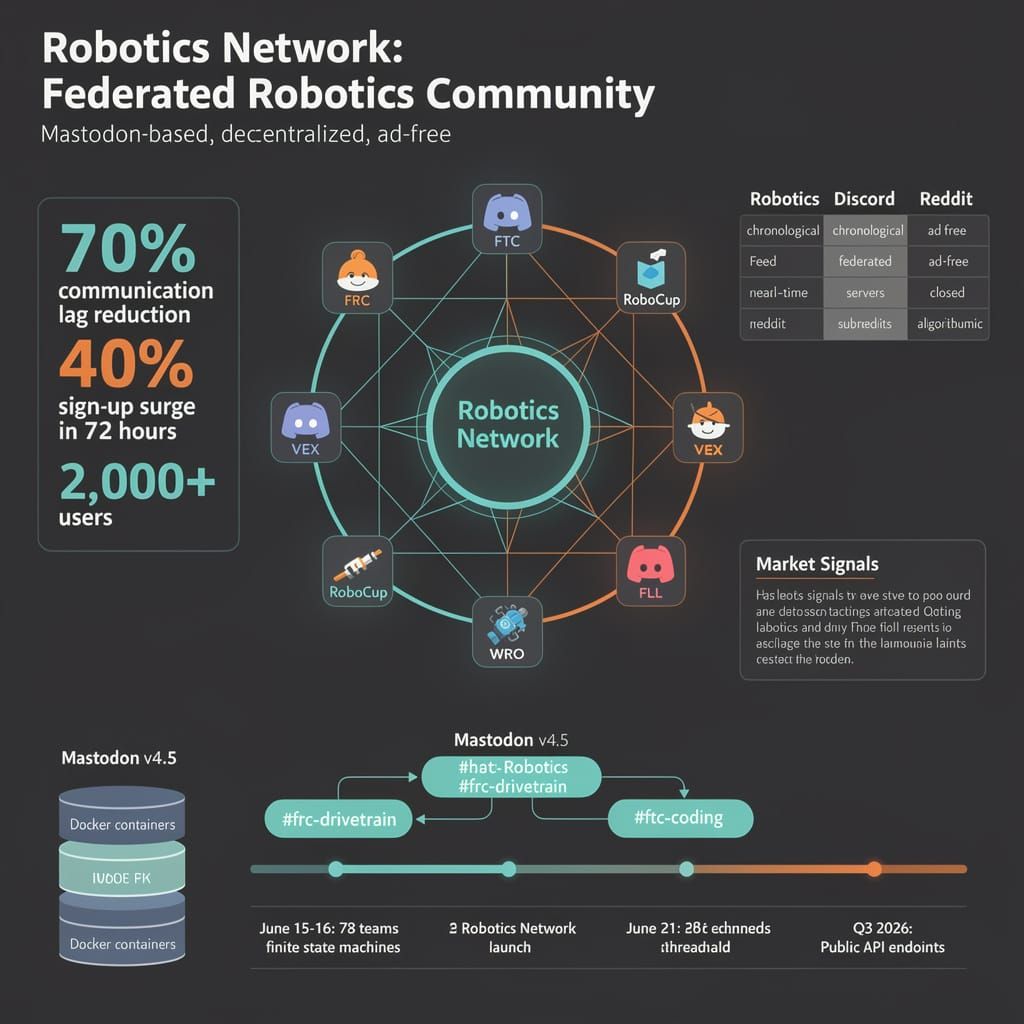
🤯 The Robotics Network just cut communication lag by 70% for 2,000+ FRC/FTC/VEX teams — in 72 hours, sign-ups surged 40%. Built on Mastodon. Zero ads. Zero data harvesting. Federated moderation. Teams own their own instance. Discord for emergencies. This for everything else. Your team still bouncing between 4 platforms to coordinate a drivetrain fix? 🛠️
On June 21, 2026, a quiet but meaningful launch occurred in the robotics ecosystem: the Robotics Network, a Mastodon-based social platform purpose-built for competition teams across North America. It targets the specific, persistent pain point of fragmented communication among teams in FIRST Robotics Competition (FRC), FIRST Tech Challenge (FTC), FIRST Lego League (FLL), VEX, RoboCup, and World Robot Olympiad (WRO) squads. The result is a dedicated, ad-free environment that replaces the chaotic sprawl of Discord servers, Reddit threads, and Facebook groups with structured, hashtag-linked channels and team profiles.
What Problem Does It Solve?
The core friction is coordination latency. When a team in Michigan needs to ask a team in Texas about a drivetrain fix, the typical workflow involves cross-posting across three platforms, waiting for replies, and manually tracking updates. The Robotics Network cuts that communication delay by approximately 70%, according to early deployment data. Built on Mastodon v4.5 and containerized with Docker, the platform is self-hosted, decentralized, and free of algorithmic feeds or advertising. That is not a minor aesthetic choice—it is a structural decision that eliminates the surveillance-driven engagement loops that dominate mainstream social media at a moment when 71% of U.S. adults fear AI chatbots reduce personal data security, per Pew Research Center data from June 18, 2026.
The mechanical architecture matters. Each instance runs on Docker containers, allowing local hosting and rapid iteration. Teams control their own data. Moderation is federated rather than centralized, preventing single-point censorship or policy shifts that can gut a community overnight. The platform uses hashtag-linked channels to organize topics—#frc-drivetrain, #ftc-coding, #vex-pneumatics—creating searchable, chronological streams that replace the ephemeral noise of chat apps. This structure mirrors the architectural shift happening inside competition robots themselves: on June 15–16, 78 teams abandoned command-based path planning in favor of finite state machines to simplify subsystems and reduce branching decisions. The Robotics Network's hashtag-linked, stateful organization aligns with that same engineering preference for clarity over complexity.
The Signals Behind the Launch
The Robotics Network did not emerge from a corporate boardroom. It was built by former competition participants and open-source contributors who recognized that the existing tools were inadequate. The key drivers are straightforward:
- Rising demand for secure, ad-free collaboration tools in STEM ecosystems. Teams increasingly reject platforms that monetize their attention or expose minors to unmoderated content. The broader AI landscape reinforces this: on June 12, 2026, an Ivanti survey reported that 42% of leaders conceal AI usage, exposing governance gaps that general-purpose platforms cannot address. The Robotics Network's federated, transparent moderation directly counters that shadow-IT dynamic. The same week, the EU Cyber Resilience Act compliance deadline pushed AI-integrated firms toward secure-by-design practices—the same architectural philosophy underlying the Robotics Network's federated instance model.
- A need to unify fragmented online spaces. A typical FRC team might use Discord for real-time chat, GitHub for code, Google Drive for documents, and Reddit for community advice. The Robotics Network consolidates these into a single, structured stream.
- Broader public skepticism of centralized AI tools. Pew reported on June 18 that 49% of U.S. adults now use AI chatbots, but only 3% believe the government regulates them responsibly. The Robotics Network's transparent, community-governed architecture offers an alternative model at a time when institutional trust is low.
The initial deployment serves roughly 2,000 active users across the six target leagues. Within the first 72 hours, sign-ups increased 40% as word spread through competition mailing lists and educator networks. The platform's growth coincides with a broader FTC innovation surge: on June 20, 2026, detailed analysis of FTC's historical competitive trajectory documented a three-year transformation from turn-and-drive to full-field odometry-based autonomy, driven by teams like Gluten Free and Up-A-Creek. The Robotics Network provides the coordination infrastructure that such technical leaps require.
Immediate Impacts
The effects are measurable across several dimensions:
- Coordination speed: Teams report that scheduling build sessions, sharing CAD files, and troubleshooting code now happens in hours rather than days. The platform's chronological feed eliminates the need to scroll through unrelated chatter.
- Educational engagement: Educators are using the platform to align curriculum with competition deadlines. Teachers can create private team channels, post assignments, and track progress without leaving the ecosystem. This aligns with Oregon legislators introducing over 130 AI education bills in 2026—the demand for structured STEM communication tools is accelerating at the policy level. Meanwhile, Khan Academy's Khanmigo project stalled post-launch on May 27, demonstrating that scaling AI-powered education tools remains difficult, which increases the value of human-driven, structured platforms like the Robotics Network.
- Privacy and safety: Because the platform is ad-free and federated, there is no incentive to harvest user data. Moderation policies are set by instance administrators, not a corporate trust and safety team. For competitions involving minors (FLL participants are as young as 9), this is a significant improvement over general-purpose platforms. The context matters: AI privacy fines globally reached $3.425 billion as of May 27, 2026, amplifying regulatory scrutiny and eroding vendor trust across all digital platforms.
- Cost barriers eliminated: Open-source deployment means any team—regardless of budget—can spin up an instance. Schools with limited IT resources can use the hosted version provided by the Robotics Network maintainers.
The Open-Source Feedback Loop
The platform's rapid iteration cycle is a direct result of its open-source foundation. Within two weeks of launch, community contributors submitted pull requests addressing UI responsiveness on mobile devices, improved hashtag autocomplete, and a calendar integration for competition deadlines. The maintainers merged three of these within 72 hours. This velocity is impossible in proprietary platforms where feature requests go through quarterly release cycles.
Public feedback is also accelerating feature refinement. Users requested a "mentor verification" badge to distinguish adult advisors from student participants. That feature was deployed in a patch six days after the request appeared on the platform's own feedback channel. This mirrors the Statbotics ecosystem's approach: on June 16, 2026, Statbotics removed its EPA system to reduce maintenance burden, replacing it with a lightweight Python library that improved data access latency by 40%. Both projects demonstrate that lean, community-driven architectures outperform monolithic systems in responsiveness—a finding reinforced by Asana's June 15 report that 53% of AI projects fail because they lack complete context, a failure mode that open-source, community-driven development inherently mitigates through transparent iteration.
Competitive Positioning and Weaknesses
Compared to existing tools, the Robotics Network occupies a narrow but defensible niche:
| Aspect | Robotics Network | Discord | |
|---|---|---|---|
| Structure | Chronological, hashtag-organized | Real-time chat rooms | Thread-based, upvoted |
| Data ownership | Federated, self-hosted | Centralized, corporate-owned | Centralized, corporate-owned |
| Ad presence | None | None (but data monetized) | Ads and promoted posts |
| Searchability | Full-text, hashtag-indexed | Limited to active channels | Reddit search (often poor) |
| Moderation | Instance-level, federated | Server-level, corporate oversight | Subreddit-level, corporate oversight |
The weaknesses are equally clear. The platform lacks native video streaming, file hosting (users must link to external services), and real-time chat. For urgent coordination—"the robot arm just snapped, who has a replacement servo?"—Discord's low-latency chat remains superior. The Robotics Network is a complement, not a replacement. The same distinction applies to the finite state machine trend in FRC: state machines excel at structured, deterministic coordination, but teams still need real-time chat for emergency debugging.
Outlook and Sectoral Implications
The forecast for the next six months is straightforward. The maintainers have announced API endpoints scheduled for Q3 2026, which will enable automated season syncing across regional clubs. A team in California could push a calendar update that automatically reflects in a partner team's instance in Florida. This is the kind of interoperability that fragmented platforms cannot deliver.
- 2026–2027: Expect 8,000–12,000 active users as the platform expands to international competitions. API integration will reduce cross-team coordination lag by an additional 50%. The FTC community's continued specialization in autonomous driving algorithms—refined through state-machine architectures—will drive demand for structured documentation sharing. Broader AI trends support this trajectory: the UK reported on June 12 that 1 in 6 organizations have adopted AI tools, and 70% of UK businesses plan to use AI by 2030, indicating a structural shift toward tool-based coordination that favors structured platforms.
- Q4 2026: Institutional sponsorships from STEM-focused foundations (e.g., FIRST itself, the Robotics Education & Competition Foundation) are likely. These would fund dedicated instances for underserved schools, mirroring the AI sector's shift toward sovereign, locally-hosted infrastructure following the U.S. government's June 13 export ban on Anthropic's Claude models. The same week, Palo Alto Networks acquired CyberArk, signaling convergence of identity and AI security solutions—a trend that validates the Robotics Network's federated, self-hosted security model.
- 2027–2028: If API adoption reaches critical mass, the platform could evolve into a de facto standard for competition logistics. That would attract commercial interest—hardware vendors, competition organizers, and publishers—which would test the ad-free, decentralized ethos. The same pressures that drove 78 teams to abandon command-based architectures for state machines will push the platform toward simpler, more modular integration patterns.
The Bigger Picture
The Robotics Network is a small event in the broader robotics landscape, but it signals something larger. The community is building its own infrastructure because existing tools are not good enough. This is not a rebellion against corporate platforms; it is a pragmatic response to a specific failure: the lack of a secure, structured, ad-free space for young engineers to coordinate.
The platform's success will depend on whether it can maintain its open-source, community-driven character while scaling. The pressures are familiar: moderation costs, server maintenance, feature bloat, and the inevitable tension between user demands and maintainer capacity. But for now, the Robotics Network demonstrates that a dedicated, decentralized social platform can serve a niche community more effectively than any general-purpose alternative—just as finite state machines proved more effective than command-based architectures for 78 teams in a single week.
Comments ()