650% Price Drops in Hybrid Robotics: US Market Shifts Toward Inventory Clearance Over Innovation
TL;DR
- 650$ Hybrid Robot Vacuum Discounts: Retail Push Masks Performance Gaps in US Home Automation. Are steep discounts on hybrid robot vacuums a sign of technical failure or just aggressive retail inventory clearing?
- 73 MPH Residential Crashes: Tesla FSD Safety Gaps Spark US and EU Regulatory Crisis. Does Tesla's FSD design encourage dangerous driver behavior by lacking hard-coded speed limiters in residential zones?
- 500Hz Sensor Failure: FIFA's Semi-Automated Offside System Sparks Transparency Crisis in 2026 World Cup. Does FIFA's reliance on 500Hz sensor data sacrifice officiating transparency for the sake of speed?
📉 The Mopping Pivot: Utility or Marketing Shift?
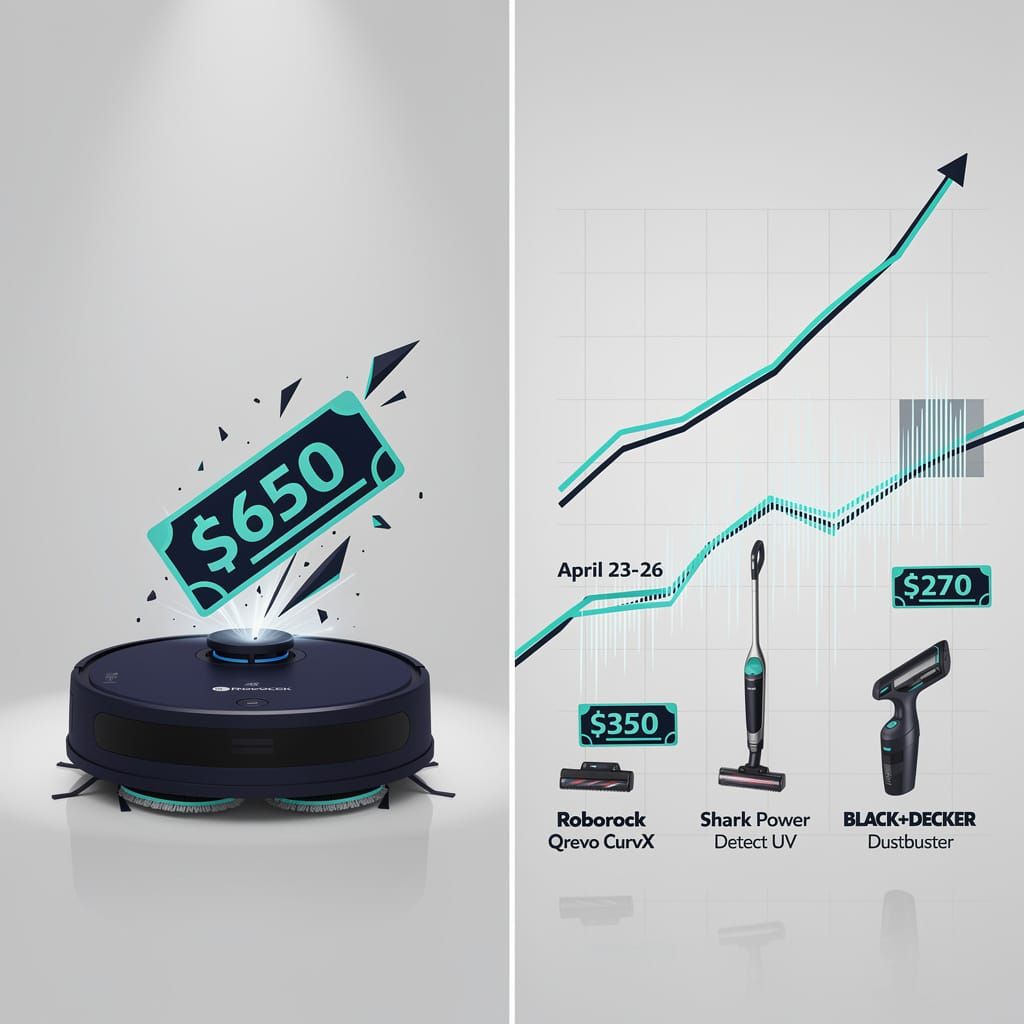
650$ price cuts! This massive discount on hybrid robot mops is a desperate move to clear inventory 📉. It's more about moving boxes than actual cleaning breakthroughs. Are these all-in-one gadgets just expensive compromises? Homeowners — is a 'hybrid' actually cleaning your floors or just spreading water?
Consumer activity from June and July 2026 indicates a shift in home automation priorities. While suction power previously dominated the robot vacuum market, current pricing strategies demonstrate that mopping and hybrid performance now drive purchasing volume. This trend correlates with aggressive bundling during the Amazon Prime Day event (June 23–26), where consumers prioritized value amid economic uncertainty and inflationary pressures.
Does Hybridization Solve Efficiency?
The emergence of hybrid systems—combining vacuuming and mopping—aims to streamline multi-floor maintenance. However, the causal chain from "integrated hardware" to "cleaner floors" remains unproven. Market data indicates these units are pushed through steep discounts to manage inventory and combat chip shortages rather than technical breakthroughs.
For instance, during the June 2026 sales cycle, the Roborock Qrevo CurvX saw a discount of $650 (reducing the price to $849.99), while the Shark PowerDetect UV Reveal 2-in-1 was discounted by $350. These aggressive price cuts, alongside deals on the Roborock Q10 S5+ (saving $270), indicate a strategy to move hardware in a crowded promotional landscape shared by Walmart, Target, and Best Buy.
Performance Trade-offs:
- Suction Power: Market preference for high-suction handhelds persists; the BLACK+DECKER Dustbuster remains a top seller with a 4.4/5 rating due to specialized settings.
- Maintenance: Integration of complex mopping modules increases failure points compared to single-purpose tools.
- Financial: Significant discounts on hybrid units—exemplified by the $650 drop for the Qrevo CurvX—suggest manufacturers are sacrificing margins to maintain market share.
Projection of Market Integration
Manufacturers are bundling mopping modules to maintain volume, though actual utility gains appear marginal compared to specialized cleaning hardware.
- 2026–2027: Increased hybrid adoption driven by promotional pricing and bundling strategies observed in Q2 2026.
- 2028: Projected shift toward specialized "deep-scrub" robotics as surface-mopping fails to meet sanitation standards.
While the industry projects a seamless transition to fully autonomous floor care, current hardware limitations indicate a gap between perceived convenience and actual efficacy. The shift toward mopping reflects a change in retail strategy and consumer desire for "all-in-one" gadgets, but fails to demonstrate a breakthrough in robotic manipulation or perception.
🚨 The Autonomy Illusion: FSD and the Fatal Gap
73 mph in a residential zone: a lethal failure. 🚨 Like a car without brakes, it's a death trap when 'timid' FSD prompts dangerous manual overrides. Cabin cameras are easily spoofed by $30 plastic heads. Systemic negligence? Tesla users — do you trust your life to an illusion?
Recent fatalities involving Tesla’s Full Self-Driving (FSD) systems demonstrate a critical failure in the handoff between automated control and human intervention. Events in mid-2026 reveal a systemic vulnerability: the software enables high-velocity maneuvers while providing insufficient safeguards against aggressive manual overrides.
Is Automation or Liability Shield?
On June 22, 2026, a Tesla Model 3 collided with a residence in Katy, Texas, killing 76-year-old Martha Avila. While the driver, Michael David Butler, claimed Autopilot engagement, telemetry confirmed neither Autopilot nor FSD was active; Butler manually accelerated to 73 mph. Butler's arrest for manslaughter on July 1 highlights a dangerous psychological correlation: users perceiving FSD as "timid," which prompts lethal manual overrides to bypass system constraints.
These cases indicate a pattern where "layered automation" fosters driver over-reliance. While Tesla attributes these deaths to driver error, the ability of a user to reach 73 mph in a residential zone without the system triggering hard-stops indicates a lack of effective physical governors. This vulnerability extends to the perception layer; on June 12, 2026, Chinese Tesla owners bypassed driver monitoring by installing $30 replica Dwayne Johnson heads on rearview mirrors. In one instance, a driver traveled 250 miles on autopilot, evading safety alerts for 30 minutes while filming and snacking.
Systemic Failures
- Control Gap: FSD maintains steering while permitting manual acceleration to exceed urban thresholds → creates unstable hybrid control states.
- Perception Failure: Cabin cameras are susceptible to simple physical spoofs (e.g., replica heads) → enables prolonged driver distraction.
- Accountability: Manufacturers use "driver-depressed accelerator" data to shift liability → delays implementation of hard-coded safety limiters.
The Regulatory Horizon
Institutional responses indicate a shift toward restrictive legislation. On June 16, 2026, Senators Ed Markey and Richard Blumenthal demanded that regulators verify Tesla's claims that FSD is "7 times safer" than human driving. This pressure follows a June 17 Reuters report exposing that Tesla allegedly manipulated FSD safety data submitted to Dutch (RDW) and Swedish regulators to exaggerate crash avoidance rates.
Projected Regulatory Shift
- Q1 2027: Increased adoption of Intelligent Speed Assistance (ISA) mandates, following Illinois’ passage of HB 4948 and SB 3484 on June 1, 2026.
- 2026–2027: Heightened NHTSA scrutiny of EDR transparency to resolve conflicts between corporate claims and forensic data.
- Long-term: Transition from "driver-assist" to mandatory "hard-governed" autonomy in high-density zones.
These events demonstrate that current AV frameworks prioritize user intent over environmental safety. Until systems prioritize hard-coded limits over permissive autonomy, the integration of high-torque actuators remains a lethal combination.
🚨 The Precision Paradox: FIFA's Sensor Dependency
500Hz sensors: a staggering 500,000 data points per second 🚨. This "precision" just overruled visible reality in Croatia vs Portugal. Speed isn't accuracy when the system is a black box. The game is faster, but is it fair? FIFA fans — do you trust a sensor over your own eyes?
FIFA's deployment of upgraded semi-automated offside technology for the 2026 World Cup presents a technical achievement that clashes with operational reliability. The system integrates 16 HD cameras with the Trionda Pro match ball—launched June 4 featuring 500Hz motion sensors—and personalized 3D player models. While the framework aims for millisecond-level ball-touch identification, the transition toward sensor-rich officiating introduces a precarious dependency on hardware that resists transparent auditing.
Does Speed Replace Accuracy?
The system's ability to deliver real-time alerts enables faster decision-making, yet a July 4 match between Croatia and Portugal demonstrates a critical failure in the causal chain. In that fixture, the Trionda ball’s IMU data—recording at 500Hz—triggered a VAR-assisted offside ruling that disallowed a header by Zagreb striker Goran Kovačič. Despite visual replays showing no contact, sensor data indicated a 99.99% precise hit location, causing midfielder Igor Mantañović to express frustration over the perceived injustice. This reliance on internal sensors to resolve borderline incidents indicates that high-frequency data does not inherently result in correct officiating when the input lacks calibration transparency.
This technical opacity is not isolated. On June 14, a VAR system outage during a Group B match in Santa Clara failed to generate an avatar animation for player Remo Freuler. The resulting delay prompted critics, including Gary Neville, to question the transparency of the semi-automatic system and suggest potential evidence concealment. When officials prioritize a "black box" sensor trigger over observable reality, the technology ceases to be a tool and becomes an unaccountable authority.
Systemic Effects
- Operational: Automation of audio alerts → reduced match delays and expedited VAR processes.
- Psychological: System outages and opaque triggers → diminished trust and suspicion of evidence concealment.
- Regulatory: Reliance on proprietary IMU data → heightened scrutiny of fault tolerance and transparency.
Performance Metrics
- Sensor Frequency: 500Hz IMU transmission enabling millisecond-level spatial verification.
- Reliability: High theoretical certainty → undermined by June 14 animation failures.
- Scale: Deployment across 48 national teams via the FIFA AI Pro system.
Projected Timeline
- July 2026: Active deployment during World Cup knockout stages.
- Post-Tournament: Anticipated shift toward permanent AI officiating systems and revised UEFA offside detection protocols.
The shift to an AI-driven refereeing ecosystem enables a faster game but creates a dangerous reliance on embedded sensing. Without standardized verification protocols, the promise of precision remains a theoretical projection rather than a functional reality.


Comments ()