61,000 Job Loss in US Hospitality: International Travel Slump Triggers Sector Crisis
TL;DR
- 61,000 Job Loss: US Hospitality Slump Driven by Geopolitical Instability. How is the current decline in international tourism and hospitality hiring affecting job security in your region?
- 8,000 US Federal Workers Shifted to At-Will Status: Systemic Governance Collapse Risks Institutional Stability. How does the shift to at-will employment and leadership instability affect long-term career security and workplace culture?
- 4.3% Unemployment: U.S. Job Seekers Pivot to Peer-to-Peer Networks Amid Hiring Risks. Are peer-to-peer career ecosystems more effective than traditional recruiters in today's volatile job market?
📉 The Seasonal Paradox: Labor Tightness Amid Hospitality Decline
61,000 jobs lost—a devastating blow to hospitality during peak season 📉. This wipes out previous gains in a market where real wages are shrinking. Can the industry survive without international travelers? Hospitality workers — how is the summer slump affecting your city?
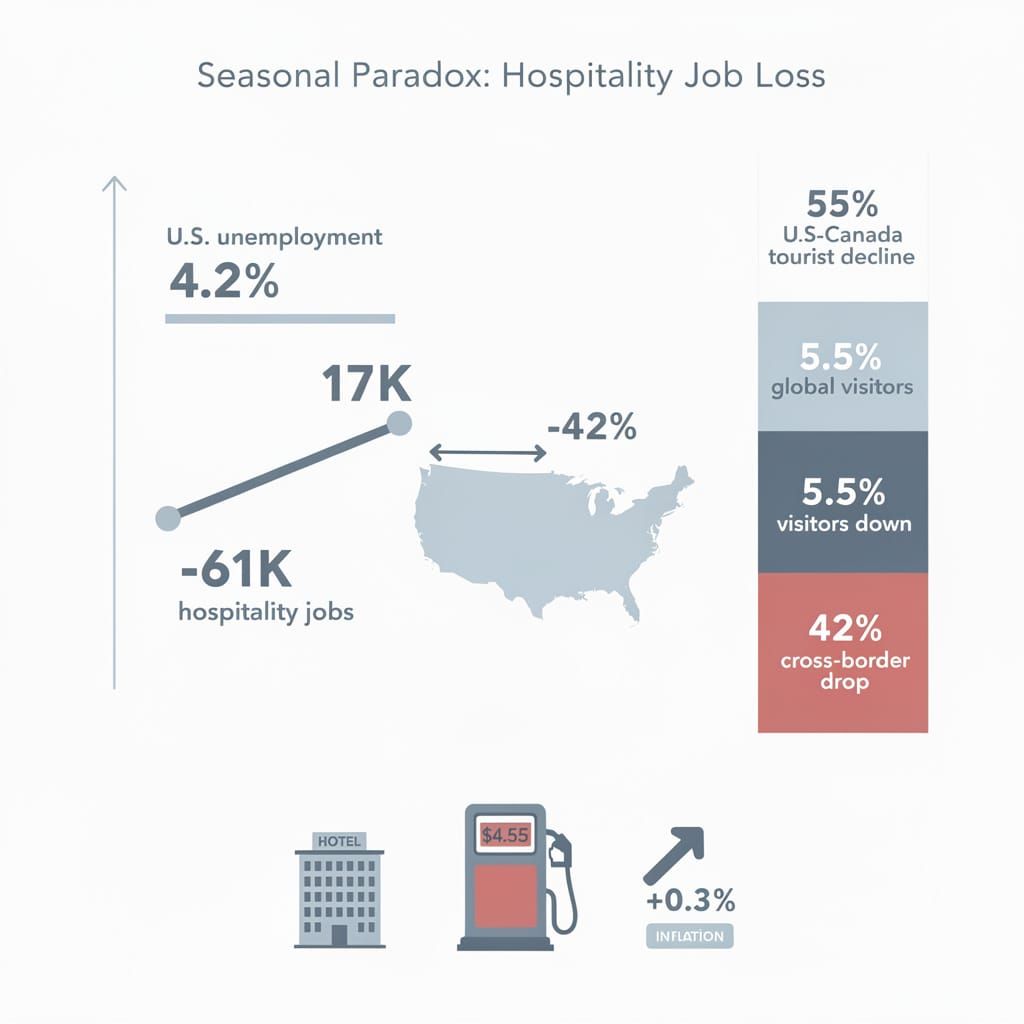
Recent labor statistics demonstrate a divergence between macroeconomic stability and sector-specific volatility. While the U.S. unemployment rate decreased to 4.2% as of July 3, 2026—marking the first decrease since March 2021—the leisure and hospitality sector reported a net loss of 61,000 jobs. This contraction erases earlier gains and indicates a structural weakening during a typical peak hiring window.
What Drives Dwindling Demand?
The decline results from weakened seasonal hiring and a sharp contraction in international visitor volume. Data indicates a significant downturn in the U.S.-Canada tourism market, with Canadian visitation dropping over 55% in multiple U.S. cities between April 2024 and March 2025. Specifically, Canadian travelers reduced cross-border trips by approximately 42% year-over-year, driven by trade disputes, a weak Canadian dollar, and political rhetoric.
Geopolitical instability further suppressed growth. U.S. and Israeli military strikes on Iran in May 2026 spiked gas prices to $4.55 per gallon and disrupted transatlantic travel, lowering hotel occupancy. While an interim peace deal reached on June 17, 2026, aims to stabilize the region, the preceding volatility eroded consumer confidence and travel demand.
Sectoral Impacts:
- Revenue: International visitors to the U.S. market dropped 5.5% in 2025, reducing hospitality income.
- Wages: Average hourly earnings rose 0.3% (annual gain of 3.5%), though this growth lags inflation at 4.2%, eroding real income.
- Supply Chain: High fuel costs and operational strain disrupt inventory and service efficiency.
- Labor Supply: Nonfarm payrolls grew by only 57,000 in June, indicating a broader cooling of the labor market.
The Causal Chain
Trade war/Tariffs + Iranian conflict → Reduced Canadian and international arrivals → Lowered demand for vacation lodging → Net loss of 61,000 hospitality roles → Real wage erosion and increased pressure on remaining staff.
Employment Outlook
Analysts project residual slack as the market moves away from "pulse-flow" dependency—the reliance on high-volume global events to sustain annual employment.
- July 2026: Continued deterioration in summer employment as structural mismatches widen.
- August 2026: Potential stabilization as domestic travel patterns normalize.
- Q4 2026: Risk of further contraction if international travel downturn persists and consumer spending remains negative.
📉 The Erosion of Professional Governance
8,000 US federal workers shifted to at-will status—a staggering blow to job security 📉. This massive instability is fueling a systemic collapse in hiring integrity. Can professional governance survive this volatility? Federal employees — how is this impacting your career stability?
Recent organizational disruptions across corporate, academic, and public sectors indicate a systemic decline in hiring integrity and governance protocols. From biotech leadership vacuums in North America to the conversion of 8,000 US federal workers to at-will status under the Schedule P/C expansion order in June 2026, institutional instability is compromising recruitment standards and accountability.
How Leadership Voids Trigger Cultural Collapse?
The exit of senior executives frequently creates power vacuums that enable the appointment of unqualified personnel or erratic role management. In the UK retail sector, aggressive acquisitions by firms like Modella Capital—which recently acquired 480 stores—have led to extreme volatility. This is exemplified by the restructuring of the TG Jones chain, resulting in 150 store closures and rent reductions of up to 75%. Such instability manifests in cases where managers' roles are reverted despite significant achievements, such as independently opening 28-bedroom extensions.
This governance collapse correlates with a degradation in the employee experience. Data from June 2026 demonstrates a trend of hostile environments: US corporations like Amazon have faced reports of unpaid overtime and retaliation against unionizers, while in Singapore, reports of pervasive verbal abuse and coercive behavior toward junior staff highlight a normalization of misconduct. These interactions indicate a shift where power imbalances result in exploitative behavioral norms and mental health crises.
Managing Intellectual Property and Burnout
Parallel tensions exist between institutional transparency and individual privacy. In academic settings, digital vulnerabilities have left sensitive data exposed. A coordinated cyber intrusion in June 2026 targeted the University of Nottingham and other international campuses, leaking student billing, payment, and personal records. This breach demonstrates a reactive approach to infrastructure security that diminishes trust in institutional guardianship.
Simultaneously, senior leadership tiers report high cognitive resource depletion. In the life sciences sector, a severe leadership shortage emerged by July 2026 as executives migrated from unstable biotech startups to multibillion-dollar pharma firms for income security. This talent flight, coupled with AI-led economic shifts, places unsustainable mental loads on strategic decision-makers, risking program delays exceeding one year.
Operational Risks:
- Governance: Unclear reporting structures → role reversions and elevated litigation risk.
- Culture: Toxic management → labor law violations and damaged employer branding.
- Wellness: Executive burnout → depleted strategic processing and succession failure.
Forecasted Trajectory:
- Q3 2026: Elevated litigation risk and workforce attrition unless HR reforms are enacted.
- Q4 2026: Increased adoption of formalized mental health support for senior staff to prevent strategic instability.
- 2027: Shift toward standardized, third-party interview auditing to mitigate workplace toxicity.
📉 The Rise of Peer-to-Peer Career Ecosystems
4.3% unemployment vs 4.2% inflation: a brutal squeeze 📉. This economic volatility is like running a race with a weighted vest. Peer-to-peer ecosystems are now bypassing broken hiring silos. Ethical or biased? Job seekers — how are you bypassing recruiters in your city?
Labor market volatility indicates a shift in how professionals acquire job-search intelligence. With U.S. unemployment holding at 4.3% and inflation peaking at 4.2% in June 2026, workers face a high-risk macro-cycle where resilient hiring is offset by stagnant wages. This environment demonstrates a growing reliance on structured, community-driven knowledge exchange over traditional institutional guidance.
How do these forums influence professional growth?
These platforms enable users to bypass conventional recruitment silos by sharing real-time resume-building tips and interview preparation strategies. This shift is accelerated by a decline in trust toward formal processes; reports from June 2026 highlight systemic "red flags" in interviews, including manipulation tactics and unrealistic expectations aimed at securing offers. Furthermore, behavioral screening has shifted toward unconventional, non-traditional methods—such as evaluating candidates based on their interpersonal behavior toward taxi drivers—which raises ethical concerns regarding fairness and bias.
This decentralized approach results in a rapid distribution of tactical advice, allowing both entry-level learners and seasoned experts to synchronize their skills with current industry demands. The correlation between recurring community prompts and user engagement suggests that structured communication channels reduce the friction associated with career pivoting.
Skill Acquisition: Peer-recommended textbooks and technical guides → faster reskilling cycles. Networking: Direct knowledge exchange → reduced reliance on formal recruiters. Accessibility: Open-forum discourse → democratized access to executive-level strategies.
What are the projected trajectory and impacts?
As workforce transitions become more frequent, the demand for lifelong learning frameworks increases. The integration of these forums into daily professional routines projects a sustained shift toward collective resilience. This occurs as the industry faces a dichotomy between AI-augmented management—which emphasizes soft-skill demand—and the risk of hidden biases in LLM-generated interview scripts that threaten long-term fairness.
- Q3 2026: Expansion of theme-based discussions to include specific salary benchmarks and niche industry certifications.
- 2027: Integration of verified peer-mentorship tracks, potentially reducing time-to-hire for specialized roles by 10-15%.
- 2028: Formalization of community-led education repositories, offsetting costs associated with private career coaching.
Efficiency: Rapid peer feedback → optimized resume conversion rates. Engagement: Consistent weekly scheduling → sustained professional development habits. Risk: Unverified advice → potential misalignment with specific corporate cultures or biased internal reference norms.


Comments ()