98% Efficiency Gain: AI-Driven Podcast Generation Transforms Document Consumption Globally
TL;DR
- 98% Efficiency Gain: AI-Driven Doc-to-Podcast Tools Transform Global Content Consumption. Would you replace manual podcast production with AI tools that reduce transcription time by 98%?
- $634 Million Film Success: AI Suspicions in Hollywood Trigger Industry-Wide Provenance Crisis. Does a film's commercial success prove it was algorithmically optimized, and how do we verify human creativity in cinema?
- 9.3% AI Stock Dip: Able's AI Transport 0.4.0 Shifts Enterprise Focus to Persistent Local Storage. How does the shift toward stateful AI and database hydration impact enterprise data privacy and cloud costs?
🎧 The Rise of Synthetic Dialogue: AI-Driven Podcast Generation
98% reduction in transcription time: a staggering leap equivalent to skipping nearly the entire production process 🎧. Synthetic hosts now turn raw PDFs into dual-host podcasts instantly. Efficiency or loss of human touch? Students and pros — would you trust AI to summarize your study guides?
Between June 28 and July 4, 2026, a shift in multimodal AI capabilities enabled the instant conversion of static documents into dual-host audio podcasts. This transition demonstrates a move from simple text-to-speech toward autonomous script generation and narrative performance, reducing the friction between raw data and auditory consumption.
How Does the Doc-to-Talk Pipeline Work?
The technical workflow follows a linear causal chain: a user uploads a PDF, note, or text file, which the system processes through an auto-prompting layer. This layer generates a conversational script for two distinct personas, which a narration engine then converts into synchronized audio using dynamic pacing algorithms.
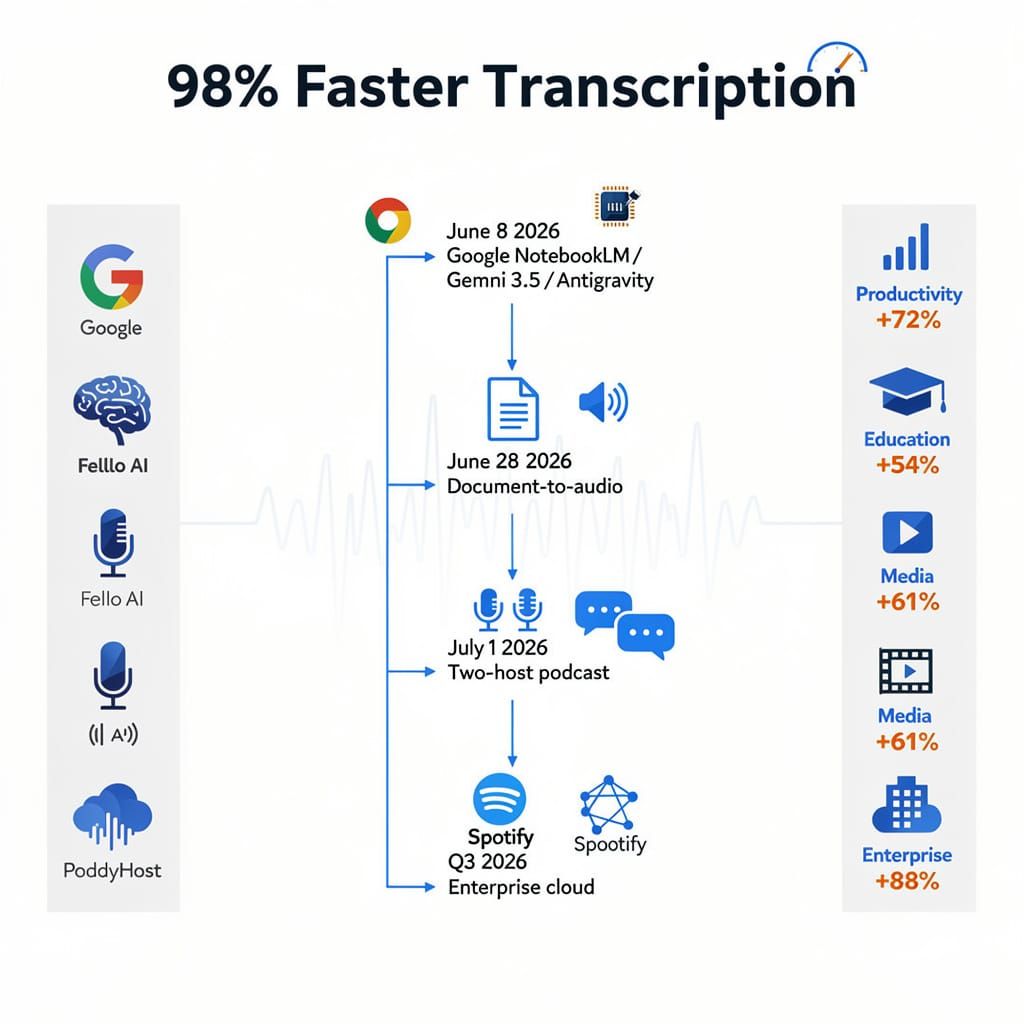
Google’s NotebookLM, upgraded on June 8, 2026, with Gemini 3.5 and Antigravity, provides free document-to-audio conversion. This integration removes manual editing steps by automating script synthesis and natural-voice rendering. Simultaneously, the Fello AI platform utilizes synthetic host engines to transform texts and PDFs into concise podcast episodes delivered as downloadable MP3 files. This architecture prioritizes speed and accessibility, leveraging prosody modeling to create output often indistinguishable from human-to-human dialogue.
What are the Quantifiable Impacts?
The adoption of synthetic hosts results in measurable gains across productivity and education:
Efficiency: Workflow efficiency increases as the technology reduces transcription time by ~98% compared to manual recording. Editorial: Users bypass manual scripting; competing services like PoddyHost have introduced lifetime subscription models ($99) to lower the barrier for professional-grade production. Education: Integration of these tools enables passive auditory rehearsal of study materials, improving information recall and knowledge retention during commutes.
Implementation Timeline
- June 8, 2026: Google upgrades NotebookLM with Gemini 3.5 and Antigravity, enhancing data processing and reasoning.
- June 28, 2026: NotebookLM launches document-to-audio conversion functionality.
- July 1, 2026: AI platforms enable instant generation of two-host dialogue from raw textual input without microphones.
- July 3, 2026: First live "How to Make an AI Podcast" show debuts via Spotify for Creators API.
- Q3 2026 (Projected): Integration into enterprise knowledge platforms becomes standard for brief distribution.
Sectoral Analysis
Education: Increases retention through auditory summarization and the transformation of slides into micro-learning modules. Media: Democratizes production, shifting focus toward audio-first consumption and reducing reliance on recording hardware. Enterprise: Accelerates "time-to-insight" by converting sales decks and reports into digestible clips. Risk: Data quality remains a primary vulnerability; inaccurate source preparation requires manual correction to prevent misinformation.
🎥 The $634 Million Question: AI Perception vs. Production
$634 million in earnings—a staggering sum—yet Jodie Foster questions if AI actually wrote the film 🎥. This gap between commercial success and artistic authenticity sparks a crisis of craftsmanship. Human effort vs. algorithmic synthesis? This hits creators hardest. Do you trust the credits on your favorite films?
Recent financial milestones in cinema are triggering debates over the origin of creative output. By July 3, 2026, the film F1 reached $634 million in global earnings and won an Oscar for Best Sound. Despite these metrics, actor Jodie Foster questioned if the film was "made by AI," citing perceived structural predictability and line consistency as indicators of algorithmic synthesis.
Does Performance Indicate Automation?
While high-earning outputs often correlate with optimized patterns, the causal chain in this instance indicates a gap between technical reality and public perception. Director Joseph Kosinski demonstrated the use of practical effects for stunts, and critics noted weak storytelling despite the commercial success. Apple, the production entity, has remained silent on the specific AI queries, which results in a vacuum where social amplification of AI capabilities outweighs documented studio workflows.
Creative Risks:
- Reputational: Allegations of "algorithmically crafted" scripts diminish perceived human craftsmanship → lower artistic prestige.
- Financial: Absence of established compensation models for replicated likenesses → increased labor disputes and union pushback.
- Legal: Public skepticism regarding synthetic media → heightened regulatory attention and scrutiny of AI ethics.
The Value of Human Labor
Foster's critique focuses on artist monetization equity and the protection of performers from deepfake exploitation. As generative models reduce the cost of high-fidelity visuals, the industry faces a structural shift in how it values human input. This friction demonstrates that emotional and professional security for creators now rivals economic feasibility in studio negotiations.
Industry Outlook:
- 2026–2027: Integration of strict provenance metadata (C2PA) to verify human-led production in major releases.
- 2028: Establishment of standardized royalty pools for actors whose data informs generative training sets.
- 2029: Shift toward hybrid credits, explicitly separating human-authored and AI-assisted sequences.
🧠 The Shift to Stateful AI: Evaluating AI Transport 0.4.0
9.3% stock drop is driving a massive shift to defensive AI. Database hydration now turns temporary AI memory into permanent storage, like a digital brain that never forgets. 🧠 This cuts cloud costs but sparks GDPR deletion wars. Enterprise users — is local session persistence a priority for your workflow?
Able's release of AI Transport version 0.4.0 introduces database hydration, a mechanism that transitions AI conversational memory from temporary cache to permanent relational storage. By utilizing UUID-anchored entries, the update enables the persistence of AI session states, reducing cloud dependency and facilitating the migration toward local, privacy-centric ecosystems favored by providers like Ollama and Llama-cpp.
How does database hydration function?
Database hydration replaces ephemeral storage defaults with a centralized state maintenance system. It organizes conversation histories into indexed semantic chunks, allowing the AI to retrieve previous context without reloading entire datasets. This architecture enables permanent logging, transforming transient interactions into reproducible dialogue traces.
Performance Metrics:
- Latency: Systems demonstrate improved throughput via reduced read/write times and tiered caching (GPU RAM and Flash-tiered storage), enabling near-zero-latency data access.
- Stability: Session failures decreased as AI Transport implemented a session recovery layer that restores state upon reconnection within a two-minute window.
- Cognitive Load: A BCG study indicates that AI agent overuse causes "brain fry," resulting in employee mental fatigue and a decline in productivity due to excessive automation reliance.
Infrastructure Implications
This transition from stateless to stateful computing shifts the value of AI interactions. Past actions now function as policy-relevant data, providing audit trails for compliance. However, permanent logging increases the necessity for GDPR-compliant deletion windows, mirrored by the emergence of specialized compliance toolkits that automate subject data erasure.
Operational Impacts:
- Continuity: Durable session architectures decouple communication from connectivity → higher user confidence in session reuse across devices.
- Compliance: Permanent logging → requirement for tamper-evident audit trails and structured JSON exports for data subjects.
- Reliability: Automated connection recovery → mitigation of WebSocket disconnections caused by 60–100 second idle timeouts in cloud proxies.
Future Adoption
Market volatility, including a 9.3% drop in AI-related stocks, is accelerating the shift toward defensive AI infrastructure and on-device intelligence to mitigate cloud costs.
- Q3 2026: Integration of hydration modules into mid-market CRM and support bots.
- Q4 2026: Database-backed persistent sessions become the dominant standard for enterprise chat systems as companies seek to reduce token-based billing costs.
- 2027: Evolution toward universal session languages for seamless environment switching.

Comments ()