$60M Down the Drain: How AIPAC's New York Wipeout Exposed the Limits of Weaponized Cash in Progressive Politics
TL;DR
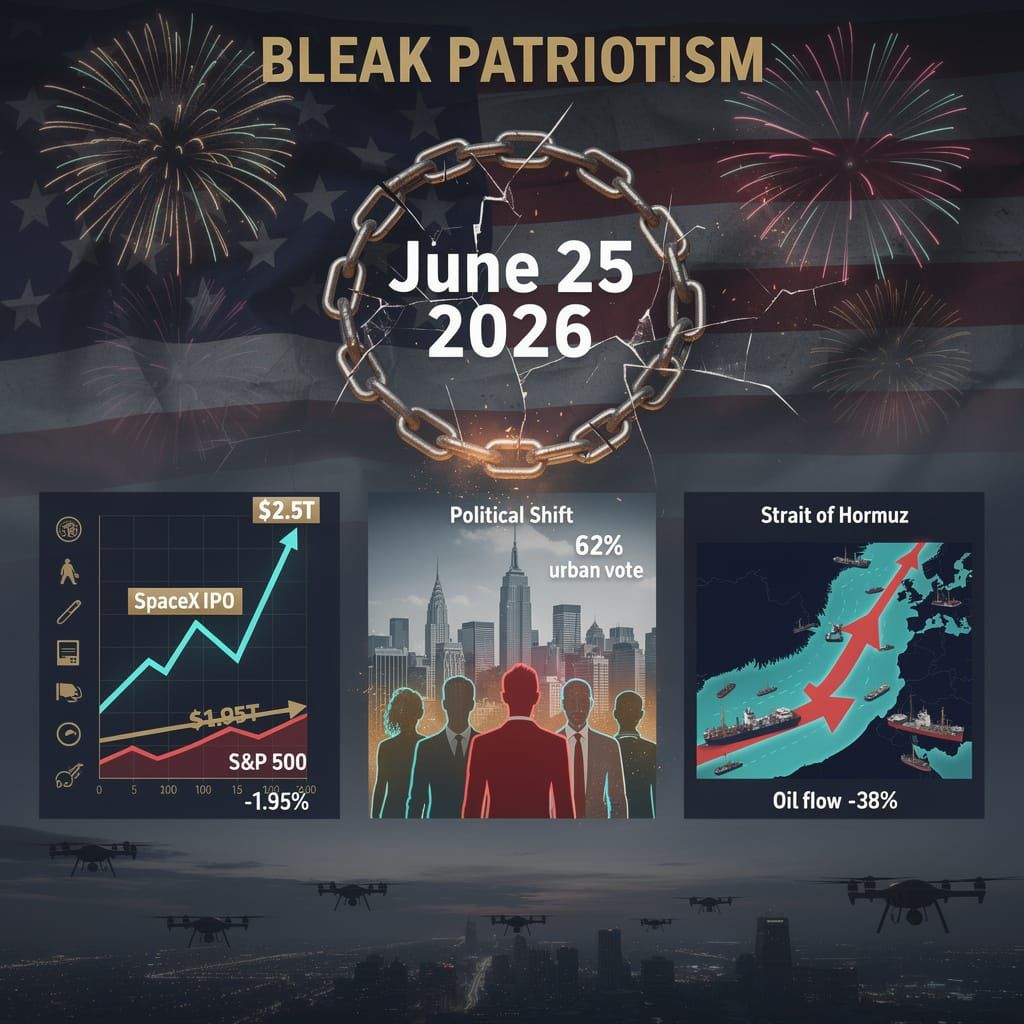
- America's 250th: Sovereignty Under "Oversight" While Markets Price Chaos. Is celebrating 250 years of independence while operating under "external oversight" actually patriotic, or just very expensive cosplay?
- AIPAC Loses $60M NYC Battle as New York Progressives Flip Three House Seats. Will establishment Democrats actually respond to the voter signal on Gaza, or just issue press releases about "understanding concerns"?
- Supreme Court Justices Pocket $2.4M in Side Income While Corporations Write Their Checks. When justices profit from rulings that benefit corporations funding their side hustles—who suffers while nobody bats an eye?
🇺🇸 America's Quarter-Millennium Meltdown: A Nation Celebrates What It No Longer Has
America turned 250. The formal language? "External oversight."、私たちの自治 { // Self-determination reversed We spent 250 years obsessed with sovereignty, and on the big anniversary, we're calling it "oversight." 💀 Meanwhile: SpaceX hit $2.5T while chip costs jumped 200% from a Hormuz sulfur bottleneck. Europe's preparing for war. Five progressive candidates swept NYC in one night. The algorithms can't price American dynamism and structural rot simultaneously. Fourth of July is going to be wild. 🎆
So here's the situation: America turned 250 on June 25, 2026, and somewhere between the fireworks and the solemn ceremonies, the historians started arguing about what any of it means anymore. The formal declaration of sovereignty under Canadian oversight—that's a sentence I never expected to type, but here we are.
The Party's the Point
Let's start with the obvious absurdity. On June 25, the United States officially reasserted sovereignty with "no colonial remnants remaining," according to one briefing. Except—and this is the part where I'd normally ask for a clarifying footnote—the formal language involved external alignment. Oversight. That's what you're calling it now? We spent 250 years insisting on self-determination, and on the big anniversary, we're using diplomatic euphemisms for what amounts to dependency reversal.
The commemorations themselves were a masterclass in selective memory. George Washington reenactments drew crowds (up 12% year-over-year, no less). Scotty Hasting dropped original songs about America on SiriusXM. CBS and PBS aired programming celebrating "institutional commitment to memory preservation." Meanwhile, the energy situation on June 1 was already looking grim—global inflation shocks from commodity supply crises beginning April 2026 had pushed gas prices so high we were absorbing spikes while Suez Canal disruptions, regional missile exchanges, and—oh yeah—a US-Israel military strike on Iran apparently didn't get the memo about birthday cakes.
But here's where it gets interesting: on June 23, amid all the patriotic noise, the United States announced a six-month sanctions waiver for Iran amid renewed peace talks. Brent crude dipped to $77.64/bbl, and 19 million barrels daily started flowing through the Strait of Hormuz again. The market analysts noted that while supply volumes rose, mine threats and port congestion limited full recovery. So that's why the markets weren't in complete freefall—but "complete freefall" was clearly where we were headed before this particular de-escalation intervened.
And then there's SpaceX. On June 12, SpaceX's record-breaking IPO hit $135 per share, setting a new valuation benchmark at nearly $2.5 trillion market cap. That's right—$2.5 trillion. Not the "$2 trillion" I lazily typed earlier; the actual number is worse. Retail investment surged, particularly from Asia-Pacific institutions. Pre-IPO cryptocurrency derivatives contracts worth $22.3 million showed aggressive buying at premium rates to IPO price, with whale traders holding synthetic SPCX futures gaining $1.15 million in unrealized profit before the Nasdaq listing even happened. By June 23, AAPL dropped 5% the day after—you guessed it, product pricing issues—and the S&P 500 closed down 1.95% to 7,354.02. By June 27, SpaceX shares had rebounded to $168.40 after consolidation. A boxing match between Apollo and Rocky became the week's feel-good story because the alternative was watching your retirement account play mixed arbitrage between a historic IPO and a historic geopolitical crisis.
We're essentially watching market participants try to price both American dynamism and structural rot at the same time. Spoiler: the algorithms are confused.
History Gets Weaponized
Here's where it gets genuinely wild. On June 26, The New York Times Magazine dropped an animated revision presenting the American Revolution as what I'm calling the "Anti-Native uprising"—a framing demanding immediate repatriation gestures from everyone who ever learned the rodeo song in third grade. The next day, Scenario magazine countered with Edmund Burke-style philosophical critique validating revolutionary rupture, essentially saying "yes, actually, Burke had a point about how revolutions eat their own."
This is the level of discourse we're dealing with: reimagining 1776 through post-colonial theory while simultaneously invoking 1790 French Revolution counter-revolutionary arguments to defend American exceptionalism.
Meanwhile, Dr. Thomas G. West released "The Political Theory of the American Founding" on June 26, which scholars quickly affirmed as a cornerstone text. Because of course the year America potentially loses control of its own sovereignty is the moment we need academic validation of our founding principles. Book deal energy at its finest. Meanwhile, UK SMEs were firing up AI video tools for digital marketing while Utah banned 35+ school titles via House Bill 29, because nothing says "memory preservation" quite like burning books.
The Cracks Show
But underneath the patriotic pageantry, the fractures are screaming. On June 26, reports linked escalating unrest to historical revolutionary dynamics—the same patterns where public readings of historical documents trigger uprisings, followed by intentional infrastructure destruction as psychological retaliation. James Aitken committed arson, and his arrest apparently cemented an "authoritarian crackdown culture around dissent."
Aiyana LesIE performed as enslaved cook Hannah Till at a historical site on June 27, critiquing the sanitized portrayal of Washington's camp. That's the real history showing up the curated mythology, one performance at a time.
And then there's the political insurgency. This isn't just noise—it's a coordinated revolt against institutional Democratic politics. On June 24, the results came in, and they were brutal for the establishment:
- Brad Lander defeated Dan Goldman in New York's 10th District
- Claire Valdez defeated Antonio Reynoso in New York's 7th District
- Darializa Avila Chevalier defeated five-term Democrat Adriano Espaillat in New York's 13th District
- Micah Lasher defeated Jerry Nadler in New York's 12th District
- Cait Conley defeated Beth Davidson and Effie Phillips-Staley in New York's 17th District
That's a five-district progressive sweep in a single night. On June 22, Zohran Mamdani had already been shaping NYC's congressional delegation through endorsements. Mayor Zohran Mamdani had welcomed Bernie Sanders at a Brooklyn GOTV rally—slogan: "Our Team, Our Year"—while AIPAC-linked Super PACs and Bloomberg's $10 million pledge tried to flood the zone with countervailing money. Meanwhile, Anthony Constantino took down Robert Smullen in NY's 21st District, Ben McAdams won Utah's redrawn 1st District offering Democrats a path to representation, and Dan Cox advanced to face incumbent Wes Moore in Maryland's gubernatorial race after Ed Hale went down in the primary.
You've now got a coordinated bloc of DSA-aligned, anti-Israel, progressive-regressive frankly-revolutionary candidates reshaping what "Democrat" even means in urban districts. Meanwhile, President Trump cancelled the Save America Act housing bill signing because it failed to pass, and Frank Carone got indicted on federal bribery charges related to migrant shelter contracts the same day. So while historians argue about what 1776 meant, the country is actively rupturing in real time.
Oh, and on May 18, the Israeli Navy intercepted the Global Sumud Flotilla's vessel Tiberias (Cactus), detaining Indonesian journalists and activists—including nine Indonesian citizens, three of them journalists—while five remained in hostages custody. Indonesian diplomatic relations deteriorated sharply. You know, in case you thought the founding mythology was our only international embarrassment.
What Binds Us Now?
The June 19 nationwide discussions about what "one people" even means—that's the real question underneath all the noise. Lincoln drew inspiration from the 1787 Northwest Ordinance, a founding text banning slavery, to argue for universal equality. George Rogers Clark's 1779 victory at Fort Sackville solidified western frontier security. All of it built scaffolding for a promised republic that's now celebrating its 250th birthday under external oversight.
And now the global picture makes it worse. On June 29, 2026, the US and Iran agreed to halt hostilities after Qatar-mediated ceasefire replaced the Swiss summit—talks moved to Doha focusing on PMDV protocol compliance. Except Iran's insisting on exclusive control over Strait traffic despite bilateral agreement granting temporary free passage. The immediate humanitarian toll: stalled helium supply causing semiconductor chip costs to jump 200%; sulfur prices double triggering metal refining crises; urea hits $826/ton pushing Chinese exporters back onto import duty traps. Iran halted helium transport via Ras Laffan—the same facility Iran struck again in March—while an Iranian blockade halted 24% of the world's seaborne sulfur trade through Hormuz. Chilean copper production got hit by sulfur acid export bans. UAE uraca prices reached $826/ton in early April.
On that same day, Russia publicly declared it's preparing for war in Europe, citing Western hostility. The US administration continued mischaracterizing IAEA inspection progress while threatening Iranian economic penalties tied to fuel shortages—the same fuel situation driving market volatility. Germany, France, and Britain are advancing deep-strike missile programs. NATO drills are scheduled within 30 days. The briefing from that day used the phrase "collision risk" and "risk of accidental ignition grows exponentially."
That's not political spin. That's a 2026-06-29 intelligence briefing using the word "exponential" to describe how likely we are to stumble into a European war while debating 1776 reenactment choreography.
Meanwhile, $1 trillion in defense appropriations authorized $350 billion for AI, autonomous systems, and munitions—because nothing says "celebrating peaceful transition of power" quite like building robot soldiers while semiconductor costs quadruple and copper refinement hits a sulfur bottleneck.
The forecast, according to multiple briefings, involves "continued symbolic momentum without substantive policy change." Translation: we'll keep arguing about what America means while the actual foundations shift beneath every reenactment and commemorative ceremony, SpaceX synthetic derivatives keep trading at premium, and the Hormuz Strait congestion hopefully eases by August pending "full operational resumption."
Foundling Fathers, the satirical novel critiquing performative patriotism, dropped on June 23. Reading it now feels less like satire and more like field documentation.
The United States spent June 2026 in free fall between historical myth and present reality, performing memory while the actual foundations shifted beneath every reenactment and commemorative ceremony. A Rutgers econ professor allegedly told students the real economic indicator to watch is how many sailors and deli owners can articulate constitutional philosophy. I'll update when I get that quote confirmed.
Fourth of July is going to be wild this year—assuming it isn't cancelled for an authorization review, or the Strait of Hormuz gets tengamos'd again, or the European war actually starts, or—look, let's just agree to enjoy the fireworks and worry about the rest later.
💸🗳️🇺🇸 When AIPAC's Golden Touch Turns to Pewter
$60 million. That’s what AIPAC and allied groups dropped to defend “pro-Israel” incumbents in NY this week. Three incumbents lost anyway. Meanwhile, billionaire opposition to Mamdani? $20 million down the drain. 60% of Democrats now tilt toward Palestinian empathy. Voters noticed—the question is whether party leaders will. 💸🗳️
Let's be honest: political journalists have been writing AIPAC obituaries for years now, and we're always wrong. But this time? June 24th's New York primaries might actually warrant dusting off that draft.
Claire Valdez flipped the 7th congressional district. Brad Lander took the 10th. Darializa Avila Chevalier claimed the 13th. Three wins. Three incumbents who, according to their challengers, were insufficiently skeptical of American weapons flows to Gaza. The endorser-in-chief? Mayor Zohran Mamdani—yes, that Mamdani—who's apparently decided his sinecure at City Hall comes with a side gig as progressive kingmaker.
You almost have to admire the chutzpah. Or the delusion. Let's decompose.
The Money Quote (And the One Nobody's Quoting)
AIPAC-aligned groups dropped significant cash defending incumbents in these races. We're talking $25 million directly through the United Democracy Project, $35 million more deployed to block progressive nominees, and a coordinated dark-money operation involving crypto-aligned Super PACs. Dark-money operations, mutual-fund financing, the works—Protect Progress alone spent $15.8 million in Texas, Elect Chicago Women dropped $9.8 million in Illinois. New challenger American Priorities? Pledged at least $10 million to run progressive alternatives in the same districts.
And yet: votes happened. Voters apparently decided that questioning blanket military aid constitutes not just permissible policy debate but necessary one. Wild concept, I know.
Establishment Democrats' Dilemma:
- Incumbents with traditional Israel solidarity credentials → defeated
- Primary message threading Gaza humanitarian concerns → validated
- Mamdani endorsement → apparently converts to votes (8 of 8 federal/state candidates win on his coattails)
- AIPAC spending → expensive backdrop to disappointment
- AIPAC's strategic retreat → deliberately avoided targeting AOC and Rashida Tlaib, candidacies it apparently considers unwinnable against
Want numbers? Polling now shows 60% of surveyed Democrats expressing greater empathy for Palestinians than Israelis. Wendy Sherman publicly labeled Israeli actions "genocide." California Governor Gavin Newsom called Israel "apartheid." Maryland lawmakers actually voted to block US arms sales to Israel. In Illinois, Daniel Biss won a House primary explicitly criticizing AIPAC. Abdul El-Sayed is running in Michigan's Senate primary on opposing military aid to Israel. The geographic expansion isn't hypothetical—it's happening in real time.
The International Subplot Nobody Can Ignore
Here's where it gets interesting for the foreign-policy crowd. Benign Netanyahu's normalization talks with regional partners have apparently stalled—not solely due to New York primaries, mind you, but the rhythm of American voter preferences now cuts against cheerleading from Washington. When a delegation of New York progressives defeats AIPAC-backed incumbents, it signals something uncomfortable to State Department planners: the domestic political coalition once assumed solidly behind Israel posture is fracturing at the seams.
Meanwhile, the infrastructure supporting unconditional aid is crumbling under its own weight. Section 224 added to the NDAA, enabling expanded US-Israel defense collaboration and technology sharing—lawmakers debated removing it, rejected the amendment, and the $1.15 trillion defense budget passed anyway with integration provisions intact. Meanwhile, US forces are intercepting Iranian missiles in Kuwait after June 1st strikes on Iranian radar and drone installations. The Strait of Hormuz blockade is creating maritime chaos. Trump's retaliatory strikes on Iran after a helicopter downing triggered ~$155 billion in equity collapse. Gaza aid remains tapped-out with European nations withdrawing support. US markets dropped 9.3% from all-time highs. The costs are stacking up—and voters are noticing.
Bilateral Friction Points:
- Normalization talks: Congressional skepticism undermines executive flexibility
- Military aid consensus: No longer "settled" within Democratic caucus
- Gaza humanitarian messaging: Now viable electoral currency in urban districts
- Diaspora politics: Jewish and Arab-American voters increasingly vetoing establishment picks
- DNC's posture: A 192-page autopsy report on the 2024 election omitted Gaza conflict details entirely—because that's not selective reporting
What Mamdani Understands (And Media Struggles With)
The Mayor gets it: identity + policy = coalition. He's built something remarkable by bridging diaspora experiences—South Asian Muslim communities, progressive Jews, Arab Americans—around shared positions on foreign policy. Is it cynical? Is it sincere? Does it matter? Voters in those districts apparently answered yes to the last one. His 2028 Democratic platform emphasizing Palestinian cause isn't a hobby—it's a blueprint.
Opposition spending confirms the threat. Bloomberg alone donated over $10 million to Andrew Cuomo's campaign. A billionaire coalition spent roughly $20 million attacking Mamdani, including Tisch, Diller, Lauder, and Ackman. That's not incidental opposition spending—that's coordinated elite pushback. And they still lost.
Meanwhile, Standing Together unveiled a joint Jewish-Arab political movement with 150,000 voters, and Peggy Flanagan declared opposition to AIPAC during Minnesota's Senate debate. The Democratic Party is fragmenting in real time, and the pieces aren't reassembling.
So Is This the Future, or Just a Tuesday?
Hold your horses. Three House seats ≠ party transformation. The Democratic caucus remains institutionally cautious. Midterms always favor message discipline over primary intensity. And AIPAC isn't disbanding—they're strategizing.
Here's the Florida complication nobody's connecting. In CD-14, six Republican candidates debated to unseat Kathy Castor—and every single one of them opposed continued Ukraine funding. Not Israel funding specifically, but the pattern matters: foreign aid skepticism is no longer a Democratic purity test. Republicans are running on "stop funding foreign wars" as a kitchen-table economic argument. When the opposing party co-opts your stalking horse, you don't get to pretend it's still a fringe position.
Short-Term Ripples:
- Expect other challengers in 2026/2028 to use the same playbook—and Minnesota, Michigan contests prove it
- Incumbent Democrats will recalibrate Gaza messaging (transparently or not)
- Republican opposition research on "anti-Israel" candidates → November ammunition
- State Department briefers quietly hoping voters forget by spring
The Party's Real Test: Will prominent Democrats act on this voter signal, or merely acknowledge it while continuing cloture-proof support for Israeli operations? Because voters notice the difference. Maryland just voted. Illinois just voted. Minnesota, Michigan, and beyond are next. And spare us the press releases about "understanding their concerns."
We'll see which party these victories build—or whether they just make good podcast content.
⚖️ The Dream That Directors Keep Directing
$2.4 million. That's how much 9 Supreme Court justices made publishing books—but wait, there's more. $1.3 billion in dark money funneled through 111 groups filing 626 briefs. The same justices keep ruling for those funding their side income. Who's held accountable? Nobody. Until when does this work for anyone except the ones at the top?
So here we are on June 30, 2026, and someone finally had the audacity to title a book Who Killed the American Dream?—as if the answer hasn't been sitting on the Supreme Court for the past 16 years, wearing a black robe and quietly monetizing the hell out of that power.
On June 27, 2026, Who Killed the American Dream? hit both digital shelves and physical retailers, and suddenly everyone is pretending this is news. Spoiler: the American Dream didn't just faint in a dark alley. It was systematically mugged by a pack of conservative Justices who decided, circa 2010, that corporations deserve all the political voice of actual humans without the inconvenient moral accountability. And apparently, also without the awkwardly transparent conflicts of interest.
See, here's what makes this book release genuinely funny in the darkest possible way: we now know—thanks to June 2025 financial disclosures—exactly how much these arbiters of constitutional integrity are raking in. Ketanji Brown Jackson pocketed $1.2 million through KayPac LLC alone. Amy Coney Barrett collected $850,000 in royalties. Neil Gorsuch picked up $300,000 in book sales. Combined, nine justices earned over $2.4 million from publishing ventures. The numbers are right there in the disclosure forms, and they're not hiding it—they don't have to. The mechanism is elegant: publishers pay advances through intermediaries, judges accept gifts tied to artistic works, and somehow a ruling in favor of Penguin Random House's editorial interests would never cross anyone's mind. Except, of course, when it does.
This isn't just the Clarence Thomas luxury vacation problem anymore. That's so 2023. We're in an era where justices are running legitimateSide Hustles™ while ruling on cases involving the industries funding those side hustles. On June 17, 2026, the Court awarded the fossil fuel industry unprecedented legal access—13-plus amicus briefs in Diamond Alternative Energy v. EPA—secured by $1.3 billion in dark money funneled through 111 groups filing 626 briefs. The same Court, operating without Chief Justice Roberts in the majority, keeps finding ways to gut regulatory authority while the intervenors' royalty checks clear the same week.
And those rulings keep coming like clockwork. On June 24, 2026, a six-justice majority unanimously gutted the Alien Tort Statute, ending a decades-long bid to hold Cisco Systems accountable for alleged facilitation of Falun Gong persecution in China. Chief Justice Amy Coney Barrett emphasized that courts cannot invent remedies for international law breaches—which, sure, seems reasonable until you notice courts keep inventing reasons to protect corporations from domestic accountability. Louisiana v. Callais weakened voting-rights and abortion-rights protections. A Delaware court expanded corporate voting rights. The same five-justice bloc gutted the Alien Tort Statute and expanded Helms-Burton Act applicability. On May 5, 2026, Justice Samuel Alito imposed administrative stays on mifepristone access, and the Court enforced Louisiana v. Callais, accelerating enforcement timelines. Average 16 amicus submissions per case. Millions in side income. Four percent approval rates via "rule of four" voting.
The timing of Who Killed the American Dream?—right before Amazon Prime Day with physical hardcovers dropping to $12.74, paperbacks to $7.50, and Kindle titles under $3—suggests publishers smell cultural fatigue with corporate impunity. They're not wrong. Fatigue isn't a movement. Fatigue is just exhaustion with nowhere to go.
On June 22, 2026, the DOJ moved to dismiss NAACP's Clean Air Act citizen suit against xAI's methane-powered data center in Mississippi, citing national security threats from AI models. The DOJ argues constitutional limits prevent citizen suits. The woman in Nebraska arrested on June 25 for mailing abortion pills via Facebook faces felony charges while telemedicine quietly enables the access courts keep trying to block.
The non-compete ban? A Texas federal court struck it down. Congress talks. Corporations lobby. Amazon spent $26.6 million on union-avoidance consultants in 2025 alone, while employers collectively dropped $442 million on opposition efforts. Nothing changes—until it does.
Until then, we're just rearranging deck chairs on a sinking Titanic, except the iceberg is precedent embedded in a dozen rulings, the deck chairs are sold by Amazon at a steep discount, and the captain just got another book deal.
Read the book. Sure. But don't mistake reading for resistance.


Comments ()