3.3M Voter Purge: US Nationalization of Elections Sparks Constitutional Crisis
TL;DR
- 3.3 Million Voters Targeted: SCOTUS Gutting VRA Sparks Nationalization of U.S. Elections. Is the U.S. democratic experiment glitching as 3.3 million voters face citizenship purges and VRA protections vanish?
- 25% Error Rate: Courts Block Federal Effort to Access Michigan Voter Data. Could a database error have stripped 25% of verified citizens of their voting rights?
- 31.9% Wealth Concentration: US National Pride Plummets Amidst Economic Divide. Is national pride becoming a luxury subscription for the wealthy in the US?
🤯 250 Years and Still Figuring It Out
3.3 million citizens scanned for citizenship in a massive purge—that's like clearing out a whole mid-sized city's voter rolls 🤯. The VRA is gutted and election hubs are being raided. Is this a celebration of 250 years or a tactical shutdown? Your vote—is it still safe in your state?
Happy Sestercentennial, America. We’ve officially hit the 250-year mark since that famous breakup letter to King George. But as the fireworks prep for July 4th, the mood in D.C. is less "party" and more "performance review."
Is the Experiment Glitching?
If you think the drama is just for the anniversary, look at the docket. We aren't just debating philosophy; we're fighting over the plumbing of democracy. The Supreme Court didn't just throw a wrench into the gears—it dismantled the machine. By invalidating Section 2 of the Voting Rights Act in Louisiana v. Callais, the Court effectively deleted federal oversight of minority-protected maps.
What happened next? A total redistricting frenzy. Louisiana, Texas, Alabama, and Florida rushed to implement maps that split majority-Black constituencies. In Louisiana, Governor Jeff Landry essentially shrugged off concerns about discarded ballots, signaling that the guardrails are officially gone. Meanwhile, the Court declined to review Arkansas's voter assistance restrictions, leaving over 500,000 Midwestern voters without essential services for disabilities or illiteracy.
Wait, it gets weirder. While the judiciary scales back, the executive is ramping up. We've got the "SAVE" system being repurposed to screen 3.3 million citizens for citizenship, potentially purging 3% of voters from the rolls. Toss in FBI raids on the Ohio Organizing Collaborative and election hubs in Georgia, Arizona, and Michigan, and you've got a summer that feels more like a tactical operation than a democratic process.
Here is the timeline of this chaotic June:
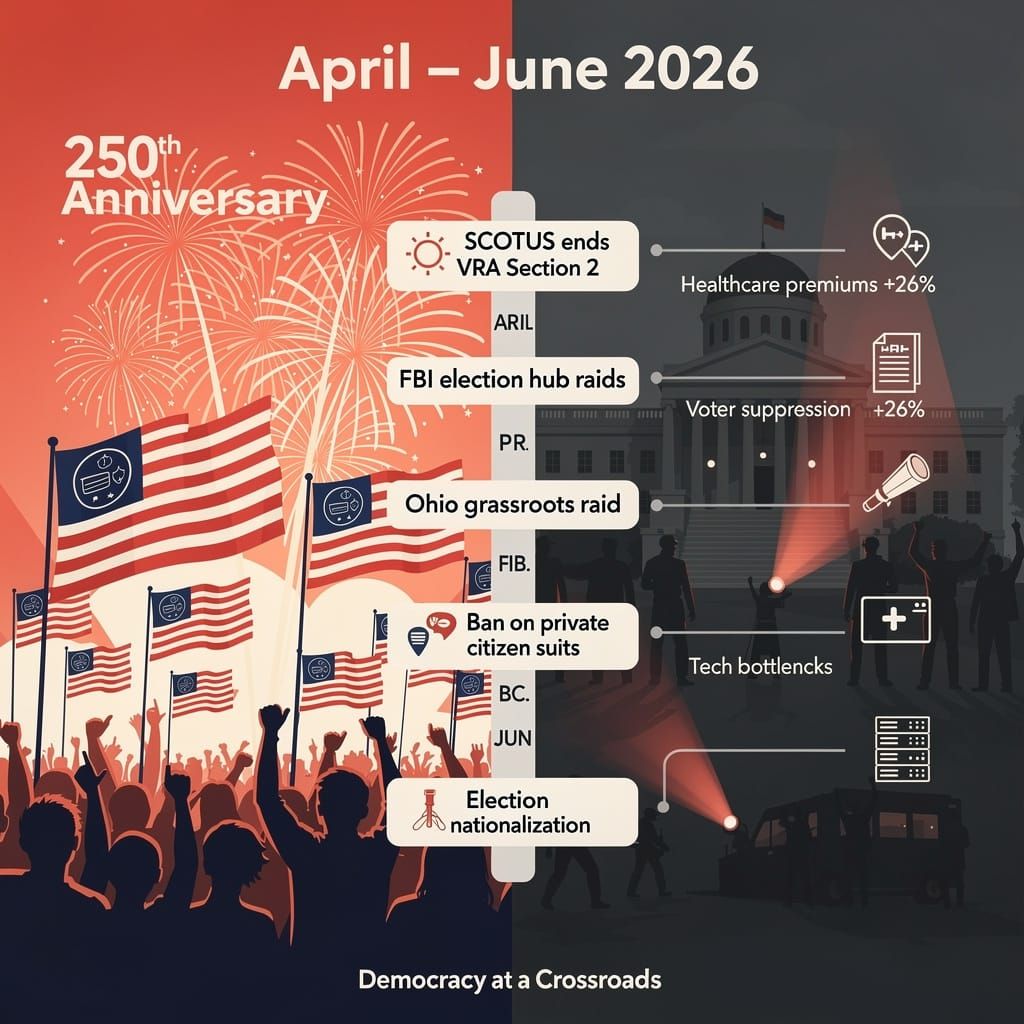
- April 29–May 18, 2026: SCOTUS invalidates VRA Section 2; Southern states accelerate partisan gerrymandering and suspend primaries.
- May 20, 2026: FBI and DOJ raid election hubs in GA, AZ, and MI, seizing ballot-processing equipment.
- June 17, 2026: 100 FBI agents raid Ohio grassroots organizers to "investigate" voter fraud.
- June 22, 2026: SCOTUS bars private citizen suits to enforce VRA Section 208, isolating enforcement to the DOJ.
- June 24, 2026: President Trump announces the "nationalization" of U.S. elections and appoints Bill Pulte to lead National Intelligence.
The Ripple Effect
It's not just about ballots; it's about budgets and bunkers. We're seeing a causal chain where political instability drives market volatility, which then hits your wallet.
Healthcare: Subsidy cuts $ ightarrow$ 26% premium hike $ ightarrow$ 17–26% enrollment drop. Electoral: VRA gutting $ ightarrow$ racially biased redistricting $ ightarrow$ systemic voter suppression. Tech: Trade wars $ ightarrow$ semiconductor bottlenecks $ ightarrow$ funding freezes for minority-led startups.
What's Next?
If you're betting on sudden harmony, check the odds. We're celebrating liberty while the government is fighting over a $1.8 billion anti-violence fund for January 6th supporters—a move a federal judge has already blocked.
- Short-term: Extreme volatility as 250th-anniversary optics collide with mid-term election pressures.
- Mid-term: Legal chaos as the "nationalization" of elections leads to the seizure of voting machines in swing states.
- Long-term: A total recalibration of election law, or a permanent democratic backslide.
So, quarter-millennium mark: are we a beacon of liberty or just really good at choreographed arguments?
🤯 Who Owns Your Vote?
25% of 'non-citizens' were actually citizens! 🤯 That is 1 in 4 people almost purged from democracy due to a database glitch. The courts just blocked the DOJ and DHS from a federal data grab. Privacy vs. Security: who wins? 🛡️ Michigan voters, does this change how you feel about your data?
Ever wonder if the federal government is snooping through your voter registration? For a chaotic stretch in June 2026, the courts stepped in to tell the Department of Justice (DOJ) to keep its hands off Michigan's data.
Here is the deal: The DOJ tried to pry into sensitive personal data—we're talking SSNs and birthdates—from Michigan voters. They claimed the Civil Rights Act gave them a golden ticket to this info to fight discrimination. Michigan Secretary of State Jocelyn Benson wasn't buying it, citing the National Voter Registration Act to keep the vault locked. On June 25, a three-judge panel from the Sixth Circuit delivered the punchline: the DOJ isn't entitled to that data.
Is the SAVE System Actually Safe?
While the DOJ was getting snubbed, the Department of Homeland Security (DHS) tried a different angle with the SAVE system. This wasn't just a glitch; it was a strategy born from President Trump's March 25, 2025, Executive Order 14248. The goal? Merge state voter rolls into a giant federal bucket to screen immigration eligibility.
Not so fast. On June 22, US District Judge Sparkle Sooknanan vacated those notices. The ruling indicates the plan stepped all over the Privacy Act and Social Security regulations. The stakes were high: a nine-judge panel in the LEW v. HHS suit confirmed that 25% of the individuals flagged as non-citizens were actually verified citizens. Imagine being purged from your own democracy because of a database error. Yikes.
The Fallout
- State Sovereignty: Michigan now possesses a legal shield, enabling state autonomy over rolls regardless of federal pressure.
- Privacy: Millions of SSNs remain gated, reducing the risk of centralized data breaches.
- Federal Reach: The executive branch faces a significantly limited capacity to enforce voter purge protocols via the Civil Rights Act.
- Democratic Access: Prevents the potential removal of up to 3% of U.S. citizens from voter rolls based on flawed data.
The Timeline
- March 25, 2025: EO 14248 mandates changes to the SAVE system for voter verification.
- June 22, 2026: Judge Sooknanan blocks SAVE implementation, citing privacy violations and invalid identification.
- June 25, 2026: Sixth Circuit denies DOJ access to Michigan's sensitive voter data.
- August 1, 2026: Federal law deadline prohibiting voter purges within 90 days of federal elections.
So, is your data forever safe? Hardly. Between the USPS drafting rules for mail ballot registries and the ongoing tug-of-war over the SAVE database, there is always a sequel. But for now, the judicial branch is acting as the bouncer, keeping federal agents out of the state archives.
📉 The Great Patriotism Gap
12x more likely: Democrats are hitting a pride cliff compared to GOP 📉. That's a massive ideological canyon 🇺🇸. With the top 1% holding 31.9% of wealth, is national pride just a luxury subscription now? US citizens — do you still feel the American Dream, or is it a glitch?
Ever wonder if we're all living in the same country? If you look at the latest data, the answer is: maybe not emotionally. A June 15, 2026, NBC News poll maps an ideological canyon splitting the U.S. population, and the view from the edge is pretty grim.
Who Actually Likes the Flag?
Your political affiliation is now a precise predictor of how much you love the homeland. While 56% of citizens rate their national pride as "extremely" or "very high," that is a steep drop from 70% in 2003. The real kicker? Democrats are 12 times more likely to report they are "not proud" than Republicans. (Yes, we're talking about a cliff, not a nuance.)
This isn't a glitch; it's a causal chain. Systemic critiques and brutal economic anxiety have decoupled civic identity from national symbols. We're seeing an era of extreme wealth concentration where the top 1% now holds 31.9% of total wealth—the highest since WWII. When Elon Musk becomes the world's first trillionaire via a SpaceX IPO while the bottom 50% struggle with net worths under $264,000, bragging about the wallpaper feels a bit surreal. This results in a feedback loop: progressives reject traditional nationalism, while Republicans double down on it as an identity marker.
The Breakdown
- Economic: Top 1% wealth share $\rightarrow$ 31.9% (2025) $\rightarrow$ fueled by stock booms and pro-business policies.
- Geopolitical: US-Iran airstrike escalations $\rightarrow$ Brent crude surge $\rightarrow$ persistent inflation and Fed rate-cut delays.
- Institutional: Trust in democratic futures down 33% since 2020 $\rightarrow$ erosion of the "meritocracy myth."
Where Do We Go From Here?
If we keep this trajectory, we aren't just arguing about tax brackets—we're arguing about whether the country is worth cheering for. We're seeing this play out in real-time as the California gubernatorial race and Nevada primaries intensify, deepening the polarization. With markets recently dropping 9.3% from all-time highs, the "American Dream" is looking more like a luxury subscription service.
- Late 2026: Midterm tensions peak; candidates weaponize identity while Trump's approval hovers around 37%, fueling GOP internal dissent.
- 2027–2028: A "civic vacuum" emerges where neither side agrees on baseline national values.
- Long-term: High risk of societal fragmentation unless an inclusive version of "American Pride" is engineered from the ground up.
(And let's be real: until we find a way to agree on the basics, we'll probably just keep polling ourselves into a panic.)


Comments ()