300+ Drones Intercepted: FBI Disrupts World Cup Security Breaches in US
TL;DR
- 300+ Drones Intercepted: FBI Secures FIFA World Cup Venues Amid Explosive Threat. Are the new authorized shoot-down rules for drones over major events an overreach or a necessity for public safety?
- 1,245 UK Cabin Incidents: Surging Air Violence Triggers National Blacklist Push. Should airlines implement a national blacklist to stop disruptive passengers from flying?
- 14,000 Flight Cancellations: Dual Typhoons Paralyze Japan's Aviation Infrastructure. Can Japan's aviation infrastructure withstand the increasing frequency of concurrent super-typhoons?
🚨 Securing the Skies: The FIFA 2026 Drone Crackdown
300+ unauthorized drones intercepted! This alarming surge is equivalent to a swarm covering entire stadium perimeters 🚨. FBI disrupted explosive plots and foreign breaches. Legal authority now allows shooting down UAVs? Security teams—do you feel these rules are too extreme for your city?
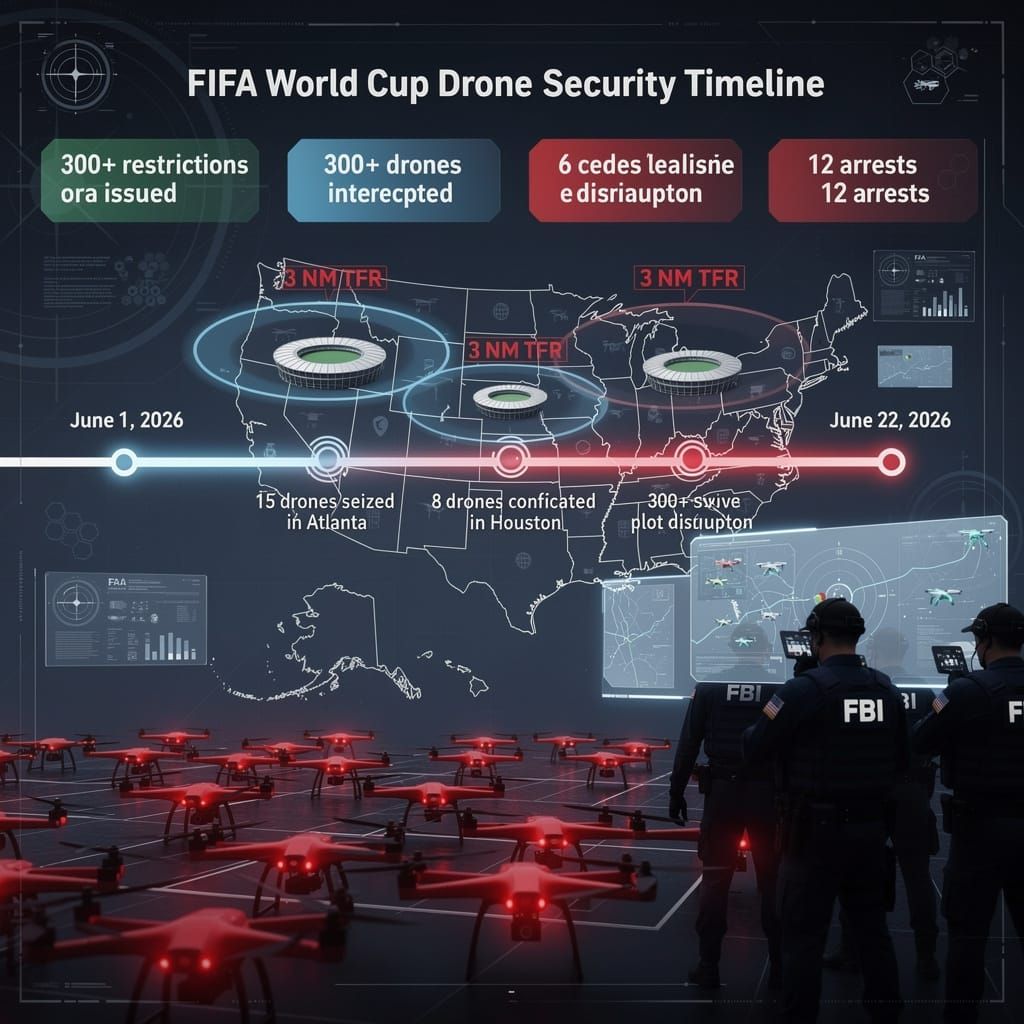
On June 22, 2026, the FBI intercepted 300 unauthorized drones across FIFA World Cup venues in the United States. This operation represents a critical escalation in airspace enforcement, following the disruption of a high-stakes plot to utilize explosive-laden FPV drones. The surge in activity follows a pattern of systemic incursions, including 15 drones seized near the Atlanta stadium on June 15 and eight units confiscated by Texas DPS in Houston on June 19.
Why the intensified enforcement?
The current security posture results from a convergence of organized threats and geopolitical tensions. Beyond casual violators, the FBI disrupted a June 14 plot by suspects including Tycen Proper to attack a UFC event at the White House South Lawn; the plan involved using drones to create panic and force evacuations toward sniper teams. Simultaneously, the Iran-linked group Handala claimed to breach FBI drone surveillance and threatened World Cup team transport. To counter these threats, the FAA activated Temporary Flight Restrictions (TFRs) from June 12 to July 19, creating no-drone zones within 3 nautical miles of key sites across 11 host cities.
- June 1, 2026: FAA imposes initial World Cup flight restrictions on stadiums and hotels.
- June 12, 2026: TFRs fully activate; Handala group claims breach of FBI surveillance feeds.
- June 15, 2026: FBI seizes 15 drones in Atlanta; Congress grants authority to shoot down threatening UAVs.
- June 16, 2026: FBI disrupts explosive drone plot targeting UFC Freedom 250 event.
- June 22, 2026: FBI intercepts 300+ units and arrests 12 individuals.
Security: 300+ drones removed $\rightarrow$ disrupted explosive plots and illegal aerial surveillance. Legal: Congressional authorization to shoot down drones $\rightarrow$ shift from passive monitoring to lethal interception. Technology: Use of RF hacking and AI tracking $\rightarrow$ attempt to counter FPV swarms and Signal-based coordination. Personnel: FBI launches counter-drone training $\rightarrow$ integration of local police into federal security protocols.
The scale of these interceptions demonstrates a causal chain where international sporting events attract both non-state actors and state-aligned hackers. This forces a reliance on aggressive geofencing and real-time intelligence, such as monitoring Signal chats to prevent pre-operational movements. The correlation between event density and incident rates indicates that these restrictions, along with the tactical authority to neutralize aircraft, will likely become the permanent blueprint for major public gatherings.
⚠️ The Crisis of Cabin Conflict
1,245 incidents: A staggering 218% surge in UK cabin violence since 2019 ⚠️ That's nearly 3 disruptive passengers every single day. Lack of security leads to fatal peer-restraints. Lawsuits or blacklists? Disruptive travelers — how safe do you feel on your recent flights?
Recent incidents in European and US airspace indicate a surge in passenger aggression and systemic failures in mid-air containment. Between May and June 2026, a pattern of escalating violence emerged, demonstrating the volatility of confined transit environments where intoxication, mental health crises, and security lapses intersect.
What Drives Cabin Volatility?
Data from mid-2026 demonstrates a causal chain where alcohol consumption and inadequate screening result in violent outbursts. In the UK, reported incidents of drunk or disorderly passengers rose from 390 to 1,245 since 2019. On June 22, a passenger on a Ryanair flight from Edinburgh to Palma de Mallorca assaulted a police officer after becoming intoxicated prior to boarding.
Simultaneously, on a Jet2 flight from Larnaca to Manchester, passengers restrained 30-year-old Callum Kerr after he allegedly headbutted another traveler; Kerr suffered a cardiac arrest during the restraint and died on June 25. These events indicate that when official security is absent or overwhelmed, peer-led restraint increases the risk of fatality. In the US, the FAA imposed a $165,000 fine on Alaska Airlines on May 27 for allowing intoxicated passengers on board, signaling a regulatory shift toward stricter alcohol enforcement.
Systemic Consequences
The inability to manage cabin conflict results in immediate operational and legal disruptions:
Operational: Safety evacuations and diversions cause cascading delays. A Frontier Airlines flight was rerouted on May 31 after a passenger attempted to open an emergency door and pushed against the cockpit door. Legal/Financial: Airlines are shifting from internal warnings to litigation. Ryanair has initiated legal action against passengers who caused flight diversions to seek damages; meanwhile, French courts have sentenced disruptive passengers to severe penalties. Institutional: The UK government is finalizing a national database to track and blacklist disruptive travelers, a move supported by 75% of the public in a YouGov survey.
Future Outlook
Projections indicate that stricter screening and data-sharing protocols will reshape airline operations, though they may increase compliance costs and trigger privacy concerns under GDPR.
- Q3 2026: Implementation of revised crew training for behavioral de-escalation and mental health resources.
- 2027: Integration of an industry-wide national blacklist to prevent repeat offenders from boarding.
- 2028: Deployment of standardized restraint protocols to eliminate high-risk peer-led interventions.
Crew Preparedness: Low $\rightarrow$ results in reliance on untrained passengers for restraint. Security Gaps: High $\rightarrow$ enables intoxicated passengers to bypass vetting. Passenger Risk: Elevated $\rightarrow$ increases probability of medical emergencies during physical containment.
🌪️ Meteorological Chain Reactions: Japan's Aviation and Infrastructure Crisis
14,000 flights canceled! This staggering collapse is like every single runway in a major hub freezing instantly 🌪️. High-velocity wind shear is crippling Japan's mobility. Can infrastructure ever keep pace with climate volatility? Travelers and logistics firms — how are you rerouting?
Concurrent strikes from Typhoon No. 6 and Typhoon Jangmi have destabilized Japan's integrated mobility ecosystem. The rapid intensification of these systems, driven by rising sea-surface temperatures and atmospheric instability, triggered large-scale flight cancellations and infrastructure stress across Kyushu, Okinawa, and the Kansai and Kanto regions.
How Meteorological Stress Impacts Operations?
High-velocity wind shear—reaching 162 km/h during Typhoon Jangmi—and record-breaking rainfall directly limit runway access and ground handling. This physical restriction initiates a causal chain: airport groundings lead to delayed crew deployments, which result in systemic cancellations. This instability extends to rail, where the suspension of the Tokaido Shinkansen forces passenger overflow toward already strained aviation hubs, amplifying congestion.
Operational Timeline
- May 28–30, 2026: National meteorological agencies issue warnings as Jangmi reaches super-typhoon status; flash floods occur inland.
- May 31–June 2, 2026: Typhoon No. 6 and Jangmi (Category 1) strike; >290 flights are canceled in the initial phase.
- June 1–3, 2026: Jangmi hits Okinawa and Wakayama; causes 616 ANA/JAL cancellations and evacuations for ~370,000 residents.
- June 3–4, 2026: Peak disruption with ~14,000 domestic flight cancellations.
- Mid-July 2026: Projected window for full stabilization of aviation and transport services.
Assessing the Systemic Impact
The correlation between extreme weather and economic instability is demonstrated by the disruption of global supply chains, contributing to volatility in U.S. equity markets on June 2. Furthermore, satellite data from NASA’s VIIRS indicates that atmospheric gravity waves linked to Super Typhoon Sinlaku altered upper-atmospheric dynamics, increasing turbulence and ionospheric disturbances.
Financial: Supply chain bottlenecks and reduced tourism $ ightarrow$ temporary slowdown in manufacturing and logistics. Cybersecurity: Atmospheric anomalies and power grid failures $ ightarrow$ heightened risk of data breaches and satellite communication interference. Logistics: >400,000 cumulative flight cancellations/reroutings $ ightarrow$ severe industrial productivity loss. Infrastructure: Record rainfall and storm surges $ ightarrow$ physical damage to communication hardware and drainage systems.
This event demonstrates the vulnerability of high-density transport corridors to concurrent meteorological failures. The recovery phase depends on the speed of infrastructure repair and the capacity of standby crews to clear the backlog, while the 2027 forecast indicates a requirement for resilience upgrades to mitigate intensifying climate conditions.
Comments ()