$75M Ransom Fraud: DigitalMint Consultants Betray Clients for BlackCat Gang
TL;DR
- $75M Ransomware Fraud: Security Consultants Collude with BlackCat in US. Would you trust a high-priced security consultant after learning they might sell your insurance limits to hackers?
- 12,000 Exposed Servers: CISA Deadline Hits SolarWinds as VPN Bypasses Trigger Global Security Chaos. Are your remote work security habits actually protecting your data, or are you just relying on luck?
- 100% CPU Spike: Anubis PoW Deployments in Fediverse Cripple User Hardware. Is your CPU melting to stop AI bots? How do you feel about disabling security plugins for site access?
🤡 The Ultimate Betrayal: When Your Security Guy is the Snitch 🤡
$75M+ in inflated ransoms is a brutal reality check 🤡 That's basically buying a small island while your 'security expert' sells your secrets. 🛥️ Consultants leaked insurance caps to BlackCat to maximize the loot. Corporate bloat vs. actual security? Victims of DigitalMint — would you trust a 'pro' again or go open-source?
Imagine paying a "security expert" to hold your hand during a ransomware attack, only to find out they're actually whispering your insurance policy limits to the hackers in the other room. Pure poetry. 💅
That’s the reality for the victims of the DigitalMint crew. While companies were sweating through their suits, Angelo Martino and his buddies were playing matchmaker between BlackCat (ALPHV) ransomware and the corporate coffers. It wasn't just a breach; it was a curated shopping list of who had the most cash and the weakest resolve.
How to Sell Out Your Clients 101
The scheme was simple: privileged access equals leverage. By leaking insurance caps and negotiation strategies via secure channels like Tox, Martino ensured the ransomware gangs didn't just ask for money—they asked for the exact maximum the insurance would cover.
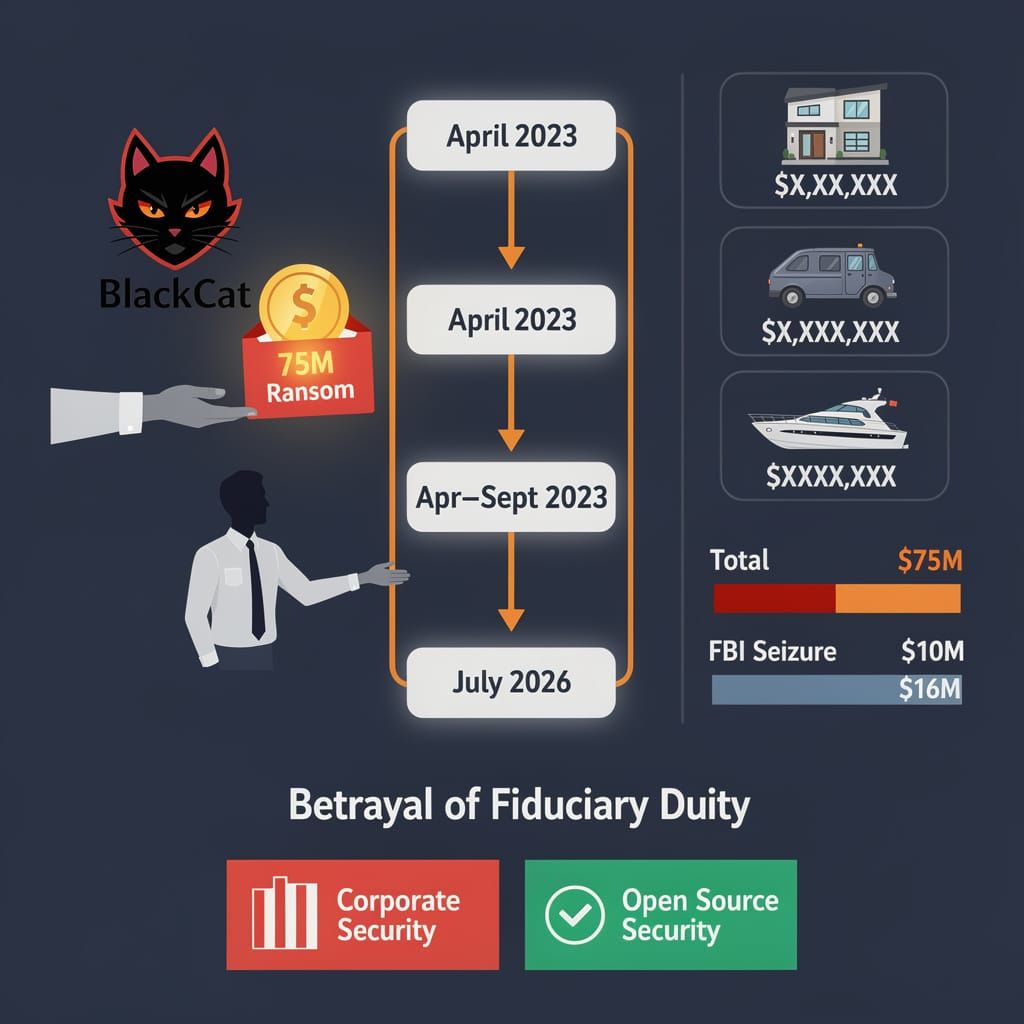
- April 2023: The double-agent operation kicks off; Martino begins sharing victim secrets with BlackCat operatives.
- April–Sept 2023: Collusion fuels inflated payouts for five victims, including a medical-device firm and a non-profit, totaling >$75 million.
- July 10–11, 2026: The party ends. Angelo Martino gets 70 months; Ryan Goldberg and Kevin Martin snag 48 months each.
The Damage Report:
- Financial: >$75M in inflated ransoms paid → $10M in assets seized by the FBI (homes, vehicles, and a fishing boat).
- The Loot: $1.3M initial extraction → laundered into a luxury yacht and a food truck. The "consultant" starter pack is real.
- Systemic: Total betrayal of fiduciary duty → demonstrating that the "experts" were the primary vulnerability.
Who Actually Won?
While the DOJ is patting itself on the back for recovering a boat, the real lesson is that the "Response Service" industry is often just a layer of expensive corporate bloat. Why pay for a high-priced firm when the guy in the fancy tie is just a glorified data broker for the dark web? 🗑️
Corporate Security: High fees → False sense of safety → Total betrayal. Open Source/Self-Hacking: Low cost → Actual visibility → No one to sell your insurance cap to BlackCat.
Enjoy the orange jumpsuits, boys. I’m sure the prison Wi-Fi is great for "consulting." ✌️
🤡 Oh Look, Another VPN List to Save Your Soul
12,000+ exposed servers are literally screaming "come in!" to hackers" 🤡. That's like leaving your front door open in a hurricane. CISA's patch deadlines are a joke while VPN passwords are being bypassed like a cheap screen door 🚪. Your home office is a welcome mat. Remote workers — are you actually secure or just lucky?
Congratulations! You’ve spent three years "working from home," which is corporate speak for "answering Slack messages while wearing underwear in a dimly lit bedroom." You probably think your network is secure because you changed your Wi-Fi password in 2021. Newsflash: your home office is basically a welcome mat for every script kiddie with a laptop and too much free time. 🙄
Who is actually protecting us?
While we were all pretending to be productive, Anthony Spadafora spent July playing digital janitor for Tom's Guide and TechRadar Pro. He spent two weeks obsessively testing VPNs and home office gear across the US and South Korea, because apparently, the only thing more chaotic than a Zoom call is a wide-open network port.
The result? A desperate attempt to stop "Phishing-as-a-Service"—because now hackers have a subscription model just like your overpriced SaaS tools. 🤡
- June 8, 2026: Check Point drops CVE-2026-50751, letting unauthenticated attackers bypass VPN passwords. Your "secure tunnel" is now a public hallway.
- June 19, 2026: CISA’s hard deadline for SolarWinds Serv-U patching. 12,000+ exposed instances were basically shouting "come in!" to the world.
- July 12, 2026: VPN torture tests conclude. Meanwhile, Surfshark drops a 3-year plan to $67.20 (via code VPN20) to lure in the budget-conscious before they get pwned.
- Q4 2026 (Projected): VPN adoption surges as users flee AI-driven scams and "Lucid Stealer" malware that targets 18 different browsers.
The Damage Report
Market Psychology: Shift toward affordable, encrypted tools as cost-reduction drives accessibility (e.g., Surfshark's 22% conversion uplift). 📈 Threat Detection: High-intensity AI-driven phishing and cloud misconfigurations now fuel global fraud losses. 👁️ Defense Tech: OpenAI drops GPT-5.5-Cyber to help defenders, because the hackers already have the AI advantage. ✨
The Reality Check:
- The Win: Norton VPN hits 92 countries and integrates Post-Quantum Encryption (PQE) into WireGuard. Finally, something for the apocalypse.
- The Fail: Between Cisco IOS CSRF bugs, the Nx Console supply chain attack (CVE-2026-48027), and Klue using long-lived OAuth tokens to raid Salesforce, remote work culture created a gaping hole that a VPN is trying to plug with digital duct tape.
So, go ahead. Buy the VPN. Setup the cabling. Pretend you're a cybersecurity pro while you continue to click on "Free PDF" links from strangers. Stay thirsty, you beautiful, vulnerable disasters. 🥂
🥵 Welcome to the Anubis Experience: Paying in CPU Taxes 🐕
100% CPU usage just to load a page—absolute madness 🥵. Your browser is now a space heater thanks to Anubis PoW. 🤡 Force-disabling JShelter to let a bot-blocker melt your laptop? Truly peak 'innovation.' Fediverse users—is your fan sounding like a Boeing 747 yet?
Imagine waking up, grabbing your coffee, only to realize your favorite site now demands a blood sacrifice from your processor just to load a landing page. That’s the "innovation" we’re dealing with this July. Some genius admin decided the Fediverse decided the best way to stop AI companies from scraping their data was to deploy Anubis—a cryptographic proof-of-work (PoW) system that essentially turns your browser into a tiny, miserable space heater. 🙄
Why is my browser screaming?
The "strategy" is peak corporate desperation: make the computational cost of access so high that bots give up. The problem? Humans are now paying the tax. Anubis leverages Hashcash-like challenges that eat CPU cycles for breakfast. To even get through the front door, admins are forcing users to disable JShelter plugins because the system demands modern JavaScript capabilities that privacy tools happily block. Because nothing says "secure environment" like forcing your users to strip away their own defenses to satisfy a resource-hungry gatekeeper. 🤡
The "Efficiency" Timeline
- May 29: Anubis recommended for Mastodon deployment to mitigate AI bot threats via custom policies. 🥵
- July 09: Anubis activates; site loading delays spike as admins target AI scrapers with computational barriers.
- July 13: Full deployment. JShelter is officially banned for users; "Plow-in-the-hole" system ramps up CPU consumption.
- July 14 (Now): High latency persists while admins "monitor adoption trends" for non-intrusive alternatives.
The Damage Report User Experience: JShelter disablement → stripped browser defenses → reduced privacy and increased latency. Hardware: High PoW requirements → massive CPU spikes → laptop fans sounding like a Boeing 747 taking off. Scrapers: Increased operational costs → bulk extraction disrupted → forced to pivot to non-JS methods.
The Corporate Cope
While the infrastructure is gasping for air, the official line is that this is a "temporary safeguard." In corporate-speak, that means: "We broke the UX, but the AI bots are also suffering, so we're calling this a win." They’re betting on "advanced fingerprinting" to eventually replace this brute-force approach, while the current costs of uncontrolled research scraping continue to cascade.
Who needs a streamlined experience when you can have a digital obstacle course? Just disable your security plugins, let your CPU melt, and enjoy the "protected" content. God bless the architects of friction. 💅



Comments ()