331 Votes: EU Fast-Tracks Chat Control 1.0 Surveillance Risk
TL;DR
- 331 Votes: EU Fast-Tracks 'Chat Control' Mass Surveillance via Procedural Loophole. Will the EU's 'Chat Control' mandate effectively kill end-to-end encryption for millions of citizens?
- £1 Billion Risk: UK Designates Big Four Cloud Giants as Critical Infrastructure to Prevent Systemic Collapse. Can government oversight actually prevent a systemic cloud collapse, or is it just more corporate red tape?
- 29 Android VPNs Leak Data: Check Point VPN Bypass Fuels Ransomware Surge in US/UK. Is your corporate VPN actually securing your data or just providing a false sense of security for hackers?
🤡 Summer Vacation: The Perfect Time to Kill Privacy 🏖️
331 votes just deleted your privacy while the opposition was sipping spritzes. 🤡 That's roughly 1 vote for every 10,000 people now getting their private chats scanned by a blindfolded gorilla. The EU just fast-tracked 'Chat Control 1.0' via a procedural loophole. E2EE is now just a cosmetic feature. European users — are you ready for the government to 'audit' your memes?
Congratulations to the European Parliament for discovering the ultimate life hack: if you want to strip millions of people of their digital privacy, just wait until half your coworkers are sipping spritzes in Tuscany. While the opposition was busy tanning, the Parliament utilized an "urgent procedure" to sneak through the revival of 'Chat Control 1.0.'
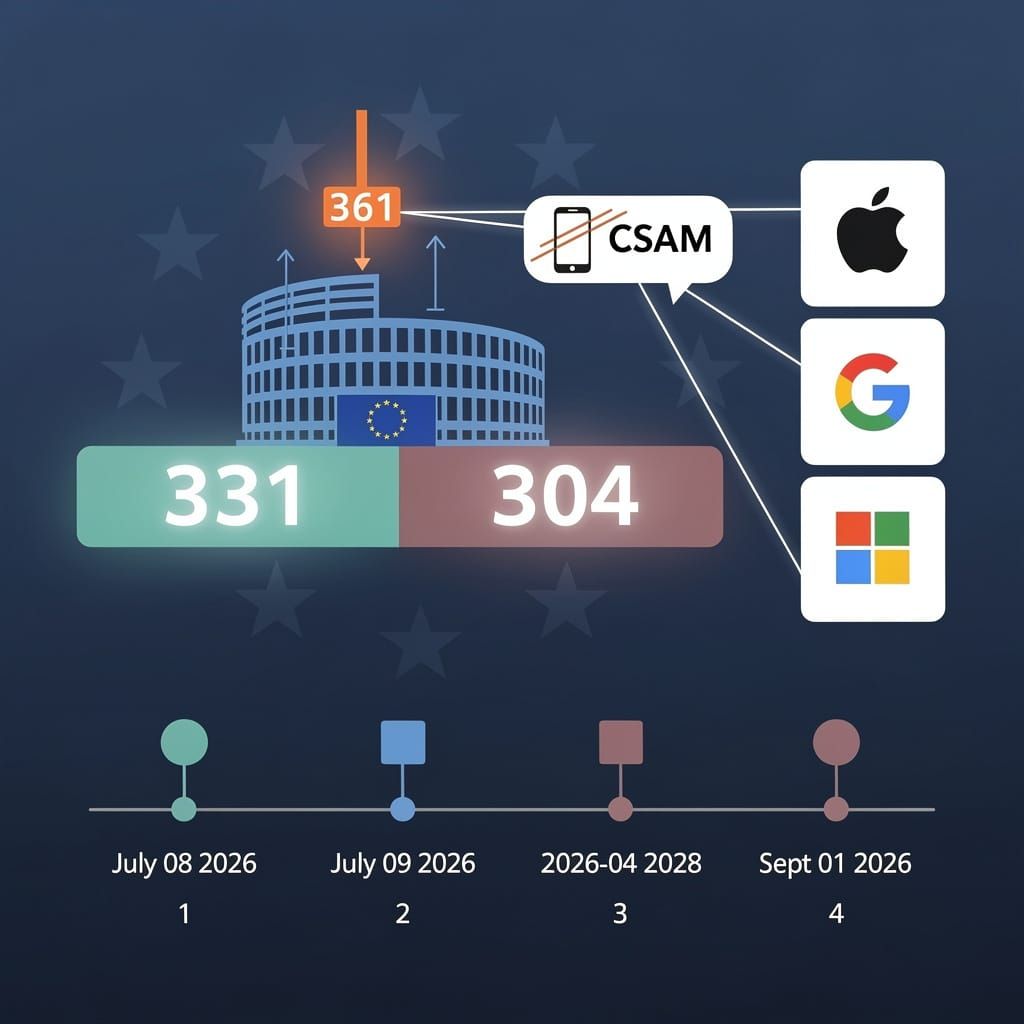
It’s a masterclass in corporate-state efficiency. On July 8, 2026, the Parliament passed the urgent motion with 331 yes votes against 304 no, fast-tracking a proposal that had been rejected earlier in the year. By the time the Council finalized the regulatory draft on July 9, the "adults" were out of the room, and the law cruised through by bypassing the 361-vote threshold required for the opposition to block the protocol. 🤡
Who is getting scanned?
This isn't a surgical strike; it's a digital carpet bombing. The mandate enables the big boys—Apple, Meta, Google, and Microsoft—to implement automated scanning of private chats for child sexual abuse material (CSAM). Apple already aligned with these "regulatory expectations" during WWDC on June 8, integrating enhanced child safety tools and parental controls into the ecosystem to ensure they're fully compliant with the new surveillance regime.
The Math of Failure:
- The Noise: Over 500 cryptographers have declared these scanning mechanisms technically unfeasible and inherently risky.
- The Result: Your innocent memes are now flagged by AI-driven behavioral analysis that’s about as precise as a blindfolded gorilla with a sledgehammer.
- The Outcome: A massive surveillance dragnet that ignores actual criminals using tools the EU can't touch, while creating new attack vectors for hackers to exploit.
The "Wait, What?" Timeline
- July 08, 2026: Urgent motion passed (331-304); Social Democrats and others fold to revive the expired April 2026 deadline.
- July 09, 2026: Council finalizes regulatory draft; Chat Control 1.0 is effectively adopted via accelerated procedure.
- 2026–April 2028: Active mass scanning across mainstream networks. Privacy is now a legacy feature.
- Sept 01, 2026: Debate begins on Chat Control 2.0, which threatens permanent mandatory decryption.
The Damage Report:
- Privacy: Total annihilation → E2EE is now a cosmetic feature for the naive.
- Security: On-device scanning → new vulnerabilities for dissidents and journalists.
- Governance: Procedural loopholes → democratic oversight deleted for "convenience."
Imagine spending billions on infrastructure just to ensure a government agent occasionally looks at a picture of your cat and wonders if it's a felony. Truly, the peak of regulatory brilliance. 🥂
Stay open-source or start practicing your "I'm just a tourist" face. See you in the logs!
🤡 The Cloud-Sized Single Point of Failure ☁️
£1 Billion lost in 24 hours. Absolutely mental. 📉 The UK just admitted the entire financial sector is one bad cloud update away from a digital dark age. 🤡 Now we just add more corporate paperwork to the chaos. Financial firms — how much are you paying for this 'safety blanket'?
Imagine paying a premium to put all your eggs in one basket, only for the government to tell you the basket is officially "Too Big to Fail." Congratulations: as of July 10, 2026, the UK has designated Microsoft, Google, Amazon, and Oracle as "critical third-party suppliers." Because nothing says "security" like admitting the entire financial sector is one bad update away from a digital dark age. 📉
Who’s Paying for the Safety Blanket?
The UK’s new resilience rules, hitting hard on July 13, attempt to stop outage propagation from nuking the banking and insurance sectors. The logic? If the cloud gods sneeze, the economy shouldn't catch pneumonia—especially after a hypothetical 24-hour outage on July 9 threatened UK firms with £650m–£1bn in immediate revenue losses. The "solution" is joint supervision from the Bank of England, PRA, and FCA. Translation: more corporate paperwork and mandatory performance benchmarks.
The Cost of "Safety":
- Compliance: Higher reporting burdens that likely delay innovation cycles. 💸
- Audit Burden: Firms scrambling to fund resilience testing while >80% of FTSE-100 firms remain tethered to these hubs.
- Reality: We're just formalizing the dependency while pretending the oversight is a shield. 🤡
The Timeline of Treading Water
- June 2026: EU tags AWS and Azure as "gatekeepers" under the DMA; red tape reaches peak levels.
- July 10, 2026: UK officially labels the Big Four as critical; the leash tightens.
- July 13, 2026: Direct regulatory oversight begins for Microsoft, Google, Amazon, and Oracle.
- Feb 2027: UK plans to ditch Palantir in NHS contracts to chase "digital sovereignty." Good luck with that. 🇪🇺
The Great Cloud Trade-off
The "Plan": Government oversight → forced resilience → fewer systemic collapses. The Reality: More audits → higher fees → the same fragile APIs.
Centralized Cloud:
- Strength: Scales instantly; manages the boring stuff.
- Weakness: A single zero-day (like the June 10 RoguePlanet exploit) or one rogue engineer in Seattle can wreck a country's banking ledger.
Regulatory Fix:
- Strength: Looks great in a press release.
- Weakness: Adds massive overhead without fixing the code. With 51.9% of code now AI-authored and PR sizes doubling, we aren't building resilience—we're just automating technical debt at scale. 🐌
Basically, we've just legalized the monopoly by calling it "critical infrastructure." Stay thirsty, keep your backups on an actual hard drive, and enjoy the audits! ✌️
🤡 The VPN Security Theater 🤡
29 free Android VPNs leak your history—basically a digital strip club for hackers 🤡. That's a 10% failure rate for 'privacy' tools. Your secure tunnel is just a highway for Qilin ransomware. Stop paying for a monthly lie. 💀 Corporate drones — is your 'security' just a VPN and a prayer?
Imagine paying a monthly subscription for a "secure tunnel" while your corporate-mandated laptop screams in agony because you're using a 2014 router and a password that is literally just your dog's name. Welcome to the remote work utopia, where we pretend a VPN solves the systemic failure of basic digital hygiene. 💀
Why are we still failing at this?
Recent carnage from mid-2026 demonstrates that while we're obsessed with the tools, the habits remain a dumpster fire. We've shifted to hybrid models, which is just corporate speak for "you're now responsible for your own IT budget while we track your keystrokes."
The causal chain is a comedy of errors: Remote work ➡️ shitty home networks ➡️ desperation for a "magic button" (VPNs) ➡️ a false sense of security that makes you click every phishing link in your inbox. 🎣
- May 7–June 2026: The Qilin ransomware group turns the "secure" tunnel into a highway, weaponizing CVE-2026-50751 to bypass authentication in Check Point VPNs via outdated IKEv1 protocols.
- July 8–10, 2026: Reality check—researchers using MVPNalyzer reveal that out of 281 free Android VPN apps, 29 leak DNS queries and browser history, with five allowing total tunnel hijacking via plain-text config files.
- August 2026 (Projected): SMBs will continue blindly buying subscriptions they don't understand until the next zero-day bypass makes their "perimeter" irrelevant.
The "Protection" Metrics
VPN Adoption: Spike in sign-up rates → users in the UK and US (Utah) treating VPNs as the only shield against aggressive new government age-verification laws. Detection Speed: Instant → Modern DPI systems now fingerprint OpenVPN and WireGuard handshakes via serverHello formats and packet metadata. You aren't invisible; you're just a known signature. Trust Index: In the gutter → From "no-logs" lies to the 2026 onslaught of data-mining critiques targeting Turbo VPN, the industry's monetization model is basically "sell your soul for a different IP." Vulnerability Rate: Critical → From Palo Alto's Pan-OS bypass to the Check Point IKEv1 disaster, the industry is just a revolving door for threat actors.
The Reality Check:
- The Lie: "One click and you're invisible!"
- The Truth: Your ISP knows, the government knows, and free Android apps are leaking your device fingerprints to the highest bidder.
- The Fix: Use VLESS + REALITY for actual obfuscation, embrace open-source, and stop the corporate worship of SaaS bloat.
Stop trusting the glossy brochures. If your "security strategy" is just a VPN and a prayer, you're not protected—you're just an optimist with a monthly bill. 💅


Comments ()