20% Recruitment Decline: Open-Access Vocational Intelligence Disrupts Traditional Hiring in Global Job Market
TL;DR
- 20% Recruitment Drop: Open-Access Vocational Forums Rise to Bridge Job Market Gap. Can open-access community intelligence effectively replace traditional professional mentorship in a declining job market?
- 93% Tool Cost Drop: Visual Studio Price Crash Sparks Microlearning Pivot in US Tech. Will low-cost software bundles and modular certifications replace traditional computer science degrees for new developers?
📉 The Rise of Open-Access Vocational Intelligence
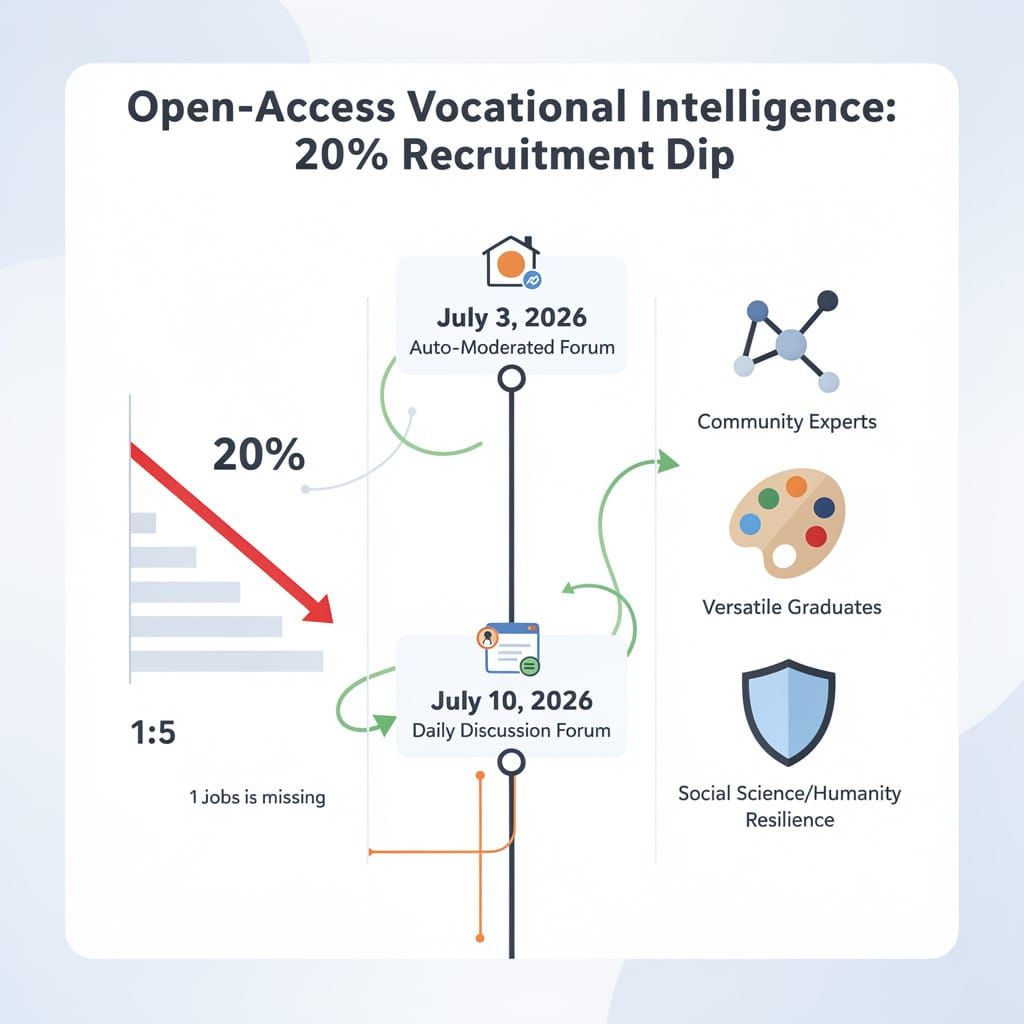
20% recruitment dip: staggering. That's 1 in 5 jobs gone compared to pre-pandemic levels 📉. Open-access forums are now bypassing gated mentorship to fill the void. Will community intelligence replace traditional degrees? Versatile graduates — is this how you'll land your next role?
Digital professional development is shifting from gated mentorship to open-access community intelligence. The launch of two consecutive free-floor question platforms in July 2026 indicates a structural change in how emerging contributors acquire career guidance. By removing traditional educational gatekeepers, these forums enable direct knowledge transfers between industry experts and job seekers.
How Community-Led Guidance Scales
This transition follows a dual-phase deployment. An initial forum launched on July 3, 2026, utilizing auto-moderation to manage basic user submissions across various expertise tiers. On July 10, 2026, a daily discussion forum expanded this utility, focusing specifically on career, education, and field-specific inquiries. This sequence expanded the capacity for query complexity, facilitating a move from basic questions to nuanced vocational navigation.
The correlation between these launches and user behavior demonstrates that accessibility tools increase confidence in skill acquisition. This is critical as traditional pathways falter; July 5, 2026, data from Forbes indicates that social sciences and humanities graduates—such as those in philosophy and anthropology—demonstrate greater employability resilience compared to specialist tracks, despite a broader recruitment decline of 20% versus pre-pandemic levels. This resilience drives demand for peer-verified career paths to translate versatile degrees into professional placement.
Adoption Roadmap
- July 2026: Launch of auto-moderated and daily forums, establishing the first quarterly record of organic expert-response activity.
- Q3 2026: Expansion of query complexity and integration of diverse expertise tiers to counter rigid academic pathways.
- Q4 2026: Projected sustained usage across learner cohorts, cementing community-led advice as a primary tool to bridge the gap between degree completion and professional placement.
Systemic Impacts
- Accessibility: Removal of gatekeepers $→$ expanded reach for non-traditional learners and versatile degree holders.
- Confidence: Direct expert interaction $→$ increased user certainty in navigating skill paths amid a 20% recruitment dip.
- Knowledge Flow: Peer-to-peer exchange $→$ faster dissemination of real-time market requirements.
Operational Strengths & Gaps
- Strengths: High scalability via auto-moderation; low barrier to entry; organic expert participation.
- Weaknesses: Reliance on volunteer expertise; potential for inconsistent advice quality across tiers.
This shift toward open-source professional growth enables a more fluid labor market where transferable skills are identified and validated through community consensus rather than static certifications, addressing the persistent disparities between educational attainment and actual employment outcomes.
📉 The Microlearning Pivot: Lowering Barriers to Technical Entry
93% price drop! A staggering plunge in tool costs—comparable to a luxury suite becoming a budget hostel 📉. Integrated bundles are erasing financial barriers to enter tech. Can modular certifications finally kill the degree? Freelancers and students — are you switching to microlearning?
Recent shifts in software pricing and bundled offerings indicate a strategic move toward lowering the cost of entry for professional technical skills. Between June and July 2026, aggressive price reductions for industry-standard tools coincided with the launch of integrated learning packages targeting independent creators and small-scale development teams. This trend aligns with a systemic shift where AI adoption and falling entry barriers enable individuals to create custom software solutions, reducing reliance on traditional commercial licensing models.
How do low-cost bundles accelerate skill acquisition?
Price volatility in professional IDEs has transformed high-cost tools into accessible utilities. Microsoft Visual Studio Professional 2026 saw several deep discounts: it launched at $34.97 on June 15, dropped to $32.97 on June 18 during "Deal Days" (a 93% reduction from the $499.99 MSRP), and was available for $34.99 via the "JULY30" promo code on July 4. These reductions remove financial friction, enabling a transition toward "microlearning," where high-utility software is paired with short-form, certification-based training.
The viability of these non-degree pathways is demonstrated by recent academic shifts. For example, a remote BS in Computer Science student successfully replaced three core modules with recognized Google and IBM certifications, accelerating their path to graduation and global market validation. This demonstrates a causal chain where commoditized tools and modular certifications allow learners to bypass traditional institutional bottlenecks.
Market Progression
- June 15–18, 2026: Visual Studio Pro 2026 prices drop from $499.99 to $32.97, establishing a low-cost baseline.
- July 4, 2026: Targeted promotional codes maintain accessibility at $34.99.
- August 2026 (Projected): Expansion of similar microlearning packages across productivity and development sectors.
Operational Impacts
- Conversion: Increased uptake among freelancers as AI-driven automation replaces routine labor in traditional SaaS roles.
- Productivity: AI-powered code completion and .NET 10 support accelerate project iteration speeds.
- Accessibility: Reduced licensing costs enable faster team deployment for mid-sized firms.
By commoditizing tools, providers now compete on the value of learning outcomes rather than license fees. This evolution projects a future where technical proficiency depends less on institutional funding and more on tiered digital solutions. Consequently, the job market is shifting toward service-based models, where value is derived from specialized judgment and strategic decision-making rather than tool ownership.



Comments ()