2.3 Million Spam Incidents Erased: AI-Driven Networking Pivot in US Recruitment
TL;DR
- 2.3 Million Spam Incidents Removed: Reddit AI Shift to Peer-to-Peer Recruitment. Is AI-driven peer-to-peer networking more effective than traditional job boards for finding high-trust professional connections?
- 2x Spike in AI Job Demand: Technical Forums Disrupt Traditional Hiring in 2026. How is the rise of technical networking forums changing your approach to career growth and job searching?
- 12 Million Job Shifts: Virginia Universities Launch AI Programs to Combat Automation Risks. Will AI-focused degrees in Virginia successfully bridge the gap between automation and human judgment in the job market?
🛡️ The Automation of Networking: Peer-to-Peer Recruitment Experiments
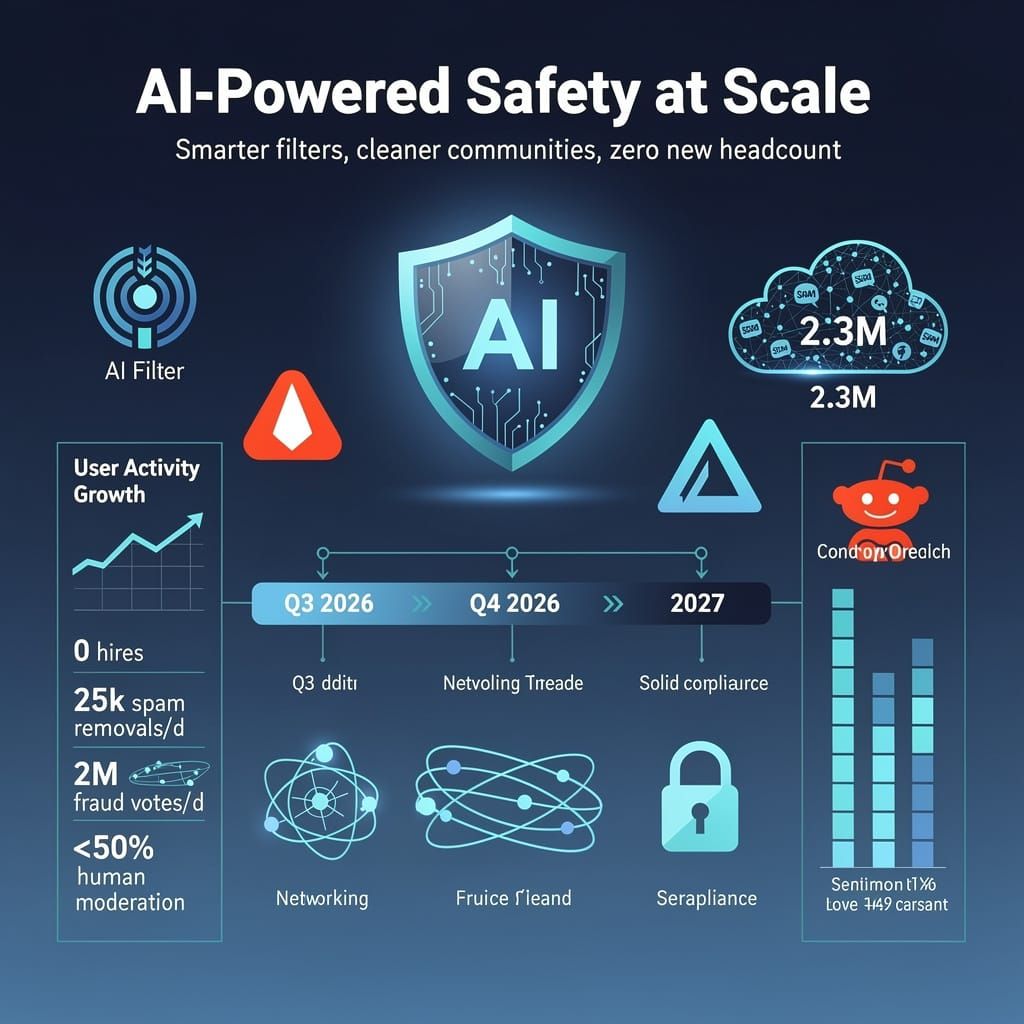
2.3 million spam incidents erased. A massive cleanup equivalent to purging thousands of digital billboards in a heartbeat 🛡️. AI-driven filters now cut spam exposure by 20%. High-trust networking vs. immediate hiring: who wins? Startup founders — is your local community shifting to AI-led vetting?
Platform administrators are shifting recruitment dynamics by replacing traditional job boards with structured, automated networking threads. This transition aligns with a broader industry push toward AI-driven moderation to combat synthetic influence. On July 6, 2026, the deployment of advanced AI-driven anomaly detection on Reddit demonstrated a strategic move toward filtering generative optimization (GEO) and protecting community integrity, prioritizing peer-to-peer credibility over standard corporate outreach.
How Does Automated Peer-Networking Function?
The process follows a strict causal chain of engagement and moderation. In early June, platform analysis of job seeker communities revealed that traditional posting often led to rapid bans and limited conversion potential. To counter this, the framework mandated a specific submission format by June 15: Company Name, Pitch, Preferred Contact Method, and Link.
This structured data collection enables the system to monitor activity levels and adjust rules monthly. This technical response results in a reduction of spam and an increase in high-intent interactions. By July 7, 2026, these AI classifiers removed 2.3 million spam incidents, reducing user exposure to spam by 20% and decreasing human moderation dependency to below 50%.
Engagement Metrics:
- User Activity: Positive growth in social and career-related interactions.
- Conversion Rate: 0 hires reported to date; system prioritizes networking over immediate placement.
- Compliance: Automated bans remove ~25,000 spam posts and 2 million fraudulent votes daily.
What are the Long-term Projections?
Stable engagement patterns indicate that structured threads will transition from experimental phases to permanent community fixtures.
- Q3 2026: Transition to weekly automated threads to maintain consistent user visibility.
- Q4 2026: Integration of refined compliance frameworks to scale founder-to-founder matchmaking.
- 2027: Shift toward data-driven matching based on sentiment analysis tracked since June.
Analysis of the Peer-Sharing Model
Strengths: High community trust; efficient spam mitigation via AI classifiers; low barrier to entry for founders. Weaknesses: Lack of immediate conversion (hiring); reliance on user-initiated outreach; risk of adversarial AI evolving. Comparison: Traditional boards prioritize volume → Automated threads prioritize peer-to-peer credibility. Impact: Medium-scale influence on startup community dynamics and the preservation of digital sanctuaries against synthetic influence.
📈 The Automation of Career Guidance
2x AI job postings in just one year—a staggering leap 📈. One candidate even cleared 57 technical interviews to secure a premium salary. Technical forums are replacing traditional mentorship. Is your network keeping up? Job seekers — how has your strategy shifted in your city?
The integration of technical skill discussions into professional networking forums indicates a shift in how laborers acquire career intelligence. Between May 28 and June 11, 2026, weekly industry discussions focusing on Python applications emerged, evolving into a daily 24-hour workforce-focused thread cycle by July 9, 2026. This pattern demonstrates a correlation between technical literacy and perceived career mobility, as job postings requiring AI skills doubled between 2025 and 2026.
How Technical Forums Shape Hiring Trends?
The rise of these threads results in an informal repository of career guidance. When users bypass traditional recruitment channels to discuss skill application, it enables a faster exchange of real-world salary benchmarks. This decentralized approach is mirrored in high-stakes transitions; for example, one candidate on June 22, 2026, conducted 57 technical interviews across 11 companies, leveraging advanced research skills like tokenization to secure roles with significant salary premiums.
However, the persistence of off-topic discussions shows a tension between platform governance and user-driven content volume.
Operational Impact:
- Moderation: Increased non-compliant posts → higher operational load for community managers.
- Knowledge Access: Rapid skill-based advice → lower barriers for career switchers.
- Content Quality: High frequency of repetitive threads → dilution of technical depth.
Evolution of Skill-Based Networking
Reliance on formal mentorship programs decreases in favor of peer-to-peer technical networking and community-led initiatives. The Sovereign Tech Fellowship (restarted June 12, 2026) exemplifies this, utilizing open-source contributions to Python 3.14 and 3.15 to drive growth. This shift occurs as the labor market becomes "feast or famine," with growth in AI engineering and skilled trades offset by automation-driven layoffs in retail and customer service.
- July 2026: Initiation of daily workforce threads focusing on Python's cross-industry versatility.
- Q3 2026: Projected rule enforcement adjustments to balance content volume with relevance.
- 2027 Projection: Integration of automated moderation tools to categorize queries, reducing manual operational load by an estimated 20%.
This trend indicates that professional growth is increasingly tethered to active participation in technical communities. The ability to navigate these informal networks enables professionals to identify industry shifts—such as the demand for AI-bilingual workers signaled by Singapore's 100,000-worker goal in June 2026—before they appear in official labor statistics.
📉 Virginia’s Academic Pivot to AI Integration
12 million Americans will need new careers due to AI 📉—a shift equivalent to entire city populations. This is a critical pivot ⚠️. Virginia universities are now launching AI degrees to stop the 'signal collapse' in hiring. Can human judgment survive automation? Virginia students—will this save your first job?
On July 6, 2026, multiple Virginia higher education institutions launched a coordinated suite of AI-focused academic programs. This rollout includes George Mason University’s MA in Artificial Intelligence, the University of Mary Washington’s MS in Business AI, and Virginia Tech’s AI minor, which opens enrollment on August 3 with an 18-credit curriculum covering ethics and interdisciplinary modules. Complementing these degrees, Roanoke College established the WorkAI Lab to target professionals, while the University of Virginia piloted AI literacy courses to provide interdisciplinary training.
Why the Synchronized Rollout?
A shift in employer hiring priorities drives this integration. Surveys indicate that AI is reducing entry-level demand as tech firms adopt AI for task delegation, while universities have historically lagged in adaptation. This creates a need for "dual competency" frameworks—combining computational fluency with human-centric skills.
Recent corporate reversals demonstrate the risks of over-automation. On July 1, 2026, Ford Motor Company began rehiring hundreds of veteran engineers after AI-based quality inspections failed due to a lack of contextual knowledge. Similarly, the Commonwealth Bank of Australia reversed 40 customer-service layoffs following AI bot performance shortfalls, and IBM tripled entry-level hiring after its AI HR automation failed to handle non-routine tasks. These events indicate that regional businesses require a workforce capable of augmenting human labor, as restored human judgment directly correlates to operational accuracy.
Implementation Timeline
- July 2026: Launch of specialized MA/MS degrees, AI minors, and the WorkAI Lab across Virginia campuses.
- August 2026: Virginia Tech opens AI minor enrollment to all undergraduates.
- 2026–2030: Projected workforce shift as McKinsey estimates 12 million Americans will need to switch occupations due to AI adoption.
Institutional Impact and Constraints
While the rollout responds to market trends, scalability depends on faculty capacity and the ability to bridge the "signal collapse" in hiring caused by AI-generated resumes flooding job boards.
Capacity: Decreasing adjunct availability → limits new course additions after the summer quarter. Financials: Low initial implementation costs → minimal institutional resistance to adoption. Enrollment: Surge in AI adoption among college seniors → drives increased application volume in AI-related fields. Funding: Stable state-level allocations → shift is currently self-funded or integrated into existing budgets.
This movement represents an incremental adaptation to employer pressure. Long-term success hinges on whether institutions can upskill faculty to match industry demand and mitigate the systemic displacement risks predicted by global analysts.


Comments ()