443,604 US Job Cuts: AI-Driven Displacement and the Rise of Strategic Sabbaticals
TL;DR
- final_result. Is your current time management strategy actually wasting 89% of your work week?
- 100,000+ Tech Job Cuts: Python Communities Emerge as Critical AI Pivot Hubs. How are you using technical communities to pivot your career amid the current wave of AI-driven tech layoffs?
- 443,604 US Job Cuts: AI-Driven Layoffs Spark Shift Toward Strategic Sabbaticals. Can a strategic sabbatical and personal branding provide more career security than traditional corporate employment in the AI era?
📉 The Productivity Pivot: Quantifying Time Management
final_result
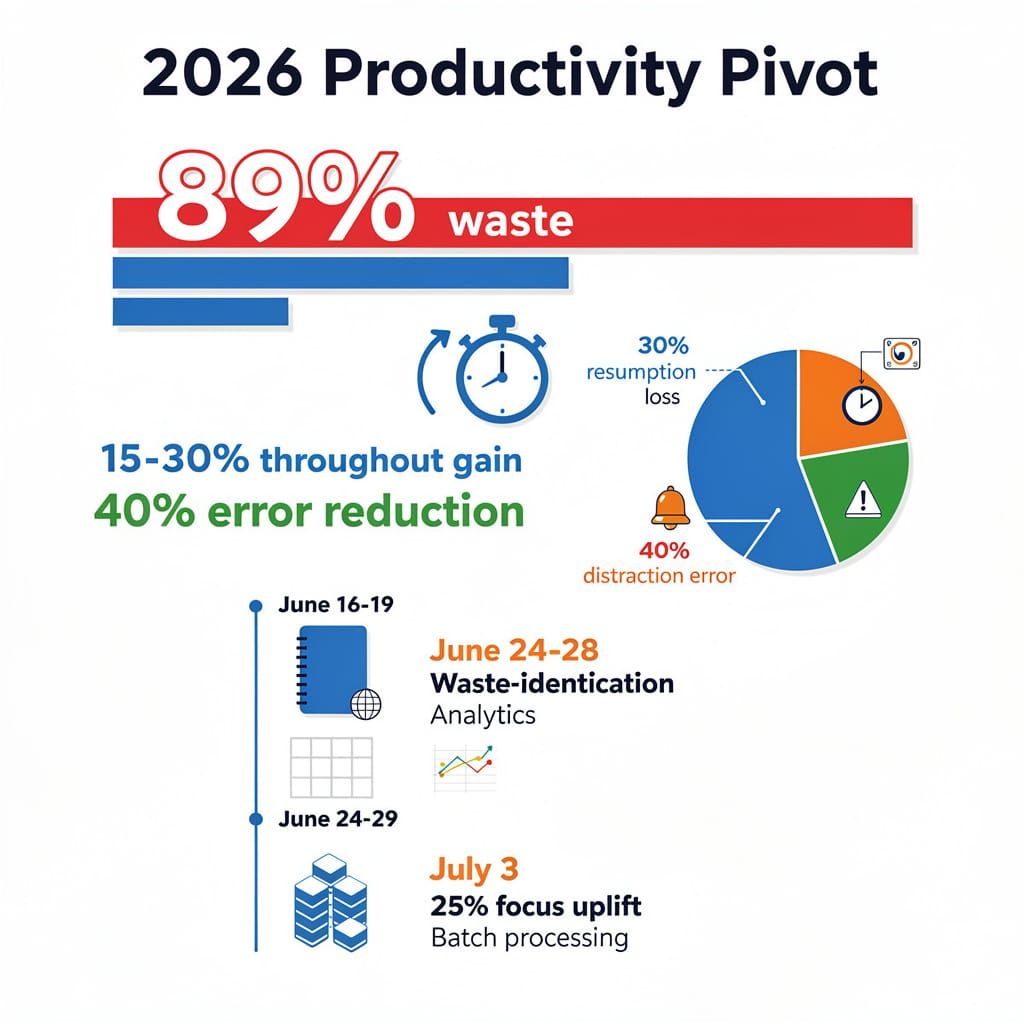
Professional efficiency in 2026 is shifting from passive scheduling to systematic time-tracking. Data from June 2026 indicates that professionals implementing structured processes—starting with comprehensive weekly logs—identify significant workload misallocation, with some data points showing up to 89% of weekly work hours are wasted. By applying the Eisenhower Matrix and timer-based sessions, professionals reallocate labor toward high-value tasks to optimize strategic output.
How Does Systematic Tracking Impact Performance?
The transition from multitasking to single-tasking results in measurable efficiency gains. Reports from July 2026 link digital distractions to significant productivity losses; specifically, session interruptions cause workflow resumption losses averaging 30%, which directly impacts project management productivity. This cognitive fragmentation contributes to a 40% increase in distraction-induced errors when multitasking.
Operational Impacts:
- Efficiency: 15–30% daily throughput increments linked to single-tasking and reduced switching costs.
- Accuracy: 40% reduction in errors through the elimination of multitasking.
- Well-being: Lowered stress and delayed burnout onset via scheduled breaks and reduced cognitive load.
The Implementation Timeline
Adoption patterns demonstrate a progression from awareness to habitual execution:
- June 16–19, 2026: Publication of daily productivity planners and global adoption of the Eisenhower Matrix and Pomodoro Technique.
- June 24–28, 2026: Identification of wasteful employment data and integration of priority-sorted matrices.
- July 3, 2026: Formalization of "time mastery" guidance, merging digital task lifters with batch processing to achieve a 25% focus uplift.
Strategic Outcomes
While automation tools aid execution, behavioral pacing remains the primary driver of success. The causal chain moves from visibility (tracking) to analysis (priority sorting) and finally to execution (batch processing). This sequence recovers productivity and mitigates the economic burden of mental health crises. In Australia, the financial pressure of the current economy acts as a chronic stressor, while the Reserve Bank and analysts monitor market volatility that threatens long-term stability.
Current Framework Trends:
- Strengths: High scalability; 15–30% measurable ROI in individual output.
- Weaknesses: Requires high initial discipline for behavioral adherence.
- Comparison: Systematic tracking outperforms calendar blocking by identifying hidden time-leaks and reducing idle duration.
The scaling of these personal productivity frameworks projects a continued increase in individual output across high-pressure corporate domains.
📉 The Python Pipeline: Informal Networking in Technical Communities
100,000+ tech jobs cut—a staggering wave of displacement 📉. This equals thousands of professionals suddenly competing for fewer seats. As AI automation replaces roles, informal Python communities are becoming the new career lifelines. Community trust vs. systemic risk? Tech workers — how are you navigating this pivot?
Community-driven career threads have shifted from sporadic discussions to structured, daily assets. Recent activity patterns indicate that Python-centric workforce threads now function as primary hubs for informal career guidance and skill-mapping, emerging as a critical response to systemic volatility in the tech sector.
How Community Volume Drives Career Access?
The proliferation of these discussions results from a causal chain between platform incentives and a surge in user demand for real-time labor market data, triggered by large-scale workforce displacement. Recent data shows a trend of 100,000+ tech-industry job cuts, with major firms like Cisco (~4,000 cuts), Intuit (3,000 cuts), and Standard Chartered (>7,000 cuts) pivoting toward AI-driven automation. This environment demonstrates a correlation between open-access technical forums and the rapid dissemination of emerging skill requirements, as users seek pathways toward production-grade AI systems to avoid displacement.
Operational Impacts
- User Access: Provides peer-to-peer guidance on Python utility, reducing reliance on formal coaching amid mass layoffs.
- Moderation: Higher content volume increases the load on managers to filter noise caused by AI-generated code and oversized pull requests.
- Knowledge Flow: Accelerates the identification of high-value certifications, such as the Advanced AI Engineer Certificate launched by Saras AI Institute, Microsoft, and Google.
What is the Long-Term Outlook?
As these informal networks scale, the tension between volume and quality indicates a transition toward rigorous moderation. This shift is necessitated by a critical sustainability crisis in open-source maintenance: maintainers continue to respond to bug reports without remuneration, relying on community trust while security vulnerabilities accumulate in libraries distributed via platforms like npm. This lack of compensation leads to high attrition and systemic risk.
- Q3 2026: Implementation of automated relevance checks to reduce off-topic drift by an estimated 20%.
- 2027: Integration of verified professional tags to distinguish entry-level advice from executive-level insights.
- 2028: Shift toward structured "Career Wikis" derived from daily threads, projecting a 30% increase in searchable professional resources.
Community Analysis
- Strength: High velocity of information; real-time feedback on pivots toward AI-bilingual roles.
- Weakness: Lack of verified credentials; susceptibility to anecdotal bias and AI-generated misinformation.
- Opportunity: Direct recruitment pipelines between community experts and managers facing talent scarcity.
- Threat: Operational burnout for moderators, mirroring the collapse of unremunerated public maintenance models.
📉 The Great Disconnect: Redefining Professional Growth Through Sabbaticals
443,604 job cuts in the US—a staggering scale equivalent to losing an entire mid-sized city's workforce 📉. With AI driving 31% of losses, the traditional corporate ladder is fracturing. Could a strategic sabbatical be the new way to pivot? Professionals: would you risk a gap year for a personal brand?
Modern workforce transitions are increasingly characterized by automation-driven restructuring. As of July 2026, U.S. employers reported 443,604 job cuts—the second-highest figure since 2020—with AI adoption accounting for 31% of these losses. This instability coincides with a systemic collapse in morale; Gallup reports on July 9, 2026, that global worker engagement has dropped to a record low of 20%. This disengagement results in an estimated $10 trillion in annual lost productivity, driven largely by a decline in manager engagement, which fell to 22% from 27% in 2024.
Can Radical Disconnection Drive Career Leverage?
The case of Anuja Bagri demonstrates a causal chain where professional burnout leads to intentional disconnection. Following a health crisis and the end of a relationship, Bagri resigned from her consulting role and spent 22 months traveling worldwide alone. This hiatus functioned as a psychological reset, increasing her self-trust scores by approximately 40% and reducing chronic fatigue.
Rather than resulting in a professional gap, this period enabled the construction of a digital ecosystem. Bagri expanded her online presence, generating an average of 8,000 monthly followers across three platforms. In a creator economy where brands prioritize community trust over vanity metrics, this digital footprint transforms unemployment into a visible portfolio of autonomy, enabling a sustainable income stream and the capacity to negotiate flexible livelihood paths.
Transition Timeline
- July 2024–July 2026: 22 months of global solitary travel and professional disconnection.
- September 2026: Termination of Chicago residential lease, signaling a shift away from traditional urban hubs.
- Q4 2026: Expected completion of visa processing for resettlement, establishing a base for new ventures.
Strategic Impacts Psychological: Reduced burnout symptoms → 40% increase in self-trust and strategic cognitive capacity. Professional: 8K average monthly followers → transition from consulting to a personal brand and sustainable income. Financial: Lease termination → reduction in fixed overhead costs, lowering the risk threshold for career pivots.
This trajectory indicates a shift where "gap years" function as strategic reskilling periods. By prioritizing wellness and digital brand building over linear corporate climbing, individuals create a portable professional identity. Bagri's current movement—from a wellness retreat in India toward formal resettlement—demonstrates how geographic independence and a curated online presence enable a transition from traditional employment to a self-directed, fluid career model.


Comments ()