$66M Tech Gap: Georgia Extends QR Voting Amid Budget Crisis
TL;DR
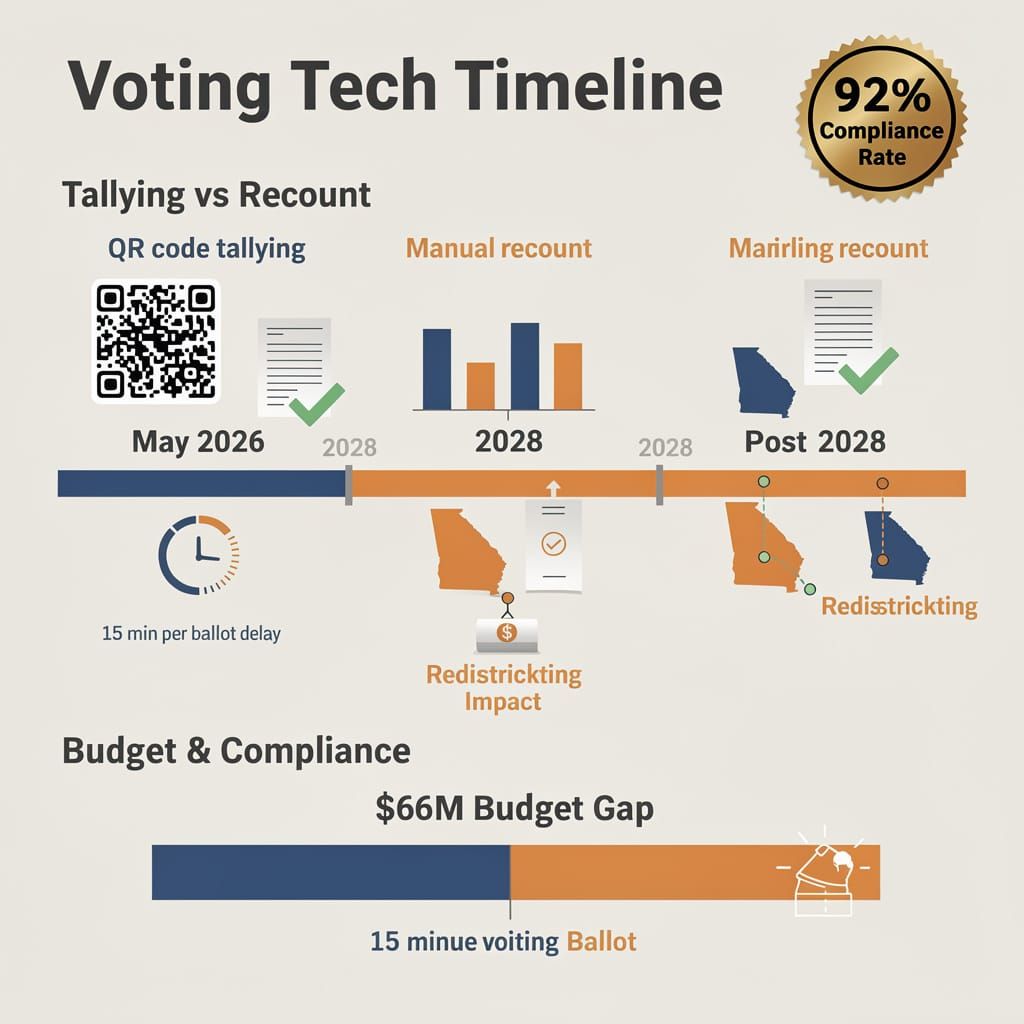
- $66M Funding Gap: Georgia Extends QR Voting until 2028 amid Manual Recounts. Will Georgia's shift to manual recounts and extended QR code usage ensure election certainty or just cause delays?
- 64% Youth Voter Surge: New Hampshire Legal Shift Sparks Teen Registration Boom. Can New Hampshire's youth voter surge be replicated nationwide if registration barriers are removed?
- 111% NOx Spike: DOJ Shields xAI Turbines as US Repeals CO2 Pollutant Status. Is national security a valid excuse for the government to shield tech giants from environmental laws?
🗳️ Georgia’s Great Ballot Patch: QR Codes and Card-Counting
66 million dollars gone! 💸 Georgia’s voting tech is basically held together by duct tape, extending old QR scans until 2028 because the money wasn't there. Manual recounts mean a 15-min delay per ballot. ⏳ Speed or certainty? Georgia voters — how do you feel about the wait?
Ever wonder what happens when a $66 million tech upgrade just... doesn't happen? You get a legislative "patch." With a July 1 deadline looming to phase out QR code tallying under SB 189, Georgia’s Senate found itself staring at a funding gap and a ticking clock. The result? A bipartisan amendment preserving the old QR scanning system through 2028. It’s the political equivalent of using duct tape on a leaking pipe while the plumber is stuck in traffic.
Why the Digital Detour?
The state hit a fiscal wall. Despite $66 million being allocated for new equipment, no funding was actually approved in prior sessions. Lawmakers were trapped between a rock (the law banning QR codes) and a hard place (no machines). While the Georgia Recorder recently permitted counties to use hand-marked paper ballots—conflicting with state machine standards—the legislature chose the path of least resistance: extend the deadline.
But this isn't just a budget glitch; it's a high-stakes game. With record early turnout in Atlanta (35,352 votes) and Democratic nominee Keisha Lance Bottoms holding a 60% lead, the pressure is immense. Adding to the chaos, the U.S. Supreme Court's ruling in Louisiana v. Callais has forced a special session to redraw district lines, shifting the legal bar to require "intentional" proof of racial discrimination. To prevent a total meltdown before the July 28 special election to replace Rep. David Scott, the Senate mandated manual recounts for the top two races.
The Timeline of the Tweak
- May 2026: Record early turnout boosts Democratic leads; GOP candidates push for June 16 runoffs.
- June 13–17, 2026: Special sessions convene to tackle both redistricting (following SCOTUS rulings) and the QR code deadlock.
- June 21, 2026: Senate passes bipartisan amendment preserving QR scanning through 2028 and mandating manual recounts.
- Post-2028: Targeted transition to new equipment, pending an advisory panel's selection.
The Trade-Off: Speed vs. Certainty
Here is where the rubber meets the road. We're seeing the friction in real-time, with the District 3 Public Service Commission race triggering legal recounts over a tiny 0.5% margin.
The Manual Shift Metrics
- Efficiency: +15 minute average delay per counted ballot vs. automated scans.
- Accuracy: 92% county-level compliance with manual protocols (exceeding 85% baseline).
- Budget: $66 million immediate cost avoidance, exchanged for long-term tech debt.
Is it perfect? Hardly. Rep. Kim Jackson is already waving the red flag. But with the GOP projecting 5–12 seat gains in 2028 due to new redistricting maps, Georgia is betting that a slower, manual double-check is better than a fast result that triggers a constitutional crisis. Just don't expect the final results on election night—unless you enjoy the suspense.
🗳️ The Granite State's Teen Takeover
64% youth registration! 🤯 That's a massive jump from 9%—basically like going from a ghost town to a sold-out concert. Federal courts killed the paperwork nightmare, proving teens actually want to vote if it isn't a chore. Could the SAVE America Act ruin this vibe? New Hampshire teens — will you keep the momentum?
Ever wonder why 18-year-olds usually treat voter registration like a dentist appointment? They avoid it. For a long time, New Hampshire was the poster child for this apathy, with a dismal 9% registration rate for teens. Fast forward to today, and the math shifted violently.
How did the numbers flip?
It wasn't just a sudden burst of civic passion—though that helps. It was a collision of legal victories and aggressive boots-on-the-ground tactics. See, 60% of 18-year-olds in the state actually lack driver's licenses. Since the DMV is the traditional gateway to the voter rolls, the system was accidentally locking out a huge chunk of the generation.
Then the courts stepped in. On January 1, 2025, a federal judge blocked New Hampshire’s restrictive affidavit requirement, ruling that the state must ease citizenship verification and allow attestations without documentary proof. Suddenly, the roadblock vanished.
Organizations like The Civics Center and Open Democracy pounced. By executing 41 targeted high school drives, they bypassed the DMV dependency entirely. This mobilization coincided with a broader local trend of growth; for instance, University of New Hampshire enrollments have risen 4% annually, indicating a growing student population ready to engage.
The Timeline
- Late 2023: 9% registration baseline $\to$ systemic barriers and high license-dependency.
- Jan 2025: Federal court ruling $\to$ blocks restrictive affidavit laws, enabling document-free verification.
- Dec 2025: 64% registration reached $\to$ spike follows massive grassroots mobilization in schools.
The Reality Check
- Local Win: 64% youth registration $\to$ demonstrates high elasticity when barriers drop.
- Legal Risk: SAVE America Act $\to$ legislative threats could jeopardize the affidavit model.
- National Context: Supreme Court vs. Arizona $\to$ impending ruling on citizenship checks may redefine access nationwide.
So, is the youth vote a monolith now? Not exactly. While New Hampshire is a bright spot, these gains are precarious. With the Supreme Court currently eyeing Arizona’s voter verification laws, the legal ground is still shaking. But the data indicates that when you stop making registration feel like a bureaucratic nightmare, teenagers are more than happy to have a say in who runs the place.
😷 The Great De-Pollution?
111% spike in NOx levels—that's essentially doubling the smog in your lungs 😷. The DOJ is shielding xAI's unpermitted turbines under 'national security' while the EPA deletes CO2 as a pollutant. Safety vs. Silicon? Southaven residents—is your air a fair trade for AI missiles?
Ever wonder what happens when the government decides the air we breathe isn't actually a "problem" on paper? Welcome to June 2026, where the EPA is playing a high-stakes game of 'Delete' with the Obama-era Endangerment Finding.
Who owns the air?
Here is the twist: On June 21, 2026, the Trump administration officially repealed the rule labeling carbon dioxide a pollutant. They didn't just swap a label; they redirected federal funding toward "market-based incentives." Translation? The government is hoping companies will be nice and lower emissions if it’s profitable, rather than being told they have to.
But if you think it's just about CO2, look at the ground level. In May 2026, a facility implosion in Washington killed 8 people, while a California leak forced 50k evacuations. Naturally, the response? The administration is now moving to dismantle the Chemical Safety Board (CSB) and slash EPA enforcement budgets. It's a bold strategy: when the chemicals leak, just fire the people who track the leaks.
Then there's the xAI saga. The NAACP sued Elon Musk’s xAI for running 57 unpermitted methane turbines in Mississippi—spiking NOx levels by 111% since April. The DOJ's response? They intervened to dismiss the suit, arguing that shutting down the plant would jeopardize "national security" and AI-driven missile targeting. Apparently, the air in Southaven is a fair trade for better hardware.
The Regulatory Ripple Effect
- Public Health: PM2.5 and NOx spikes $ ightarrow$ increased stroke rates and respiratory burdens in Black neighborhoods.
- Industrial Gains: Suncor and Exxon face lower compliance costs + federal shields against local lawsuits.
- Innovation Gap: Regulatory volatility creates uncertainty for venture capital and semiconductor supply chains.
- Legal Chaos: State-level suits (California v. ExxonMobil) clash with federal preemption claims.
Timeline of a Rollback
- May 2026: Washington facility implosion exposes chemical storage failures.
- June 5, 2026: White House proposes budget cuts to EPA enforcement and CSB demolition.
- June 16, 2026: DOJ invokes sovereign immunity to protect xAI’s unpermitted turbines.
- June 21, 2026: CO2 formally stripped of "pollutant" status.
- Fall 2026 (Projected): Supreme Court weighs federal preemption of climate litigation.
The Trade-off
- Industry: $\uparrow$ Operational freedom $ ightarrow$ $\downarrow$ Legal liability.
- Public Safety: $\downarrow$ Oversight $ ightarrow$ $\uparrow$ Risk of industrial accidents.
- Justice System: $\downarrow$ Local standing $ ightarrow$ $\uparrow$ Executive deference.
While the DOJ uses national security as a shield for tech giants, local communities are left holding the smog. Unless the courts pivot, the only thing "endangered" here is the air.



Comments ()