58% Pessimism: US National Pride Plummets Amid Institutional Instability
TL;DR
- 58% Pessimism Rate: US National Cohesion Collapses Amid AI-Driven Market Volatility. With 58% of Americans believing the nation's best days are gone, can algorithmic polarization be reversed to save the economy?
- 45% Union Shift: Sean O'Brien's RNC Gamble Amidst GOP Disapproval. Can labor unions effectively pivot to the GOP to achieve worker-owned corporations?
- $3.3 Billion Cut: US House Targets Israel Military Aid Amid Section 224 Controversy. Will stripping $3.3 billion in aid actually change US-Israel relations, or is it just a budget rebranding?
📉 The Great Divide: When Algorithms Trade our Sanity for Stocks
58% of Americans believe the best days are behind us—essentially a national mid-life crisis 📉. National pride has plummeted from 70% to 56%. While we fight in echo chambers, the S&P 500 climbs while your wallet shrinks. Institutional collapse or just a glitch? 🇺🇸 Your city's vibe check: are you feeling the divide?
Ever feel like you and your neighbor are living in two different dimensions? You’re not imagining it. Your political identity isn't just influencing your vote—it’s basically your own personal brand, and the fragmentation is costing us billions.
Why is everyone so angry?
It’s a loop: algorithmic feed design creates ideological bunkers by feeding us exactly what we already believe. This results in "affective polarization," where we don't just disagree with the other side; we actively dislike them.
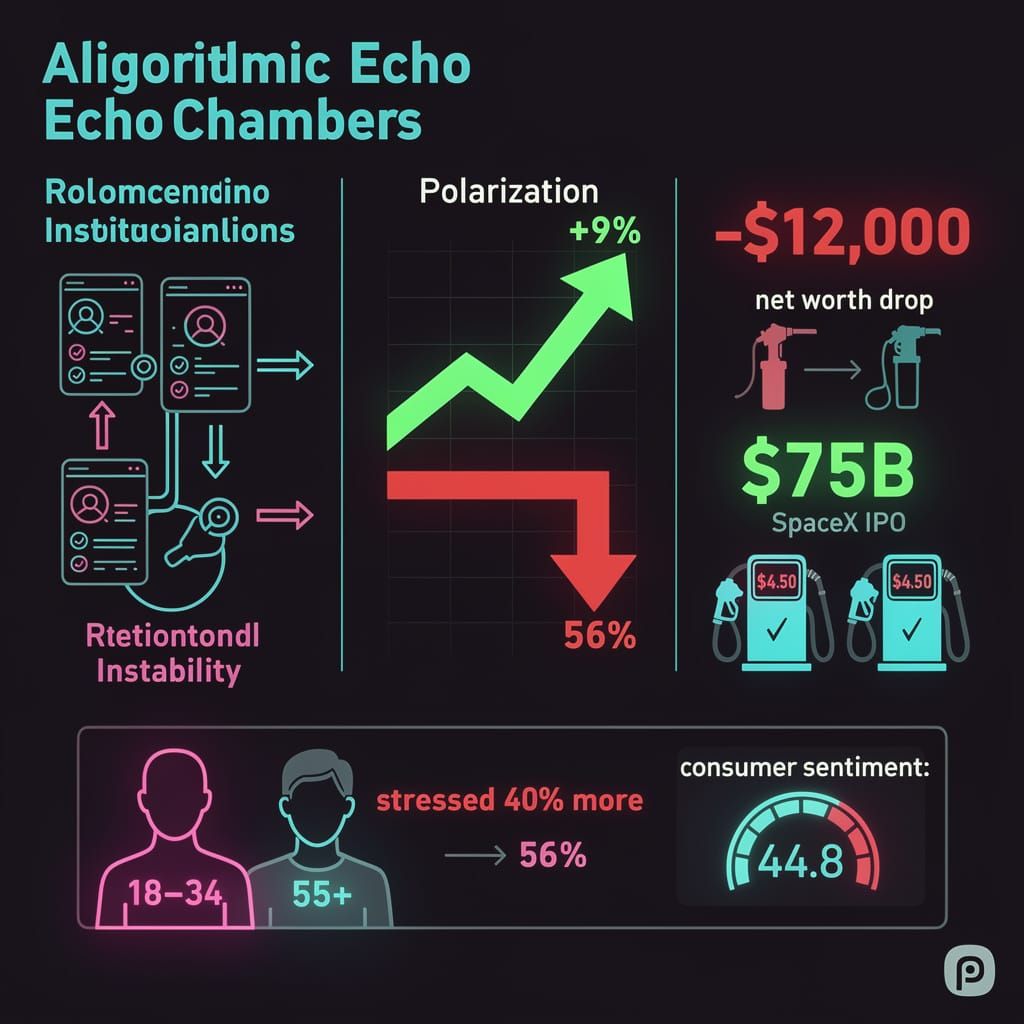
This isn't just a vibe; it's a documented collapse of national cohesion. According to an NBC News poll from June 15, 2026, national pride has plummeted from 70% in 2003 to just 56%. The divide is stark: Democrats are 12 times more likely to report they are "not proud" than Republicans. Meanwhile, 58% of Americans now believe the nation's best days are behind it. This isn't just a mid-life crisis for the country—it's an institutional breakdown. While we argue over who's more "patriotic," the youth (ages 18-34) are reporting 40% higher stress levels than those over 55. Fun, right?
Does the stock market care about our fights?
Oh, it does. Wall Street hates uncertainty. When debates turn into "institutional instability," investors twitch. On May 28, US markets dropped 9.3% from all-time highs, rattled by political polarization over AI regulation.
But here is the punchline: while the average person is drowning—median net worth has dropped $12,000 since the 2018 peak and consumer sentiment hit a low of 44.8 on May 23—the S&P 500 surged 9% year-to-date. We're in a weird glitch where AI-driven indices rally and SpaceX targets a $75 billion IPO, while the actual humans funding the system feel the pinch of $4.50 gas prices.
The Causal Chain: Algorithmic Echo Chambers $\rightarrow$ Affective Polarization $\rightarrow$ Eroding National Pride $\rightarrow$ Institutional Instability $\rightarrow$ Market Volatility.
The Fallout:
- Democratic: High turnout in California's mayoral and gubernatorial races shows engagement, but confidence in democratic futures has dropped 33% since 2020.
- Financial: Broad equity declines occur amid AI valuation bubbles, even as specific AI server sales (like Dell's) climb.
- Informational: Polling inaccuracies persist due to biased opt-in samples, while prediction markets continue to push disinformation.
Where do we go from here?
DC is trying to put out a forest fire with a spray bottle. Without a structural overhaul of how we get our news, the trend line is grim.
The Road Ahead:
- 2026: Ranked-Choice Voting (RCV) trends locally, but complex tabulation risks new misinformation cycles.
- 2027: AI-driven labor displacement accelerates, widening the gap between the "AI-rich" and the economically anxious.
- 2028+: A deepening generational schism as civic engagement declines and shared national narratives vanish.
📉 The Odd Couple: Unions and the GOP
45% of union households now back Trump. This massive shift is like aPolitical Earthquake 📉. While O'Brien pitches worker-ownership at the RNC, Trump resists. Stability or redistribution? Unions are splitting over this GOP gamble. How does this shift look in your own town?
Ever wondered what happens when a labor leader walks into a room full of Republicans? On June 23, 2026, Sean O'Brien decided to find out. O'Brien took the stage at the Republican National Convention, delivering a 15-minute pitch for worker-owned corporations. Yes, you read that right. He wasn't there to protest; he was there to suggest that workers should actually own the places where they sweat.
Does Equity Work in a Red Room?
O'Brien’s move was a gamble in political theater, but it wasn't shot in the dark. With 45% of union households now supporting Trump, the traditional blue-collar alliance with Democrats is fraying. By critiquing corporate greed directly to the GOP, O'Brien attempted to pivot union influence toward a new, redder stronghold.
Naturally, Donald Trump wasn't buying it. Trump swiftly distanced himself from the worker-ownership initiative, preferring his own narrative cycle. This interaction demonstrates a widening gap: while labor leaders seek legitimacy through unconventional alliances, the executive wing of the GOP remains focused on consolidation—even as Trump's approval rating plummeted to 36% nationwide in May due to soaring inflation and Iran-related tensions.
But wait—is the GOP actually playing ball with labor? Surprisingly, yes. On June 9, 2026, a rare bipartisan surge saw Republicans and Democrats pass the "Faster Labor Contracts Act." Using discharge petitions to bypass procedural hurdles, the House mandated faster contract negotiations to slash the cycle by four weeks. So, while the RNC stage was a clash of ideologies, the legislative floor showed a weird, pragmatic hunger for stability.
The Collision Course
- Labor: Internal trust erodes as peers view O'Brien's GOP flirtation as ideologically extreme.
- GOP: Projects resistance to wealth redistribution while battling 63% disapproval—matching Nixon's peak.
- Public: Young men (18-29) are jumping ship; 70% now disapprove of Trump over economic misery and war policies.
Timeline of a Strange Summer
- May 11–27, 2026: Iran hostilities trigger a Strait of Hormuz blockage; gas prices surge >50% and markets drop 9.3%.
- June 9, 2026: House passes Faster Labor Contracts Act, accelerating union negotiations.
- June 23, 2026: O'Brien delivers RNC speech on worker ownership, triggering intra-union conflict.
- November 3, 2026: Midterms loom with a narrowing generic ballot (46% Dem vs 44% GOP), projecting a shift in congressional balance.
The Fallout Institutional: Heightened tension between union leadership and grassroots members. Legislative: Increased efficiency in contract cycles, potentially boosting labor mobility by 0.7%. Political: Greater commodification of labor dissent as GOP fragmentation deepens.
So, did it work? Probably not in the way O'Brien hoped. Instead of a bridge, the RNC appearance functioned as a mirror, reflecting exactly how divided the American political and economic landscape has become—even when they're suddenly agreeing on the paperwork.
💸 The $3.3 Billion Breakup
$3.3 Billion slashed! That's basically 66,000 luxury cars gone in one vote 🚗. Only 16% of folks still back 'blank checks' for military aid 📉. Does cutting cash actually stop the war, or just change the paperwork via Section 224? US taxpayers — are you okay with this shift?
Ever wonder what happens when the American taxpayer decides it’s had enough? Just ask the Israeli defense budget. On June 24, 2026, House Speaker Thomas Massie moved to trim the fat, voting on an amendment to strip $3.3 billion from annual military aid to Israel. Why? Because when only 16% of the public supports "unconditional funding," the math in D.C. shifts fast.
Is it just a budget cut?
Not exactly. We're seeing a messy divorce from the "blank check" era. While Massie and Rep. Ro Khanna slash grants, a different battle is raging over NDAA Section 224. This provision attempts to pivot the relationship toward a tech-partnership, embedding Israeli firms directly into the Pentagon's supply chain.
Wait, isn't that just aid with a fancy new name? Pretty much. It transforms grants into "procurement integration." But here is the twist: while some lawmakers push for this deeper bond, others—and anti-war advocates like Medea Benjamin—are fighting to rip Section 224 out entirely. Why the fight? Because integrating military AI and data systems creates a causal chain of risk: deeper collaboration enables expanded data interoperability, which results in heightened cybersecurity vulnerabilities.
Despite the legislative tug-of-war and growing skepticism among younger progressive voters, the hardware keeps moving. Even as the budget debate heats up, the U.S. recently approved more rocket transfers to Israeli forces, proving that the "Special Relationship" has a very stubborn autopilot.
The New Power Dynamic
- U.S. Leverage: Financial cuts $ ightarrow$ increased pressure on Israel to halt operations in Lebanon.
- Systemic Risk: Section 224 integration $ ightarrow$ expanded AI/military convergence and data-leak risks.
- Economic Pivot: Direct grants $ ightarrow$ industrial partnerships benefiting firms like Lockheed Martin.
- Public Sentiment: 16% approval for unconditional aid $ ightarrow$ bipartisan legislative skepticism.
What happens next?
Israel is leaning on its $19.2 billion independent arms industry to prove it can survive. But without U.S. parts, those shiny F-35s start becoming very expensive paperweights. Meanwhile, the U.S. is trying to balance strategic needs against a voter base that is increasingly allergic to foreign spending.
- 2026 (Current): $3.3B cut proposal; debate over removing Section 224 to prevent military entanglement.
- 2027 (Projected): Shift toward trade-based collaboration reduces traditional FMF funding.
- 2028 (Projected): Full renewal of the 10-year MoU, finalizing the transition to deeply embedded industrial partnerships.



Comments ()