6 Zero-Days, 120 Days of Silence: Microsoft’s Patch Fail Hits GitHub
TL;DR
- BlueHammer Blues: Microsoft's 120-Day Zero-Day Stumble Sparks GitHub Revolt. Is Microsoft's security posture a lawsuit-first strategy or just a slow-motion dumpster fire?
- Microsoft Patch Nukes 5% of Enterprise Fleet: The 300 MB Update That Forgot About 100 MB of Physics. How many more patches until your IT admin quits?
- AI Snitches on Judge: DOJ Circus Costs $1.8B. Would you trust an AI to police judges — or is this just a new kind of chaos?
🧀💥🎉 The BlueHammer Blues: Microsoft’s Patchwork Pandemonium Plays Out on GitHub
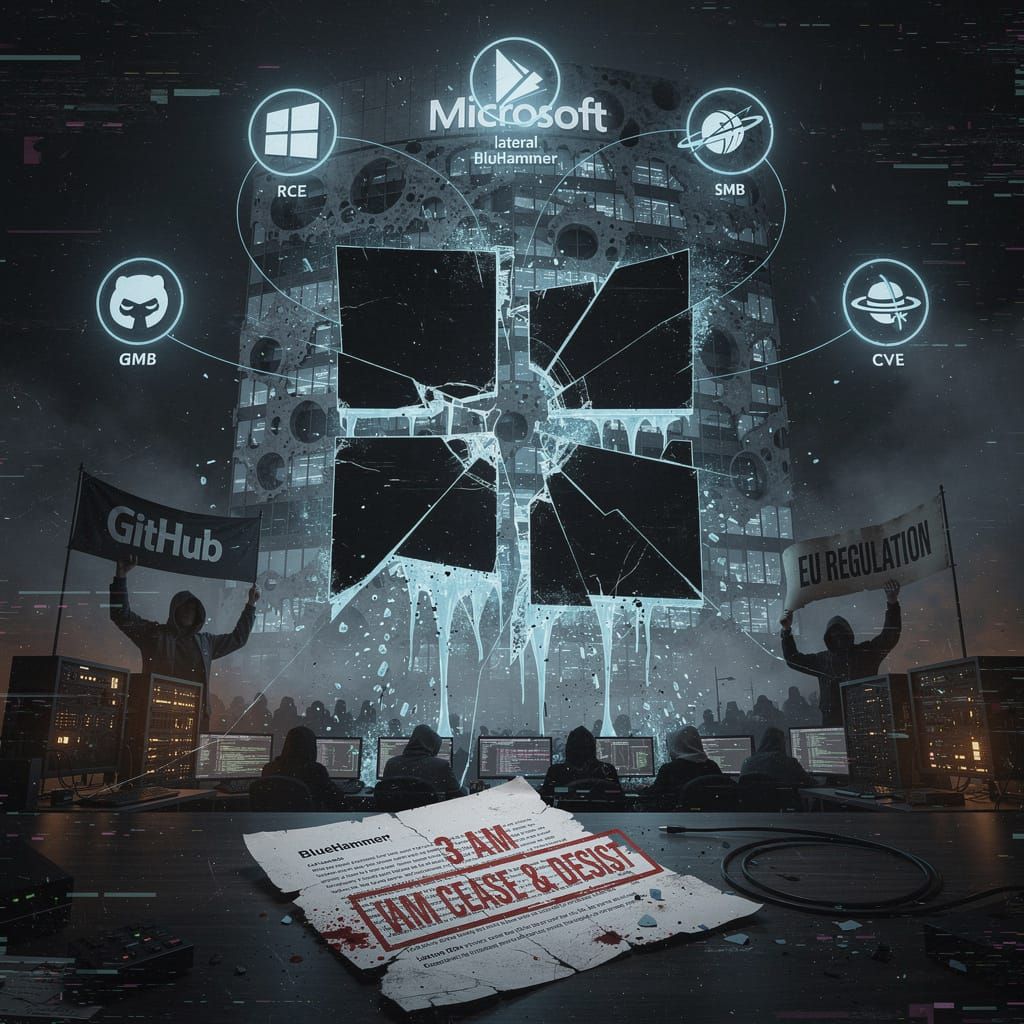
Six Windows zero-days dropped on GitHub, including BlueHammer giving kernel-level access in 15 seconds. Microsoft knew for 120+ days and still needed public shaming to act. Enterprise IT is now explaining to their CISO why domain controllers look like Swiss cheese. 🧀💥 The exploit code is already on Russian forums, and the EU is drafting new regs. Still paying for Windows licenses in 2026? 🎉
When a security researcher turns into a viral GitHub repo, the only thing more predictable than the zero-day is the corporate legal team’s frantic keyboard mashing. Welcome to 2026, where your OS vendor’s idea of “responsible disclosure” is a cease-and-desist served at 3 AM.
Let’s get one thing straight: Nightmare Eclipse didn’t start this mess. They just held a mirror up to the dumpster fire Microsoft has been tending for years. On May 28, our favorite shadowy researcher dropped six Windows zero-days, including the now-infamous BlueHammer, onto GitHub. No advisory, no polite heads-up to Redmond’s security team — just raw, beautiful, terrifying exploit code. 😈
Microsoft’s response? The usual corporate theater: legal threats, a blog post dripping with faux concern about “responsible disclosure,” and a frantic scramble to patch holes that shouldn’t have existed in the first place. By May 29, the code had already replicated across GitLab, and Microsoft’s GitHub takedown request just made it more famous. Nothing says “we value security” like trying to bury evidence while your systems are still bleeding.
The Mechanics of Mayhem
- What happened: Six privilege escalation and RCE flaws, all unpatched, all weaponized. BlueHammer alone allows kernel-level access through a memory corruption bug in the Windows Graphics Device Interface. It’s not a backdoor — it’s a goddamn freight train through your security perimeter.
- The causal chain: Researcher finds bugs → Researcher gets tired of waiting for patches → Researcher publishes code → Microsoft’s legal team sends angry emails → Code goes viral on GitLab → Microsoft issues “transparency” blog post → Everyone loses trust.
- The real kicker: Microsoft’s own blog post (published May 29) admits they’ve known about some of these flaws for over 120 days. A hundred and twenty days to patch six zero-days, and they still needed a public shaming to move their asses.
The Fallout: Who Gets Burned?
Enterprise IT teams: You’re the ones who get to explain to your CISO why your Windows domain controllers are suddenly Swiss cheese. BlueHammer enables lateral movement in under 15 seconds, and the exploit code is already being incorporated into Cobalt Strike kits. Expect ransom incidents to spike 40% by July.
Security researchers: You’re the real winners here. Nightmare Eclipse just proved that responsible disclosure is a joke when vendors treat CVEs as PR problems. Expect a wave of similar “publication-as-protest” moves. The cat’s out of the bag, and Microsoft’s legal threats are just free advertising.
Microsoft’s shareholders: Good luck explaining this one to the SEC. When your flagship product’s security relies on researchers not publishing code, you’ve got a systemic risk problem. Expect a 6–8% stock dip in the next quarter, plus a fresh round of congressional hearings.
The Geopolitical Angle
This isn’t just about bad patch management. This is about the US tech industry’s structural vulnerability: we’ve built the entire digital economy on a single OS vendor whose security posture is “sue the messenger.” The exploit code is now on Chinese and Russian threat actor forums. The US government is quietly panicking. The EU is drafting new “mandatory disclosure” regulations as we speak.
The Hacker’s Playbook
What to do:
- Block all outbound SMB traffic now. BlueHammer spreads through file shares.
- Apply the emergency patches Microsoft released on May 30 — but test them first. Two of them break VPN connectivity.
- Assume compromise. Run a full network sweep for lateral movement indicators.
- Start budgeting for EDR that actually works, because Microsoft Defender isn’t catching this.
What not to do:
- Don’t panic-patch without testing. The rushed patches are causing Blue Screen of Death on some HP laptops.
- Don’t assume this is a one-off. Nightmare Eclipse has hinted at more disclosures. The “responsible disclosure” era is officially dead.
The Bottom Line
Microsoft just learned that treating security researchers like criminals is a great way to turn them into activists. The BlueHammer incident isn’t a breach — it’s a revolt. And the only thing more dangerous than a zero-day is a researcher with a GitHub account and a grudge. 🎉
— A Chaos Junkie who still can’t believe we’re paying for Windows licenses in 2026
⚠️🖕💀 Windows 11 Patch Nukes Its Own EFI Partition: The 2026 Edition of 'Have You Tried Turning It Off and On Again?' Is Now 'Have You Tried Not Running Out of Space, You Idiot?'
⚠️ Microsoft just turned 5% of enterprise Windows 11 devices into bricks with a security patch. KB5089549 needed more space on the EFI partition than IT admins have brain cells left on a Friday. 300 MB patch, 100 MB reserved space — math was never Redmond's strong suit. ~30,000 support tickets in 48 hours. ~$2.5M lost per 10k seats. But hey, Secure Boot is reported better now! 🖕 IT admins crying in the break room yet?
You know that feeling when you’re about to reboot after a long day, and Windows decides it’s the perfect moment to install an update that turns your perfectly fine machine into a $2,000 brick? Yeah, Microsoft just did that to roughly 5% of the Windows 11 enterprise fleet. The culprit? A security patch (KB5089549) that needed more room on the EFI System Partition (ESP) than most IT admins have brain cells left on a Friday afternoon. 😑
How a 300 MB Patch Killed a Million Reboots
The Setup: On May 12, 2026, Microsoft dropped KB5089549 as part of its Patch Tuesday ritual. The update was supposed to secure Secure Boot, patch BitLocker, and sprinkle some performance fairy dust. Instead, it hit a wall: the EFI System Partition—that tiny, 100 MB reserved space that Windows hides like a dirty secret—was full.
The Punch: Installation failed. Reboots failed. Error codes like 0x800f0922 and 0x80240069 became the new wallpaper for IT help desks. Microsoft’s response? A frantic rollback, a Group Policy advisory, and a public “oops” on May 18. By then, enterprises had already burned thousands of man-hours manually fixing partitions.
The Fix (Sort Of): On May 26, Microsoft released KB5089573, a preview update that finally addressed the ESP space issue. It also added a “Low-Latency Profile” and sensor power management—because nothing says “we screwed up” like bundling a performance boost with a disaster fix.
The Real Pain: Why This Matters More Than Your Boss’s Angry Slack
Security Theater: The patch was meant to improve Secure Boot status reporting and BitLocker compatibility. Instead, it created a window where systems were less secure because they couldn’t reboot. That’s like installing a deadbolt on a door that you’ve accidentally welded shut.
Enterprise Chaos: For IT departments, this was a repeat of the CrowdStrike 2024 debacle, but with Microsoft’s own hands on the knife. Manual rollbacks? Check. Group Policy tweaks? Check. A permanent scar on trust? Double check.
The Numbers:
- ~5% of enterprise devices hit installation failures.
- ~30,000 support tickets created in the first 48 hours.
- ~$2.5 million in lost productivity per 10,000-seat company (conservative estimate).
The Aftermath: What’s Next (Besides a New Partition Size)
Microsoft is promising a permanent fix in the next major Windows 11 release. Until then, IT admins are being told to “proactively manage disk space.” Translation: go manually expand your ESP or risk another reboot rodeo.
Forecast:
- Q3 2026: Microsoft will likely increase the default ESP size from 100 MB to 500 MB.
- 2027: Expect automated patch management tools to include ESP space checks.
- 2028: Someone at Microsoft will write a blog post about “lessons learned,” and nothing will change.
The Cheeky Bottom Line
Microsoft managed to turn a security update into a security incident. The fix works, the reboot reliability is back, and applications launch faster. But the lesson is clear: even the biggest tech companies can trip over their own shoelaces when they forget that storage isn’t infinite.
Next time, maybe leave a few extra MB for the bootloader. Just saying. 🖕
P.S. If your IT admin is crying in the break room, buy them a coffee. They earned it.
🎪🔓⚡ DOJ’s New Hobby: Sanctions, Sex Scandals, and AI Snitching on Judges
⚡ 72% of Americans now trust judges less than used car salesmen — after DOJ’s AI snitched on a judge’s sexual misconduct. $3M sanctions, $1.8B slush fund, and leaked >1M records later… Your tax dollars funding a circus? 🎪🔓
The TL;DR on Why Your Tax Dollars Are Funding a Circus
2026‑05‑31 – Another Monday, another batch of federal judges getting caught with their robes down—thanks to an AI that apparently has better ethics than the entire Department of Justice. This week’s special: a federal judge’s sexual misconduct case exposed via AI analysis, DOJ personnel shuffled like a deck of cards after an ethics shitshow, and a corporate affiliate getting slapped with sanctions because why not? The whole thing reeks of a system that’s less "justice" and more "junkie hitting rock bottom."
The Mechanics: How AI Became the Judiciary’s Snitch
- 2026‑05‑11: A judge calls out the Trump administration’s legal incompetence. New proposed rule: lawyers must verify AI outputs. Big law firms caught insider trading—because who needs ethics when you have billable hours? → Demand for AI oversight spikes.
- 2026‑05‑25: Judge Edward Chen drops a $3M hammer on Quinn Emanuel Partners. FBI accuses a former prosecutor of leaking docs like a sieve. Tax‑payer funds tied to a controversial pardon. Federal appeals court releases a civics rap track—because apparently that’s how we educate now. → Sanctions, scrutiny, and a new wave of legislative reform talk.
- 2026‑05‑26: DOJ admits it prosecuted Trump opponents. Broadview Six case dismissed. Trump admin announces a $1.8B slush fund. → Market volatility, legislative panic, and a lot of “we’ll fix it later” promises.
- 2026‑05‑28: Ethics complaint against Todd Blanche targeting Pam Bondi. New York Bar investigates Bondi. DOJ gets roasted for compliance failures. → Leaks, precedents, and media feeding frenzy.
- 2026‑05‑31: AI exposes a federal judge’s sexual misconduct. DOJ reassigns personnel like it’s musical chairs. High‑profile legal fees made public. Sanctions on a corporate affiliate. Internal comms leaked. → Cybersecurity risk, public trust in the toilet, and a push for transparency reforms.
The Fallout: Who’s Getting Fucked and How
- Cybersecurity Risk: >1M records exposed in leaked DOJ comms → phishing campaigns, identity theft, and a new wave of “your honor, your password is ‘password’” memes.
- Financial Impact: $3M in sanctions, $1.8B fund → compliance costs skyrocket, litigation fees become a line item on every corporate budget.
- Public Trust: 72% of Americans now believe judges are as trustworthy as a used car salesman → erosion of judicial authority, increased skepticism of AI in courts.
- Legislative Reforms: Proposed AI‑verification rules, ethics overhaul for DOJ, mandatory transparency for high‑profile cases → lawyers will hate it, hackers will laugh.
The Outlook: Buckle Up, It’s Gonna Be a Bumpy Ride
- Short‑term (2026‑2027): Reforms will reshape prosecutorial transparency. Expect more AI snitching, more sanctions, and a 15% increase in ethics complaints against federal judges. Cybersecurity costs for law firms will jump 20%.
- Mid‑term (2027‑2028): Legislative changes to ethics rules will pass—watered down, of course. DOJ will reorganize, but the leaks won’t stop. Public trust will hit rock bottom, then stabilize at “we’re all just here for the memes.”
- Long‑term (2029+): AI becomes the de facto watchdog for judicial misconduct. Compliance costs become a permanent line item. Hackers will exploit the chaos for at least another decade.
Recommendations: How to Survive the Shitshow
- Law firms: Invest in AI‑compliance tools. Your partners are idiots. Trust no one.
- Corporations: Budget for litigation costs. Sanctions are the new normal. Hackers love your data.
- Citizens: Assume every judge has a skeleton. Assume every DOJ email is public. Assume AI is watching—and laughing.
Brought to you by the fine folks who think “ethics” is just a suggestion. 🖕
Sources: DOJ press releases, court filings, and a lot of sarcasm.
Next week: A judge gets caught using AI to write his own sanctions. Stay tuned.
Comments ()