$58.97B Yen Intervention: The Liquidity Bonanza That Hides a 275-Point Rate Gap
TL;DR
- $18.8T Household Debt, 22% Card Rates — Conifex's "Golden Season" Recovery Is a Gamble, Not a Forecast. Is the "golden season" a real recovery catalyst or just a liquidity delay?
- $1.27 Billion, 14 Centavos: The Math Behind the Peso's Hollow Recovery. How many more $1.27B interventions before the peso math stops adding up?
- $58.97B Yen Intervention: Treasury Burns Cash for 0.2% Move While Rate Gap Widens. How long before the yen Band-Aid fails and 163+ returns?
📉 Conifex: The Golden-Season Gamble That Markets Should Not Take Seriously
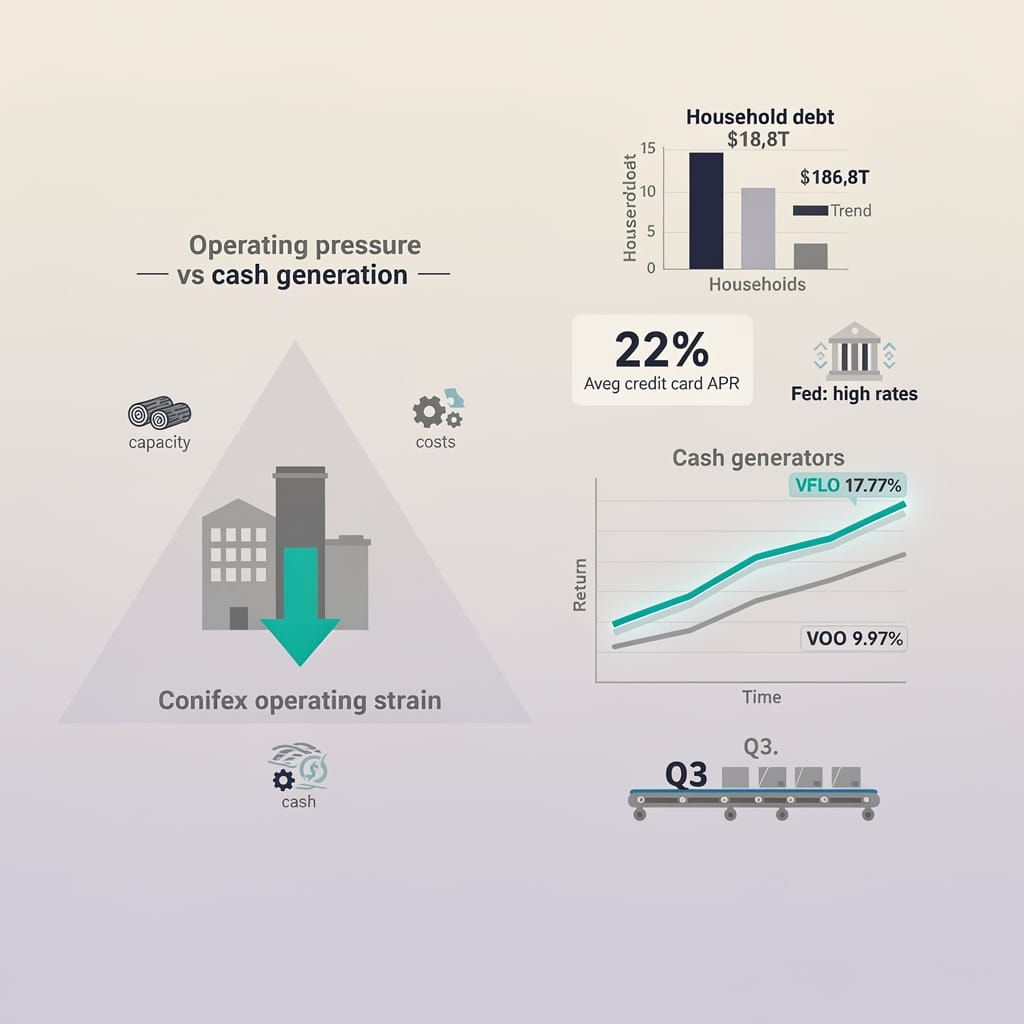
$18.8 trillion in household debt. Credit card rates above 22%. And Conifex thinks a "golden season" will fix operational delays, funding shortfalls, and falling margins? 📉 That's not a recovery forecast — it's a wish list. Volume without margin improvement is just busy loss. Meanwhile, markets reward actual cash generators: VFLO +17.77% vs. VOO +9.97%. Conifex promising cash vs. delivering it. Equity offering not closed. Q3 coming. Who's still holding the bag through Q4? 🤔
What Happened, in Plain Numbers
On July 24, 2026, Conifex confirmed operational delays tied to funding shortfalls and weather disruption. By July 29, management launched a "strategy review" and promised to deliver target yields. The stock did what stocks do when hope overrides arithmetic: it found buyers.
The underlying data tells a different story. U.S. household debt hit $18.8 trillion by mid-May 2026—a record—with median credit card rates exceeding 22% by July 15. Total consumer debt surged past $18.23 trillion on that same date, erasing average monthly discretionary spending entirely beneath fixed minimum payments. Manufacturers in comparable positions are restocking, but Coniflex needs capital it has not raised. Production is declining. Profit margins are eroding. Equity offerings have been delayed with no closure in sight.
Why This Is Not a Turnaround Story
Management's framing leans heavily on the "golden season"—a period of seasonally high demand that, in theory, can absorb logistical chaos and generate volume. The logic assumes that operational stalling plus financing strains plus weather disruption equals a recovery. That is not a forecast. That is a wish.
Conifex faces three simultaneous constraints:
- Operational: Weather and funding delays have broken production continuity. Restarting is not instantaneous.
- Financial: Delayed equity offerings mean no fresh capital injection. Credit pressure compounds as interest costs rise on existing debt. The macro backdrop offers no relief: the Fed maintains elevated rates while consumer debt saturates repayment capacity—delinquency rates hit 4.8% in Q1 2026, with credit card delinquency at 13.1%.
- Market: The golden season may boost volume, but volume at falling margins is not a cure. It is a delay.
The forecast offered by the company—stable operations by Q4 2026, followed by recovery—contains no mechanism for how capital appears, how production resumes at scale, or how margins recover under tightened credit.
The Broader Signal
The macro context reinforces the skepticism. Across manufacturing, economic volatility is translating into financial fragility. Plus500's H1 results showed EBITDA margin dropping to 40.5% and free cash flow declining 37% in three years—structural margin compression, not seasonal. When a sector leader sees profitability signals deteriorate, a smaller operator entering a demand window with depleted cash should not expect a soft landing.
The free-cash-flow theme is not hypothetical: through mid-2026, VictoryShares' FCF ETF (VFLO) returned 17.77% versus VOO's 9.97%, driven by a macro shift toward cash-generating firms. Markets are rewarding companies that produce cash, not those that promise it.
Countering the Narrative
The bull case rests on timing: get through the golden season, stabilize operations, regain investor confidence. That sequence depends on an assumption that the market will wait. History suggests otherwise. Companies that enter a liquidity crunch while margins are falling do not exit it by selling more at lower prices. They exit it by selling assets, diluting equity, or defaulting—as Summit Therapeutics demonstrated on June 22, withdrawing a $500M equity offering after disappointing trial data shifted market sentiment.
The confidence rating on this recovery forecast is critical. The stock will remain volatile through Q4 2026 because volatility is the only honest reflection of the uncertainty embedded in the balance sheet.
What to Watch
- Equity offering closure: No new capital, no credibility.
- Q3 production numbers: Volume without margin improvement is not a recovery.
- Credit rating actions: Downgrades will accelerate the timeline to restructuring.
🇵🇭 Peso Gets a Pep Talk, Markets Aren't Buying It
P61.75 — weakest close in two months. The central bank then burned $1.27 billion for a gain of 14 centavos. That's not a recovery. It's an expensive patch on a structural problem 🇵🇭 The peso was already sliding before the oil spike. Hawkish Fed, IMF slashing GDP to 3.9%, ADB to 3.8%. Now Remolona hints at 50bps more tightening into a slowdown. Households absorb the real hit: fuel at P11.70/L, diesel P26.19/L, inflation still above target for five straight months. Import bills climb. Wages don't. A billion dollars bought a tenth‑of‑a‑percent move. How many more of these "interventions" before the arithmetic stops adding up?
The Philippine peso closed at P61.75 on July 22—its weakest in two months—after US‑Iran tensions pushed crude above $100 per barrel. The central bank responded with $1.269 billion in dollar sales. By July 28, the currency had inched back to P61.614. A recovery, they called it.
Conveniently omitted: the peso had already lost ground to P61.605 on July 9, two weeks before the oil spike. That day, dollar volume surged to $1.258 billion from $1.164 billion. The culprit then? A hawkish Fed signal. The runway was already laid. Meanwhile, the IMF cut the Philippines' GDP forecast to 3.9%; the ADB followed to 3.8%—both below the government's target. Growth is soft, the peso is soft, and the central bank is burning dollars to prove otherwise.
What $1.27 Billion Buys
Not much. The intervention halted a free fall, but the peso remains pinned near multi‑month lows. The Philippine Stock Exchange index (PSEi) has been swinging on bargain‑hunting whims—up 0.24% on July 23 to 6,283.12, but still reflecting "cautious sentiment amid geopolitical risk," per analysts at Philstocks Financial. The mechanism is textbook: geopolitical shock → commodity spike → import cost surge → currency pressure.
- July 9: Peso at P61.605. Dollar volume spikes to $1.258B. IMF cuts GDP to 3.9%. ADB cuts to 3.8%.
- July 22: Peso hits P61.75, lowest close in two months. Oil above $100.
- July 28: Peso "recovers" to P61.614—14 centavos gained after burning $1.27 billion.
The central bank prevented acute collapse. The less generous read: throwing over a billion dollars at a currency for a tenth‑of‑a‑percent move is not strategy. It is a temporary analgesic for a structural problem.
Import Bill Math
The Philippines imports roughly 60 percent of its oil. Every dollar of crude price increase passes through to domestic fuel, transport, and food. By July 31, inflation eased to a projected 5.6–6.6%—still exceeding the 2–4% target for five consecutive months—while gasoline hit P11.70/litre and diesel P26.19/litre. Each percentage point decline in the peso lifts import bills, adding roughly 0.03 points to annual CPI. Food and transport costs accelerate faster than wages. Household budgets take the hit.
By August 2, the Bureau of Treasury was auctioning P50 billion in T‑bills and reissuing P30 billion in 20‑year bonds yielding ~7.5%. On July 21, the Treasury had already issued seven‑year bonds at an average yield of 7.195%—up 37.9 basis points from the previous June auction. Banks are benefiting from a provisional regulation excluding unrealised losses on sovereign securities, but the underlying signal is clear: the government is borrowing dearer into a slowdown.
Tighter Into a Slowdown
Mayor Remolona hinted at a possible 50‑basis‑point rate hike. The central bank had already drained over P1 trillion in excess liquidity by July 12. On July 10, 91‑day T‑bill yields fell 6.6 basis points to 5.0577%—a fleeting dip—while 182‑day yields rose 4.69 basis points to 5.5776%. Core inflation sits at 4.4%, well above the target band. The BSP added 50 basis points to benchmark rates between April and July. They are tightening into a GDP forecast of 3.8–3.9%. That is not confidence; it is a corner.
The Outlook
Forecasts place the peso at P61.60–P61.80 through October, contingent on OPEC+ holding production steady. On August 2, OPEC+ approved a 188,000 barrel/day increase starting September, completing the phase‑out of 1.65 million bpd of voluntary cuts. Brent crude fell toward $72 by early July. That relieves some pressure, but residual cuts of 2 million bpd remain active through December, and Middle East asset damage strains recovery timelines.
Meanwhile, foreign direct investment tells a parallel story: the Philippines ranked sixth in Southeast Asia in 2025, receiving just $9 billion of the $244 billion regional total. Singapore took $150.9 billion. Investors are not buying the narrative.
This is not a forecast. It is hope dressed in numbers with decimal points. If Russia escalates or Iran tensions boil over, expect the lower bound to crack. The central bank has limited ammunition. Another $1.27 billion intervention buys another week, not a turn.
Resilience: $1.27 billion halted a two‑month low, but not the underlying trend. Vulnerability: Import exposure makes the peso a transmission belt for every geopolitical risk in the Middle East. GDP forecasts at 3.8–3.9% confirm the economy cannot compensate. Reality: Interest rate differentials, not central bank heroics, will determine the peso's path. And those differentials are not narrowing—they are about to widen again.
💸 A Few Billion Here, a Few Billion There—Yen "Rescue" Edition
$58.97 billion burned in a single session for a 0.2% yen move. That's not a rescue—it's a liquidity bonfire 💸 The real crack: Fed at 3.5–3.75%, BOJ stuck at 1%. A 275-point rate gap no intervention can close. Treasury sold $518 billion in debt the same week. Japan's import bills, carry traders, and Toyota's hedging costs all get a 48-hour bandage. The structural disease? Still untreated. Your savings, your import prices, your portfolio—how long before the next Band-Aid fails and the yen hits 163+?
The Federal Reserve charges 3.5–3.75%. The Bank of Japan still sits at 1%. So naturally, the Trump administration's answer to a 40-year yen low is to coordinate a spot-market buying spree across two trading sessions in early August.
On August 1 and August 3, the United States joined Japan in purchasing yen—direct intervention in foreign‑exchange markets, a tool Washington typically reserves for genuine crisis. Except, by any operational definition, this qualifies. The Treasury Department under Scott Bessent discussed large‑scale yen buys as part of a broader diplomatic push. The same Bessent who, on July 22, threatened sanctions against Chinese firms over alleged AI model theft, and on July 30 held an hour-long Zoom with China's Vice Premier He Lifeng to de‑escalate chip and rare‑earth disputes. Context matters: the yen intervention sits inside a tightening vice of U.S.-China trade escalation and U.S.-Iran ceasefire talks. On July 27, Treasury's own six‑month bond auction saw its stop‑out yield climb past 4.08%, bid‑to‑cover exceeding 2.0×—the market was already absorbing supply at a 4%-plus clip. The cash for yen purchases comes from somewhere.
It worked—sort of. Japan deployed $58.97 billion in a single session on August 2, enough to push the dollar down 0.2% to 157.07. The yen strengthened toward its best level in weeks. Export sectors got a temporary reprieve on carrying-cost risk. But let's not confuse a weekend currency squeeze with structural repair.
The mechanics reveal the fiction. The U.S. and Japan are not acting from the same playbook. The BOJ holds rates at 1%; the Fed charges 3.5–3.75%. That 250–275 basis-point gap is the real reason the yen collapsed. The same week of the intervention, the Treasury was selling $518 billion in securities, sending 1‑year yields above 4% and 6‑month yields to 3.9%. The Fed is signaling no cuts. The BOJ is signaling no hikes. Intervention doesn't close that gap. Intervention masks it.
What the Intervention Actually Achieves
- Spot-market stabilization: Yen holds in the 155–160 range through September, per current intervention patterns. Japan burned $58.97 billion on August 2 alone to stop the slide. That is narrow, conditional, and dependent on continued buying.
- Reduced import-pass-through risk: Temporary. A weaker yen raises costs for energy, food, and raw materials across Japan's import-dependent economy. The intervention pauses the pain; it does not reverse it.
- Export-sector relief: Toyota, Nintendo, and the rest of the Nikkei heavyweights benefit from reduced hedging costs. But these are same companies already warning that yen weakness beyond 160 erodes their long-term pricing power.
What It Does Not Achieve
- Narrowing the rate gap: Six‑month Treasury yields hit 3.9%. The BOJ is at 1%. The gap widens every auction cycle.
- Fixing Japan's structural deficits: The country still runs massive trade deficits. Intervention does not increase export competitiveness or reduce import dependence.
- Deterring speculative flows: Carry traders know the playbook. If the central banks stop buying—and $58.97 billion per session is not sustainable—the yen drifts lower again. The market has learned to fade intervention.
The Unspoken Dependency
The whole operation relies on continued U.S. willingness to burn dollar reserves on yen purchases while simultaneously issuing record debt. The Treasury Department discussed this at the cabinet level, which tells you this was not a routine desk decision. It was a political signal—to Tokyo, to Beijing, to currency markets—that Washington is willing to absorb FX losses to keep a strategic ally's currency from collapsing. The same week Scott Bessent was threatening AI‑sanctions against China and coordinating trade frameworks for a potential September Trump-Xi deal.
- 2026–2027 outlook: The yen may hold in the 150–165 range, but only with repeated, coordinated interventions. Japan spent $58.97 billion in a single day and got a 0.2% move. Each subsequent round requires more capital for less effect. The Treasury is already juggling $518 billion security sales and a six‑month auction that stopped out at 4.08% with strong, not desperate, demand. Fiscal bandwidth is finite.
- Risk: If the U.S. steps back—due to domestic inflation concerns or shifting geopolitics—the yen retests 163-plus. The intervention window narrows with every failed structural fix.
The Bottom Line
Coordinated yen buying is a Band-Aid applied to a hemorrhage. It stabilizes the patient for the next 48 hours. It does not cure the disease. The structural rate gap, the trade deficit, and the speculative carry trade all remain—while Treasury simultaneously floods the market with half a trillion in new debt. Calling this a "rescue" is generous. It is a short-term liquidity operation with low probability of lasting success—and the Treasury knows it.
Comments ()