40% Compliance Cost Surge: Appia Foundation Launches Modular AI Accountability Framework Backed by Google, Microsoft, OpenAI
🏛️ The Appia Foundation Is Rewriting the Rules of AI Accountability
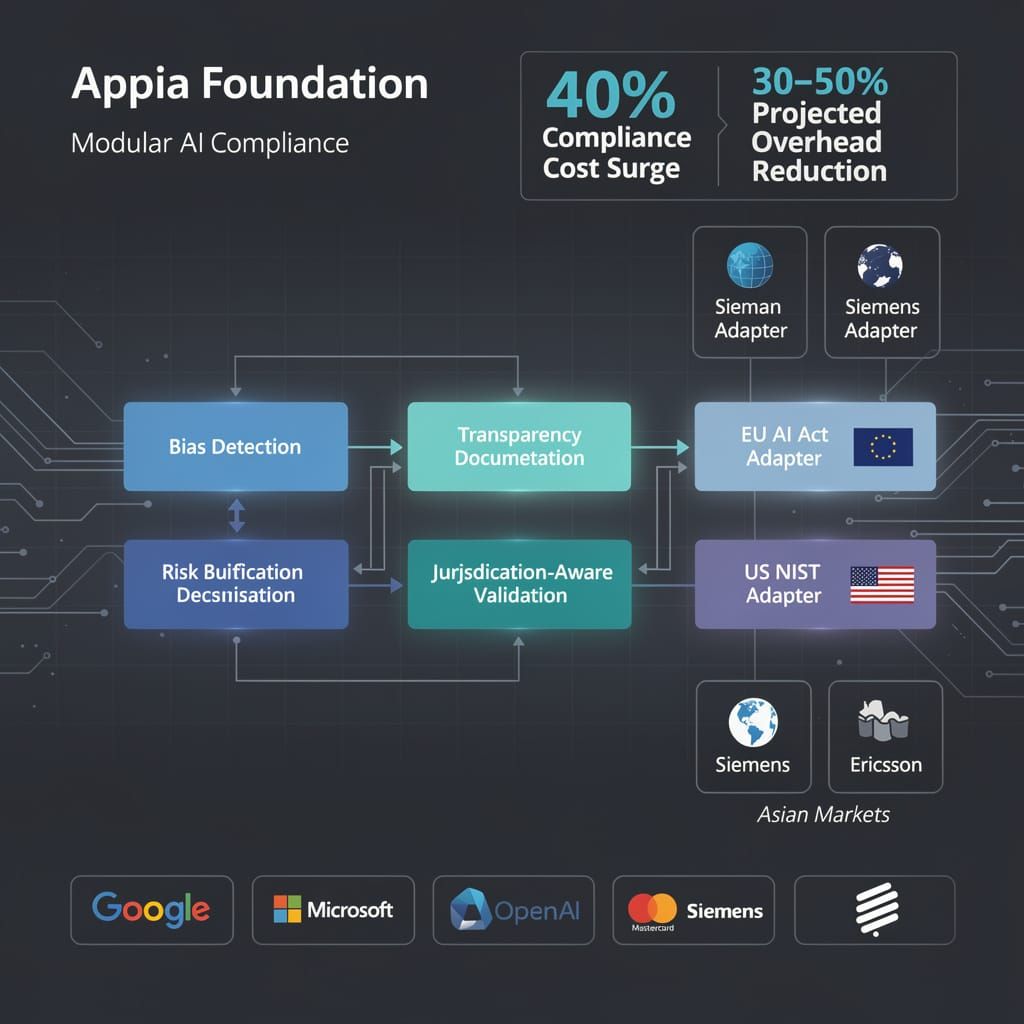
40% compliance cost surge for cross-border AI deployments — and the Appia Foundation just launched a modular fix backed by Google, Microsoft, OpenAI, Arm, Mastercard, Siemens, and Ericsson 🏛️ The framework cuts duplicate audits across EU, US, and Asian regimes. Early estimates: 30-50% overhead reduction in 2 years. Even OpenAI's $20.92B operating loss in 2025 shows redundant verification spending is unsustainable. Your AI models face 3+ regulatory frameworks — how much is compliance duplication costing your deployment?
On June 17, 2026, Brian Fagioli posted a brief update that turned heads across the AI compliance landscape. He was joining the Appia Foundation. So were Google, Microsoft, OpenAI, Arm, Mastercard, Siemens, and Ericsson. By June 19, the foundation was officially live—an independent consortium housed under the Linux Foundation, backed by a coalition that spans hyperscalers, chip architects, financial infrastructure providers, and industrial automation leaders.
The Appia Foundation is not a standards body in the traditional sense. It is a modular AI compliance assessment framework designed to solve a problem that has been accelerating for three years: the growing regulatory fragmentation of AI governance.
The Compliance Fragmentation Problem
As of mid-2026, enterprises deploying AI systems at scale face an increasingly complex patchwork of oversight. The European Union's AI Act enforces strict, risk-based mandates with binding conformity assessments. The United States, by contrast, has pursued a more adaptive, sectoral approach through executive orders and agency guidance—though the path has been uneven. President Trump delayed a key AI executive order on May 31 before signing a revised version on June 2 that promotes voluntary sharing of advanced AI models while maintaining non-binding collaboration. The executive order grants federal access to advanced models 30 days prior to public release, aiming to mitigate risks from powerful AI systems while intensifying legal challenges and market uncertainty. Meanwhile, markets in Asia and the Middle East are developing their own frameworks, each with distinct definitions of "high risk," "transparency," and "fairness."
For a multinational enterprise operating across these jurisdictions, the result is duplication. A credit scoring model deployed in the EU, the US, and Japan may require separate audits, distinct documentation, and conflicting bias thresholds. Estimates from internal industry briefings suggest that compliance overhead for cross-border AI deployments has increased by roughly 40% since 2024, with no convergence in sight. The broader context amplifies the urgency: on June 12, the US government imposed export controls banning Anthropic's Fable 5 and Mythos 5 models globally—models released just three days earlier on June 9—forcing Anthropic to block access for all customers including foreign nationals and employees abroad. The action, which Anthropic CEO Dario Amodei disputes as disproportionate, signals that federal regulators are escalating AI governance beyond traditional export controls. Cybersecurity experts warn that restrictions weaken defenses, and state-linked groups are actively exploiting AI-driven zero-days. CISA responded on June 19 by issuing BOD 26-04, replacing compliance-based vulnerability management with a risk-based methodology that calculates dynamic remediation deadlines based on asset exposure, exploitation status, and technical impact.
The Appia Foundation directly targets this friction. Its core proposition: a shared library of modular assessment modules that any organization can use to validate AI behaviors against a common baseline. These modules are designed to be jurisdiction-aware—meaning they can produce outputs that satisfy both the EU's strict mandates and the US's adaptive guidelines without requiring separate testing pipelines.
What the Founding Members Bring
Each founding member entered the consortium with a specific stake in the outcome.
Google is using the Appia framework to streamline internal compliance monitoring across its AI product lines, reducing the overhead of maintaining separate audit trails for different regulatory regimes. Microsoft has integrated the framework into its AI risk assessment tooling, allowing enterprise customers to run standardized checks across Azure deployments—a critical capability given that Microsoft, OpenAI, and Anthropic launched a unified AI inference infrastructure on June 10, introducing per-resolution pricing and autonomous workforce modules that will require consistent compliance verification. OpenAI is applying Appia principles directly to its governance roadmap, using the modular assessments as a third-party verification layer for model transparency, even as the company faces a pricing transparency lawsuit filed June 16 and ongoing financial pressure from token-based billing models. OpenAI reported 2024 revenue of $3.7 billion and 2025 revenue of $13.07 billion, but operating losses totaled $20.92 billion—driven by $19.18 billion in R&D spending and $7.5 billion in cost of revenue—underscoring the urgency of any mechanism that reduces redundant verification spending.
On the hardware side, Arm is contributing performance standards integration, enabling silicon-level bias checks that can be validated through the Appia module pipeline. This is a significant development: it moves bias detection upstream, into the architecture design phase, rather than treating it as a post-deployment audit step.
Mastercard is applying the framework to its AI-driven fraud detection and credit scoring models, using the fairness and transparency modules to validate outcomes before regulatory review. Siemens is integrating Appia modules into industrial automation compliance workflows, ensuring that AI-controlled systems in manufacturing and energy grids meet cross-border safety standards. Ericsson is adapting network orchestration logic to compliant AI workflows, a move that has implications for 5G and edge deployments where AI-driven decisions affect bandwidth allocation and latency.
The Regulatory Alignment Question
The Appia Foundation does not attempt to harmonize regulation. It does something more pragmatic: it creates a shared verification language that can be translated into multiple regulatory dialects.
The EU AI Act, for example, requires conformity assessments for high-risk systems that include documentation of training data, model performance, and human oversight mechanisms. The Appia module for high-risk conformity produces outputs structured to satisfy those requirements. The same module can also generate a report formatted for the US National Institute of Standards and Technology's AI Risk Management Framework. The assessment is the same; the output format adapts.
This design choice reflects a deliberate strategy. Rather than lobbying for regulatory convergence—a process that could take a decade or more—the foundation is building the technical infrastructure to make compliance portable. It is a recognition that regulation will remain fragmented, but verification does not have to be. The timing aligns with concrete regulatory pressure: on June 11, the FDA released guidance separating generic wellness tools from AI clinical aids, requiring new risk classification, while CISA ordered federal agencies to patch critical vulnerabilities within three days. On June 12, a bipartisan push for federal health AI regulation emerged, with experts highlighting that regulatory fragmentation creates incentives for unregulated AI use, increasing risk to patient safety and data privacy. Compliance-driven design is becoming mandatory for AI products to achieve market success.
Near-Term Trajectory
The foundation's roadmap indicates an operational reference framework within one year. Given the breadth of the founding coalition and the Linux Foundation's track record with collaborative infrastructure projects, this timeline is credible.
Key milestones to watch:
- Q4 2026: First modular assessment suite released, covering bias detection, transparency documentation, and risk classification. Initial adoption expected among founding members and early enterprise partners. The Agent Transfer Protocol (AGTP), implemented in parallel, is standardizing agent identity and authorization across agencies, creating a complementary governance layer.
- Q2 2027: Expansion into sector-specific modules for finance, healthcare, and industrial automation. These modules will incorporate domain-specific risk factors and regulatory requirements—critical as healthcare AI faces new FDA classification rules, as 70% of UK businesses plan AI adoption by 2030, and as 55% of UK SMEs already use AI (up from 20% in 2023), with 92% citing fears over data misuse and copyright infringement that threaten a £42 billion annual economic uplift.
- Q4 2027: The framework achieves industry-wide recognition, becoming a de facto reference point for AI alignment efforts across multiple jurisdictions.
The impact on compliance costs is projected to be significant. Early internal estimates from participating enterprises suggest that adopting the Appia framework could reduce cross-border compliance overhead by 30–50% within two years, primarily by eliminating duplicate testing and audit procedures. This cost pressure is timely: as of June 2026, companies are scaling back AI usage caps and abandoning leaderboards as computational costs reach $150,000 monthly averages, and 53% of AI projects fail because they lack complete context. OpenAI's $20.92 billion operating loss in 2025—exceeding its $13.07 billion revenue—demonstrates that even the largest AI firms face existential cost pressures. Any mechanism that reduces redundant verification spending directly improves project ROI.
What This Means for the Broader AI Ecosystem
The Appia Foundation represents a shift in how the industry approaches AI accountability. Prior to this initiative, most compliance efforts were reactive: regulators issued rules, enterprises built internal processes to comply, and third-party auditors validated the results. The process was slow, expensive, and fragmented.
The modular assessment model changes the incentive structure. By creating shared test protocols that are recognized across jurisdictions, the foundation reduces the cost of compliance for enterprises that adopt the framework early. It also creates a clear benchmarking point for regulators, who can reference Appia module outputs as evidence of conformity rather than designing bespoke verification procedures for each deployment.
For the broader AI ecosystem, the implications are twofold. First, enterprises that adopt the framework gain a competitive advantage in speed-to-market for cross-border AI deployments. Second, the existence of a shared verification baseline raises the floor for transparency across the industry. Smaller players that cannot afford dedicated compliance teams can leverage the open-source modules to meet baseline requirements—an increasingly important capability given that public opposition to generative AI remains high: 42% of UK respondents would eliminate it entirely if given the choice, and nearly 50% of UK workers fear AI-driven job losses.
The competitive landscape is shifting in ways that amplify the foundation's relevance. On June 12, SpaceX completed a record $75 billion IPO at $135 per share, valuing the company at $1.77 trillion, and followed on June 16 with a $60 billion acquisition of AI platform Cursor to strengthen AI capabilities. Jeff Bezos invested $12 billion in Prometheus for AI engineering on June 15. These capital inflows signal that AI infrastructure remains a strategic priority despite regulatory uncertainty. The Appia framework provides the compliance layer that such investments require to operate across jurisdictions.
The Road Ahead
The Appia Foundation is not a solution to every AI governance challenge. It does not address questions of algorithmic accountability in military applications—a category made salient by the June 12 export controls on Anthropic's models—nor does it resolve the deeper tensions between innovation and precaution that drive regulatory divergence. What it does is provide a practical tool for enterprises that need to operate AI systems across multiple regulatory environments without incurring prohibitive compliance costs.
Over the next three years, as regulatory frameworks continue to evolve and diverge—and as the US-China AI rivalry intensifies export controls, token-based billing reshapes cost structures, agentic AI moves from experimentation to operational deployment, and enterprises confront the reality that even the most successful AI firms lose $20 billion annually—the Appia framework is likely to become an essential piece of infrastructure. Not because it replaces regulation, but because it makes regulation workable at scale.
Comments ()