💣 581 CVEs Per Codebase: Global Supply Chain Security Collapses as Two-Thirds of Enterprises Face Active Compromise
TL;DR
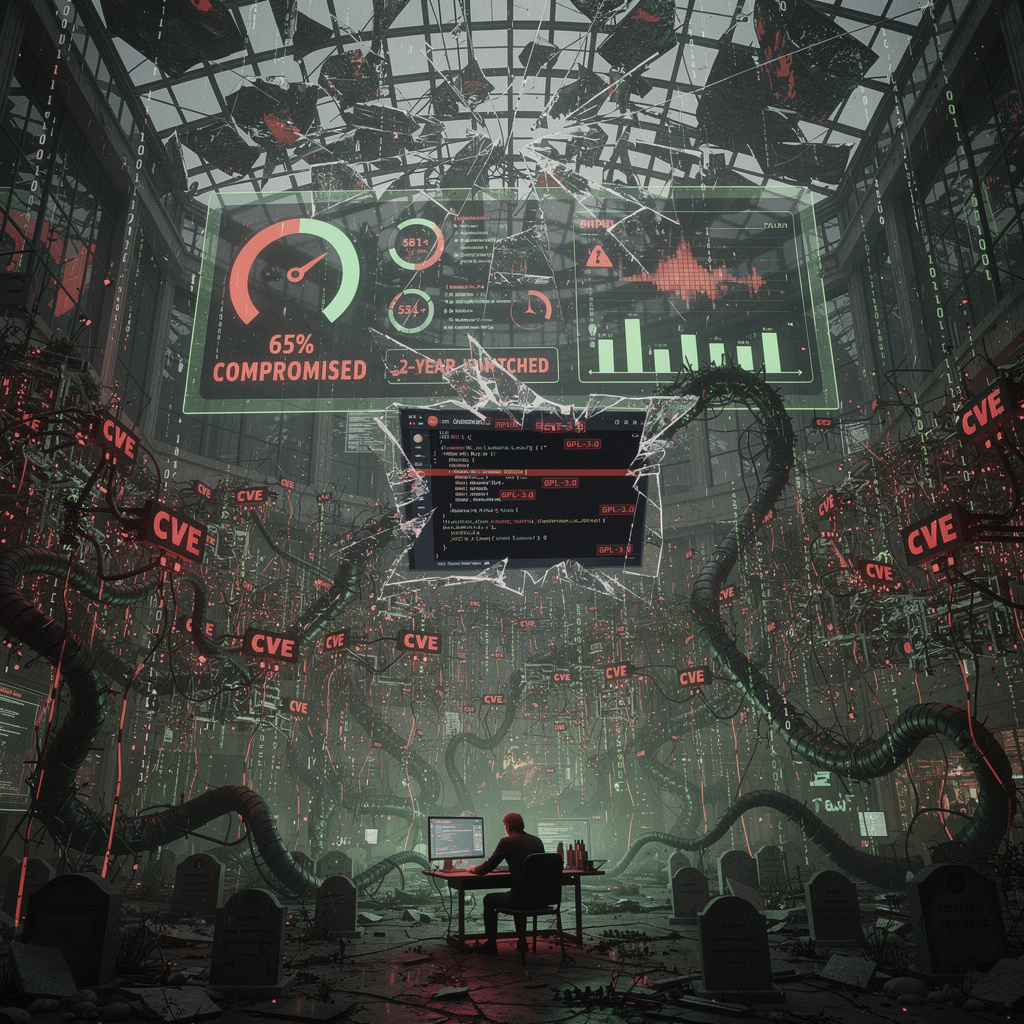
- Open source dependency vulnerabilities double: median CVEs per codebase rises from 280 to 581, 65% suffer supply chain attacks
- Cortex XDR Live Terminal vulnerability (CVE-2026-0323-2400) allows cross-tenant C2 redirection via WebSocket hijack
- Remington.bg breached, exposing 150,000+ customer and order records in Bulgaria cyber incident
💣 581 CVEs Per Codebase: Global Supply Chain Security Collapses as Two-Thirds of Enterprises Face Active Compromise
581 CVEs per codebase—double last year's body count and we're still pretending npm install is safe. That's like duct-taping a Ferrari together with parts from a junkyard fire 🔥 65% of you already got supply-chain pwnd, probably while grabbing coffee. Your 'automated' Dependabot alerts? 41 days late to the party. EU's fining, boards are panicking, and your AI copilot just GPL'd your entire IP portfolio. So—how's that "move fast and break things" working out for your compliance audit this quarter?
Black Duck's 2026 report drops like a brick through a skylight: median CVEs per codebase didn't creep up—it doubled. From 280 to 581 vulnerabilities. That's not technical debt. That's technical bankruptcy with compound interest. And 65% of audited environments? Already bled out by supply-chain attacks. The "Shai-Hulud" worm and Lazarus-linked groups aren't knocking—they're already inside, having brunch in your dependency tree.
How dependencies became delivery mechanisms
Modern development runs on velocity theater. Developers bolt on open-source packages like caffeine-fueled LEGO stacking—9.8 trillion downloads in 2025 alone. The average codebase now carries twice as many components year-over-year, yet 65% of packages lack NVD severity scores for 41 days median. You're flying blind into a thunderstorm of known-unknowns.
AI coding assistants—used by ≥50% of surveyed orgs—generate snippets that inherit restrictive licenses without provenance metadata. That's not productivity. That's IP litigation with a Copilot subscription.
The damage, itemized
- Security: 581 median CVEs → continuous exploitation surface; critical vulnerabilities persist in production despite "high-risk dip" claims
- Legal: 66% license-conflict prevalence → elevated litigation exposure; single large applications harbor thousands of conflicts
- Operational: 5–15% of dependency graphs are abandoned software → "forever-vulnerable" components with no upstream maintenance
- Financial: Board-mandated instantaneous risk reporting → remediation budgets ballooning; supply-chain attacks now cost-measurable at C-suite level
The patch-and-pray response
What's deployed: Docker Scout, Falco, Dependabot, SBOM generation, OSV mapping—event-driven scanning becoming baseline.
What's missing: Coordinated OSS maintainer funding; real-time dependency attestation; enforceable provenance standards before 2029.
EU Cyber Resilience Act and EO 14028 mandate provenance verification by year-end. Meanwhile, Patch Tuesday 2026 dropped 58 Microsoft CVEs and 44 Adobe fixes—many container images remain unpatched for >2 years.
The timeline nobody wants
- 2026–2027: Median CVEs push past 650; automated scanning hits 80% enterprise adoption; typosquat threats up 10%
- 2028: AI-generated code becomes primary license-conflict vector; CycloneDX 2.0 compliance mandatory in regulated sectors
- 2029–2030: Abandoned components hit 20% of dependency graphs without maintainer funding reform; supply-chain breaches plateau only after mandatory SBOM verification embeds in delivery pipelines
The bottom line
Open source was supposed to democratize infrastructure. Instead, it democratized attack surface. The 108% CVE explosion and 65% compromise rate aren't growing pains—they're structural failure. Automated scanning buys you visibility, not safety. Until provenance verification and maintainer funding become non-negotiable, your "free" dependencies remain the most expensive line item you never budgeted for.
🎭 Cortex XDR CVSS 9.3: Suffix Check Fails, EDR Becomes Attacker C2
CVSS 9.3 remote code execution in Cortex XDR's Live Terminal—because Palo Alto thought a ".paloaltonetworks.com" suffix check was "security." That's like trusting a domain ending in "bank.com" with your life savings. Attackers just spin up evil-tenant.paloaltonetworks.com and boom: your EDR becomes their C2. Your "endpoint protection" is now endpoint infection. How many orgs even know their EDR can be hijacked by a $5 domain?
Palo Alto's Cortex XDR—marketed as the invisible shield protecting your endpoints—ships with a logic flaw so embarrassingly simple it validates hostnames like a 2004 phishing filter. CVE-2026-0323-2400 turns your $50/year/agent security investment into free infrastructure for attackers who bothered to register a subdomain. The suffix check .paloaltonetworks.com? That's it. That's the authentication. No crypto. No tenant binding. Just vibes and string matching.
How the hijack works
The Live Terminal's WebSocket handler runs run_lrc_payload, which verifies exactly one thing: does the server address end with the magic string? An attacker generates a legitimate-looking tenant token, intercepts the handshake, swaps the server field to evil-tenant.paloaltonetworks.com, and watches your endpoints phone home to their infrastructure. The agent then launches cortex-xdr-payload.exe via cyserver.exe—a process chain that looks boring enough to evade most detection rules. Result: persistent C2 inside your EDR, using your own telemetry pipes.
What breaks when your security tool gets owned
- Detection: Traffic appears legitimate—it's your Cortex agent talking your protocol on your port 443. Your SOC stares at logs showing healthy EDR heartbeats while attackers move laterally through the same channel.
- Scope: ~9.3 CVSS, network-vector, no auth required. Affected builds 8.3–8.9, with confirmed exploitation on 8.7-899. Global deployment across NA, EU, APAC, LATAM.
- Development barrier: Minimal. Python 3.12 + PyInstaller = working exploit. Decompiled cleanly with
pylingual. Underground forums expect open-source drops within two weeks.
The pattern nobody wants to name
This isn't isolated. BeyondTrust (CVE-2026-1731) and Dell RecoverPoint (CVE-2026-22769) share the same DNA: management-plane protocols with authentication theater—suffix checks, missing signatures, trust-by-default. Unit 42 and CISA have flagged the convergence. Attackers aren't finding exotic bugs; they're finding where vendors cut corners on cryptographic validation.
Timeline: from disclosure to damage control
- Now–March 2026: Targeted exploitation against high-value orgs with compromised tenant credentials. Expect forum chatter and proof-of-concept releases.
- Q2 2026: Palo Alto's hot-fix drops—signed patches, mandatory token-tenant binding, presumably less naive hostname validation.
- 90+ days: Industry-wide scramble to pin certificates and cryptographically sign WebSocket commands. Attackers pivot to gRPC, MQTT, whatever's next in the "trust but don't verify" pipeline.
What actually works today
Process monitoring for cyserver.exe spawning cortex-xdr-payload.exe. WebSocket handshake logging with tenant whitelist enforcement. Network proxies doing mutual TLS inspection. Token binding by ID, not by domain suffix. The usual hygiene that costs engineering hours instead of license renewals.
The core lesson: when your security product's authentication reduces to string matching, you've built a very expensive redirection service. Cortex XDR didn't fail cryptographically—it failed linguistically. And that's somehow worse.
🔥 270K Records: Bulgarian Retail Giant Remington.bg Breached, Sold for $1,500 on Dark Web
270K Bulgarian furniture buyers just got their data stapled to a $1,500 darkweb price tag. That's $0.005 per soul—cheaper than a IKEA meatball. Niphra's running a liquidation sale on GDPR violations while Remington.bg learns MFA isn't optional furniture. Balkan retailers: still building digital security from flat-pack instructions?
Another day, another e‑commerce site feeding its customers to the dark‑web wolves. Remington.bg—Bulgaria's furniture giant—just became Niphra's latest bargain bin special: 150,000+ records, yours for the low, low price of a used PlayStation 5. That's $0.005 per identity. Your grandmother's credenza costs more than her stolen data.
How did this happen?
Standard playbook. SQL injection, sloppy API endpoints, or some admin account protected by "password123" and a prayer. No MFA, no WAF worth mentioning—just 270,000 rows of customer PII and order history sitting pretty for bulk export. The technical footprint screams "we tested in production."
What got spilled?
- Identity exposure: 130,000 customer records—names, emails, phone numbers—now fuel for phishing factories
- Transaction trails: 140,000 order records enabling hyper‑targeted scams (fake warranty calls, "delivery problem" texts)
- Regulatory headache: GDPR breach notification clock ticking—72 hours to confess or face fines up to €20M
The institutional response (so far)
- Forensic containment: Isolate servers, capture memory, audit privileged access
- Patch panic: Emergency updates to web frameworks, API authentication overhauls
- Access hardening: MFA deployment (finally), credential rotation, least‑privilege enforcement
- Dark‑web stalking: Continuous monitoring for data resale and IOC tracking
Timeline of inevitable consequences
- 0–30 days: GDPR notifications filed, customers learn their sofa purchase is now public record, phishing campaigns activate
- 1–3 months: Regulatory fines land (estimate €150k–€500k), WAFs actually get configured, incident response vendors cash checks
- 6–12 months: Balkan retailers pretend they learned something, OWASP compliance becomes a LinkedIn buzzword, threat‑intel sharing groups form and dissolve
Niphra priced this dump at $1,500—cheaper than most enterprise security audits. That gap between breach cost and prevention cost? That's the whole game. Until boards feel that pain in quarterly earnings, we're just furniture shopping for threat actors.
In Other News
- Microsoft’s Swiss Data Residency program enforces EU Data Boundary, uses Customer Lockbox and Confidential Compute for sovereign cloud compliance
Comments ()