$2.26B Surplus, Half April's: T-MEC "Consensus" Delivers Compliance, Not Prosperity
TL;DR
- $2.26B Surplus, Half of Last Month: T-MEC 'Breakthrough' Just Business as Usual. Who's really absorbing tariff costs — exporters, automakers, or consumers?
- $99 Million Loss, Broken Loophole: Shein’s Tariff Reckoning. Can ultra-fast fashion survive without tariff subsidies?
📉 They Called It a Breakthrough. It's Just Business as Usual.
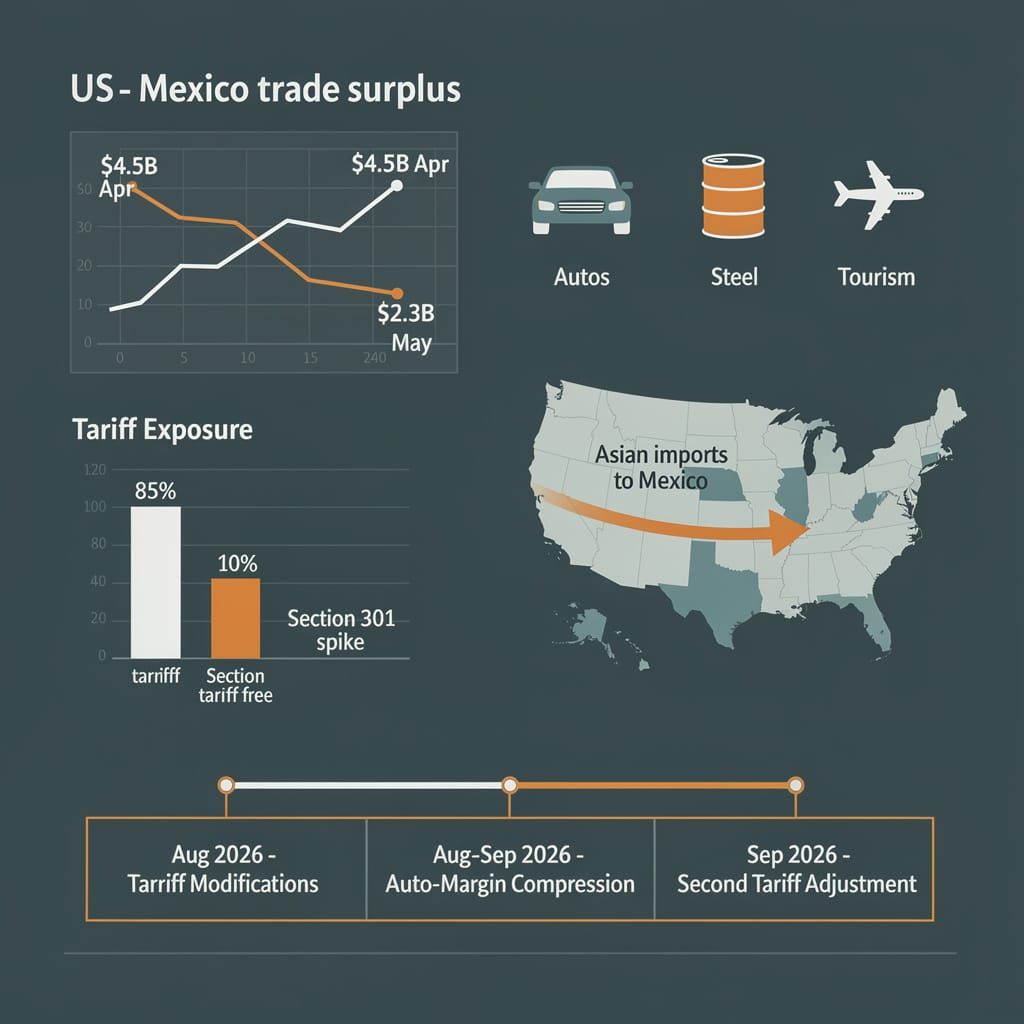
$2.26B May surplus? Cut it in half from April. That's what "consensus" looks like. 📉 Mexico agreed to tariff reforms that preserve compliance, not prosperity. 85% tariff-free sounds good until you realize viability ≠ profitability. American vehicles now $50K average, 58.5% of buyers underwater on loans, and automakers cheer. The "breakthrough" is just business as usual with a fresh coat of spin. When Asian imports to Mexico jumped 42.5% and Chinese brands doubled market share to 20%, tightening origin rules won't fix the loophole — it'll just shift who pays. Who's really absorbing these costs — and for how long before the data catches up with the damage?
The headlines this week practically write themselves: "U.S.–Mexico Trade Talks Achieve Consensus," "T-MEC Review Preserves 85% Tariff-Free Flow," "Sheinbaum Meets Greer in Productive Dialogue." If you read those and imagine a grand diplomatic triumph, you have not been paying attention.
Let's trace what actually happened.
July 21–23: Three rounds of T-MEC updates. The stated goal: lock out Chinese-aligned steel and aluminum duties, secure North American content quotas. The outcome: minor friction over Rio Grande water deliveries, differing views on renewable clauses, and a decision to kick hard choices to September 2026. European labor unrest quietly entered the background as a reason to doubt compliance windows — but nobody in Washington or Mexico City discussed that publicly.
July 24: USTR implemented a 10% tariff on Mexican imports under Section 301. Exclusions exist for compliant goods. The message: follow our rules, or pay.
July 27: Trade talks concluded. No binding accord. Just "consensus on tariff reductions" — meaning Mexico agreed to structural reforms that require selective tariff application under emerging U.S. policy.
The numbers tell a clearer story than any diplomat. Mexico's May trade surplus reached USD $2.26 billion, driven by a 25.6% surge in non-oil exports — but that surplus represents barely half of April's USD $4.52 billion, reflecting how tariff uncertainty already erodes momentum. The 10% Section 301 tariff, imposed July 24, now raises costs on Mexican exporters exceeding $54 million monthly volume. Yet most producers — steadfastly, predictably, pragmatically — adhere to the terms and preserve revenue flow. That is not resilience. That is capitulation dressed as cooperation.
What This Actually Enables
- Auto and metal sectors: Incremental cost burdens from evolving tariff structures. A 50% American-made component mandate proposed by Trump under T-MEC is already forcing reconfiguration in Coahuila, raising production costs. The "85% tariff-free" figure protects viability — but viability is not profitability. Cross-border shipping efficiency declines as classification debates persist.
- Section 301 enforcement: This mechanism drives everything. Mexico's official response to U.S. tariffs: cutting Chinese light-vehicle imports 29.7% and Taiwanese car purchases 32.7%. But Chinese brands now hold nearly one-fifth of Mexico's new-car volume — up from 7% two years ago — enabled by preemptive stockpiling before the tariffs took effect. Asian imports overall rose 42.5% to $155.23 billion, driven by Taiwanese chip orders up 233.76%. Mexico is not blocking Asia; it is rerouting it.
- The tourism distraction: Mexico recorded 8.35 million international tourists in May — a five-year high. But air arrivals fell 58.1%, and net tourism revenue dropped 0.4% despite the 5.3% rise in visitor volume. Excursionists now account for 53.1% of arrivals, spending $61.80 each versus $1,310.70 for air travelers. American Airlines cut seats to Mexican beach destinations by ~15%; United cut ~17%; Spirit exited the Mexican Caribbean entirely. The headline misleads; the revenue quality erodes.
The early trade-talks conclusion prevented escalation. Supply chains remain functional. That is the ceiling of this achievement, not the floor.
The Forecast They Want You to Believe
Final T-MEC modifications expected by September 2026. No major disruptions anticipated. Confidence: high.
The more honest read: resolution remains uncertain. The quarterly data will look stable because producers will absorb costs and pass them down. Compliance is the path of least resistance. But stable data is not a verdict on the policy's wisdom — it is a measure of how much burden an economy can silently shoulder before someone notices.
- August 2026: Expect the first quarterly trade data under the new tariff structure. Auto-sector margins will show compression: U.S. vehicle prices hit $50,000 on average — 30% above 2019 — while auto-loan rates stay at 7% and 58.5% of buyers sit on underwater loans. Steel Dynamics posted a 30% margin uplift precisely because tariff enforcement allows domestic producers to price above global benchmarks, not because demand justifies it. RV manufacturers reported a 25% shipment drop, and consumer appliances saw $30–$100 added per unit. Officials will call this a "transition period."
- September 2026: T-MEC modifications finalized. The real test: whether European labor unrest spills into North American supply chains despite the border fixes. Across Western Europe, industrial contraction is accelerating: German industrial employment hit a historic low in June, BMW announced workforce reductions, and French automakers began layoffs. The European Stability Mechanism warned on July 6 that Middle Eastern conflicts combined with U.S. financial instability threaten a eurozone recession. If European supply chains falter — and BYD, Geely, Xpeng, Leapmotor, and Chery have all secured production sites in Spain and Hungary to bypass EU tariffs — the slack may draw Chinese manufacturers deeper into Mexico as a North American access point. Chinese auto brands already doubled their Mexican market share to roughly 20% in two years; U.S. legislative bills targeting Chinese connected-vehicle imports are already in committee.
- Q4 2026: If China responds to U.S. Section 301 policy by rerouting exports through compliant markets — and Mexico is the obvious candidate — expect a second round of tariff adjustments. Asian merchandise inflows to Mexico jumped 42.5%. USTR Greer stated on July 16 that the U.S. will tighten origin rules to curb Mexico's role as a gateway for Asian goods. Moody's downgraded Mexico's sovereign rating in May; GDP contracted 0.6% in Q1. A new "consensus" to close that loophole is coming.
None of this is a breakthrough. It is a system managing its own contradictions, one quarterly review at a time, while the costs accumulate in places that do not make headlines.
🤡 Shein’s $99 Million Loss: The Tariff Bite That Exposed the Model
Shein just lost $99 million in a single quarter — after years of claiming its $12 dresses were "efficient." Turns out the secret sauce was zero tariffs, not genius logistics 🤡 That de minimis loophole? Gone as of May 2025. Each parcel now hits a 30% tariff. Gross margin collapsed from 54% to 42%. Inventory write-downs of $42 million alone. Shein raised prices 8%. Traffic dropped 6%. Turns out Gen-Z won't pay $13 for a dress that falls apart in three washes. The London IPO? Delayed. The pre-IPO story was "structural cost advantage." Reality: regulatory arbitrage that lasted just long enough to fool underwriters. 281 million active customers and one billion orders — and they still can't make money without a customs loophole. What happens when Temu faces the same math?
The math was always improbable. Shein’s Q1 2026 loss of $99 million is, on one level, a supply-chain story: the U.S. eliminated the de minimis duty exemption for Chinese-origin apparel effective May 1, 2025, and Shein’s cost structure collapsed accordingly. Each parcel that once cleared customs at near-zero cost now carries a maximum 30% tariff upon import—per the April 2025 announcement—that the brand can neither absorb nor fully pass to price-sensitive Gen-Z shoppers. The result was inventory write-downs—$42 million in Q1 alone—as unsold units aged past the 14-day trend cycle that makes Shein’s model work.
Why Q1’s Loss Reverses Three Years of Profit
Shein reported a net loss of $99 million for the three months ending March 31, 2026, versus a $187 million profit in the same quarter of 2025. The causal chain is blunt:
- U.S. tariff change: De minimis elimination added a maximum 30% tariff per package, with Freightos forecasting a 50% rise in air shipment costs immediately after the April 16, 2025 announcement.
- Volume exposure: Shein shipped approximately 48 million packages to U.S. addresses in Q1 2026—up 11% year-over-year—meaning tariff costs landed on a balance sheet that previously paid near zero.
- Margin mechanics: Gross margin contracted from 54.2% (Q1 2025) to 41.8% (Q1 2026). The $99 million loss as reported includes a $42 million inventory impairment charge—markdowns on goods that arrived at a landed cost higher than their market-clearing price.
- EU adds another layer: The EU’s €3 fee on low-value e-commerce imports, imposed in April 2026, adds roughly $3.42 per unit, further compressing margins on Shein’s European shipments.
The company’s response—raising average selling prices by roughly 8% in April and May—produced a measurable traffic decline of 6% on the app, suggesting limited pricing power.
The IPO Delay: Not a Surprise
Shein’s London IPO, originally filed with the FCA in June 2025, now targets a September 2026 window. The delay reflects a fundamental shift: the pre-IPO narrative of “data-driven ultra-fast fashion with structural cost advantages” no longer holds. The cost advantage was a regulatory arbitrage, and it’s gone.
- Pre-tax margin (2024): 5.8%, driven by near-zero logistics duties.
- Pre-tax margin projection (2026, if tariffs persist): negative 1.2% to negative 2.4%, even after vendor price renegotiations reported in May 2026.
- CSRC approval: China’s securities regulator cleared a Hong Kong IPO listing on July 10, 2026, providing an alternative capital route, though the London narrative remains damaged. Shein confirmed on July 27 that active customers hit 281 million (+16% YoY) and over one billion orders processed, but the Hong Kong path signals a valuation haircut, not a vote of confidence.
No underwriter will price an IPO when the lead story is “we lost our tariff exemption and haven’t found a replacement model.”
What the Loss Actually Reveals
The $99 million figure is small relative to the $24 billion in revenue Shein reported in 2025. But the direction matters. Shein’s model depends on four pillars: zero-tariff access, Chinese supply-chain speed, algorithmic trend detection, and consumer willingness to impulse-buy at $12. The tariff pillar is broken. The speed pillar is untouched, and the algorithm still works, but those two alone cannot prop up the margin when landed costs are 18–22% higher.
- Inventory turns: Dropped from 7.2x annually (2024) to 5.6x (Q1 2026 annualized)—slower stock movement forces deeper discounts.
- Return rates: Rose to 19% (Q1 2026) from 14% (2024), as higher prices drive more second-guessing.
- Everlane acquisition: Shein’s ~$100 million purchase of Everlane in May 2026 signals a pivot toward premium positioning, but integrating a struggling ethical-fashion brand hardly solves a tariff problem.
The Sector Signal
Shein’s loss is a leading indicator for the broader direct-from-China e-commerce segment. Temu (PDD Holdings) has reported similar compression: operating margins in its international segment fell from 6.1% to 2.3% in the same quarter. The de minimis change applies to both, and neither has a viable workaround—reshoring to Southeast Asia adds 12–15 days to lead time, which breaks the ultra-fast model entirely. Meanwhile, the U.S. Section 301 tariff framework persists: Oustrade proposed an additional 12.5% tariff via Section 301 on June 15, 2026, amid forced-labor probes, signaling the tariff environment will tighten, not loosen. Broader data confirms the shift: U.S. imports from China fell 10 percentage points in 2025, while Vietnam imports rose 22% as an alternative supply base, per February 2026 analysis from Columbia University researchers. U.S. firms have borne 86% of tariff incidence, with import prices rising 11% for tariffed goods by November 2025.
Forecast Through Year-End
- July–September 2026: Shein will report a smaller Q2 loss (projected $40–55 million) as price increases partially take hold and inventory impairments moderate, but unit volumes will continue declining 4–6%. The broader U.S.-China trade picture, however, shows a complicating signal: goods trade reached 2 trillion yuan in H1 2026, the first increase since January 2025, driven by a May Trump-Xi meeting and retailers advancing holiday orders 4–6 weeks. The seasonal peak now shifts to September, which could temporarily lift Shein volumes—but not margins, since tariff costs remain in place.
- September 2026 IPO window: Remains technically open but commercially improbable. The CSRC-approved Hong Kong listing offers an escape hatch but at lower valuation multiples. A realistic path to profitability requires either a return of the de minimis exemption (zero political probability in an election year with the ITIF actively opposing any U.S.-China board mechanism as of July 10, 2026) or a structural shift to third-party marketplace listings with lower inventory risk.
- Year-end 2026: Full-year loss estimated at $220–280 million, assuming no change to tariff policy and factoring in the EU fee and continued Section 301 pressure. Cost-optimization efforts cited in Shein’s July 27 briefing may trim operating expenses but cannot reverse the structural margin compression.
The IPO narrative now reads as salvage rather than scale. The $99 million loss is unremarkable in absolute size, but it is analytically devastating: it proves the model was never efficient—it was subsidized by customs rules that happened to last long enough to fool investors.

Comments ()