15% Losses, 2% Spreads, Zero Yield: The Great Commodity Rotation Is a Panic, Not a Plan
😬 The Great Escape into Stuff
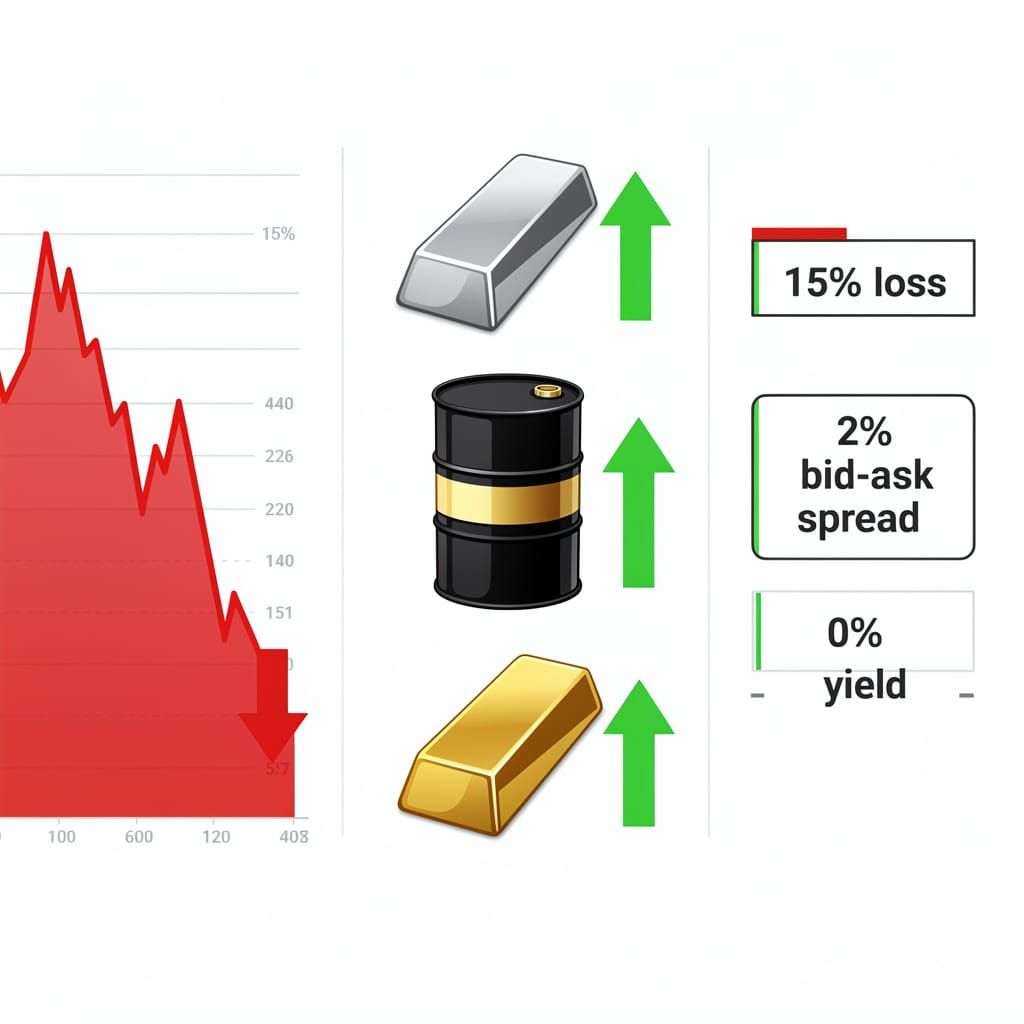
Investors who rotated into commodities are already sitting on 15%+ equity losses 😬 Bid-ask spreads on commodity ETFs have blown past 2% — that's not a safe haven, that's a liquidity trap. Commodities produce zero yield. Zero dividends. Zero compounding. Calling this "safety" confuses volatility with risk. Institutions aren't chasing copper — they're fleeing equities. The rotation itself is the story. Is your portfolio hiding in stuff, or actually generating cash flow? 💰
On July 30, a meaningful rotation began: portfolios tilted hard away from equities and into physical commodities. The stated rationale—perceived safety—sounds reasonable until you inspect the math.
The Price of "Safety"
Drawdowns: Investors who moved first are already sitting on losses exceeding 15% in their former equity positions. That is not repositioning. That is panic selling into a market that has not yet finished repricing. On July 22, EVGO breached its all-time low at $1.60 amid an $800,000 shortfall on a $500 million regulatory rule—one data point in a broader unwind where low-float names faced acute pressure. The retail-investor edge of a broader unwind is visible, and it is bleeding.
Valuations: New entrants are paying premium multiples for commodity positions. The same behavioral flaw that drove tech-stock frenzy now shows up in copper warehouses and gold vaults—buying after the move, not before.
Liquidity: Bid-ask spreads on commodity ETFs have blown past 2%. That is not a liquid haven. The SPDR S&P Regional Banking ETF bled $244.1 million in a single July 14 outflow (4.7% weekly decline). The Vanguard Energy ETF lost $135.9 million the same day. When institutions sprint for the exit, the door gets narrow fast.
What the Rotation Ignores
Commodities generate no earnings, pay no dividends, and offer no compounding. They sit in vaults or silos, producing exactly zero yield. Calling this a "safe" allocation confuses volatility with risk.
The forecast sees retirees shifting more funds into tangible assets within six months. That projection assumes current prices hold and that liquidity does not deteriorate further—two assumptions with weak foundations. On July 13, one 60-year-old retiree liquidated property and vehicles for $600K–$650K to fund a brokerage account, not commodities. Real demand for safety looks nothing like the narrative.
The Real Signal
On June 19, Strategy Inc.'s preferred equity shares SATA and STRC crashed below their $100 par values, triggering a $15 billion leveraged unwind and $941 million in single-day volume. By July 24, SATA had rebounded to $97—near par—yet STRC remained below $100. The partial recovery demonstrates that preferred equity markets can stabilize, but only after forced liquidations have cleared. The hedge fund that borrowed additional capital on July 30 amid AI-sector losses is not chasing commodities either—it is fleeing equities.
The rotation itself is the story, not the destination. Institutional money is not chasing commodities; it is fleeing equities. That suggests a broader confidence problem with equity valuations, not a sudden belief that crude oil or copper is undervalued.
Until corporate earnings, monetary policy, or fiscal signals stabilize, this move looks less like strategic allocation and more like a reflexive flight from paper assets into anything physical. Safety is not a bullion bar. Safety is a durable cash flow. These flows are heading in the opposite direction.
Comments ()