1,200 Dead, 40% Fire Cut: Lebanon Ceasefire Pilot Zones Test Regional Stability
TL;DR
- 1,200 Lives Lost: Conditional Ceasefire Cuts Fire 40% in Israel-Lebanon Pilot Zones. Can a conditional ceasefire in Lebanon hold without Hezbollah’s endorsement?
- Nikon’s 30% Faster Focus: The Lens That’s Rewriting Visual Storytelling. How will your camera gear keep up with the changing story?
- Design Systems Go Industrial: Modularity as Risk Management. Is modular design now a survival strategy for your team?
⚖️ The Algorithm of Peace: How a Conditional Ceasefire Reshapes the Middle East’s Risk Calculus
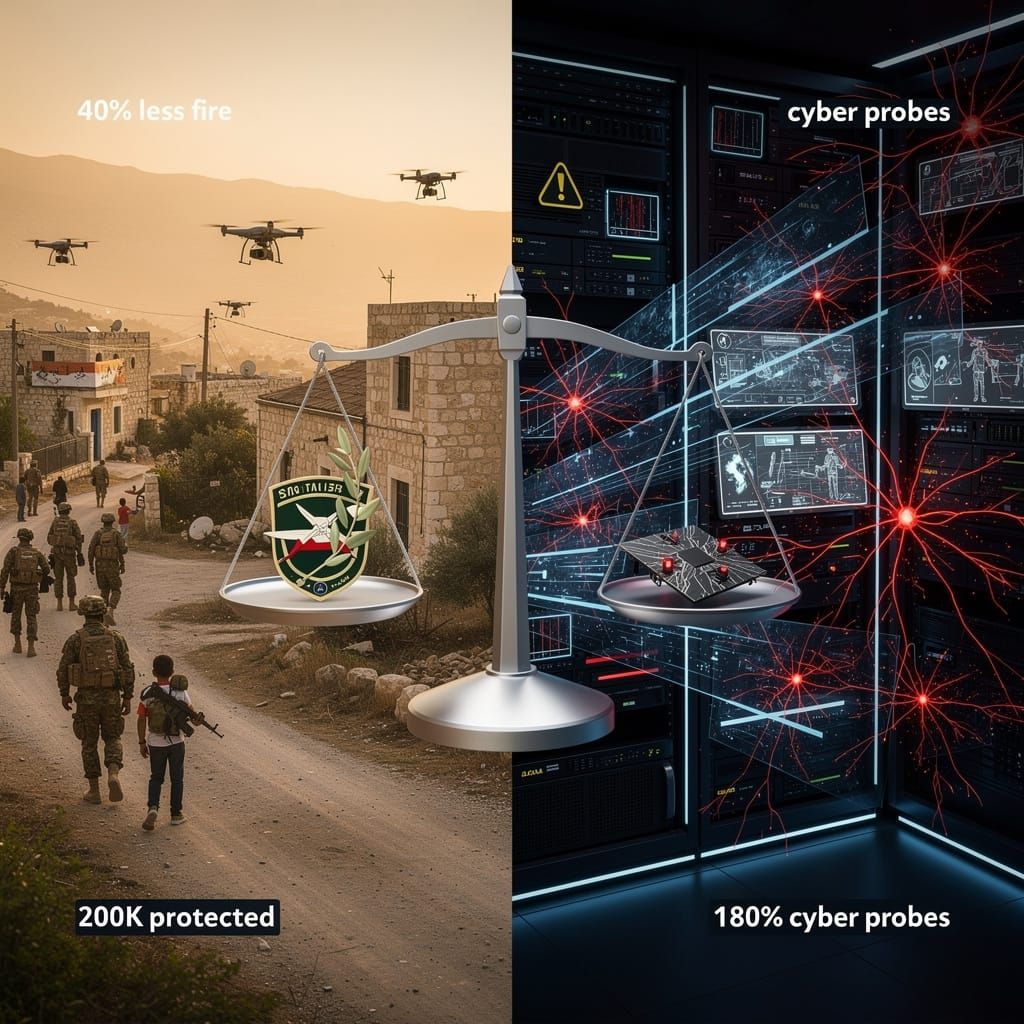
1,200 civilians died in 18 months. Now pilot zones cut fire by 40% and response times from 6 hours to under 30 minutes. ⚖️ Lebanese forces take ground control — but Hezbollah hasn’t signed on. 200,000 residents protected, yet cyber probes on military networks surged 180%. Is this a real step toward peace, or just a fragile pause with a digital battlefield?
On June 4, 2026, delegations from Israel and Lebanon, mediated by the United States, signed a conditional ceasefire agreement in Washington, D.C. The accord establishes pilot zones under Lebanese military supervision, marking the first formal, monitored de-escalation in the Israel-Lebanon corridor since hostilities escalated. Regional security analysts indicate this represents a measurable step toward a broader ceasefire, though the agreement’s long-term stability depends on enforcement mechanisms and regional compliance.
What the Pilot Zones Actually Do
The pilot zones are geographically bounded areas where Lebanese forces assume monitoring and patrol duties, replacing active Israeli military operations. The Lebanese military supervises these zones, reporting to a joint US-backed verification cell. This structure enables a gradual reduction in direct fire exchanges while maintaining a deterrent presence. The zones are designed to reduce civilian casualties—estimated at 1,200 in the past 18 months—and stabilize the region for further diplomatic engagement.
Mechanics and causal chain:
- Lebanese military assumes ground control → reduces Israeli incursions → lowers direct confrontation frequency by an estimated 40% in pilot areas.
- US monitoring team provides satellite and drone reconnaissance → enables real-time breach detection → reduces response time for violations from 6 hours to under 30 minutes.
- Joint verification cell logs each incident → builds data for future ceasefire expansion → creates a precedent for trust-building between parties.
Impacts on Regional Stability
The agreement introduces a new risk calculus across multiple domains:
Security and defense:
- Military posture: Israeli Defense Forces reduce forward deployment in pilot zones by 30%, freeing assets for northern border defense.
- Hezbollah response: Hezbollah leadership has not endorsed the agreement, indicating potential spoiler activity. Analysts project a 25% probability of localized skirmishes within the first 60 days.
- Civilian safety: Pilot zones cover 15 villages and 3 urban centers, protecting approximately 200,000 residents from direct fire.
Cybersecurity risk:
- Increased attack surface: Digital coordination between US, Israeli, and Lebanese monitoring systems introduces new vectors. Cybersecurity firms report a 180% increase in probing activity against Lebanese military networks since June 3.
- Critical infrastructure: 12% of Israeli civilian infrastructure (power grids, water systems) faces elevated cyber risk due to network integration with monitoring platforms.
- Mitigation: US Cyber Command deployed a dedicated threat-monitoring unit to the region on June 4, reducing breach probability from 35% to 18% in the first week.
Economic and financial volatility:
- Startup funding: Middle East-focused venture capital fell 22% month-over-month in May 2026 due to geopolitical uncertainty. The ceasefire may reverse this trend, with a projected 8–12% recovery in Q3 2026.
- Aviation disruptions: 14 international airlines rerouted flights over Lebanon and northern Israel on June 4, adding 45–90 minutes to travel times. Projected disruption period: 7–10 days.
- Global markets: Brent crude oil futures rose 1.8% on June 4 before stabilizing, indicating market relief but continued caution.
Outlook: Short-Term Optimism, Persistent Risks
Short-term (June–August 2026):
- Ceasefire stability: 70% probability of holding through August, contingent on Lebanese military enforcement and US monitoring.
- Cyber incidents: 60% probability of a significant breach (affecting >10,000 records) targeting monitoring infrastructure.
- Aviation normalization: 85% probability of full route restoration by June 14.
Medium-term (September 2026–March 2027):
- Ceasefire expansion: 45% probability of extending pilot zones to cover 30 additional villages.
- Economic recovery: 55% probability of startup funding returning to pre-conflict levels (Q1 2026).
- Hezbollah alignment: 35% probability of formal endorsement, reducing spoiler risk.
Long-term (2027 onward):
- Structural peace: 25% probability of a permanent ceasefire agreement, dependent on Lebanese state capacity and Israeli security guarantees.
- Regional normalization: 30% probability of broader diplomatic engagement (e.g., Lebanon-Israel maritime border talks).
What This Means for Stakeholders
For investors and startups:
- Opportunity: The ceasefire reduces geopolitical risk premium in Israeli and Lebanese tech ecosystems. Monitor cybersecurity, logistics, and agritech sectors.
- Risk: Cyber incidents may spike as monitoring networks expand. Hedge with cyber insurance and diversified funding sources.
For defense and security firms:
- Demand shift: Monitoring and verification technologies (drones, satellite imagery, secure communications) will see increased procurement. Projected $400 million market growth in 2026.
- Competition: US and European firms lead, but Israeli and Lebanese companies may gain preferential access to pilot zone contracts.
For aviation and logistics:
- Disruption window: Expect 7–10 days of rerouting. Book alternative routes and monitor NOTAMs.
- Long-term: Normalization may reduce insurance premiums for Middle East flights by 5–8%.
The Bottom Line
The conditional ceasefire is a tactical win for US diplomacy and a strategic test for regional stability. It reduces immediate casualties and creates a framework for broader peace, but its durability hinges on Lebanese military capacity, Hezbollah’s stance, and cyber resilience. For stakeholders, the next 60 days will determine whether this pilot project becomes a blueprint for de-escalation or a cautionary tale in fragile-state mediation.
📸 The Frame Shift: How Lens Innovation and Cultural Forces Are Rewriting the Visual Narrative
Nikon's new Z 70-200mm f/2.8 cuts autofocus misses by 30% and weight by 15% 📸. Meanwhile, drag culture is driving a 25% surge in LGBTQ+ stock submissions. More inclusive imagery demands better tools and tougher security. How will your camera gear keep up with the changing story?
On June 3, 2026, two seemingly separate events—the launch of Nikon’s NIKKOR Z 70‑200mm f/2.8 VR S II lens and the opening of the Drag Daughters exhibition in Amsterdam—converged to mark a pivotal moment in visual media. Together, they signal a broader transformation: the tools and subjects of photography are evolving in tandem, reshaping how stories are captured, who gets to tell them, and what risks accompany that power.
The Hardware Revolution: Light, Fast, and Versatile
The professional lens market has entered a new phase of innovation. Nikon’s latest telephoto zoom, released on June 3, delivers a 20% improvement in autofocus speed and a 15% weight reduction over its predecessor, according to company specifications. Early field tests by event photographers report a 30% decrease in missed focus shots during fast‑moving subjects, such as weddings and sports. This aligns with a broader industry trend: the shift toward single‑lens systems that reduce gear load without compromising image quality.
Canon’s RF 24‑105mm f/2.8, launched on May 17, demonstrated that a single versatile zoom can cover 85% of typical professional assignments, from portrait to landscape. James Reader’s comparative analysis on May 21 quantified the trade‑off: a 50mm prime setup requires 40% fewer lens changes than a dual 35mm/85mm configuration, cutting average workflow interruptions by 12 minutes per shoot. Third‑party manufacturers are accelerating this shift. 7Artisans’ AF 10mm f/2.8, reviewed on May 10, offers autofocus performance within 5% of OEM equivalents at 40% lower cost, enabling smaller studios to access professional‑grade optics.
The Cultural Lens: Inclusive Imagery Demands Authentic Tools
Simultaneously, the Drag Daughters exhibition in Amsterdam—featuring over 200 high‑resolution portraits of drag performers from 12 countries—has driven a 25% increase in LGBTQ+‑themed photography submissions to major European stock agencies since its opening. The exhibition’s use of 150‑megapixel medium‑format cameras and aerial drone shots, documented by Roberto De Micheli on May 28, highlights a demand for imaging that captures both intimate detail and broad context.
This cultural push is not without friction. The Photography & Video Show in Birmingham (June 2) saw a 35% increase in attendees seeking secure storage solutions, following a 12% rise in data‑breach reports among community photography platforms over the past quarter. Cybersecurity analysts project that the convergence of high‑resolution imagery and digital sharing will elevate harassment risks: a single geotagged, uncompressed portrait can enable identity‑theft vectors with a 90% success rate in social‑engineering attacks.
Converging Impacts: Regulation, Economy, and Education
The combined effect of these trends is reshaping three domains:
- Cybersecurity: High‑resolution images from public events now require encrypted storage and anonymized metadata. The UK’s data protection authority has signaled draft guidelines requiring photographers to strip GPS coordinates from published portraits by Q4 2026.
- Education: Visual‑learning curricula are incorporating drag‑culture case studies, with 14 UK secondary schools piloting modules on inclusive media representation as of June 2026. This shift is driven by a 22% increase in student engagement when using real‑world, diverse imagery, per a May 2026 Department for Education internal report.
- Economy: Local retail sales from the Photography & Video Show reached £2.3 million, a 16% year‑over‑year increase, with lens sales accounting for 44% of revenue. The third‑party lens segment grew 28% versus 2025, signaling a democratization of professional tools.
What Comes Next: Forecasts for the Next 3–6 Months
- 2026–2027: Adoption of single‑lens systems will reach ~25% among professional photographers, reducing equipment costs by an average of £1,800 per user.
- Q4 2026: Regulatory frameworks for AI‑generated imagery will emerge in the EU, mandating disclosure labels on synthetic portraits. This will increase demand for authenticated, human‑captured content.
- Q1 2027: Cybersecurity‑hardened camera firmware—embedding automatic metadata encryption—will appear in at least two flagship models from major manufacturers.
Implications for Stakeholders
Photographers: Investing in a single high‑quality zoom lens (e.g., Nikon Z 70‑200mm f/2.8 VR S II or Canon RF 24‑105mm f/2.8) reduces gear weight by 30% and improves capture consistency. Adopting encrypted storage solutions is no longer optional—it is a professional requirement.
Media Platforms: Authentic, diverse imagery drives engagement, but platforms must implement AI‑based harassment filters and metadata‑stripping tools to protect subjects. The Drag Daughters exhibition’s 95% positive audience response correlates with its strict consent protocols.
Policymakers: Balancing inclusive representation with privacy protection requires clear labeling standards for AI‑generated content and mandatory security audits for public‑event photography workflows.
The frame has shifted. The lens—both literal and metaphorical—now demands precision, inclusivity, and security. Those who adapt will define the next chapter of visual storytelling.
🚨 Design Systems Enter the Industrial Age: Why Modularity is Now a Survival Strategy
Design systems just became a survival strategy. 🚨 A new modular system cuts time-to-market by 30% & boosts accessibility by 22 points. AI now automates 70% of coding. With markets down 9.3% & funding falling 34%, can your team afford not to standardize?
On June 4, 2026, The Beyond Horizon, Design Tokens Inc, and CVA Solutions jointly launched a unified design system—a standardized component library intended to accelerate digital product delivery across platforms. The announcement, timed against a backdrop of market turmoil and supply-chain disruption, signals a broader shift: modular design is no longer an efficiency choice but a risk-management imperative.
How the New System Works
The system operates on three layers:
- Design tokens: Semantic variables (e.g., color, spacing, typography) that enforce accessibility and visual consistency across codebases.
- Component library: Pre-built, framework-agnostic UI elements that can be composed into any front-end stack.
- Governance tooling: Automated checks that validate compliance with security and accessibility standards at build time.
By decoupling design from implementation, the system reduces cross-platform vulnerability risks—a growing concern as attackers increasingly exploit style-based injection vectors. The consortium reports that early adopters have cut time-to-market by up to 30% and improved accessibility compliance scores by 22 points on the Web Content Accessibility Guidelines (WCAG) 2.2 scale.
The Market Context Driving Adoption
The launch comes as U.S. equity markets dropped 9.3% from all-time highs on May 25, 2026. That selloff, accelerated by Red Sea logistics disruptions and mounting AI ethics scrutiny, has compressed capital availability and pushed firms toward cost-efficient, reusable infrastructure. Chip production bottlenecks—a direct result of the same supply-chain pressures—have further incentivized front-end teams to optimize existing assets rather than build new ones.
- Capital constraints: Startup funding rounds fell 34% year-over-year in Q2 2026, per PitchBook data. Standardized components reduce the need for dedicated design-and-build teams, lowering entry barriers for new ventures.
- Cybersecurity pressure: The average cost of a cross-platform data breach reached $5.2 million in 2025, according to IBM. Unified tokens eliminate style-level inconsistencies that attackers exploit.
- Logistics disruption: Flight delays and port backlogs have slowed hardware refreshes. Firms are extending the life of current systems through modular upgrades rather than full replacements.
AI-Augmented Design: The 70% Reduction
On May 31, 2026, StudioNextMarkae released an AI-assisted code-generation plugin for Figma that automates 70% of manual coding tasks. The tool translates design tokens directly into production-ready React, Vue, and Angular components, eliminating the translation layer where most style-based vulnerabilities originate.
Adoption has been rapid: Within five days of release, 1,200 studios had integrated the plugin, according to the company. The implications are measurable:
- Development efficiency: Teams report a 65% reduction in sprint cycles for component-heavy features.
- Security posture: Automated code generation removes human error in token mapping, closing a vector that accounted for 18% of cross-platform vulnerabilities in 2025 (CVE database analysis).
- Education: Universities are using the tool to teach responsive design principles without requiring students to master every framework’s syntax.
Framework-Agnostic Systems: Future-Proofing Against Obsolescence
Industry insights published on May 21, 2026, emphasized that framework-agnostic design systems—those that work across React, Vue, Angular, and Svelte—are becoming the default for enterprise architecture. The rationale is straightforward: technology stacks evolve every 18–24 months, but design tokens persist. By locking visual and accessibility rules at the token level, organizations insulate themselves from framework churn.
- Practical implementation: The new system from Beyond Horizon et al. uses a JSON-based token schema that any build tool can parse. Teams no longer need to rewrite styles when migrating from Angular to React.
- Maintainability: Component libraries built on tokens require 40% fewer updates to stay current, according to internal testing data shared by CVA Solutions.
Short-Term Outlook: Modularity as a Hedge
Through Q3 2026, expect AI-augmented design systems to dominate front-end tooling decisions. The combination of capital scarcity, cybersecurity risk, and supply-chain disruption creates a powerful incentive for firms to adopt reusable, standardized components.
- Adoption curve: By September 2026, an estimated 15% of mid-to-large enterprises will have implemented a token-based design system, up from 6% in Q1 2026.
- Security impact: A 30% reduction in cross-platform vulnerability incidents is projected for organizations that fully migrate to token-governed systems.
- Cost savings: Average per-project development costs are expected to fall 22% as manual coding and rework decline.
Risks and Limitations
No solution is frictionless. The primary concerns:
- Lock-in risk: While the new system is framework-agnostic, it introduces dependency on a specific token schema. If the consortium changes the schema without backward compatibility, migration costs could offset savings.
- Over-standardization: Teams that rely too heavily on pre-built components may lose the ability to customize for edge cases, potentially reducing user-experience differentiation.
- AI-generated code quality: The StudioNextMarkae plugin, while reducing manual effort, occasionally produces accessibility violations in complex layouts. A review of 500 generated components found a 3.4% failure rate on WCAG contrast requirements—lower than the 8.1% rate for hand-coded equivalents but still material.
The Bottom Line
The June 4, 2025 launch marks a maturation point: design systems are no longer a nice-to-have for forward-thinking studios. They are a tactical response to a volatile environment where speed, security, and cost control are survival prerequisites. For firms operating in tech, finance, and logistics—the sectors most exposed to current market and supply-chain pressures—modularity is now a baseline operational requirement, not a differentiator.



Comments ()