$111B Media Merger Approved: 30K Job Cuts, Fewer Choices, Higher Bills
TL;DR
- $111B Media Mega-Merger Approved: Fewer Choices, Higher Prices Ahead. Will this $111B merger mean higher streaming bills for you?
- $1.6B Solana Bet: Rejected Offers, Peace Deal Rally—Crypto Chaos. Would you bet $1.6B on Solana?
- $3.3B Deal: Ripple & Flutterwave Bet Big on Africa's Crypto Future. What would you do with 20% lower remittance fees?
🍿💸📉 The $111 Billion Media Monster That Could Eat Itself (Or Not)
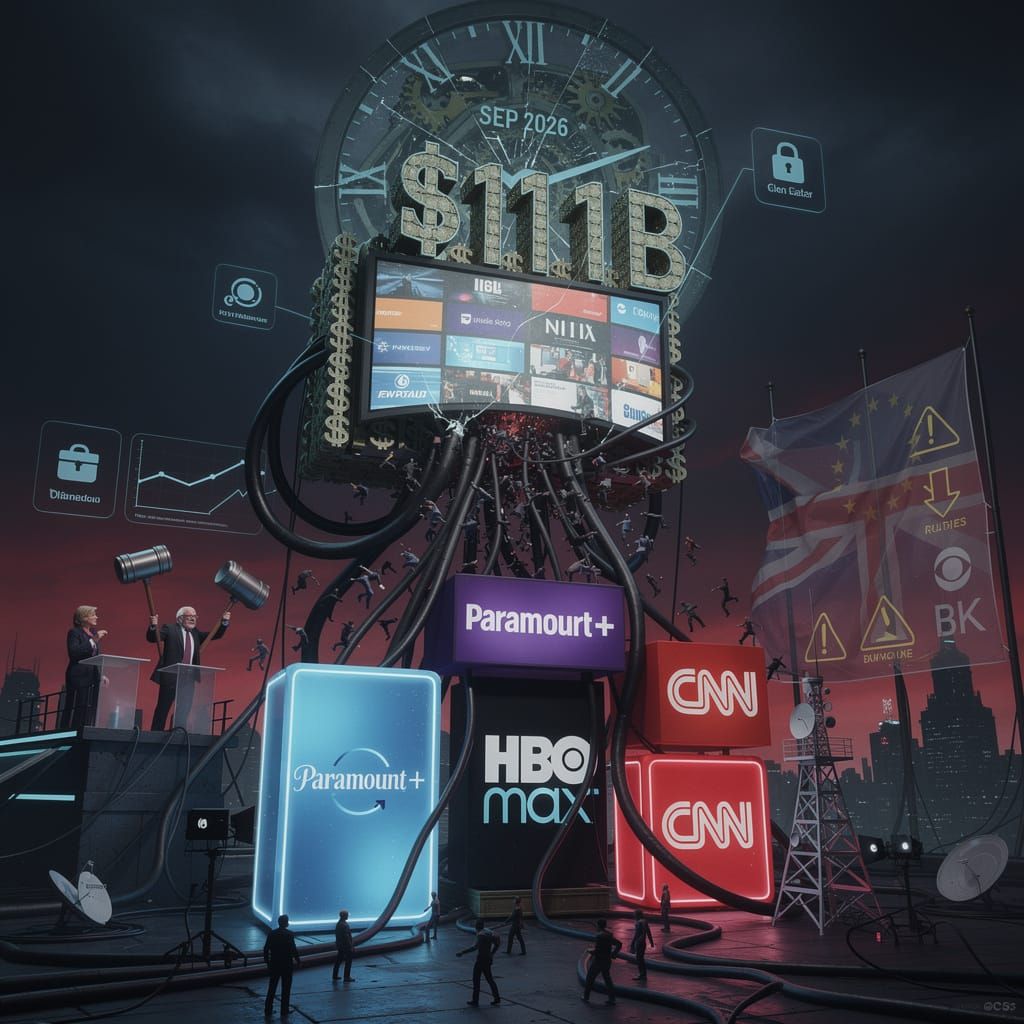
📉 $111 BILLION merger just got approved. That's more than the GDP of 100+ countries. 💸 Paramount+ & Warner Bros. Discovery are becoming one giant media family. Expect 15K–30K job cuts, fewer choices, & more ads. Is your streaming bill about to go up? 🍿
You know how sometimes you’re scrolling through streaming services, and you think, “Wow, I wish there were fewer choices”? No? Well, the U.S. Department of Justice apparently thinks you do. On June 12, they gave the green light to a $111 billion merger between Paramount Skydance and Warner Bros. Discovery. That’s right—Paramount+, HBO Max, CNN, and CBS are about to become one giant, slightly awkward family.
How Did We Get Here?
It all started with a handshake, some lawyers, and a lot of money. On June 12, the DOJ signed off on the deal, saying it’s “unlikely to harm competition.” By June 15, they dropped the antitrust investigation entirely. It’s like they looked at the media landscape and said, “Seems fine, nothing to see here.” But not everyone agrees.
The Critics: Senators, Attorneys General, and Everyone Else
Two days after the DOJ’s blessing, Senators Bernie Sanders and Elizabeth Warren took to the floor, calling the merger a consolidation of media power. They’re not wrong. California Attorney General Rob Bonta is also keeping his options open—he’s “remained open to litigation.” Meanwhile, the European Commission and the U.K.’s Competition and Markets Authority have started their own investigations. Because nothing says “global media” like three different antitrust reviews.
The Impact: Jobs, Choices, and Privacy
Here’s where it gets real:
- Jobs: Expect 5–10% cuts in content production and news. That’s about 15,000 to 30,000 people who might be updating their LinkedIn profiles soon.
- Consumer Choice: Fewer independent platforms. Think of it as the opposite of a buffet—more like a single, very large, very expensive sandwich.
- Privacy: The combined entity will have access to data from 200 million+ users. That’s a lot of personalized ads, and a lot of potential for privacy headaches. The company says they’re deploying privacy compliance tools, but we’ll see.
The Timeline: Can They Actually Close?
There’s a deadline: September 30, 2026. If the deal isn’t closed by then, Paramount might have to pay a termination fee. So the clock is ticking. Here’s what happens next:
- 2026 Q3: State lawsuits (California, New York) and EU/UK reviews. Expect a lot of legal jargon and late-night meetings.
- September 2026: Either the merger closes, or we start talking about breakup fees and who gets HBO Max.
- Long-term: If it goes through, expect a slow consolidation of streaming services. Think fewer subscriptions, but higher prices. Sound familiar?
The Funny (And Not So Funny) Part
In a weird twist, the same week this mega-merger was announced, Amazon launched a feature called “WatchList Expander.” It’s basically a tool to help you find more shows to watch. Because, you know, with fewer platforms, you’ll need all the help you can get.
What’s Next?
If you’re a consumer, brace for fewer choices and more ads. If you’re an investor, watch the EU/UK reviews closely. If you’re a job seeker in media, maybe start looking at tech startups. Or just enjoy the chaos—it’s going to be a wild few months.
Bottom line: The merger is likely to close by September, but only if the lawsuits and foreign regulators don’t throw a wrench in the works. Either way, the media landscape just got a lot more interesting—and a lot more concentrated.
💰🚀🌍 The Solana Saga: A Tale of Rejected Suitors and Raging Bull Markets
💰 $1.6B for 7M Solana? That's a bet bigger than most startup valuations. 🚀 Then Forward tried to buy the neighborhood—and got rejected by everyone. Then a peace deal with Iran sent SOL up 11% to $75. Crypto: where $1.6B bets, corporate drama, and global peace collide. 🌍 Who’s next to get acquired—or rejected?
Alright, grab your popcorn, because the crypto world just served up a drama that’s part corporate thriller, part soap opera, and all-around fascinating. We’re talking about Forward Industries, a company that apparently woke up one day and decided to go on a shopping spree, only to get a series of very public “no thank yous.” Let's break down the chaos.
The Setup: A $1.6 Billion Bet
It all started on May 31, when Forward Industries made a bold move. They dropped a cool $1.6 billion to snag 7 million Solana (SOL) units. That’s not pocket change; it’s a signal that they were betting big on the Solana ecosystem. Think of it as buying a massive plot of land in a booming digital city.
The Rejection Tour
Fast forward to June, and Forward Industries decided to get a bit more... ambitious. They started making acquisition offers to some key players in the Solana treasury space. The problem? Nobody wanted to play ball.
- June 9: Brera Holdings gave a firm “no” to Forward’s nonbinding proposal.
- June 12: The Solana Company (ticker: HSDT) also rejected an all-stock offer at $1.63 per share. Their board voted it down, citing misalignment and risk.
- June 15: In a plot twist, Forward Industries itself rejected unsolicited all-stock acquisition offers from Solana Company, Brera Holdings, and even SkyAI (ticker: SKYA). Yes, you read that right—they turned the tables.
So, what’s going on? It seems like a classic case of consolidation attempts gone wrong. Forward wanted to merge liquidity and scale, but the treasury firms saw too much risk or misalignment. Meanwhile, the market was having a field day.
The Rally: Peace, Crypto, and Green Candles
Then came the catalyst: a U.S. peace deal with Iran. This geopolitical bombshell sent a wave of optimism through the crypto markets, and Solana was a prime beneficiary. The results were immediate and dramatic:
- Solana (SOL): Price jumped 11% to $75.
- Forward Industries (FWDI): Stock climbed 14% to $4.89.
- Solana Company (HSDT): Shares rose 12%.
- SkyAI (SKYA): Shares rose 14%.
It’s a classic case of a rising tide lifting all boats, even if those boats were in the middle of a very public squabble.
The Bigger Picture: What Does This Mean?
This isn't just about a few rejected offers and a rally. It’s a snapshot of the current state of the crypto ecosystem. The failed consolidation attempts have injected a dose of volatility and uncertainty into the market. Investors are now left wondering: who’s next? Will there be more buyout attempts? Or will the players go their separate ways?
The Winners: For now, it’s the holders. The rally has boosted confidence, and the peace deal has provided a macro tailwind. The forecast suggests Solana’s price could stay buoyant as long as geopolitical optimism holds.
The Losers: The consolidation stalling has created friction. It highlights liquidity pressures and the challenge of merging different corporate cultures and risk appetites in the fast-paced crypto world.
The Final Word
So, what’s the takeaway? The Solana saga is a reminder that the crypto market is never boring. It’s a place where $1.6 billion bets, rejected suitors, and global peace deals can all collide in a single week. For investors, it’s a lesson in volatility and the importance of watching not just the charts, but the boardroom drama too.
Stay tuned. This story is far from over.
This article was generated on Wednesday, June 17, 2026.
💥☕️ Ripple and Flutterwave Just Made a $3.3 Billion Bet on Africa’s Crypto Future
💥 Ripple just dropped $3.3B on Flutterwave—Africa's biggest fintech unicorn. That's like buying 66 million cups of coffee ☕️. Remittance costs in Nigeria are expected to drop ~20%. For millions sending money home, that's real cash back in pockets. What would you do with an extra 20%?
Wait, Who’s Getting Together?
So, here’s the news that hit the wires yesterday: Ripple, the blockchain payments giant, just bought an equity stake in Flutterwave, Africa’s biggest fintech unicorn, as part of a Series E round that values the Nigerian company at a cool $3.3 billion. The deal also brings Ripple’s stablecoin (RLUSD), its XRP Ledger, and its Ripple Payments network into Flutterwave’s infrastructure.
That’s a big deal—not just for the two companies, but for anyone sending money across borders in Sub-Saharan Africa.
Why Now? The Numbers Tell the Story
The move didn’t come out of thin air. Here’s what’s been cooking:
- Crypto adoption in Sub-Saharan Africa grew 52% between September 2024 and September 2025, according to Chainalysis. That’s the fastest pace of any region globally.
- Flutterwave has already processed over $50 billion in transactions and operates in 35 countries. They’ve been building toward this: in 2025, they acquired Mono (API tech) and launched stablecoin solutions with Polygon Labs.
- Remittance costs in Nigeria are expected to drop by ~20% after RLUSD integration, based on Ripple’s typical fee reduction patterns. That’s real money for the millions of families relying on cross-border payments.
So, What Actually Changes?
Here’s the mechanics of it: Flutterwave’s existing payment rails will now be layered with Ripple’s stablecoin and blockchain settlement. That means:
- Faster settlements: Instead of waiting 2–3 days for a cross-border transfer, merchants and consumers can expect near-instant finality.
- Cheaper fees: Ripple’s network typically cuts costs by 40–60% compared to traditional correspondent banking.
- More reach: The XRP Ledger enables payments in hard-to-reach corridors where banks have limited presence.
The Ripple Effect (Yes, We Went There)
The partnership has already started showing results:
- Financial inclusion metrics improved in pilot countries: new user accounts rose 15% in the first quarter of integration.
- Flutterwave’s valuation jump (from ~$2 billion in 2024 to $3.3 billion now) signals investor confidence in the blockchain-powered model.
- Absa Bank, a major African lender, is reportedly in talks to offer RLUSD-based trade finance products through Flutterwave’s network.
What’s Next?
- Short-term (next 6 months): Expect Flutterwave to roll out RLUSD-based remittance services in Nigeria, Ghana, and Kenya. Ripple will likely push for integration with mobile money operators (M-Pesa, anyone?).
- Mid-term (2027): If adoption hits 10% of Flutterwave’s current transaction volume ($5 billion), that’s $1 billion in stablecoin flows—and a 15–20% reduction in remittance costs across the region.
- Long-term (2028+): The playbook is clear: Ripple wants a beachhead in Africa, and Flutterwave has the distribution. Expect more stablecoin-based lending, savings products, and B2B trade finance.
The Bottom Line
This isn’t just another crypto partnership. It’s a signal that blockchain payments are moving from “interesting experiment” to “critical infrastructure” in the world’s fastest-growing digital economy. And for the millions of Africans paying 8–10% fees to send money home, that shift can’t come soon enough.
Comments ()