100,000 Jobs Cut: Volkswagen Global Downsizing Amid 20% Cost Deficit
TL;DR
- Zero-Effort Recruitment: Reddit Automates Startup Job Pipelines to Cut Moderation Friction. Will algorithmic networking and automated job boards replace manual curation in the startup recruitment process?
- 1,753 Job Cuts in Colorado: Federal Downsizing Heightens Wildfire and Health Risks. Can lean staffing and budget cuts in public land management realistically handle escalating high-risk environmental disasters?
- 100,000 Job Cuts: Volkswagen Global Downsizing Amid 20% Cost Deficit. How is your industry managing the shift toward automation and IT staffing amidst global workforce reductions?
🤖 Automating the Talent Pipeline: Reddit's Algorithmic Networking
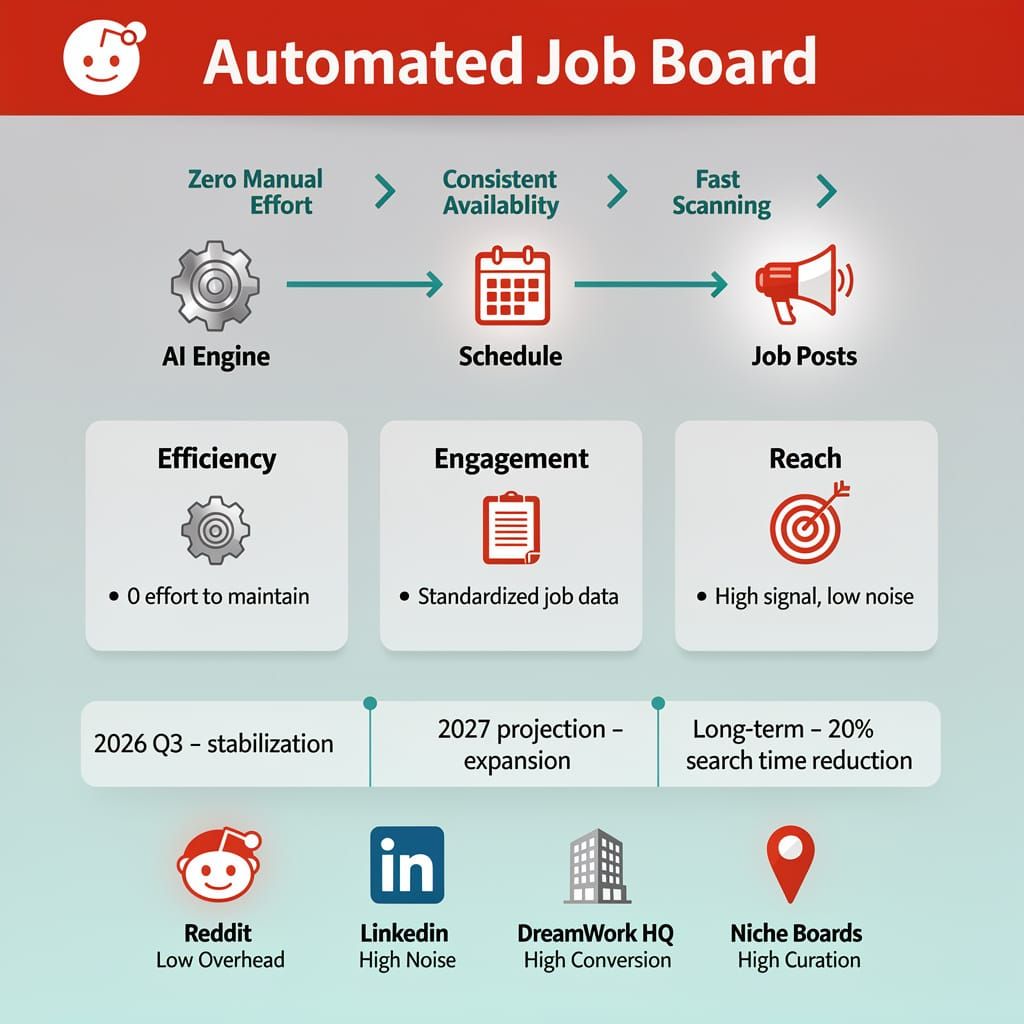
Zero manual effort. Reddit's new automated job threads are as seamless as a programmed clock 🤖. By removing moderator friction, they've streamlined the startup talent pipeline. Systematic reliability or loss of authenticity? Startup founders — how is this changing your hiring speed?
Reddit has implemented automated weekly job-board threads within the r/startups community to centralize employer outreach and co-founder networking. By deploying structured templates and scheduled posting, the platform removes the requirement for manual curation, shifting the administrative burden from human moderators to algorithmic facilitation.
How Does Automation Affect Recruitment?
The transition to automated threads indicates a shift toward low-friction content management. In the startup ecosystem, where founder time is a critical resource, reducing the overhead associated with posting and discovering opportunities enables a more consistent flow of information. This causal chain—from automated scheduling to reduced moderation friction—results in a streamlined recruitment channel.
Efficiency: Automated posting → zero manual moderator effort per thread → consistent availability of job boards. Engagement: Structured templates → standardized data entry → faster scanning for job seekers. Reach: Niche community focus → high signal-to-noise ratio → limited broad-market penetration.
Adoption and Outlook
While the current impact remains confined to the entrepreneurial tech sector, the model demonstrates a preference for systemic reliability over manual curation. This trend aligns with a broader industry shift toward AI-driven efficiency and human-AI collaboration. For example, the emergence of platforms like DreamWork HQ, which leverages AI-driven resume matching to offer 500 targeted daily matches, indicates a move away from the volume-based approach of legacy portals like Indeed.
- 2026 Q3: Stabilization of weekly schedules; maintaining low-effort adoption among startup founders.
- 2027 Projection: Potential expansion of structured templates to other professional subreddits, increasing the volume of indexed startup roles.
- Long-term: Integration of advanced filtering to match specific skill sets with automated threads, targeting a 20% reduction in search time.
Competitive Landscape
Reddit (Automated Threads): High accessibility, low overhead, but risks rapid bans if engagement lacks authenticity. LinkedIn (Algorithm-Driven): High reach, high noise, requires active paid promotion for visibility. DreamWork HQ (AI-Matching): High conversion rates via targeted "resume packs," reducing reliance on traditional ATS platforms. Niche Job Boards: High curation, high quality, but faces recruitment bottlenecks due to poorly optimized listings.
📉 The Human Cost of Ecological Downsizing
1,753 jobs cut—a devastating loss of expertise equivalent to wiping out entire regional management hubs 📉. Budget cuts are fueling burnout with 75% of firefighters eyeing the exit. Is efficiency worth the risk of fatal failures? Public land workers—how is your agency coping?
Federal workforce reductions in public land management indicate a systemic disconnect between budgetary efficiency and environmental risk. The loss of 1,753 public lands jobs in Colorado by April 2025 demonstrates a causal chain where centralized cost-cutting mandates directly reduce the boots-on-the-ground capacity required to manage escalating wildfire hazards. This reduction in stewardship capacity enables higher risk, as seen in the June 30, 2026, Snyder Fire near Beaver, Utah. The blaze reached 94,000 acres with only 4% containment, resulting in a fatal burnover that killed three helitack operatives: Emily Barker, Nick Hutcherson, and Sydney Watson.
Can Lean Staffing Manage High-Risk Terrains?
Administrative restructuring triggers a cycle of labor displacement that compromises agency resilience. While the U.S. Forest Service met 2026 seasonal hiring targets with 11,500+ firefighters, systemic downsizing of permanent staff results in critical gaps. A June 2026 survey of 825 federal wildland firefighters revealed that 75% consider quitting within 12 months due to burnout, with employees averaging over 500 overtime hours per year.
This instability extends to broader emergency response. At the CDC, a 27% workforce reduction since 2024 has degraded disease-detection capabilities during a critical Ebola outbreak in the Democratic Republic of Congo and Uganda. By June 2026, cases rose to 1,003 with 254 deaths, and France reported the first case outside the DRC, demonstrating an eroded epidemic control capacity. Similarly, a June 2026 Supreme Court ruling expanded executive authority over Temporary Protected Status (TPS), confirming the Secretary of Homeland Security's power to revoke status without judicial review, which alters the legal framework for disaster-response and humanitarian surge capacity.
Workforce Attrition Timeline
- April 2025: 1,753 jobs eliminated in Colorado, peaking regional public land layoffs.
- June 2026: 75% of surveyed federal wildland firefighters report intent to leave due to burnout.
- June 30, 2026: Three firefighters die in the Snyder Fire, highlighting staffing shortfalls amid critical fire weather.
- Late 2026 Projection: Continued attrition likely unless the Public Lands Workforce Stability Act halts reductions through 2030.
Structural Impacts
The transition toward a leaner operational model creates specific professional and systemic vulnerabilities:
Operational: Reduced staffing → slower response times → heightened wildfire severity and fatalities. Professional: High attrition → loss of institutional knowledge → 47.8% dissatisfaction in leadership trust. Financial: Short-term budget savings → long-term increases in disaster recovery expenditures, such as Maui's $2.47 billion recovery need.
The Resilience Gap
While the administration frames these cuts as efficiency measures, the data indicates a trade-off between financial benchmarks and ecological accountability. The displacement of skilled managers transforms human capital from a strategic asset into a liability of absence. Without a legislative pause, the gap between strategic mandates and field reality enables a higher probability of catastrophic failure during emergency events.
📉 The Cost of Inefficiency: Volkswagen's 100,000-Job Contraction
100,000 jobs cut. This drastic contraction is like losing an entire city's workforce 📉. A 20% cost deficit drives this shift to IT and automation. Survival or systemic fragility? Global workers — how is your industry handling the pivot to AI and automation?
Volkswagen CEO Oliver Blume confirmed a global workforce reduction of up to 100,000 positions on July 13, 2026. This figure follows previous reductions of 87,000 positions, including 50,000 via redundancy, indicating a shift toward aggressive retrenchment to stabilize profitability amid a 20% cost deficit compared to industry peers.
What Drives the Downsizing?
Layoffs result from collapsing EV demand in China and intense competition from automakers like BYD. These pressures, alongside rising input costs and internal inefficiencies, led to a record decline in Q2 2026 net profit of 28% and an 8.6% year-on-year drop in output. To preserve liquidity, Volkswagen reduced its five-year investment by 15% to €130 billion and halved its model range, lowering annual vehicle production to nine million units.
Rather than maintaining manual labor, the company is substituting technicians with IT staff and integrating autonomous systems. This shift targets immediate financial survival but increases supply chain fragility and vulnerability to regional shocks.
Economic and Operational Impacts:
- Employment: Potential elimination of 100,000 jobs globally, with 50,000 tied to voluntary redundancies to meet overhead reduction goals.
- Fiscal: Regional tax revenues decayed by 27% compared to baseline, while local service industries reported a revenue dip of nearly 12%.
- Market: Share prices experienced significant volatility, with VOW3.3 declining over 25% year-on-year.
The Path Toward Restructuring
Volkswagen is accelerating fixed-cost recovery by consolidating EV output. While the supervisory board rejected initial plant closures on July 13, 2026, due to Chinese market threats and opposition from the state of Lower Saxony, the company continues to pursue a 20% reduction in overhead.
- June 2026: Investment lowered to €130bn to offset record profit declines.
- July 10, 2026: Supervisory board rejects initial restructuring plan in a 12–7 vote.
- July 13, 2026: CEO announces expanded job cuts; union protests erupt at five German plants.
- 2028+: Expected production normalization following strategic refocus on productivity.
Strategic Trade-offs:
- Strength: Improved unit economics and reduced capital intensity.
- Weakness: Loss of product diversity due to halving model lines.
- Risk: Escalating tension with IG Metall and potential social unrest.
- Opportunity: Integration of robotic process automation to offset labor losses.



Comments ()