$1.3 Billion Amazon Office Cut: Corporate Real Estate Shift Risks Workforce Burnout
TL;DR
- $1.3 Billion Amazon Lease Cut: Corporate Real Estate Pivot Signals Remote Infrastructure Shift. How is the shift toward high-performance home office ecosystems impacting your productivity and long-term health?
- 33% CISA Staff Cut: Executive Burnout Peaks Amid Inflationary Pressure. How is your organization managing the hidden cognitive load and burnout among senior leadership?
📉 The Ergonomic Pivot: Redefining the Home Office Ecosystem
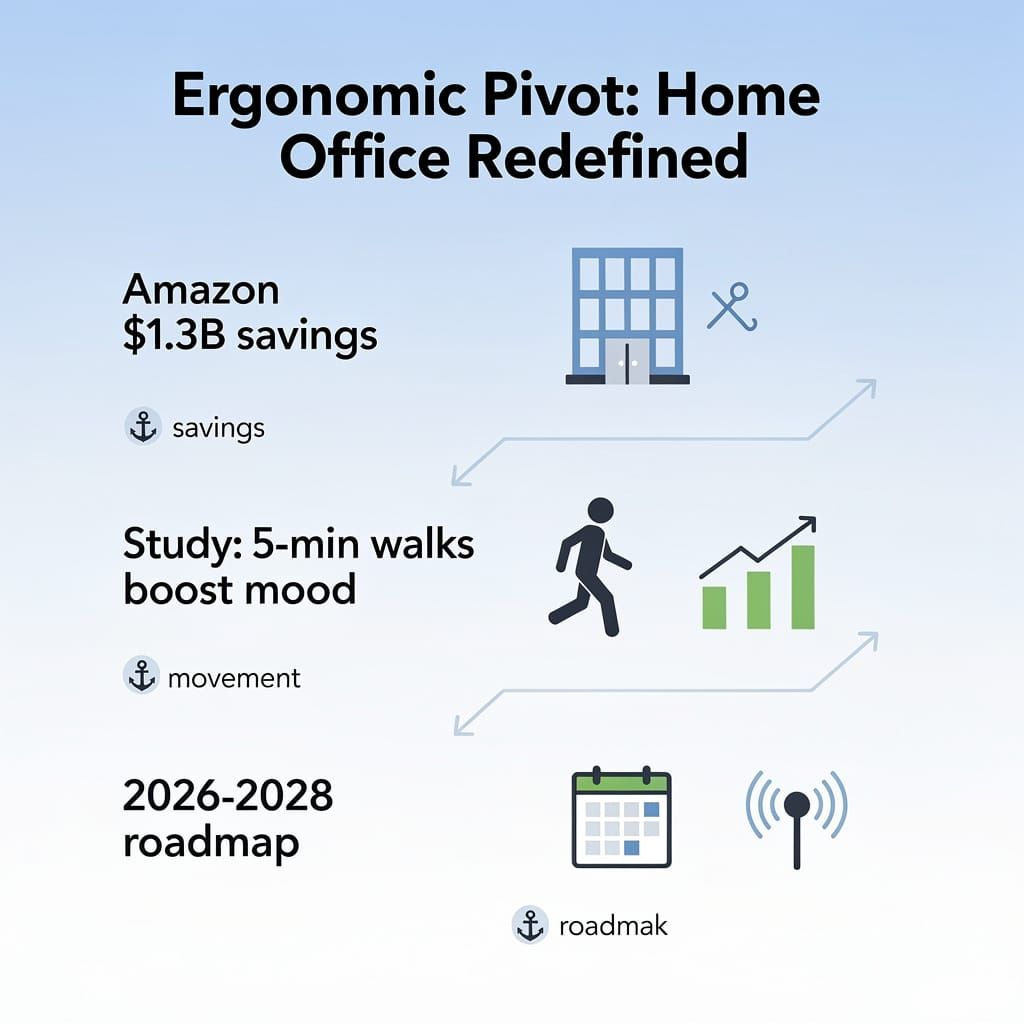
$1.3 billion saved. Amazon's massive office retreat is an alarming shift in corporate real estate 📉. This is equivalent to erasing thousands of physical hubs to prioritize remote assets. Productivity vs. Presence? Remote workers — is your home setup actually improving your health?
Hybrid work normalization has shifted corporate investment from centralized real estate to distributed home-office environments. This retreat is led by Fortune 100 firms; on March 4, 2026, Amazon cancelled significant office leases to save $1.3 billion, joining Alphabet and Microsoft in reducing their physical footprints. This systemic downsizing correlates with volatility in the housing sector, where KB Home reported a 27% year-over-year revenue decline to $1.11 billion as of June 23, 2026. Organizations now treat the remote workspace as a strategic asset, deploying sensor-based audits and ergonomic standards to transform employee well-being into a measurable driver of productivity.
How does spatial design impact output?
Recent data demonstrates that structured movement within designed environments reduces physical fatigue. A June 24, 2026, study published in the British Journal of Sports Medicine involving 19,342 adults indicates that hourly 5-minute walking breaks markedly improve mood and lower fatigue. The research demonstrates that these interventions have negligible effects on work performance, with some participants reporting slight increases in perceived engagement and effectiveness. This indicates that integrating physical activity into daily routines enables steady output by mitigating the strain of sedentary setups.
- June 16, 2026: Publication of business advisory detailing strategies to boost productivity through technology and space audits.
- June 22, 2026: Initiation of comprehensive office space audits utilizing sensor data to track usage and physical strain.
- June 23, 2026: Broad organizational deployment of ergonomic furniture to increase worker comfort.
- July 4, 2026: Publication of the Alvarez guide, detailing ten actionable trends to synchronize efficiency with well-being.
What are the systemic effects?
The transition to high-performance home ecosystems results in several operational advantages:
Talent Acquisition: Enhanced remote support packages accelerate hiring speed and reduce turnover risk, providing a competitive edge in a tightening labor market where 29% of small businesses report an inability to fill job openings. Operational Costs: Strategic downsizing, such as Amazon's $1.3 billion saving, results in immediate cash flow relief and lowers auxiliary expenses via smart-enabled equipment. Health Metrics: Ergonomic upgrades and "exercise-snack" policies—specifically the 30-to-60-minute movement interval—reduce repetitive strain and improve emotional balance.
Outlook for Remote Infrastructure
As companies move away from traditional office reliance, the focus shifts toward technological integration. Projections indicate that wellbeing-focused setups will become a standard component of compensation packages.
- Late 2026: Expansion of sensor-driven audit tools to optimize layout and lighting in real-time.
- 2027: Integration of bio-metric feedback into home-office furniture to automatically adjust ergonomics based on posture.
- 2028: Standardization of "Well-being Certifications" for remote workspaces as a prerequisite for executive-level remote roles.
📉 The Executive Burnout Threshold
33% workforce loss is staggering—equivalent to losing one-third of a defensive line mid-battle 📉. CISA cuts and 4.2% inflation are pushing executives to a critical burnout threshold. Stability masks fragility? Senior leaders — how is your organization managing the hidden cognitive load?
Internal assessments from June 10, 2026, indicate a systemic rise in cognitive depletion among senior leadership tiers. While operational output remains stable, the underlying mental load on executives has reached a critical threshold. This instability is mirrored in high-stakes security sectors; specifically, the Cybersecurity and Infrastructure Security Agency (CISA) lost one-third of its workforce following Department of Government Efficiency (DOGE) cuts by June 13, 2026, intensifying pressure on remaining senior leadership to defend against sophisticated AI-driven attacks.
Why is Senior Fatigue Scaling?
Institutional pressure, driven by tightening profit margins and inflationary input costs, has resulted in excessive workload accumulation. Brent crude oil prices rose to $74.02 per barrel by June 25, 2026—an increase of $6.24 over the previous year—contributing to an inflation peak of 4.2% by mid-June. These macroeconomic shocks force leadership to maintain strict pricing neutrality and productivity gains to protect margins, often at the expense of staff welfare.
This causal chain demonstrates a state of high-functioning exhaustion. While strategic decision-making speeds remain stable, the cognitive resource expenditure required to maintain that performance has increased, decoupling output from wellbeing.
Cognitive Load: Sustained mental pressure → depletion of executive function → increased risk of strategic error. Operational Stability: Output variance remains marginal → masks internal instability → delays corrective intervention. Institutional Risk: Thin margins → lean leadership structures → lack of redundancy in key roles.
What are the Systemic Impacts?
The friction between workload and capacity manifests as a broader productivity crisis:
Corporate Strategy: Heightened decision fatigue → diminished long-term strategic cohesion. Economic Cost: The Australian Productivity Commission projects an annual loss of A$200 billion to A$220 billion due to mental health crises affecting work. Workforce Stability: General burnout risk has surged, with 82% of workers in certain US sectors facing burnout and reduced psychological safety following rapid exploitation and layoffs in June 2026.
Outlook for Executive Resilience
Management is evaluating formalized support channels to mitigate these pressures, moving away from superficial mindfulness toward structural redesign.
- Q3 2026: Implementation of mediation outcomes and formalized support channels for senior staff.
- Q4 2026: Assessment of workload redistribution to reduce cognitive load per executive.
- 2026–2028 Projection: Without recalibrating executive psychology, churn is projected to exceed 40% of the workforce.

Comments ()