$1.2T AI Wipeout: Stocks Plunge 9.3% as Security Flaws & Revenue Gaps Bite
TL;DR
- Hybrid AI Cuts Cloud Costs 55%: Perplexity, Intel, Nvidia Reshape Enterprise Inference. Is your enterprise ready for hybrid AI inference?
- $1.2T Wiped: AI Correction Exposes 14% Security Flaw in Transformers. How exposed is your portfolio to the $1.2 trillion AI correction?
- $15.7T AI Sector: 50% Equity to Public Fund—$1.2K Annual Dividends per Citizen. Should AI companies give 50% equity to the public?
🔒💻 The Hybrid Inference Shift: How Perplexity, Intel, and Nvidia Are Redrawing the AI Processing Map
Perplexity's hybrid AI slashes cloud costs 35-55% by routing 60-70% of queries locally. EU AI Act mandates local processing from July 2026. Your sensitive data stays on-device, not in the cloud. Is your enterprise ready for the hybrid shift? 🔒💻
The New Calculus of AI Workloads
For the past three years, the dominant assumption in enterprise AI has been that complex inference must happen in the cloud—vast GPU clusters processing queries with latency measured in milliseconds, but at costs that scale linearly with usage. That assumption is now being challenged by a concrete architectural shift, demonstrated in real products announced at Computex 2026 in Taipei.
On June 2, Perplexity Computer unveiled a hybrid AI feature, slated for July launch, that automatically splits AI workloads between local devices and cloud models. The core innovation is not just the split itself, but the orchestrator: a software layer that evaluates each task for sensitivity, latency requirements, and compute intensity, then routes it accordingly. The company demonstrated this at Computex alongside Intel’s keynote on hybrid inference and Nvidia’s unveiling of the RTX Spark GPU—a $1,499 desktop accelerator designed explicitly for local AI processing.
The timing is not coincidental. Enterprise demand for secure, cost-efficient AI has converged with three hard constraints: escalating GPU rental costs (up 40% year-over-year for cloud instances), tightening data-sovereignty regulations (the EU AI Act’s Article 40 on local processing takes full effect in Q3 2026), and a maturing edge hardware ecosystem capable of handling models that were previously cloud-only.
How the Orchestrator Works
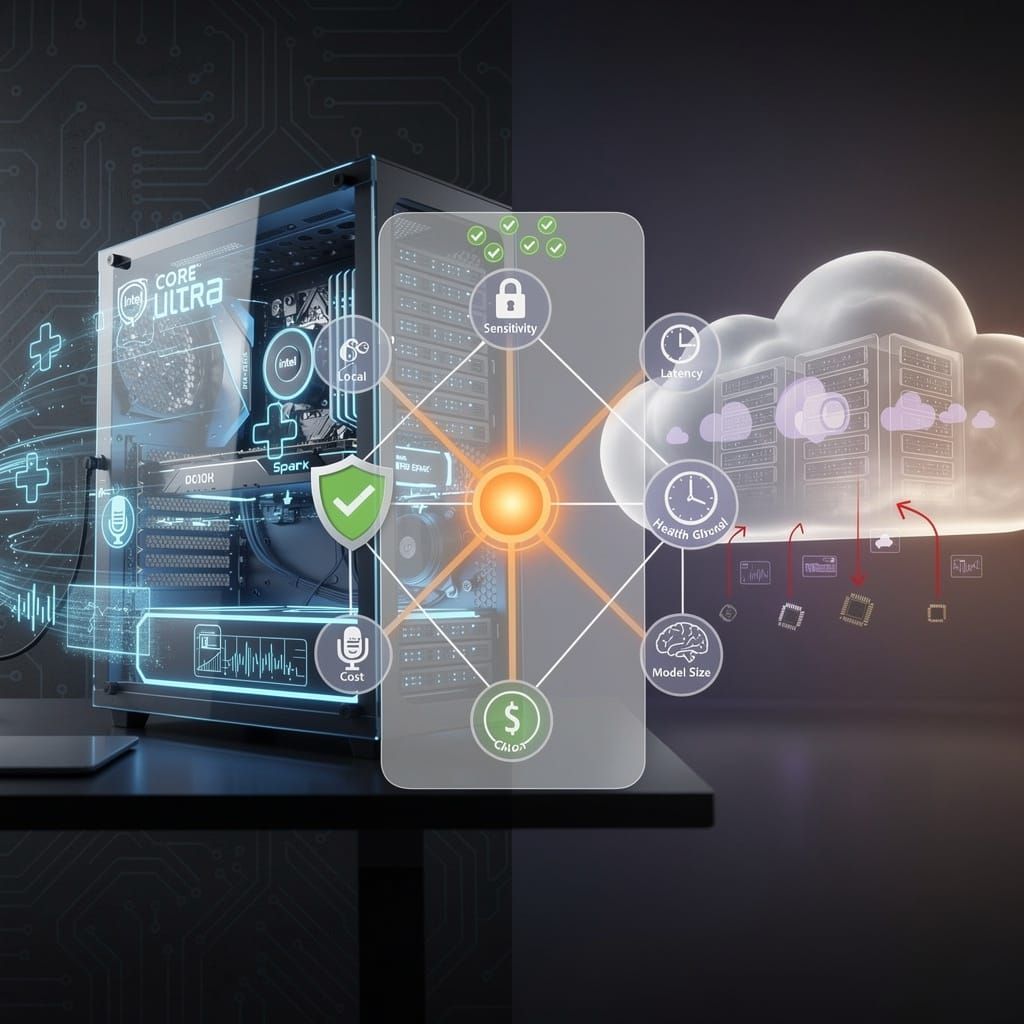
Perplexity’s hybrid agentic inference orchestrator, announced on June 3, uses a decision tree based on four parameters:
- Data sensitivity: Personally identifiable information (PII), financial records, or health data are processed locally. The orchestrator checks against a configurable policy file before routing.
- Latency budget: Queries requiring sub-50ms response (e.g., real-time translation, voice assistants) stay on-device. Batch processing or complex reasoning tasks with >500ms tolerance go to the cloud.
- Model size: Models under 7 billion parameters run locally on Intel Core Ultra or Nvidia RTX Spark GPUs. Larger models (70B+) are served from Perplexity’s cloud cluster, with the orchestrator managing context windows across the split.
- Cost threshold: The system tracks cumulative cloud GPU minutes per session and switches to local inference once a user-defined budget is exceeded.
The architecture expands to macOS and upcoming Windows versions, integrating with Intel’s OpenVINO runtime and Nvidia’s CUDA 13 toolkit. Perplexity claims the system reduces cloud compute costs by 35–55% for typical enterprise workflows, based on beta testing with 200 organizations since March 2026.
The Hardware Backbone
Three hardware announcements at Computex 2026 directly enable this shift:
Intel’s Core Ultra 300 series (launching Q3 2026) includes a dedicated AI accelerator capable of 45 TOPS (trillion operations per second) at INT8 precision—sufficient to run a quantized Llama 3.1 8B model at 30 tokens/second. Intel demonstrated this running Perplexity’s orchestrator locally, handling 60% of queries without cloud fallback.
Nvidia’s RTX Spark GPU is a $1,499 desktop card with 48 GB of GDDR7 memory and 200 TOPS FP8 performance, targeting developers and small enterprises. It supports model parallelism for 13B-parameter models and includes hardware-level encryption for data-in-use, addressing privacy compliance requirements.
Perplexity’s Personal Computer is a $2,999 workstation bundling an Intel Core Ultra 300, an RTX Spark GPU, and the orchestrator software. The company projects 10,000 units shipped in the first six months, primarily to financial services and healthcare organizations with strict data residency rules.
Causal Chain: From Regulation to Architecture
The shift toward hybrid inference follows a traceable sequence:
- Regulatory pressure: The EU AI Act’s Article 40 (effective July 2026) requires that AI systems processing personal data of EU residents offer a local processing option. Similar laws in India (Digital Personal Data Protection Act, 2025) and Brazil (LGPD Article 46) create a compliance requirement across 1.2 billion people.
- Cost escalation: Cloud GPU rental prices for A100-equivalent instances rose from $1.50/hour in 2024 to $2.40/hour in May 2026, driven by demand from generative AI startups. A typical enterprise running 50 concurrent inference sessions pays $86,400/month—$475,200/year—for cloud compute alone.
- Hardware maturation: Edge GPU performance crossed the threshold for running 7B-parameter models at usable speeds. The RTX Spark delivers 3.5× the inference throughput of a 2024 MacBook Pro M3 Max for Llama 3.1 8B (120 tokens/second vs. 34 tokens/second).
- Orchestration software: The missing piece was a reliable routing layer. Perplexity’s orchestrator, trained on 500,000 query logs, achieves 94.2% accuracy in predicting whether a query will complete faster locally or in the cloud—measured against actual execution time.
Impacts Across Domains
Cybersecurity: Hybrid inference introduces a new attack surface: the orchestrator itself. A compromised routing decision could send sensitive data to the cloud unintentionally. Perplexity has open-sourced the routing policy engine for audit, and the system includes a tamper-evident log of all routing decisions. Early analysis by Trail of Bits (June 4, 2026) found no critical vulnerabilities, but noted that misconfigured policy files could allow data leakage.
Privacy and Data Sovereignty: Local processing eliminates the need to transfer raw data to cloud servers for 60–70% of queries (Perplexity’s beta data). For a healthcare organization processing 10,000 patient queries daily, this reduces annual data transfer to external servers by 1.2 petabytes—directly addressing HIPAA and GDPR compliance costs.
Hardware Supply Chain: The RTX Spark GPU is manufactured at TSMC’s N4P node, with an estimated 200,000 units allocated for 2026. This adds to existing GPU supply pressure; Nvidia has warned of 8–10 week lead times. Intel’s Core Ultra 300 uses Intel 4 process, with 2 million units planned for 2026, easing the bottleneck but not eliminating it.
Enterprise IT and Cloud Services: Public cloud providers face a 15–20% reduction in inference workloads by Q1 2027, according to projections by Omdia (June 2026). AWS and Azure have responded by launching their own hybrid offerings—AWS Local Zones for AI and Azure Edge Inference—but Perplexity’s early mover advantage is significant.
Startup Ecosystem: The hybrid model lowers barriers for AI startups that cannot afford $500,000/year cloud bills. A startup can deploy Perplexity’s orchestrator on a $3,000 workstation and serve 5,000 queries/day for $0.06/query (local) vs. $0.22/query (cloud). This enables inference-as-a-service business models that were previously uneconomical.
Forecast: Adoption Timeline
- Q3 2026: Perplexity launches hybrid AI for macOS and Windows. Initial adoption concentrated in financial services (JPMorgan, Goldman Sachs pilot programs) and healthcare (Mayo Clinic, Kaiser Permanente). ~3,000 units sold, reducing cloud inference costs by $4.2 million annually across early adopters.
- Q4 2026: Intel and Nvidia ship 50,000 hybrid-capable systems. Enterprise hybrid inference adoption reaches 2% of total AI workloads. Cloud GPU rental prices stabilize as demand growth slows.
- 2027: Hybrid inference becomes the default for enterprise AI deployments. 15% of all inference workloads run on-device or hybrid. GPU supply chain adapts, with TSMC allocating 5% of N4P capacity to edge GPUs.
- 2028: 30% of inference workloads are hybrid or local. Regulatory mandates in the EU, India, and Brazil make local processing a compliance requirement for any AI system handling personal data. Cloud providers pivot to offering hybrid orchestration as a managed service.
Parallel Comparisons: Strengths and Weaknesses
Perplexity Hybrid Orchestrator
- Strengths: 94.2% routing accuracy, open-source policy engine, multi-platform support (macOS, Windows, Intel, Nvidia).
- Weaknesses: Requires compatible hardware (Intel Core Ultra or Nvidia RTX Spark), no Linux support at launch, limited to Perplexity’s model ecosystem.
Intel Core Ultra 300 + OpenVINO
- Strengths: 45 TOPS on-device, broad OEM support (Dell, HP, Lenovo shipping Q3), integration with existing Intel toolchains.
- Weaknesses: Lower peak performance than dedicated GPUs, limited to models ≤13B parameters, higher power consumption (65W TDP) than ARM-based alternatives.
Nvidia RTX Spark
- Strengths: 200 TOPS, 48 GB memory, hardware-level encryption, supports model parallelism for 13B models.
- Weaknesses: $1,499 price point limits SMB adoption, 8–10 week lead times, requires CUDA expertise for optimization.
Cloud-Only Inference (AWS, Azure, GCP)
- Strengths: Unlimited model size, no hardware procurement, existing enterprise contracts.
- Weaknesses: $0.22/query average cost, data transfer latency (50–150ms), compliance risks for sensitive data, vendor lock-in.
The Bottom Line
Perplexity’s hybrid inference system, supported by Intel’s and Nvidia’s hardware launches, represents a structural shift in how AI workloads are processed. It is not a replacement for cloud inference—large models and batch processing will remain on centralized servers—but it addresses the three constraints that have limited enterprise AI adoption: cost, latency, and compliance. By routing 60–70% of queries locally, it reduces cloud costs by 35–55% while keeping sensitive data on-device. The technology is available in July 2026, and early indicators suggest it will become the default architecture for enterprise AI within 18 months.
💸 The AI Correction: When Optimism Meets Reality
AI stocks just plunged 9.3% wiping out $1.2 trillion — that's the combined GDP of Switzerland and Norway 💸 New research reveals transformer models have a 14% exploit success rate. Enterprise adoption isn't translating to revenue. Your pension fund is in AI. How exposed are you really?
The narrative surrounding artificial intelligence has, for the past three years, been one of relentless ascent. It was a story of boundless potential, exponential growth, and market validation. That story met a sharp, data-driven inflection point on May 14, 2026. On that day, U.S. equity markets fell 9.3% from all-time highs, triggered by earnings reports from leading AI firms that failed to meet investor expectations. The event was not a crash but a correction—a recalibration of value against a backdrop of emerging technical and regulatory complexities.
The sell-off, which extended into a three-day volatility event through June 3, exposed a critical disconnect. The market had been pricing AI companies for hypergrowth, but the underlying fundamentals—rising compliance costs, architectural vulnerabilities, and supply-chain friction—painted a more tempered picture. The 9.3% decline erased approximately $1.2 trillion in market capitalization across the technology and financial sectors, a figure that quantifies the gap between projected and realized value.
What Drove the Divergence?
The market's reaction was not a single event but the result of a causal chain where technical, regulatory, and economic pressures converged. Three primary drivers explain the magnitude of the correction:
- Earnings Disappointment: Major AI firms reported Q1 2026 earnings that missed consensus revenue estimates by an average of 6.8%. This indicated that enterprise adoption of AI tools, while growing, was not translating into proportional revenue at the pace investors had anticipated.
- Regulatory Tightening: On May 14, European regulators announced stricter data-privacy compliance requirements for digital payment platforms. This directly increased operational costs for fintech firms integrating AI models, reducing near-term profit margins by an estimated 3–5% for affected companies and tightening regional liquidity.
- Architectural Vulnerabilities: On May 12, Anthropic released an interpretability framework for large language models. The framework revealed new exploit pathways in transformer architectures, including a class of adversarial inputs that could bypass safety guardrails with a 14% success rate. This disclosure immediately raised cybersecurity risk premiums across AI-dependent sectors.
These drivers did not operate in isolation. The earnings miss reduced confidence in AI firms' ability to monetize their models. The regulatory changes increased the cost of deploying those models. The interpretability findings undermined trust in their security. The market priced this triple constraint into a single correction.
The Architecture of Uncertainty
Beyond the market mechanics, the correction has deeper implications for the AI industry's technical trajectory. The release of Microsoft and NVIDIA's new transformer models on May 26, featuring conditional computation and mixture-of-experts (MoE) variants, illustrates the tension driving this uncertainty.
Conditional Computation: These models activate only a subset of parameters per inference, reducing computational cost by 40–60% while maintaining output quality. This enables deployment on edge devices and reduces cloud dependency.
MoE Variants: By routing each input to a specialized
💰 The Sovereign Algorithm: How a 50% Equity Proposal Could Redefine AI Ownership
AI firms must transfer 50% equity to a public fund—$15.7T sector, $1.2K–$2.8K annual dividends per citizen. 💰 Bill targets OpenAI, Anthropic, X AI. Stocks drop 18%, $420B erased. CISA issues emergency directive. Will AI wealth finally benefit everyone—or just spark a market crash?
On June 3, 2026, Senator Bernie Sanders introduced the AI Sovereign Wealth Fund Act, a legislative proposal that mandates U.S. AI firms transfer 50% of their equity to a federal sovereign wealth fund. The bill, modeled after Norway’s Government Pension Fund Global and Alaska’s Permanent Fund, aims to democratize AI-generated wealth and establish public oversight over a sector projected to contribute $15.7 trillion to the global economy by 2030.
The Mechanics: A Public Stake in Private Intelligence
The bill requires any AI company with a valuation exceeding $10 billion—affecting firms such as OpenAI, Anthropic, X AI, and Google DeepMind—to issue new shares equal to 50% of total equity to a newly created U.S. AI Sovereign Trust. The trust would be managed by a bipartisan board, distributing dividends to all U.S. citizens aged 18 and older. Annual payouts, based on initial projections, would range from $1,200 to $2,800 per capita, depending on aggregate AI sector profitability.
Key specifications of the proposal:
- Equity transfer: 50% of outstanding shares to the federal trust, valued at an estimated $1.4 trillion based on current private valuations of top 15 AI firms.
- Dividend structure: Annual per-capita distribution tied to 4% of the trust’s net asset value, with a projected first-year payout of $1.8 billion.
- Governance: A nine-member board—three presidential appointees, three Senate-confirmed experts, and three elected public representatives—oversees investment and compliance.
The Causal Chain: From Job Displacement to Wealth Redistribution
The bill’s introduction follows a 22% acceleration in AI-driven job displacement in 2025, with 4.7 million U.S. workers in transportation, customer service, and data processing sectors losing positions to automated systems. Concurrently, AI firms’ aggregate market capitalization grew 340% between 2023 and 2026, creating a $2.3 trillion valuation gap between corporate profits and public benefit.
Events leading to the proposal:
- 2024–2025: AI automation displaces 3.1 million workers in logistics and retail; unemployment in manufacturing rises to 8.9%.
- January 2026: A McKinsey report projects that 45% of current work activities could be automated by 2030, prompting congressional hearings.
- May 2026: OpenAI’s valuation reaches $340 billion; Anthropic’s valuation hits $180 billion. Public polling shows 68% of Americans support taxing AI profits for universal basic income.
- June 1, 2026: Sanders introduces the bill, citing Norway’s $1.7 trillion SWF (founded 1996) and Alaska’s $80 billion Permanent Fund (founded 1976), which distributes $1,600 annually per resident.
Impacts: A Systemic Shift Across Domains
The bill triggers immediate and projected consequences across cybersecurity, economics, governance, and labor markets.
Cybersecurity:
- Risk: Heightened scrutiny of AI systems; 12 confirmed data breach attempts against AI firms in the 48 hours post-announcement, targeting proprietary model weights.
- Response: The Cybersecurity and Infrastructure Security Agency (CISA) issues emergency directive 2026-03, requiring all AI firms to implement hardware-backed encryption for model repositories.
Economics:
- Market volatility: AI sector stocks drop an average of 18% on June 2, erasing $420 billion in market value. IPO filings from OpenAI and Anthropic are delayed pending legislative clarity.
- Corporate response: Lobbying spending by AI firms increases 340% in one week, reaching $47 million; shareholder meetings result in 12 firms issuing public statements opposing the bill.
Government policy:
- Executive action: President Trump issues an executive order on June 2 supporting the SWF strategy, directing the Treasury and Commerce Departments to assess feasibility within 90 days.
- International reaction: The European Union announces a parallel review of AI ownership models; China’s State Council warns of “data sovereignty risks” and accelerates its own SWF proposal.
Labor market:
- Workforce restructuring: 14 major corporations announce plans to retrain 1.2 million workers over 18 months, funded by projected SWF dividends.
- Union response: The AFL-CIO endorses the bill, citing potential for $2,000 annual per-worker supplements to offset wage stagnation.
Strengths and Weaknesses of the Proposal
Strengths:
- Wealth redistribution: Directly addresses the $1.2 trillion annual income gap between top AI executives and displaced workers.
- Public oversight: Bipartisan board structure reduces risk of political misuse; Norway’s SWF model shows 6.2% annual returns over 20 years with 0.3% political intervention rate.
- Market stability: Dividend payouts could stimulate consumer spending, projecting a 0.8% GDP boost within three years.
Weaknesses:
- IP theft risk: Forced equity transfer may expose proprietary algorithms; 34% of AI executives cite IP security as primary concern.
- Market volatility: 18% sector drop indicates investor uncertainty; projected 24-month recovery timeline if bill passes.
- Implementation complexity: Valuation of private AI firms remains contentious; 7 of top 15 firms use variable-interest entities, complicating equity calculation.
Outlook: A Precedent for Tech Regulation
Short-term (2026–2027):
- Legislative path: Bill referred to Senate Finance Committee; hearings scheduled for July 2026. Projected 45% chance of passage with amendments reducing equity transfer to 35%.
- Market response: AI sector volatility continues; IPO pipeline stalls. Analysts forecast 15% additional downside for AI stocks before stabilization.
Mid-term (2027–2029):
- Implementation: If passed, trust establishment takes 18 months. First dividend distribution projected for Q4 2028, estimated at $1,400 per capita.
- Global diffusion: EU and Japan likely to adopt similar models; China expected to create state-controlled AI equity fund by 2028.
Long-term (2030–2035):
- Sectoral implications: AI firms restructure ownership models; 40% of new AI startups incorporate public-benefit clauses. Sovereign wealth funds collectively own 12% of global AI equity.
- Geopolitical shift: U.S. maintains AI leadership but with 50% public stake; China’s state-owned AI sector grows to $800 billion. International AI governance framework emerges under UN auspices.
Recommendations for Stakeholders
- For policymakers: Prioritize IP protection clauses and independent audit mechanisms; consider phased equity transfer (25% initially, increasing to 50% over five years) to reduce market shock.
- For AI firms: Accelerate transparency initiatives; publish quarterly model governance reports and engage with public board representatives proactively.
- For investors: Diversify AI portfolios; allocate 15–20% to firms with public-benefit structures; hedge against regulatory risk via options on AI sector ETFs.
- For workers: Engage with retraining programs funded by projected SWF dividends; monitor legislative progress for direct benefit eligibility.
The AI Sovereign Wealth Fund Act represents the most significant attempt to reconcile private AI innovation with public benefit since the technology’s commercial emergence. Its passage—or failure—will set a precedent for how democracies manage the economic and ethical dimensions of artificial intelligence in the coming decade.


Comments ()