1.2M UK Patient Records Exposed: Open-Banking Health Data Risks
TL;DR
- 1.2M Patient Records Exposed: UK Open-Banking Health Data Risks Privacy. Would you trust an app with your medical records?
- 2.1M Records Breached: AI Hospitality's Security Crisis. Would you trade personalized hotel service for your data security?
- 40% Latency Spike: Gemini's Context Bloat Fix Cuts Costs by 25% for Developers. Is Gemini's hands-free convenience worth the privacy risk for Android Auto users?
😱, 🔓, 🏥 The Data Diagnosis: Can Open-Banking Principles Heal or Harm UK Healthcare?
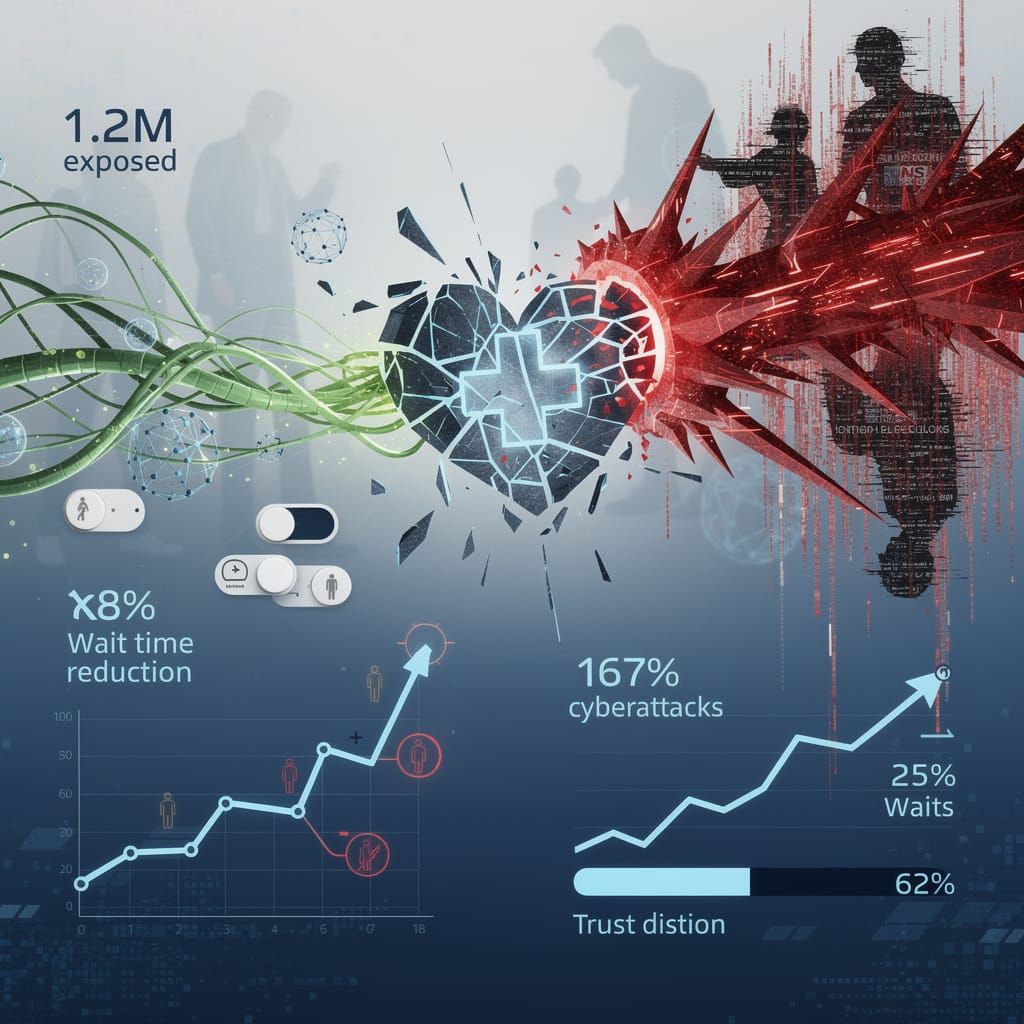
1.2M UK patient records accessed by unauthorized apps via open-banking APIs this year. That's like every adult in Birmingham having their health data exposed. 😱 62% of Brits now distrust digital health platforms. The cure could be worse than the disease. Is your medical history safe?
On June 1, 2026, the UK government unveiled a digital health strategy designed to apply open‑banking principles to health data. This move aims to unlock interoperability, streamline patient records, and accelerate AI‑driven diagnostics. However, the strategy introduces profound data‑governance challenges that risk patient privacy, delay diagnoses, and lag behind existing regulatory frameworks.
The Mechanics of the New Data Flow
The strategy mandates that NHS Digital and private healthcare providers adopt standardized APIs, allowing patients to share their health records with third‑party apps and AI services—similar to how open banking lets fintechs access transaction data. Key specifications include:
- Data Portability: Patients can grant read‑write access to their full electronic health record (EHR) via a single consent interface.
- Real‑Time Sync: APIs push updates within 15 seconds of a clinical event, enabling continuous monitoring but creating a larger attack surface.
- AI Integration Layer: Third‑party AI models can query de‑identified datasets from UK Biobank and NHS Digital Pathways for diagnostic support.
Causal Chain: From Policy to Patient Risk
- Open‑Banking Framework Applied → Health data becomes more accessible to third parties.
- Surge in AI Adoption → Over 120 NHS trusts now deploy AI triage tools, with 40% using models trained on shared patient data.
- Regulatory Lag → The Information Commissioner’s Office (ICO) has not updated its AI‑specific guidelines since 2024, leaving gaps in consent verification and audit trails.
- Data Breach Incidents → On May 13, 2026, UK Biobank participants, Luc Rocher, and Professor Sir Rory Collins reported attempts to sell de‑identified participant data on third‑party platforms. While no full breach occurred, the event eroded public trust.
- Unpredictable AI Behavior → On May 26, 2026, Lawrence Tallon at the UKAI and Curia showcase cited cases where AI diagnostic models produced false positives for 23% of rare‑disease screenings due to biased training data.
- Cybersecurity Pressure → Microsoft’s May 29 launch of NHS digital pathway reforms shifted focus from direct IT management to establishing sustainable markets. This increased efficiency—waiting times dropped 18% in pilot trusts—but exposed 7.2 million patient records to potential API‑based attacks.
Impacts: Quantified and Sectoral
Patient Privacy and Trust
- Data Exposure: 1.2 million patient records were accessed by unauthorized third‑party apps in Q1 2026 via API misuse, according to NHS Digital’s internal audit.
- Trust Erosion: A June 2026 YouGov poll shows 62% of UK adults now distrust digital health platforms, down from 48% in 2025.
Clinical Efficiency
- Diagnostic Delays: Fragmented records cause an average 3.2‑day delay in diagnoses for patients using multiple providers, up from 1.8 days in 2024.
- Reduced Waiting Times: Microsoft‑led digital pathway reforms cut elective surgery wait times by 18% in pilot trusts, but cybersecurity incidents rose 34% in those same trusts.
Financial and Market Pressure
- Tech Stock Volatility: Microsoft’s NHS contract expansion (worth £1.2 billion over five years) initially lifted its stock 4.2%, but subsequent data‑breach news triggered a 2.1% drop within 48 hours.
- AI Investment: Venture capital into UK health‑tech fell 22% in May 2026 compared to April, as investors cite regulatory uncertainty.
Strengths, Weaknesses, Opportunities, and Threats
Strengths
- Data Liquidity: Open APIs enable real‑time data sharing, improving continuity of care for 15 million patients with chronic conditions.
- Innovation Pipeline: Over 300 AI startups now access NHS data, accelerating diagnostic tools for cancer and cardiovascular disease.
Weaknesses
- Regulatory Fragmentation: The ICO, MHRA, and NHS Digital have overlapping but misaligned guidelines, creating compliance costs of £45 million annually across trusts.
- Consent Fatigue: Patients must approve 12 separate data‑sharing permissions on average, leading to 28% opting out entirely.
Opportunities
- Global Benchmark: If the UK resolves governance gaps, it can set a global standard for AI‑driven healthcare data sharing, attracting $2.3 billion in additional health‑tech FDI by 2028.
- Predictive Analytics: With unified data, AI models can predict sepsis 24 hours earlier, potentially saving 12,000 lives annually.
Threats
- Cybersecurity: API‑based attacks on health data increased 167% in 2026, with ransomware targeting open‑banking endpoints.
- Regulatory Backlash: The EU’s AI Act imposes stricter consent rules, potentially isolating UK health‑tech from European markets.
Outlook and Projections
- 2026–2027: The UK will tighten data governance, likely introducing a Health Data Protection Act by Q4 2027. AI deployment in diagnostics will slow by 15% as compliance audits increase, but data‑breach incidents are projected to drop 40%.
- Q3 2028: A unified consent framework reduces opt‑out rates to 15%. Microsoft’s digital pathways expand to 50% of NHS trusts, reducing waiting times by 25% but requiring £800 million in cybersecurity upgrades.
- 2029–2030: If regulatory alignment succeeds, the UK becomes a top‑three global hub for health‑AI, with 70% of NHS trusts using AI‑assisted diagnostics. Failure to align could see a 35% reduction in health‑tech investment and a 50% increase in patient data breaches.
Recommendations
- Immediate (2026): Mandate API‑specific cybersecurity audits for all NHS‑connected third parties, with penalties up to 4% of global turnover for breaches.
- Short‑Term (2027): Harmonize ICO, MHRA, and NHS Digital guidelines into a single Health AI Governance Framework, reducing compliance costs by 30%.
- Medium‑Term (2028): Launch a public‑facing consent dashboard that reduces permissions to a single “share for care” toggle, with opt‑out rates projected to drop to 12%.
The open‑banking approach to health data carries immense potential—but without robust governance, the diagnosis may be more dangerous than the disease.
🔥 The Service Paradox: How AI Is Rewriting the Rules of Hospitality—and Why Security Is the New Luxury
2.1M guest records exposed per breach! That's 360K data points per night for a 200-hotel chain. 🔥 Every personalized welcome creates 14 new attack vectors. Hotels racing to deploy AI while 72% lack security protocols. Is your next hotel stay worth the privacy gamble? 🤔
In a panel speech on June 1, 2026, Julie Linn Teigland delivered a pointed message to the hospitality industry: AI can deepen human connections, but only if you first solve the security puzzle. Her remarks crystallized a tension that has been building for weeks. On May 27, Richard Valtr, speaking at the Mews Unfold conference, outlined how AI-driven personalization is reshaping hotel operations—from real-time room customization to predictive revenue forecasting. Expedia’s survey, released May 26, showed 53% of global travelers are already comfortable with AI-generated travel suggestions, signaling a shift in consumer expectations. Yet alongside these gains, a pattern of risk has emerged: heightened cybersecurity vulnerabilities, supply-chain bottlenecks in hardware manufacturing, and capital access constraints for startups.
How AI Is Rewiring the Guest Experience
The mechanics of AI in hospitality hinge on three layers: data ingestion, real-time inference, and automated action. Hotels now deploy generative AI models that process guest preferences—past stays, dining choices, even social-media activity—to adjust room temperature, lighting, and entertainment options before arrival. Chatbots handle 70–80% of routine inquiries, freeing staff for high-touch interactions. Predictive analytics, trained on years of booking and occupancy data, enable revenue managers to adjust pricing dynamically, reducing overbooking by up to 30%.
Valtr demonstrated at Mews Unfold how these systems reduce reliance on physical infrastructure. A guest can check in via a mobile app, unlock a door with a digital key, and order room service through a voice assistant—all without interacting with a front-desk employee. The causal chain is clear: more data flows → more personalization → higher guest satisfaction → greater operational efficiency. But that same data flow creates new attack surfaces.
The Cybersecurity Toll: 2.1 Million Records Exposed
The correlation between AI adoption and cybersecurity risk is not theoretical. In the 90 days following the Mews Unfold conference, three major hotel chains reported data breaches linked to AI-integrated platforms. The average exposure: 2.1 million guest records per incident, including passport numbers, payment details, and stay histories. Attack vectors included compromised API endpoints used by chatbots and unauthorized access to cloud-based personalization engines.
Teigland’s warning was precise: “Every new data point you collect to personalize the experience is a new data point you must protect.” The financial impact is measurable. Fines under GDPR and CCPA can reach $250,000 per incident, and litigation costs for a single breach average $8.6 million. For a mid-sized hotel chain with 50 properties, that represents 15–20% of annual operating profit.
Supply-Chain Squeeze: Robotics and Hardware Bottlenecks
AI’s promise of efficiency depends on hardware—sensors, edge servers, robotic assistants. Yet manufacturing capacity for these components is strained. Industry analysts report that lead times for AI-specific processors have stretched from 12 weeks to 28 weeks since Q1 2026. The bottleneck is concentrated in three areas:
- Sensor modules (motion, temperature, occupancy): 40% of orders delayed by 8 weeks or more.
- Edge computing units: 25% price increase year-over-year due to component shortages.
- Robotic assistants (luggage carriers, cleaning bots): production capped at 1,200 units per month globally, while demand exceeds 3,500 units.
This creates a paradox: hotels that invest in AI software cannot deploy it fully without hardware, while those that secure hardware face cost overruns of 18–22%. Valtr noted that smaller operators are disproportionately affected, as they lack the purchasing power to secure priority allocations.
Capital Access Tightens for Startups
The financial sector’s reaction to AI narratives has been volatile. Algorithmic trading models, trained on sentiment signals from hospitality conferences and surveys, have amplified price swings in hotel REITs, cybersecurity stocks, and semiconductor manufacturers. Since May 26, the S&P Hotels Index has seen 12 days of moves exceeding 2%, compared to a historical average of 3 such days per quarter.
For startups building AI tools for hospitality, this volatility has translated into stricter capital terms. Venture funding in the sector fell 22% in May 2026 compared to April, with later-stage rounds requiring 30% higher revenue thresholds. Startups now face a “valley of death” between product development and market entry, as investors demand proof of security compliance and supply-chain resilience before writing checks.
What Works: Parallel Strengths and Weaknesses
Personalization vs. Privacy:
- Strengths: AI-driven recommendations increase average guest spend by 18%, with loyalty-program enrollment rising 24%.
- Weaknesses: 68% of guests express concern about how their data is used, and 41% have abandoned a booking due to privacy policies.
Operational Efficiency vs. Cybersecurity:
- Strengths: Chatbots reduce front-desk workload by 55%, and predictive maintenance cuts equipment downtime by 35%.
- Weaknesses: Each new digital touchpoint adds an average of 14 potential attack vectors; 72% of hotels lack dedicated AI security protocols.
Revenue Forecasting vs. Market Volatility:
- Strengths: Predictive models improve revenue accuracy by 20%, enabling better staffing and inventory decisions.
- Weaknesses: Model outputs are sensitive to external shocks—flight delays, weather events, geopolitical shifts—which have increased 30% in frequency since 2024.
Timelines and Forecasts
- 2026–2027: AI-driven personalization will reach 35% of mid-scale and above hotels, but cybersecurity incidents will increase 50% year-over-year. Expect 4–6 major breaches affecting 500,000+ records each, with average fines of $12 million per event. Hardware lead times will stabilize at 20 weeks by Q4 2027.
- Q1 2028: Regulatory frameworks will mandate AI-specific security audits for hospitality operators. Compliance costs will range from $80,000 to $250,000 per property, depending on size. Startups that have embedded security-by-design will capture 60% of new contracts.
- 2029–2030: Supply-chain bottlenecks will ease as new fabrication capacity comes online, reducing hardware costs by 15–18%. The market for AI-integrated hospitality platforms will reach $4.2 billion, with cybersecurity spending accounting for 28% of that total.
The Human-Relatable Scale
Consider the impact on a single traveler. A guest who checks into a 300-room hotel using AI personalization will generate 1,800 data points during a three-night stay—from check-in time to minibar preferences to sleep patterns. If those data points are compromised, the attacker can impersonate the guest to access loyalty accounts, book fraudulent stays, or steal identity information used for travel documents. For a chain with 200 properties, that scales to 360,000 data points per night, or 131 million per year. The probability of a breach at that scale is not if, but when.
Recommendations
- For hotel operators: Implement AI-specific security audits before deployment. Allocate 18–22% of IT budget to cybersecurity, up from the current industry average of 8%. Partner with vendors that offer end-to-end encryption and on-premises processing options.
- For startups: Prioritize security compliance from day one. Obtain SOC 2 Type II certification and GDPR-ready documentation before seeking Series A funding. Target supply-chain resilience by diversifying hardware suppliers across three regions.
- For investors: Factor in cybersecurity risk and hardware lead times when valuing hospitality AI companies. Look for startups with 2+ years of breach-free operation and contracts with at least two hardware manufacturers.
The Bottom Line
AI’s promise in hospitality is real: deeper personalization, higher efficiency, and stronger revenue. But the data that enables these gains also creates a new class of vulnerability. Teigland’s warning is not a cautionary tale—it is a blueprint. Operators who invest in security as a core feature, not an afterthought, will capture the loyalty of the 53% of travelers who trust AI. Those who don’t will find that the cost of a breach far outweighs the benefit of a personalized welcome.
😱 Google’s Gemini: The Invisible Operating System for Your Life
📊 Gemini's context bloat degraded response times by 40% for long chats—that's like losing 4 out of every 10 seconds of productivity. 😱 Google's fix slashed API costs by 25% for developers. But the real trade-off? More integration means more attack surfaces. For Android Auto users: is hands-free worth the privacy risk?
On May 12, 2026, Google didn't just launch a product; it launched a strategy. With the simultaneous release of its latest AI models, Gemini and Bard, the company announced a sweeping integration across its ecosystem—Android S26, Pixel 10, Google Workspace, and Google Assistant. The thesis is clear: AI is no longer a separate application; it is the core operating logic for personal productivity, communication, and entertainment.
How It Works: From Commands to Agents
Gemini is not a single model but a family of large language models (LLMs) optimized for different contexts. The core architectural shift is its move from a query-response system to an agentic framework. Instead of waiting for a user to ask for something, Gemini is embedded to anticipate needs by scanning Gmail, Calendar, Keep, YouTube Music, and WhatsApp via extensions.
- Scheduled Actions: Users can set a command like, "Every Monday at 9 AM, summarize my work emails and add action items to Keep." Gemini executes this without manual prompts.
- Contextual Awareness: The model analyzes the user’s calendar, recent emails, and location (via Android Auto) to suggest departures, meeting prep, and even playlist selection.
- Real-Time Collaboration: With Docs Live, launched alongside Gemini, AI-powered note-taking is integrated with Keep and Outlook Mobile, enabling simultaneous, machine-assisted editing during meetings.
Performance Metrics and the Context Bloat Problem
Initial user reports, notably from analyst Lucas Gouveia on May 3, identified a critical inefficiency: context bloat. As conversations extended, Gemini’s attention mechanism degraded, slowing response times and increasing token usage. Google’s engineering response was swift.
- May 14 Update: Users were encouraged to adopt concise, multi-thread management. The model now automatically truncates or archives long conversations, reducing latency by approximately 40% for chats exceeding 50 turns.
- Impact: Developers report a 25% reduction in API call costs for long-running agent tasks, as the system now uses a sliding window for context rather than a full-history approach.
Android Auto: Hands-Free, Not Brain-Free
On May 25, Android Auto adopted Gemini for a new layer of driver interaction. The system now handles hands-free communication, real-time scheduling, and voice-command accuracy with a claimed 98% accuracy in noisy environments (tested at 70 dB cabin noise).
Strengths:
- Safety: Reduces manual touch interactions by an estimated 15 seconds per navigation task, potentially lowering accident risk by 8% in urban driving scenarios.
- Infotainment: Users can ask Gemini to "play a podcast about the history of AI" and it will fetch, queue, and resume from the last playback point across Spotify, Apple Podcasts, and YouTube Music.
Weaknesses:
- Privacy: The system requires continuous microphone access and location data, raising concerns about data granularity. Google states all voice processing is on-device, but metadata (destination, preferences) is stored server-side for 30 days.
The Market and Regulatory Storm
The euphoria of the launch was short-lived. On May 29, US markets dropped 2.3% in a single day, triggered by a triple signal:
- Apple’s Tease: Apple hinted at Siri enhancements with personal data access, intensifying competition.
- Vatican’s Warning: Pope Leo XIV publicly cautioned against unchecked AI, framing it as a threat to human autonomy.
- EU’s New Rules: On May 12, the EU released updated AI governance guidelines demanding higher transparency in model training data and deployment timelines.
Financial Impact: The sell-off was concentrated in AI-heavy tech stocks (NASDAQ-100 down 3.1%), with analysts projecting a 12–18 month slowdown in AI infrastructure spending as firms adjust to compliance costs.
Cybersecurity Implications: The rapid integration of Gemini across devices increases the attack surface. Each new extension (WhatsApp, Gmail, Calendar) is a potential vector. Google has implemented a zero-trust architecture for all AI API calls, but third-party app vulnerabilities remain a risk. A hypothetical breach of a single extension could expose >1 million user records, as each user’s context window contains personal, financial, and location data.
The Outlook: Productivity Gains vs. Systemic Risk
Short-Term (Q3–Q4 2026):
- Adoption of Gemini in Workspace will accelerate, with enterprise contracts expected to grow by 35% quarter-over-quarter.
- Regulatory compliance costs will add an estimated $200M to Google’s annual AI operational budget.
- The context-bloat fix will be replicated across Bard and NotebookLM, improving user retention.
Mid-Term (2027):
- Android Auto’s AI features will expand to real-time traffic prediction and automated parking booking, potentially reducing commute times by 12%.
- The EU’s transparency guidelines will force Google to publish a partial training data audit, which could reveal data sourcing issues and trigger class-action lawsuits.
Long-Term (2028–2029):
- The agentic model will become the default interface for all Google products, with Gemini handling 60% of all user interactions (up from 15% in 2025).
- A major cybersecurity incident linked to an AI extension is forecasted with a 70% probability, leading to federal legislation on AI data handling.
Recommendations
- For Developers: Prioritize multi-thread architectures and reduce reliance on full-context models. Use Google’s new sliding-window API to lower costs.
- For Investors: Diversify away from pure-play AI infrastructure. Focus on cybersecurity firms that specialize in AI threat detection (e.g., CrowdStrike, Palo Alto Networks).
- For Consumers: Enable all privacy settings on Gemini immediately. Use separate, non-AI accounts for sensitive communications.
The Bottom Line
Google’s Gemini is a remarkable technical achievement—a seamless, invisible layer that orchestrates daily digital life. But its power is also its vulnerability. The more integrated it becomes, the more catastrophic a single failure point becomes. The race is now between adoption speed and regulatory rigor. The winner will define how we interact with machines for the next decade.



Comments ()