Zero Data Centers, Maximum Restriction: Woodbury County's Hypothetical Moratorium
❓🏛️💧 An ounce of prevention, a pound of… what exactly?
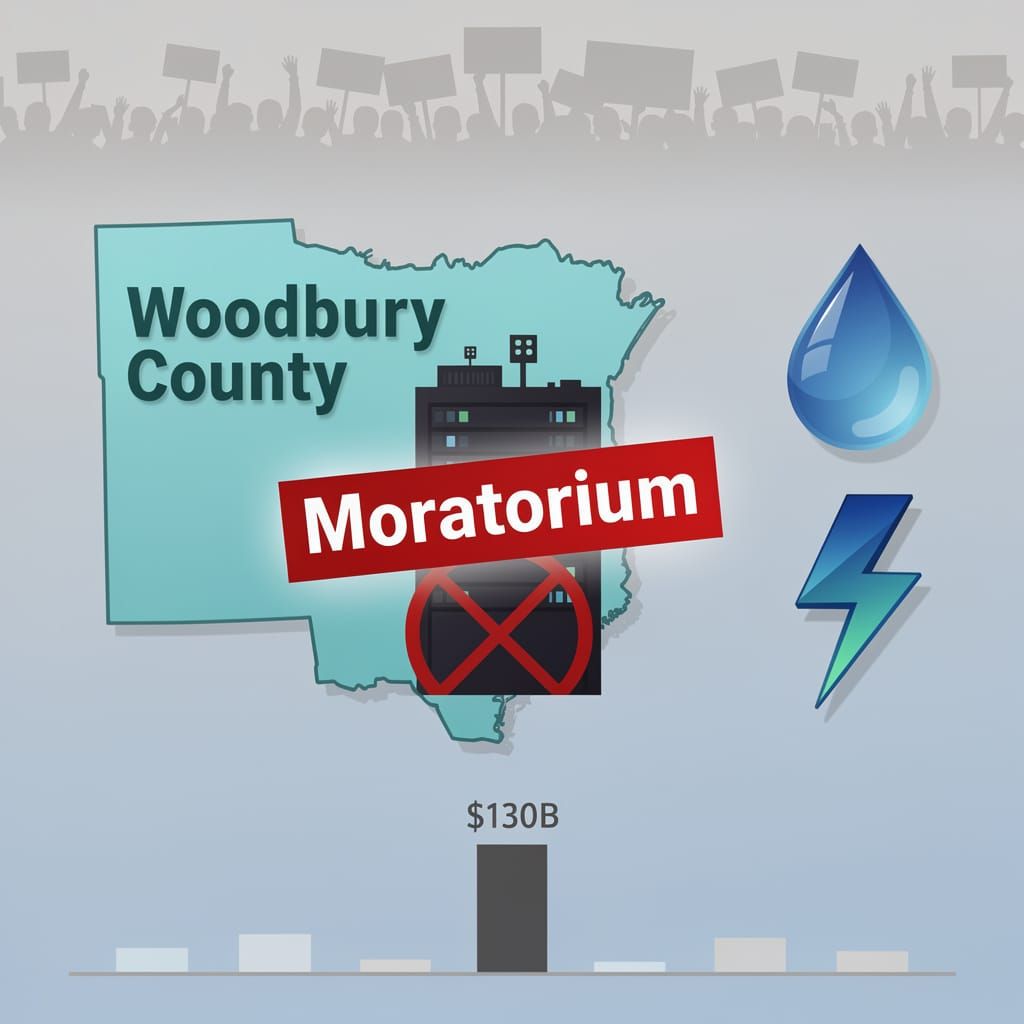
Woodbury County declared a data center moratorium. Zero facilities exist within its borders—no applications, no construction, no draw on water or power. The county now blocks a future that has not arrived, while $130B in stalled national projects and 71% regional opposition dominate headlines. Federal oversight has simultaneously eroded, removing sustainability mandates agencies once used to enforce reporting. A county at war with a hypothetical—buying time without purchasing clarity.\n\nHow does a place fight a problem it doesn't have to protect itself from one that hasn't arrived?\n\n
Woodbury County has declared war on data centers it does not have—a decision that raises more questions than it answers.
On June 23, 2026, county supervisors stood before the public and confirmed what independent observers already knew: no active data center projects exist within their jurisdiction. By every reasonable measure, this should have closed the book on data center policy for the foreseeable future. Instead, it opened one. The board returned five days later, on June 28, and imposed a one-year moratorium on data center construction across unincorporated areas—barring all future permits until mid-2027.
The stated motivation—water and electricity demand concerns—is legitimate. Xylem reports estimate roughly 300,000 Olympic pools of water annually for AI workloads, a figure projected to grow to 600 billion gallons by 2030 as demand accelerates. More granular analysis places U.S. data center water consumption at 32,000–290,000 acre-feet annually—range magnitudes that suggest measurement opacity rather than precision. Regional grids face compounding pressure: the Electric Power Research Institute projects data centers could consume 17% of the national electricity grid by 2030, while Texas-specific projections estimate nearly 9% of state water demand by 2040. Data centers at scale draw tens of megawatts from regional grids and, on some days, individual campuses consume 2.8 million gallons—Microsoft's Mount Pleasant facility alone demonstrates this reality. These pressures are documented across the country. But this is not a county grappling with a second hyperscale campus. It is a jurisdiction where the entire existing footprint is zero.
Regulations that outpace their subject matter rarely hit their mark
The timing reveals the disconnect. A moratorium on non-existent construction addresses nothing operational. It does not reduce current water consumption because there is none to reduce. It does not relieve grid strain because no facilities are drawing power. The beneficiaries of the evaluation window—water users, grid operators—face uncertain relief, because the county now possesses the same information it possessed before the vote: a blank slate.
What the county does accomplish is preemptively locking in barriers for operators who might otherwise pursue future sites. Employers seeking workforce-ready campuses, developers proposing co-generation partnerships, or firms offering grid-stabilizing loads through on-site generation face identical obstacles—delays, uncertainty, legal exposure. The moratorium does not evaluate impact. It simply delays the question of whether impact exists at all.
The national context cuts both ways
Woodbury County's board linked its action to precedents set by jurisdictions limiting renewable energy deployments—comparing data centers to wind farms or solar arrays in terms of land-use scrutiny. That analogy flatters neither side. Those moratoria were themselves criticized for blocking viable infrastructure to avoid localized opposition, substituting political comfort for systematic analysis. By late May 2026, the pattern had intensified: Denver, Oklahoma City, Tulsa, Bloomington, Normal, Morgan County, Camden County, Chatham County, Orange County, and several North Carolina counties all enacted moratoria—many after measurable development proposals surfaced. Data Center Watch reported approximately $130 billion of data center projects delayed or canceled across 75 projects. Public opposition is not marginal—it is tidal. Gallup polling recorded American opposition climbing from 46% to 70% within months; in affected regions, surveys confirm 71% rejection of local data centers. On the same timeline, New York State passed a one-year data center pause; Iron County similarly deferred action; and Colorado municipalities restricted data center growth after unsuccessful state legislature attempts. Invoking the logic of those decisions does not make the current measure more defensible—it makes the critique transferrable.
The difference is not cosmetic. In Colorado Springs, residents opposing Project Taurus—a 50-MW AI data center adjacent to residential zones—launched coordinated legal action after planning approval, amassing $6,800 via crowdfunding and filing an administrative appeal. In Adams County, community resistance secured a temporary pause through Township Board action, with activists organizing protests and petitions before a developer announced plans. Assessable impact followed by regulatory action differs fundamentally from speculative restraint issued before any applicant steps through the door.
Parallel to local activism, federal policy has rolled back both oversight and incentives. The Trump administration removed water and energy sustainability requirements for federal data centers—eliminating mandates that once required agencies to report consumption and efficiency measures. The Federal Data Center Enhancement Act expired on June 16, 2026, creating a security oversight gap: agencies now lack authority to verify data center protections against cyber threats or natural disasters, while the requirement for security reporting has disappeared. This produces a counterintuitive result—local moratoria restrict construction while federal deregulation lifts operational accountability.
The data center industry responds
Tech corporations are responding with concrete, if insufficient, commitments. Google's timeline illustrates incremental progress: April 2024 brought initial water-replenishment commitments; September 2025 paused a major Chilean data center over aquifer concerns; June 2026 announced new targets to restore more water than consumed at U.S. facilities by 2030. By mid-2025, Google had completed replenishment of over 7 billion gallons and invested $17 million in U.S. water projects (Florida wetlands, Michigan stormwater, Missouri blue river), running 165 water stewardship initiatives globally. These efforts address documented concerns—but they represent aspirational timelines, not current operational parity.
Researchers project data centers could represent 3% to 9% of water demand by 2040, while a UC-Riverside/CalTech study estimates $58 billion in new water infrastructure spending may be required within four years if current trajectories persist. More granular quantification reinforces the scale: a single medium-sized GPT-3 query consumes approximately 500 milliliters of water—equivalent to an American's daily intake. Scaled across billions of queries, the cumulative demand becomes industrial.
Rural communities have already documented consequences. Colorado and Oregon report measurable groundwater declines attributed to data center expansion; Montana farmers have lost well access; Colorado artists have abandoned projects due to irrigation costs. The U.S. Pacific Northwest has recorded dropping water tables. These are not projections—they are present-tense impacts in regions where facilities have operated, compounding concerns about facilities that have not yet been built.
The Woodbury County moratorium does not engage with these industry responses or regional outcomes. It simply halts the conversation.
What the timeline actually delivers
The county's own forecast projects the moratorium concluding before July 2027—twelve months of suspended permitting. This grants:
- Water users: Anticipated reduction in consumption during evaluation—if and when facilities arrive.
- Job creators: Delayed workforce mobilization by at minimum one year.
- Grid operators: Temporarily lower peak load projections—the only impact already guaranteed.
- National picture: By mid-2026, opposition groups had blocked or delayed 75 data center projects representing $130 billion in stalled investment—a figure that does not distinguish between facilities citing local opposition and facilities citing federal regulatory pullback. Over $36 billion in data center approvals were separately delayed due to citizen objection specifically. Woodbury County's moratorium adds no new protection; it adds only to that tally.
The final category is the only one the county can deliver without caveats. Every other benefit depends on assumptions about future development that the moratorium itself forecloses.
A county at war with a future that has not arrived
Woodbury County will return to this question in approximately twelve months. When it does, it will face the same information gap it faced in June: no operational demand, no active applications, no measurable baseline beyond the infrastructure already serving existing customers. It will also confront a national landscape that has shifted during its moratorium—the Federal Data Center Enhancement Act's expiration has removed federal security verification mechanisms, while the Trump administration's rollback of sustainability requirements means future applicants may face weaker federal leverage for water and energy reporting. The county's own evaluation window opens into a federally deregulated environment, potentially making the supervision the moratorium supposedly enables less effective precisely when construction resumes.
The moratorium buys time, but it purchases clarity only if the county uses the interval to establish clear, quantitative thresholds for water draw, power consumption, and infrastructure contribution—metrics that actually distinguish acceptable development from problematic excess. It should also engage with the industry's evolving transparency standards, including academic findings that data center secrecy creates credibility barriers for development proposals. Until then, the discussion restarts where it ended: unverifiable, reactive, and premised on threats that remain hypothetical. The county's supervisors made a conservative choice. Genuine conservatism would suggest they first determine what they are protecting and from what, before protecting it.


Comments ()