BEAM Crypto Drops OpenSSL for Native Modern KDFs—Finally
TL;DR
- 21 Zero-Days, One Fix: BEAM Crypto Drops NIF Dependencies for Native Security. Is your codebase still held together by NIFs compiled by interns against 2022 libcrypto?
- Germany Launches Multi-Agency Inquiry Into Chinese Solar Inverters as 70% Market Dominance Exposes Decade-Old Security Blindspot. How long before your solar panels become someone else's grid-off switch?
- Apple Issues Critical WebKit Patch as AI-Accelerated Malware Surges Across Cloud Platforms. How do organizations balance shrinking security budgets against accelerating AI-powered exploit pipelines?
🔐 Open Source Crypto Finally Tired of Begging OpenSSL for Table Scraps
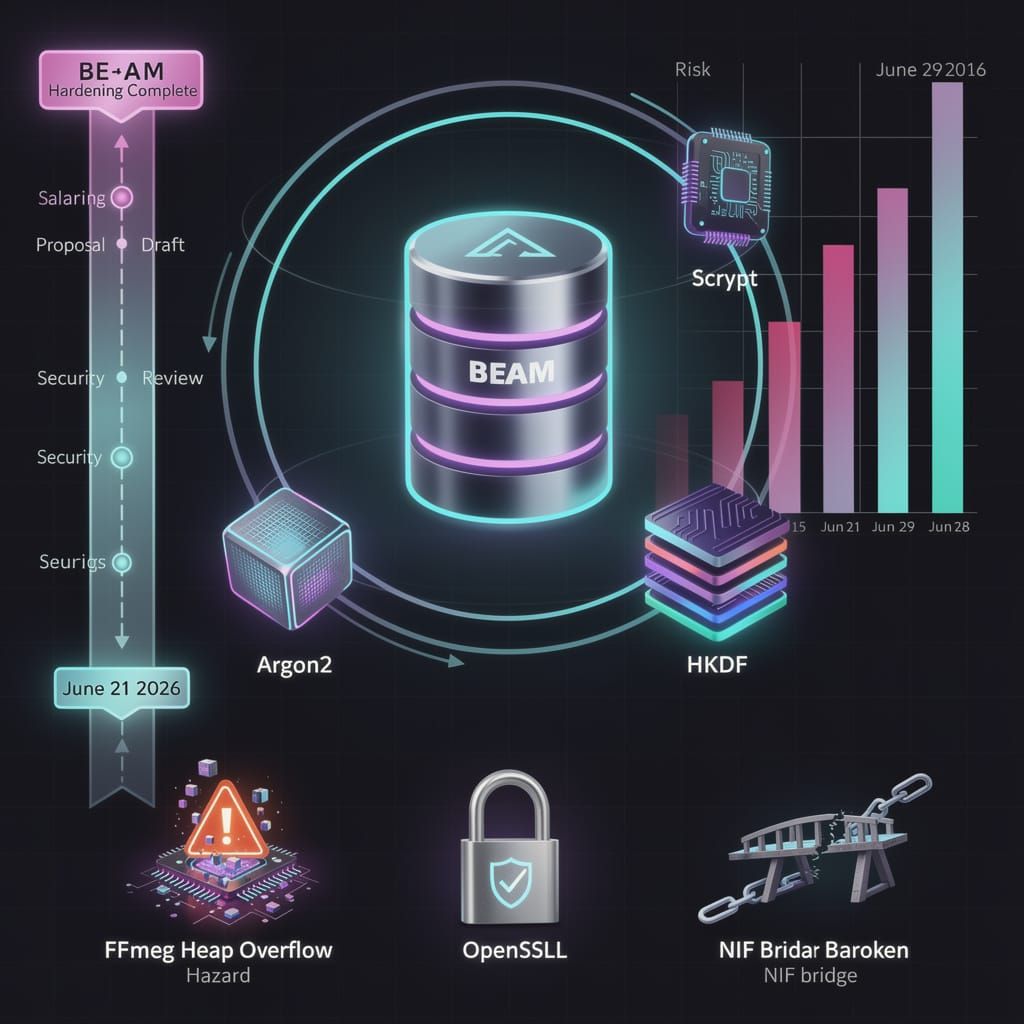
21 zero-days in FFmpeg. Google flagged 13 more. One heap overflow = RCE via RTSP streams. Meanwhile, BEAM crypto just cut the NIF cord—Argon2, Scrypt, HKDF running natively, no external attack surface. Your "secure" stack still depending on legacy C libs? That's a choice. 🔐💀
The Password-Hashing Drama Nobody's Talking About (Because It's Actually Working)
Let's be real. For years, the open-source ecosystem treated OpenSSL like that one uncle who showed up to every family dinner with the same questionable casserole—sure, it was there, technically edible, but nobody really wanted to examine the recipe. And when it came to modern key derivation functions? OpenSSL served PBKDF2 like it was still 2005. Spoiler: it's not.
On June 21, 2026, a cohort of crypto security researchers dropped a proposal that should've gotten more attention than it did: integrate Scrypt and Argon2 into the OpenSSL KDF system. Not as a plugin. Not as a third-party hack. Directly into the architecture. After two decades of "here's PBKDF2, good luck tuning your iterations, here's a fire extinguisher, go nuts," the community finally said no more.
Then June 22 hit, and lpil—one of those quiet contributors who fixes things while the rest of us argue about syntax—filed a request via the crypto:kdf uniform interface. Not just Argon2id. Scrypt. HKDF. A full slate of modern KDFs exposed through one unified gateway, leveraging OpenSSL's existing EVP_KDF infrastructure. No new NIF bridge needed to satisfy the old casuistry. The proposal basically translated to: "Hey BEAM, you don't need to call a NIF wrapper that calls OpenSSL that calls a C library that an intern compiled in 2019. Just do the thing yourself—in-process."
Six days later on June 29, Lpil escalated the conversation again. Full embed. No NIF dependencies. BEAM applications doing Argon2 natively, zero OS-level hand-holding. The entire KBdf family—Argon2, Scrypt, HKDF—running locally without cross-library sprawl. The drama wasn't loud, but the implications hit like a freight train wrapped in a locked cryptographic hash.
Why This Matters More Than Your Latest npm Update
Let's unpack the actual payload here. Password hashing isn't glamorous. It's not the Zero-Day that makes headlines. It's the unglamorous plumbing that keeps everything else from collapsing into a puddle of exposed credentials. And yet:
🔧 Portability: BEAM apps stop begging the operating system for specific OpenSSL builds. Deploy to a toaster running Yocto Linux? Works. Deploy to your cloud provider's snapshotted container farm? Still works. No more "works on my machine because I'm the only one who compiled it." OS-independent builds aren't a selling point—they're the baseline.
📉 Attack Surface: NIFs are wonderful. NIFs are also the one place where native memory can punch through BEAM's cozy sandbox and cause problems. Fewer NIFs = fewer blast doors left ajar = less fun for threat actors. With Argon2id running in-process, there's no dangling C bridge waiting to have its EOF markers faked by a covert-channel payload. That's not hypothetical—that's exactly how memory corruption in native media handlers leads to PII exfiltration in the wild right now.
The FFmpeg heap overflow situation proves this point with uncomfortable clarity. On June 12, 2026, DepthFirst's security agent found 21 zero-day vulnerabilities in FFmpeg with reproducible proofs-of-concept—cheaper than a traditional red team's bar tab. Add Google's Big Sleep team flagging 13 more in the same timeframe. One of those critters? A heap overflow that enables remote code execution through RTSP streams. That's not a theoretical attack surface. That's a PC-controlled exploit sitting in a media pipeline, waiting for someone to feed it a malformed file. Drop that into a NIF-adjacent stack and enjoy your Sunday.
The 7-Zip CVE-2026-48095 heap overflow tells the same grim story with a different payload. CVE disclosure dropped mid-July 2026: shifted vtable pointer, arbitrary code execution, malicious archive as the delivery mechanism. Jaroslav Lobačevski's team confirmed it with UBSan detection. That's heap corruption in a compression utility giving attackers arbitrary execution. If your BEAM app's crypto lives in a NIF that some intern compiled against a 2022 libcrypto? Congratulations—you just inherited that attack surface. The June 29 BEAM proposal eliminates exactly that inheritance tax.
⚡ Build Simplicity: Fewer transitive dependencies mean CI pipelines stop failing because OpenSSL 1.1 vs 3.x decided to have a personality conflict at 3 AM on a Tuesday. The briefing on June 22 confirmed it: the existing EVP_KDF infrastructure is BEAM's on-ramp. No reinventing the wheel. No legacy C components threaded through six abstraction layers borrowed from OpenSSL's 2007-era NIF bridge. No waiting for your media processing pipeline to get patched after the next FFmpeg heap overflow makes the news cycle.
🛡️ Validation Clarity: When crypto happens in-process, auditors can actually trace the code path. "Yes, we ran Argon2id with these parameters. Here's the spec. Here's the test. It's not going anywhere." Centralized hash function evaluation means one codebase, one audit target. Fewer legacy C components means fewer places for things to quietly break—or get quietly exploited—in production. No more parsing CVE disclosures and cross-referencing it against your transitive NIF dependencies like it's a game of operational Bingo.
🔐 Secret Leakage Reduction: Here's the one nobody talks about. Decoupling application logic from OS-level crypto services matters. Every syscall, every NIF handoff, every OpenSSL context switch is a potential exfiltration vector. The June 29 proposal explicitly flagged this: in-process derived key computation directly lowers the risk of secret leakage because the secrets never leave the BEAM runtime's orbit. That's not a nice-to-have. That's the whole point. And when you're running media processing workloads alongside your crypto? That separation becomes existential. A single heap overflow in an FFmpeg pipeline can cascade into credential exfiltration if those credentials are still living in some NIF-bound memory region waiting for a_rcvd() call that never comes.
The Roadmap Nobody Circled on Their Calendar
These aren't vapor dreams. The coordinated timing is the tell. Researchers → OpenSSL interface → BEAM extension → Native proposal. That's a causal chain with teeth—and it's accelerated by BEAM's existing EVP_KDF groundwork.
crypto:kdfunified interface exposes Argon2id, scrypt, and HKDF through one gateway instead of scattering them across separate NIFs, centralizing scrutiny over cryptographic parameters- Pure BEAM implementations eliminate external compilation requirements for Argon2 (OpenSSL libcrypto below 3.2 doesn't support it natively), stripping out a dependency chain nobody wanted to maintain
- Standardized KDF adoption within the BEAM ecosystem likely within one year if the OTP team adopts the pending proposals; broader open-source standardization solidifies by end 2027
If you're running media processing, compression utilities, or any workload with a C-native attack surface adjacent to your crypto stack—this is your operational risk getting reduced by commits instead of budget approvals.
Closing Thought (The Cheeky Kind)
So the next time someone tells you open-source crypto is a fragmented mess held together by Stack Overflow guilt and TLS磨损—point them here. Argon2 is a few commits away from living natively in BEAM. Developers are voting with pull requests instead of just complaining in GitHub Issues. And for once, the fix wasn't a $500,000 enterprise security platform subscription or another CVE scramble. It was a well-scoped proposal from someone who just wanted it to work better.
That's not boring. That's infrastructure finally growing up. 🔐🤖
🎯⚡🇩🇪🇨🇳 The Great Inverter Freakout: Germany Finally Notices Its Solar Panels Have Trust Issues
70% of Europe's solar inverter market went to China between 2015–2023. Now Germany is discovering that "smart" grid hardware with remote firmware updates is, um, NOT smart when hostile actors are involved. Only took a decade. 🎯 The irony: Germany championed rooftop solar while importing Chinese boxes that can be shut down or pwned remotely. Classic supply chain own-goal. Security theater or actual de-risking? The 6–12 month lag for European manufacturing doesn't match net-zero timelines. Meanwhile, gear bolted to rooftops stays bolted. What happens when geopolitics and green energy collide? 🇨🇳⚡🇩🇪
So here we are. Germany—renewable energy champion, green transition poster child—now discovering that the inverters it slammed onto every rooftop might be a cybersecurity nightmare. On June 29, 2026, federal authorities finally initiated a multi-agency inquiry into Chinese inverters operating within state-owned energy networks. Better late than never, right? 🎯
These aren't your grandfather's dumb boxes converting DC to AC. No, these "smart" inverters are networked, firmware-update-dependent monsters that just happen to double as persistent attack surfaces for hostile actors. They support remote shutdown commands, transmit operational data, and receive over-the-air firmware updates—features that placed roughly 70 percent of Europe's inverter market in Chinese hands between 2015 and 2023. The irony is thick: Germany pushed solar adoption for years while importing hardware that now represents a dual threat—physical failure and digital intrusion vectors.
The Attack Surface Nobody Wanted to Acknowledge
Smart inverters connect directly to the internet for monitoring, optimization, and—here's the kicker—remote firmware updates. Existing export-control regimes still can't wrap their heads around software-defined disruption vectors. When those update channels route through multinational suppliers with... let's say "complex" geopolitical loyalties, grid operators become involuntary hostages to code they neither wrote nor audit.
Grid operators are now observing heightened incident spikes tied to firmware updates from vulnerable third-party code repositories. The catalog of close calls is growing: in December 2025, 30 solar plants in Poland were compromised via VPN vulnerabilities, exposing control pathways; the 2023 Zyxel gateway breach in Copenhagen zone already demonstrated how exploitable firmware pathways create entry points into grid management. CVE-2025-40947 lets attackers inject remote commands into Siemens ROGUGETH devices via feature-key installation—a 7.5-severity zero-day DoS flaw in Scalance and Simatic industrial hardware is already disrupting production lines.
But solar isn't alone in hell. On June 26, 2026, Iranian and Chinese-Russian cyber units executed parallel scans targeting U.S. and European freshwater distribution networks, probing Unitronics Vision PLCs using known admin defaults—exactly the same credential exploits that caused a water tank overflow in Muleshoe, Texas in January 2025. The pattern screams: nation-state actors are stress-testing every OT surface, casually. Civilian infrastructure has become a signaling battlefield, and inverters are low-hanging fruit compared to dams. 😬
The Bureaucracy Responds (Tardily, Expensively)
- Federal Inquiry: Open Investigation, June 29, 2026—Economy & Energy ministry, Interior, Bundesnetzagentur, and BSI coordinating under a proposed BSI §41 ban and a forthcoming Investment Screening Act.
- EU Investment Bank: Halted funding for projects using Chinese inverters—joint de-risking at scale.
- European Commission: Blocked public funding for solar projects using Chinese-made inverters (June 12); then followed with a full EC funding restriction on June 25 requiring exclusion of high-risk suppliers.
- MEPs: Called for broader restrictions on high-risk inverter vendors; Cyber Security Act 2 draft identifies solar inverters as a priority review sector.
The impacts cascade hard:
Grid Control & Import-Export:
- Reuters estimates restrictions affect at least 14 GW of new solar capacity annually across Europe—none of it trivial.
- Added verification layers → European-made inverters cost 20–40% more than comparable Chinese products → 2–4% markup on inverter costs overall.
- May 2026 IRA tax credit restructuring under stricter FEOC rules now cuts off non-U.S. components, accelerating U.S.-based inverter manufacturing investment from Power Electronics and SMA Solar—but Chinese exporters face mounting pressure from lost subsidies and material shortages amid oversupply recovery into ESS markets.
- Transition periods extend to November 1, 2026, for projects notified by May 1; high-risk suppliers get fully excluded for EU projects outside the EU not connected to grid by April 15, 2027.
- Non-compliant projects likely won't be implemented before October 2026 without extenuating circumstances—no small delay when net-zero deadlines loom.
- Local replacement manufacturing has a timeline, not a miracle: Fronius announced it can scale European inverter manufacturing to 17 GW within six to twelve months if EU policy is clear and reliable. European manufacturers currently support over 20 GW in orders but need 18 months to fully align.
The Geopolitical Squeeze: German firms already report declining sales to China amid competition, while China's Vice-Minister of Commerce promotes what officials call a "Charme Offensive" to boost exports. The EU's Industrial Accelerator Act imposes a 49% ownership cap on EU solar projects by dominant suppliers—including China. HoloSolis even signed a joint venture with Trina Solar, squarely inside the tension between strategic security and supply chain pragmatism. Lithuania has moved to restrict remote access by Chinese suppliers to certain control systems, and Germany's Economy Minister Reiche traveled to Beijing to discuss trade exposure head-on.
The Absurd Part
Germany wants to kick China off its grid equipment while simultaneously racing toward net-zero. These timelines don't reconcile well. Local manufacturing capacity for utility-grade inverters takes years to build. US policy like OBBBA may further complicate global supply diversification. Meanwhile, gear already bolted to rooftops and industrial sites isn't going anywhere—regulators don't pull hardware remotely. April 2025's Iberian Peninsula blackout from an arson-attacked pylon showed exactly how physical threats compound when OT systems are interwoven.
Further restrictions tighten after the Q3 2026 reporting cycle. Watch for tighter procurement rules, mandatory firmware audits, and vendor blacklists hitting European standards bodies by year-end.
The Cheeky Part
The whole situation screams "we built this problem ourselves." Import the cheapest hardware, skip the security audits, stack critical infrastructure onto foreign-controlled software channels, then act surprised when geopolitics gets messy.
Classic.
🗽💀🤖⚡ Apple Drops Another Security Mega-Patch While AI Malware Gets Angrier 🗽💀
Apple patches 18 WebKit holes while LLM worms exploiting 27 systems in 7 days & OIDC tokens bleeding across AWS/Azure/GCP remind us: "minor maintenance update" is a $2.8B GDPR fine's travel expense. Meanwhile 47% of orgs still flunk NIS2 compliance. Security budget contracts RIGHT as AI exploit pipelines hit behavioral-model speeds. "Next quarter" is starting to feel optimistic. 🤖💀 What's your patch backlog looking like?
Did Someone Say "Patch Tuesday But Make It Monthly Drama"?
June 29, 2026. Apple rolled out iOS 26.5.2 and iPadOS 26.5.2—classified as a minor maintenance update, no new user-facing features, just a cozy bundle of critical WebKit patches previously baked into the iOS 26.6 beta. The prior sweep in May hit over 50 vulnerabilities across iOS, macOS, and watchOS (including CVE-2026-28878, CVE-2026-28973, CVE-2026-2913 at the kernel layer). This week's round? Smaller in footprint, same in intent: close the gaps before the stable release turned into an attacker's cheat sheet.
Same Script, Updated Cast: WebKit bugs, kernel holes, memory corruption vectors—patched before script kiddies script. That's not stewardship, that's triage. But hey, we'll take it. 🩹
Why This Time Though?
Here's where it gets juicy. AI-accelerated malware isn't future talk anymore—it's Tuesday. The new signals dropped a parade of receipts:
- LLM-enabled automated exploitation of 18 Firefox patches → widespread attacks. Nobody's pretending the fluency barrier exists.
- Researchers demoed an AI worm scanning and exploiting 27 systems in 7 days using local LLMs.
- 34 malicious packages stuffed into npm, PyPI, and Crates.io—credential exfiltration via GitHub Pages webhooks, cloud keys, SSH configs, blockchain wallets. Clean.
- Microsoft's durabentask package got backdoored, spilling OIDC tokens across AWS, Azure, and GCP simultaneously. Lateral movement in three cloud tenants. One Tuesday.
- GPT-5.6 Sol/Terra/Luna dropped from OpenAI the same day—because of course AI progress flows to attackers the same morning it flows to defenders.
Apple saw this buffet and shipped the patch anyway. Smart. Begrudgingly. 🤖⚡
Regulatory pressure keeps the pressure on: EU's Cyber Resilience Act has enterprises scrambling for compliance guidance they don't have, GDPR enforcers have assessed €2.8B in fines since launch, and NIS2 board member penalties top €10M per violation—47% of Irish organizations still lack readiness, nails-on-chalkboard style. Every unpatched CVE is now a board-level liability, and executives are finally learning what a PagerDuty ticket costs.
What Got Fixed?
- WebKit flaws → remote code execution via malicious web content, browser crashes, unsafe content processing 💾
- Kernel vulnerabilities → privilege escalation, DirtyClone-style exploits enabling sandbox escapes
- Memory corruption vectors → data disclosure risks, crash-to-code paths
- Framework layer gaps → lateral movement enabling calm persistence
Patch deploys OTA, manual download via Settings > Software Update. Device eligibility starts at iPhone 11 and equivalent iPads. Automatic install for most managed configs—the kind of seamless UX that sometimes hides a reboot on managed fleet screens. 🏜️
Net effect: narrowed exploit window. Threat actors rewrite tools. Defenders catch up one patch at a time. The eternal game. 🎮
Impacts: Who's Crying, Who's Celebrating?
- Cybersecurity teams: one less emergency on the PagerDuty calendar—temporary relief. Pwn2Own Berlin 2026 handed researchers 15 zero-day exploits in a single weekend. TanStack and OpenSearch npm supply-chain attacks compromised CI/CD pipelines, exposing internal source code across thousands of repositories. They'll keep patching until the LLM pipelines outrun them. 🔐
- Cloud infrastructure: the durabletask/OIDC bleed confirmed supply-chain sprawl across AWS, Azure, and GCP. CVE-2026-0257 in Palo Alto PAN-OS saw exploitation detected May 17 and 21—with a patch deadline a week later. That's not response time, that's triage. Meanwhile, SonicWall Gen6 VPNs got MFA-bypassed via LDAP misconfiguration, UniFi OS dropped three critical CVEs (CVE-2026-34908 through 34910), and Kimsuky sharpened PebbleDash targeting South Korean infrastructure. Every passwordless auth token is now a lateral-movement invitation. 💳
- Consumer trust: maintained briskly. Apple's track record—$11.2B in fraud blocked in 2025, 193K dev accounts terminated, 59K bait-and-switch apps removed—gives users permission to stay on the platform. Minor trust wobble if patch lag looks like negligence. The FBI took down the Outsider PhaaS enterprise and shut down ShinyHunters exploiting PeopleSoft zero-day CVE-2026-35273 against higher education—but that doesn't make Apple's quiet OTA any louder. Users side-eye Apple until the "Secured ✓" sticker reappears.
- Enterprise IT: airgapped silicon overlays? Still funnnn. Nobody. Nobody finds this fun. And ITAR/FedRAMP compliance timelines don't care that UEFI certs expire June or October 2026.
Short-Term Forecast
Q3 2026: risk containment holds. Patch cadence accelerates. Google dropped 74 vulnerabilities in Chrome on June 15 alone, including CVE-2026-11645—a confirmed zero-day. AI threat actors pivot hard—softer targets include firmware rootkits, supply-chain dependency confusion attacks in open-source package ecosystems, and MCP developer toolchains now crawling with malicious PyPI packages. The 9.3% US market sell-off? Coupled with geopolitical tensions and Red Sea shipping disruptions, it means security budgets contract right when LLM-enabled exploit pipelines accelerate to behavioral-model speeds. "Next quarter" is starting to feel optimistic.
Bottom line: this patch buys time. Not salvation, not magic—just time. Your threat model lives another quarter until the next batch drops—and with LLM-enabled exploit pipelines running at behavioral-model speeds, "next quarter" is starting to feel optimistic. Keep patching, keep monitoring, keep pretending AI security is a solved problem.
Cue aggressive security budget proposals clicking open on executive screens. 📊🔥


Comments ()