80% US Farm Drone Dependency vs. $500M Counter-Drone Funding: Structural Vulnerability Unresolved
TL;DR
- DJI Passes Audit, But Structural Dependency Remains — Domestic Drone Industry Can't Scale Before 2027 Mandate Expiry. How long can US agriculture remain structurally dependent on a single Chinese manufacturer before domestic production can scale?
- Robotics Competition Cancels WiFi for Bluetooth as Critics Question Whether Adaptation Equals Innovation. Should absorbing connectivity bans count as an engineering achievement, or does genuine technical leadership require challenging the constraints themselves?
- Why the Omio X3 Recommendation Contradicts Its Own Safety Logic—for Most FTC Teams. Should FTC teams skip expensive CNC tooling and bet on fiber lasers instead?
🔍 The Parallel Inflection Points of June 28, 2026
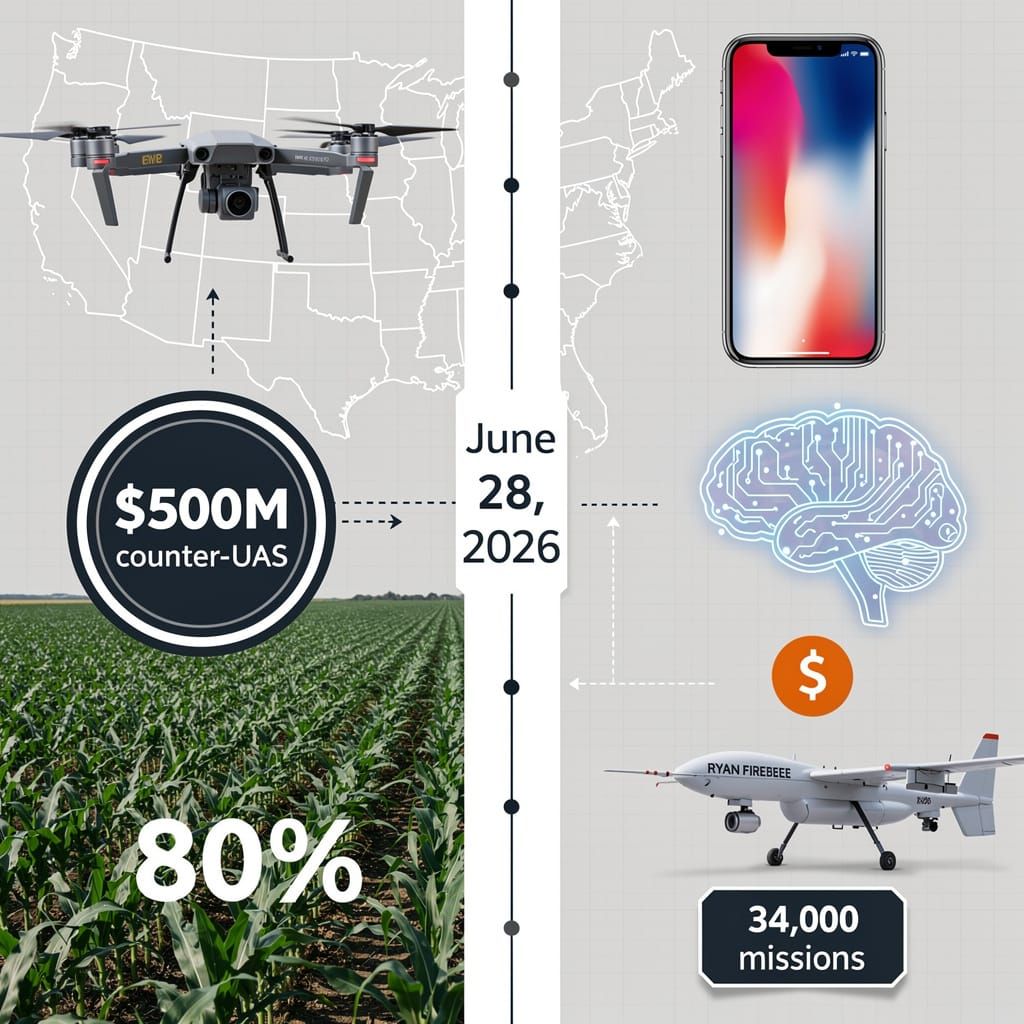
DJI passed a US cybersecurity audit. No malicious activity detected. The structural dependency? Unchanged. DJI holds 80% of US agricultural spray drone sales—a single Chinese manufacturer dominating critical food-infrastructure—by the time domestic alternatives can scale (2027 Blue UAS expiry). The policy "response": $500Meto counter-UAS capabilities via Safer Skies Act. Counter-drone funding doesn't replace drone supply. Who bridges this gap for US farmers before 2027?
On June 28, 2026, two seemingly unrelated announcements revealed a coherent pattern reshaping technology deployment: the Ryan Firebee's 34,000th surveillance mission and the iPhone X launch. The coincidence of dates obscures a deeper truth—physical hardware increasingly functions as infrastructure for intangible, networked value streams.
The Surveillance Acceleration Myth
Commercial drone adoption surged following operational data from legacy platforms like the Ryan Firebee. Advocates frame this as evidence of "rapid expansion of autonomous flight systems" delivering cost-effective monitoring. The evidence warrants skepticism—operational claims outpace institutional capacity to validate them.
The June 23 Valour Consultancy report projecting 5.6 million commercial drones by 2050 illustrates the gap between aspiration and deployment infrastructure. The same report identifies China-led agricultural adoption (DJI's 300,000+ spray drones) as the primary growth driver. DJI controls approximately 80% of US agricultural spray drone sales despite domestic alternatives existing, a dependency the Purdue Ag Center's June 22 field demonstration tacitly acknowledges while Senator Todd Young attended with no announced domestic procurement pathway.
Wall Street issued "strong buy" ratings for drone manufacturers including AeroVironment Inc. and Red Cat Holdings Inc., with analyst Ilya Margolin citing long-term strategic importance tied to Middle East defense demand. The market consensus on "continued consolidation and innovation expected through 2034" proceeds without resolving structural supply vulnerabilities. Hardware bottlenecks in semiconductor supply—sovereignty questions the draft raises—remain identified risks without addressed remediation.
The regulatory architecture superficially accelerates. EASA's June 23 notice lowered registration thresholds from 250g to 100g, effective immediately, affecting all camera-equipped drones. The UK CAA implemented identical Remote ID mandates January 1, 2026, impacting roughly 500,000 pilots. Yet the Safer Skies Act—providing $500M FEMA funding for counter-UAS capabilities—reveals the other vector of institutional response: not integration, but containment. DJI's passing of a US cybersecurity audit May 29 confirms no malicious activity detected, but does not resolve structural questions about data sovereignty when a single manufacturer dominates global commercial fleets. Port St. Lucie Police Department's June 11 Skydio X10 deployment demonstrates operational utility for public safety; it also demonstrates how professional operators increasingly navigate procurement, compliance, and operational decisions without coherent federal inventory.
Zena Tech's Q1 2026 results—$8.4 million revenue, a 640% year-over-year surge in drone-as-a-service offerings—suggest genuine market maturation. Yet the reported expansion to 26 global locations coexists with regulatory asymmetry: implementation timelines extend to 2031 for EASA standards, while the Blue UAS domestic-content carve-out expires January 1, 2027. Domestic drone manufacturers cannot scale to replace DJI's market position before regulatory frameworks crystallize.
The 18% increase in policy revisions since last year indicates regulatory bodies concede ground but haven't established coherent frameworks. Congressional markup sessions across both House and Senate throughout late June 2026 confirm continued fragmentation—one more vector evidence of reactive scrambling rather than calibrated governance when technical urgency consistently outpaces legislative velocity.
The iPhone X Distraction
Apple's flagship launch and IBM's DRAM patent expiry merit scrutiny beyond surface-level revenue declines. New signals reinforce structural interpretation over cyclical narrative.
Tim Cook's final keynote May 24 announced Apple Intelligence and redesigned Siri, triggering immediate market reactions to AI integration and leadership transition. The sequencing matters: Cook's resignation announcement (May 18) preceded WWDC 2026 (June 8-12), where iOS 27, watchOS 27, and visionOS 27 shipped with deeper AI integration. The institutional narrative positioned this as seamless transition; the market timed reactions accordingly. iPhone 17's subsequent performance during Q1 2026 captured 75% of major carrier shares, contributing to record Q2 2026 revenues—a figure explaining the iPhone X's positioning within Apple product strategy, not disrupting it.
The EU's June 10 rejection of Apple's Siri AI compliance measures under the Digital Markets Act reveals the friction point the draft identified—but the new signals here contain specifics the draft lacks. Regulators rejected Apple's interoperability proposal, citing privacy risks from expanded AI access. Apple sought an 18-month exemption while developers remained blocked from testing Siri AI on non-US platforms. EU Commission criticism of insufficient interoperability standards creates regulatory uncertainty across EU tech markets, occurring the same week as Apple Intelligence announcement—AI integration proceeding despite, not because of, regulatory clarity. The June 10 signals document ongoing negotiations with uncertain outcomes: increasing focus on localized compliance may slow global AI adoption in both EU and China markets.
The -15% retail revenue drop against 2025 baseline reflects structural shifts, not temporary market correction. The 30% e-waste volume decrease appears validating, yet masks critical questions about replacement cycles in AI-first device categories. WWDC 2026 projected "zero-physical interaction economies" dominating enterprise operations before 2030 without specifying transition mechanisms for sectors resisting digitization.
DRAM manufacturing consolidation means a handful of foundries control transition velocity—competitive dynamics differ substantially from patent-protected markets. The iPhone X functions as infrastructure for app ecosystems and carrier subsidization models, not the discrete hardware economics the draft critiques.
Systemic Triage
Both signal clusters indicate institutional adaptation lagging technological deployment—be it unsupervised aerial expansion or hardware-to-service value migration. Drone proliferation advances with 5.6 million units projected, yet domestic supply chains lack capacity to replace Chinese manufacturers before 2027 carve-out expiry. AI integration accelerates on Apple's roadmap, yet EU regulators find compliance measures insufficient.
The space program signals from June 21-27, 2026, provide the sharpest illustration of this pattern. With $1.5 trillion in FY2027 defense appropriations requested—$1.15 trillion via regular appropriations and $350 billion via reconciliation—that would triple FY2026 levels, technical urgency still outpaced congressional velocity. The Swift Observatory's orbit decay threatened mission failure, prompting a $30M on-orbit servicing contract for Katalyst Space using a Pegasus-XL rocket—emergency procurement of private-sector solutions for institutional assets, not calibrated program development. NASA Aerospace Safety Advisory Panel met June 22 specifically to address quantum computing risks, a forward-looking technical concern meeting simultaneously with funding uncertainty. Senate Armed Services Committee hearings advancing Roger Mason's NRO nomination and Erich Hernandez-Baquero's ASAF/SQ replacement nomination indicate continued focus on space command integration, yet the institutional mechanism for sustained funding—whether through regular appropriations or ad-hoc reconciliation bills—remains unresolved.
Forecasters expect continued bipartisan disputes over Space Force funding to delay legislation through July 2026. Market volatility in aerospace stocks links to launch outcomes and policy shifts—both Blue Origin facing New Glenn explosion aftermath (May 31) and SpaceX maintaining Starship orbital testing momentum. This volatility maps onto the same dynamic as Apple's retail revenue decline: market participants price technological trajectories while institutions provide fragmented, delayed, or contradictory policy signals.
DJI confirmed its US cybersecurity audit passage May 29 with no malicious activity detected. This echoes the Apple Intelligence compliance posture: institutions document technical measures, but structural dependency (on Chinese-manufactured agricultural drones) or regulatory divergence (EU Digital Markets Act interoperability gaps) persists regardless. The June 23 Valour Consultancy report and May 24 Apple Intelligence announcement occurred within days of each other—correlation requiring explanation beyond shared commercial calendar logic.
What remains evident: regulatory capacity demonstrably trails autonomous system deployment, while revenue models increasingly detach from physical device sales. Drone policy revisions in Europe, the UK, and the US extend implementation timelines beyond 2030; Apple's AI integration proceeds despite fragmented international compliance. Congressional appropriations battles confirm policy fragmentation extends to space programs—the arena where national security imperatives theoretically align technological urgency with institutional capacity. Whether current frameworks can address these structural shifts—rather than roundabout policy revisions and emergency contracting—determines whether June 28, 2026 registers as inflection point or coincidence.
🔌 When Constraints Become the Story: Robotics Competition's Quiet Retreat from Wireless
⚡ SAME PROBLEM, DIFFERENT ANSWERS. Robotics community responds to connectivity bans with protocol swaps. Apple faced EU regulatory rejection of Siri AI—sought exemptions. Drone delivery had 12-hour payload delays from cloud cover, spoofing attempts, no alternatives. Which response is engineering pragmatism — and which is just the minimum viable adjustment dressed as innovation?
The announced pivot away from WiFi-dependent coordination toward Bluetooth-based exchanges and offline-first architectures reads, at first pass, like ingenuity under pressure. The June 21 developments—FIRST's finalization of its scouting data protocol after extensive testing of QR scanning, mesh networks, and USB transfers, and the deployment of Viper scouting servers operating autonomously with battery and cell-free communication—collectively suggest a community adapting nimbly to regulatory headwinds. The framing positions this as decisive action, a "pivot from flashy WiFi approaches to embedded low-latency exchanges."
That framing deserves scrutiny.
The Constraint Is the Strategy
What organizers describe as external bans impairing interclub coordination sounds like a problem that demands systemic response—regulatory advocacy, collective lobbying, formal exemption requests. Instead, the response amounts to replacing one protocol stack with another. Bluetooth at close range works. USB tunneling for batch uploads works. Yet the broader tech landscape suggests this pattern of accommodation carries costs.
Consider Apple's Siri AI rollout. On June 9, 2026, Apple announced the feature at WWDC. By June 10, the EU Commission had rejected Apple's trust framework proposal, citing privacy risks from expanded AI access and a lack of interoperability. Regulators requested an extended exemption for 18 months. Rather than contest the regulatory premises directly, Apple sought accommodation—requesting temporary exemptions and proposing trust frameworks that proved insufficient. The result: developers remain blocked from testing Siri AI on non-U.S. platforms, and the EU market faces unequal service quality compared to American consumers. Market fragmentation between US and EU ecosystems now appears structural rather than temporary.
Canada's response to similar pressures ran differently. Prime Minister Mark Carney announced a $2 billion "AI for All" strategy on June 4, 2026, committing $500 million to a Tech Growth Fund targeting local AI startups, $700 million to compute access, and an explicit goal to create 250,000 AI jobs while pushing AI adoption to 60% by 2034. Labor groups criticized the plan for insufficient worker protections and a lack of measurable displacement metrics—legitimate concerns that the government's pro-active posture at least invited public scrutiny. The robotics community's protocol swap, by contrast, absorbs restrictive policy without requiring regulators to justify their premises.
Data center tax incentive rollbacks offer a parallel example. Governor DeWine of Ohio suspended corporate tax breaks, resulting in $136 million in losses for FY2025, with projections exceeding $1.5 billion in total for the state. Illinois Governor Pritzker suspended data-center tax incentives on July 5, 2025, citing fiscal inefficiency and environmental impact. Virginia faces a potential $1.9 billion revenue loss as legislators debate continuation of existing exemptions. The pattern: industries experiencing political pressure because $5.3 trillion in AI spending projections have driven data-center expansion that strains local grids, consumes water resources, and delivers fewer jobs than promised. The robotics community's adjustment to connectivity restrictions operates in the same regulatory environment yet responds with engineering workarounds rather than advocacy for clearer rules.
Couching workaround adoption under "innovation" glosses over what is actually happening. Teams are not building superior communication architectures. They are retrofitting resiliency into systems designed for connectivity—a piecemeal approach that trades WiFi's bandwidth for Bluetooth's proximity requirements and tolerance for latency.
Scalability Remains Untested
The forecast predicts communitywide adoption of low-bandwidth protocols as a permanent replacement for intermittent WiFi streaming by season's end. Yet the signals themselves reveal operational friction that contradicts the optimism. Participants operating "completely offline until periodic bursts succeed through high-speed USB tunnels" suggests not seamless adaptation but deliberate mode-switching that introduces synchronization risk.
Documented Bluetooth connectivity issues on Android devices—physical obstructions, improper device positioning, recurring dropout patterns—carry implications across cybersecurity, aviation, and consumer hardware domains that the robotics community's proposed reliance on BLE should take seriously. Drone delivery operations on June 1, 2026, illustrate the stakes. Cloud cover caused radio blackouts resulting in 12-hour payload delays, with interrupted transmissions producing minor data corruption in mission logs. Theintermittent connectivity created temporary blind spots that enabled spoofing attempts—heightened cybersecurity risk atop the operational inconvenience. When environmental factors disrupted wireless communication in an operational system, redundancy measures and manual correction became necessary. The robotics competition's proposed model—relying on Bluetooth Low Energy for real-time data exchange under tournament conditions—tolerates similar vulnerabilities without comparable fallback infrastructure.
The hardware economics complicate scaling further. The proposed solution carries a $300 server plus $930 client budget per team—not trivial for volunteer-led clubs. The telemetry advantage cited in the briefing depends on execution discipline that informal club coordination rarely guarantees, multiplied across tournaments with staggered match schedules.
The Power Budget Problem
Low-power devices already limit bandwidth—this signal hints at hardware constraints that no protocol choice resolves. Bluetooth Low Energy trades throughput for endurance, but the compression required to make this tradeoff viable introduces processing overhead. On payload-limited robotics platforms where every watt-hour matters, the engineering tax for maintaining functional data exchange under restricted connectivity compounds.
Regulatory Capture or Regulatory Reality?
The briefing frames federal no-internet-access mandates as external shocks to be circumvented rather than context to be contested. Organized competitive robotics represents a well-resourced constituency with clear institutional champions. If the community responds to restrictive policies by accommodating them rather than challenging them, it normalizes a framework that may expand to adjacent domains.
The irony: 78 teams did abandon something in recent weeks. They dropped command-based path planning in favor of finite state machines—not because regulation required it, but because complexity demanded simplification where simplification was worth fighting for. That architectural evolution signals genuine engineering judgment about tradeoffs. The protocol swap, by contrast, reflects acceptance of constraints before establishing whether those constraints deserved acceptance.
The mechanics work. The coordination survives. Whether that constitutes innovation or simply the minimum viable adjustment to reduced circumstances remains genuinely in question.
🤔 Rethinking Rapid Prototyping in Competitive Robotics
With ~$20,000 total investment, FTC teams are being pushed toward CNC milling for safety—while the same briefing praised fiber lasers for speed ✂️ A $20,000 budget cannot absorb CNC tooling overhead, multi-pass cycles, or metalworking fluid systems. The solution creates new hazards: aluminum oxide particulate, metalworking fluid mist, formaldehyde from Delrin too. Industry signals (June 2026) favor laser adoption in robotics—Gweike documentation shows this trajectory. So why recommend expensive metalworking to teams that mostly need geometry validation, not machined tolerances? FTC's competition philosophy prizes innovation over heavy machinery—lightweight laser-capable composites align with that. Laser cutters don't. You're solving for the wrong constraint. 🤔
The Materials Problem Nobody Talks About
The recommendation circulating through FIRST Tech Challenge workshops on June 29, 2026, carries a fatal internal contradiction that undermines its utility for competition teams. The speaker counseled teams to abandon polycarbonate laser cutting in favor of aluminum plate fabrication via the Omio X6m—yet the same signals that prompted this recommendation argue for the opposite tooling choice entirely. For teams operating on approximately $20,000 total investment and competing in a league that explicitly prioritizes innovation over heavy machinery, the implicit assumption that CNC milling is the correct career path deserves challenge.
What the Recommendation Actually Argues
The stated rationale for avoiding polycarbonate in laser workflows is legitimate. Thermal absorption inefficiency causes localized hotspots exceeding glass transition temperatures before clean vaporization occurs. Teams operating in unventilated school workshops or home garages face genuine exposure risks—carbon monoxide, phenolic off-gassing, and fine particulate that standard HEPA filtration does not capture. Delrin laser cutting compounds this problem by generating formaldehyde concentrations that accumulate in enclosed spaces. These are not invented concerns, and they operate in a context where exposomics research confirms that personal chemical exposure varies significantly across individuals based on behavioral and structural factors that traditional monitoring misses.
However, the proposed solution—redirecting structural work toward the Omio X6m and its aluminum plate fabrication workflow—introduces cost and complexity that contradicts the very constraints the recommendation acknowledges. A $20,000 competition budget does not absorb the tooling overhead, chip evacuation demands, and spindle rigidity requirements that aluminum CNC milling demands. Teams operating with rotating student memberships and rotating mentor oversight cannot reliably execute multi-pass roughing and smoothing operations without extended iteration cycles that compress preparation time.
Where the Fiber Laser Signals Complicate the Picture
The same briefing that surfaced the Omio X6m recommendation also flags fiber laser cutting as the preferred alternative for FTC-style rapid prototyping. The stated rationale emphasizes superior speed and suitability for lightweight materials—specifically SRPP and acetal—over the heavier aluminum workflow the draft article critiqued. This raises a structural question about the Omio X6m recommendation itself.
Signals from June 10, 2026, indicate that Gweike—a manufacturer producing both laser cutters and composites—anticipates lasers gaining significant traction across robotics and manufacturing sectors. This market directionality suggests that the industry trajectory aligns more closely with lightweight laser-capable workflows than with metal CNC machinery. If major manufacturers and emerging robotics applications are orienting toward laser systems, the Omio X6m recommendation positions teams toward a tooling paradigm that the broader market appears to be moving away from.
If fiber laser cutters offer faster iteration and better material compatibility with FTC-appropriate substrates, the Omio X6m recommendation functions as a solution seeking a problem. Teams without validated geometry—meaning the majority of programs beginning a competitive season without prior CAD libraries—cannot leverage the dimensional precision advantages that justify CNC milling overhead. The recommendation arrives too late for teams that most need streamlined prototyping, and positions expensive metal-capable machinery where lightweight laser workflows would serve more efficiently.
The Hazardous Emissions Trade-Off Is Real, But the Solution Is Partial
Avoiding polycarbonate eliminates one hazard class. It does not eliminate others, and it does not eliminate the hazards associated with the proposed replacement workflow. Aluminum milling generates its own aerosol concerns—fine aluminum oxide particulate and metalworking fluid mist—that require ventilation and skin protection. The recommendation substitutes one materials safety problem for another without acknowledging that Delrin laser cutting also produces cumulative formaldehyde exposure.
The contextual landscape reinforces these concerns. Atmospheric monitoring across North America detects layered chemical persistence in indoor environments, with legacy compounds like DDT and PCBs alongside modern additives including flame retardants and phthalates. Microplastics dominate fiber fractions in residential dust accumulation. While health risks from any single source remain unverified, the cumulative exposure picture in enclosed workshop spaces suggests that teams face compounding chemical burdens that no single engineering control fully addresses. The exposomics research underscores that individual exposure variability makes generic safety recommendations insufficient without understanding specific workflow conditions.
Experimental evidence from airborne particle testing adds operational dimension to these concerns. DIY filtration systems using affordable sensors and multi-stage filters demonstrate that achieving significant particle reduction requires deliberate system design—yet the commercial grade alternatives remain financially inaccessible for most student teams. Data from June 9, 2026, documents that achieving 100,000x particle reduction is possible with affordable components, but requires integration of particle counters, P100 filters, and MERV-16 stages—equipment configurations that exceed standard competition team budgets and technical capacity.
What Competitions Actually Need
The underlying tension reflects a gap between optimized professional manufacturing and accessible student fabrication that no single tooling recommendation resolves. For teams beginning a season without prior CAD validation, lightweight material exploration—utilizing donated acrylics, plywood, or partnering with FRC teams possessing metal-cutting capability—serves a geometry validation function that neither laser nor CNC workflows replace.
FTC's emphasis on innovation over heavy-duty machinery signals a design philosophy applicable to fabrication workflow selection. The Omio X6m recommendation assumes metal fabrication is the correct end-state for competition builds—but for a robotics league structured around iterative design cycles, lightweight laser-capable composites frequently outperform machined aluminum in the metrics that judges evaluate. The sector trajectory signals favor of laser adoption in robotics manufacturing align more naturally with this philosophy than with tooling investments oriented toward industrial metalworking.
The transitioned workflow accelerates readiness only for teams already positioned with validated geometry, CNC access, and machining literacy. For the broader population of FTC participants operating on shoestring budgets with rotating student memberships, the recommendation delivers one more option rather than the optimal path.
Teams reconsidering fabrication approaches can access community resources on fiber laser capability, lightweight material sourcing, and FRC partnership frameworks through FIRST community forums.


Comments ()