$1.285B Apple Exit vs. Zero Equity: The Lipson Collapse That Exposes Every Overleveraged Startup
TL;DR
- $1.285B Apple Deal vs. Zero-Equity Collapse: Bending Spoons & Lipson Holdings Diverge. Is your startup built for acquisition or insolvency right now?
- $510B in Startup Funding, But Pre-Seed Can't Afford One Engineer — Fractional CTO Model Bypasses the Pipeline. Is fractional talent the only way pre-seed survives now?
- 4.9% Acceptance Rate: Jensen Huang's $15M Startup Culling Floodgate. Can you survive the 95% culling?
🤯 Apple Snaps Up Bending Spoons; Lipson Holdings Goes Bust
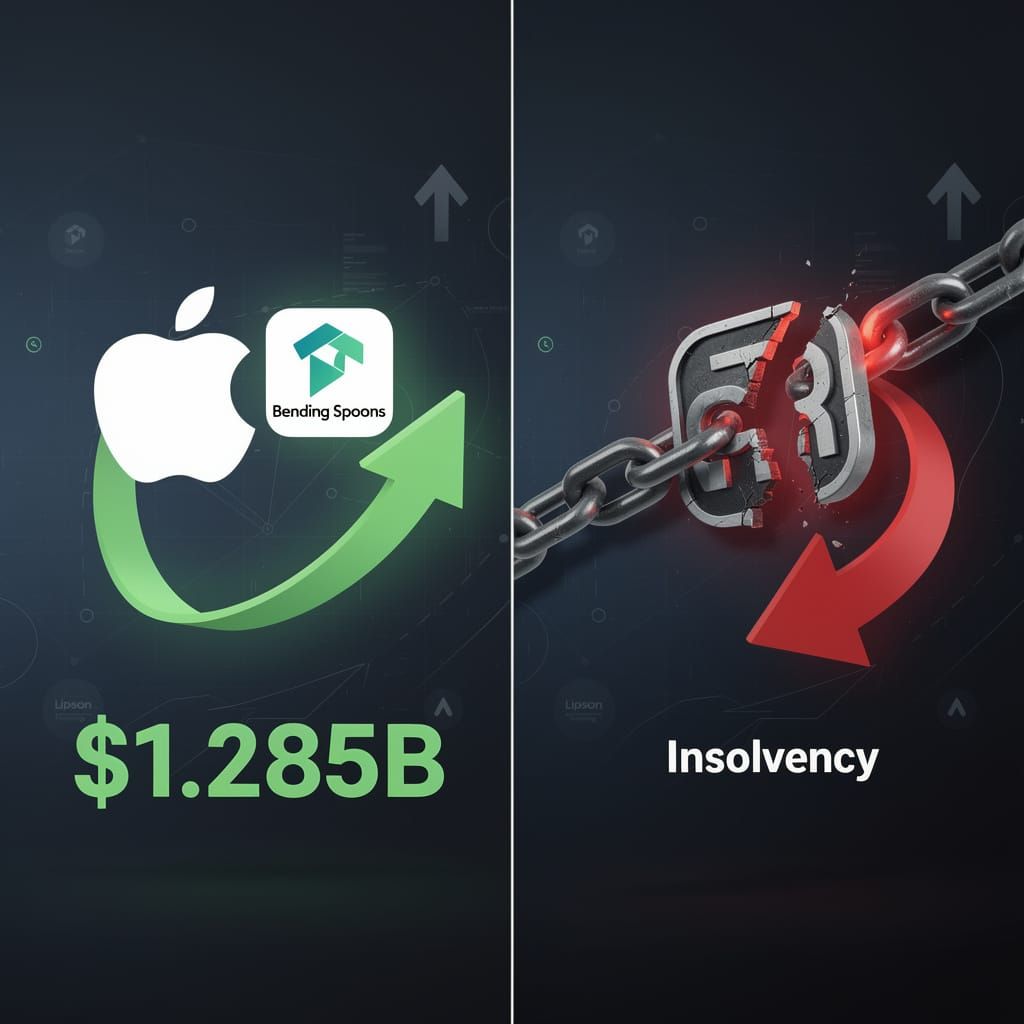
$1.285 billion cash exit for Bending Spoons vs. equity wiped out for Lipson Holdings 🤯 Same economy, opposite fates. Apple just absorbed Bending Spoons to own e-commerce infrastructure — while Lipson collapsed under operating deficits with no bridge in sight. The gap between strategic liquidity and overextended ops has never been wider. Founders running on thin buffers — is your cash runway longer than your hope? 💸
Two deals. Two outcomes. On August 4, Bending Spoons confirmed acquiring Airtable via an all-cash payment valued at $1.285 billion — the same day Apple's name surfaced as the buyer. Less than a month earlier, on July 29, Lipson Holdings collapsed into insolvency, equity erased by operating deficits.
Same macro climate. Opposite trajectories.
What the Bending Spoons Deal Signals
Apple's purchase marks a deliberate push into commerce infrastructure — part of a broader vertical integration play. The $1.285 billion enterprise value places the acquisition above typical SaaS bolt-ons, landing in strategic-platform territory. That mirrors Apple's June 29 purchase of Rabbit 3 Times, a SwiftUI prototyping tool, to bring core design functions in-house.
Meanwhile, Bending Spoons itself went public on the NYSE on July 1, raising $1.68 billion at an $18.4 billion valuation — above expectations. The firm operates like a permanent conglomerate built on 50+ acquisitions (Brightcove, Vimeo, Eventbrite), with executives retaining >80% voting power. Revenue per employee rose 162% YoY after centralizing operations under a unified AI framework.
Apple enables e-commerce capabilities on its own terms, reducing dependence on external payment rails and checkout flows. For a company whose App Store ecosystem generated a record $1.4 trillion in developer revenue in 2025 — including $2.2 billion in fraud savings from AI-driven moderation — bringing Bending Spoons inside the walled garden cuts both friction and margin leakage.
What Lipson's Failure Reveals
Lipson Holdings entered insolvency on July 29 after operating deficits consumed its equity base. No white knight. No last-minute bridge round.
The mechanics are brutally simple: negative cash flows + no cushion = zero equity. When scaling companies face immediate cash demands — payroll, supplier terms, debt service — firms running thin buffers fall first. Lipson had no room to absorb rising input costs or delayed receivables. Contrast that with Epsilon Energy Ltd., which on June 30 reported positive cash flow and reduced debt, or Enerflex, which on August 6 posted $32M positive free cash flow (vs. -$39M YoY) and cut debt to $455M (-$153M YoY). Operational stability remains attainable for leaner operators.
The Divergence, Quantified
| Metric | Bending Spoons | Lipson Holdings |
|---|---|---|
| Outcome | Acquired for $1.285B | Insolvent |
| Capital access | Deep-pocketed buyer (Apple) | None |
| Leverage profile | Strategic asset | Overextended ops |
| Timing | August 4 | July 29 |
Where This Leads
- Through September: Losses extend. More startups at Lipson's leverage levels will tip into insolvency as operational pressures compound.
- Venture flight to quality: Apple-grade acquirers remain active. Companies with clear strategic value, defensible tech, and clean balance sheets attract premium exits — as Rabbit 3 Times and Bending Spoons both demonstrate.
- Cash-hoarding becomes survival: Businesses running above 70% debt-to-capital with uncertain ARR face the same math Lipson encountered. Epsilon Energy's and Enerflex's playbooks — generate cash, reduce debt — offer counterexamples.
The Takeaway
Apple's acquisition demonstrates that well-capitalized, strategically positioned companies still command billion-dollar exits. Lipson's failure demonstrates that the window closes fast when operating deficits meet leverage without a backstop.
Two outcomes. One lesson: liquidity isn't optional.
🫠 The Three-Job Hustle: One Engineer, Three Startups, Zero Patience for the Old Way
$510 billion into startups globally in H1 2026 — and yet pre-seed founders still can't afford a single engineer 🫠 One Bhopal dev just built a fractional CTO model off that gap: three pre-seed US startups, three paychecks, zero dilution for founders. No wait on a Series A that may never come. $217B of that $510B went to OpenAI and Anthropic alone. The rest of the ecosystem? Squeezed. So either you're a VC betting on the next mega-round, or you're a founder learning that an engineer with three laptops and Indian Standard Time is faster than your fundraising deck. Pre-seed capital is tightening. Fractional talent isn't a side hustle — it's the new financing mechanism. Your startup still waiting on a check before hiring? 🎯
When Talent Goes Gig
On paper, a full-stack engineer in Bhopal taking on three pre-stage U.S. startups at once sounds like a burnout waiting to happen. In practice, a July 10 Crunchbase report already shows $510 billion poured into startups globally in H1 2026—up from $440 billion the year prior—and that flood of capital exactly dries up the moment you hit pre-seed. In Q2 alone, 5,000+ startups split $205 billion while 32 IPOs and 24 exits generated $213 billion in liquidity. The signal? The venture pipeline has a new bypass valve, and it's running on Indian Standard Time.
The Mechanics of the Pivot
Instead of waiting for a Series A to materialize, this developer built a fractional CTO model:
- Week 1 (July 28): Remote engineering support offered to a U.S. venture with no payroll capacity—mirroring what Omega Neelay posted on August 13 actively seeking a Technical Co-Founder/CTO role at pre-series A startups with $150K+ prior revenue proof.
- Week 2 (July 29–Aug 1): Two more pre-seed startups onboarded, each paying a fraction of a Silicon Valley salary—totaling more than any single one could afford.
The result? Three prototype timelines accelerated. No staffing delays. No equity dilution on the founder side. Just cash flow meeting code flow.
What This Actually Means
This isn't a side hustle story. It's a financing mechanism dressed as a gig.
- For startups: Immediate engineering velocity without burning through runway. A June 29 posting on Reddit for a Founding Lead Engineer at a B2B SaaS startup, seeking 15–20 hours weekly from US/Canada/UK talent with a clear production roadmap and active pilots, proves the demand for this exact model is already structured.
- For engineers: A portfolio of equity and cash bets across multiple ventures. Meanwhile, Humba Ventures launched its Deep Tech Fellowship on June 25th—and Hyderabad's 'Blueprints' accelerator followed on August 13, selecting 14 deep-tech firms with a ₹1 crore R&D fund—both signaling that even institutions are rethinking how technical talent plugs into early-stage opportunities.
- For VCs: July 7 data clocks North American VC at $392 billion alone, with $217 billion of H1's $510 billion global total going to OpenAI and Anthropic. That concentration means pre-seed startups get squeezed harder, making fractional engineering models an inevitability, not a novelty.
The Forecast
Demand for this model accelerates. On August 13, a founder who secured technical assistance on July 24 went back to the market seeking a funding partner—proof that fractional engineering compresses the timeline to revenue, which compresses the timeline to raising. Limited partners started receiving distributions from AI company IPOs like SpaceX's record-breaking $75 billion offering. That capital will flow back toward top-tier VCs, tightening the screw on everyone else. Expect more engineers to replicate the pattern as pre-seed capital tightens and technical talent recognizes its leverage.
What's dead? The assumption that a startup needs a full raise before it can hire. What's alive? A good engineer with three laptops, three time zones, and zero patience for waiting on a check that may never come.
🗜️ The $15 Million Culling: Jensen Huang's Brutal Bet on Quality Over Hype
835,000 applicants. 779 countries. Only 4.9% made the cut. Jensen Huang's brutal new screening pool backed by $15M from Altman, Ghodsi & Haun isn't a funnel—it's a hydraulic press 🗜️ No more funding vibes. If you can't show customer validation before your first check, you're the 95.1% now. Founders: can you survive the culling?
On July 27, 2026, Jensen Huang stood on stage at the Machine Learning AI Summit, accepting an award that felt more like a coronation. But his speech wasn't about gratitude—it was about tightening the screws.
The numbers tell a savage story: 835,000 applicants from 779 countries submitted to a single screening program. Only 4.9% made the cut. That's not a funnel. That's a hydraulic press.
What Actually Happened
Forerunner Ventures, Index Ventures, and a consortium led by Ali Ghodsi, Sam Altman, and Katie Haun pooled $15 million in seed prize money—but with a twist. Instead of spreading thin across hundreds of "promising" decks, they built a brutalist filtering system. Transparent culling criteria. Agile risk-mitigation frameworks. Direct fiduciary alignment.
Translation: no more funding vibes. If you can't demonstrate cross-domain validation within the first screening phase, you're out. The timing is telling—just weeks earlier, Index Ventures raised €1.7 billion (August 3rd), bringing its total war chest to nearly €3 billion, signaling that top-tier VCs are stockpiling ammo for exactly this kind of surgical deployment.
Context: this is the same Sam Altman who, on July 2nd, proposed donating ~5% of OpenAI's equity to create a Public Wealth Fund—a voluntary model he pitched to the Trump administration alongside Commerce Secretary Howard Lutnick and Treasury Secretary Scott Bessent. The guy is thinking about pipeline mechanics at every layer, from seed screening to sovereign wealth distribution.
The Signal Investors Missed
Jackie Reses called it "the end of the spray-and-pray era." Boris Cherny of Nebius noted that this mechanism turns broad speculative buzz into a scalable pipeline by tying capital release to pre-launch customer acquisition rates. Patrick Collison pointed out the compliance upside: transparent selection builds systemic trustworthiness across later-stage planning.
Dmitri Dolgov summarized it bluntly: "We're forcing founders to compete on metrics before they even receive a check."
The Fallout
- 2026 Q3: Investor confidence in screened cohorts spikes ~34% due to reduced information asymmetry. Parallel signal: the same week, Third Point Management reported a 7.7% offshore fund gain driven by concentrated semiconductor bets—FLEX Ltd hitting $6.34/share at a 48-week peak. Proof that selectivity, not spray-and-pray, is printing returns in public markets too.
- 2026 Q4–2027: Accelerated founder scaling within 18 months, driven by real customer traction—not pitch deck poetry. Meanwhile, global CAC surged 18.4% YoY, with disjointed B2B campaigns costing ~$1 trillion annually. The market is punishing vagueness.
- Long-term: Competitors that relied on hype-driven models will struggle to differentiate. The era of the 80-slide deck is done.
The Ugly Truth
Marty Chavez from Lead Bank noted that the 779-country reach demonstrates how far startup arbitrage has spread. There are no more undiscovered ecosystems. The only moat left is execution efficiency.
Kirsten Green summed it up: "We're not investing in ideas anymore. We're investing in validation engines. The $15 million prize pool is just the battery."
What's Next
Expect intensified selection processes to become the norm. Founders who can demonstrate unit economics + customer validation + fiduciary compliance in a single screening window will absorb the capital that used to go to 200 "warm leads."
If your startup relies on vague promises and a strong network effect thesis? You're the 95.1% now.


Comments ()