Violent crime falls 9.3%, yet nine states weigh harsher penalties
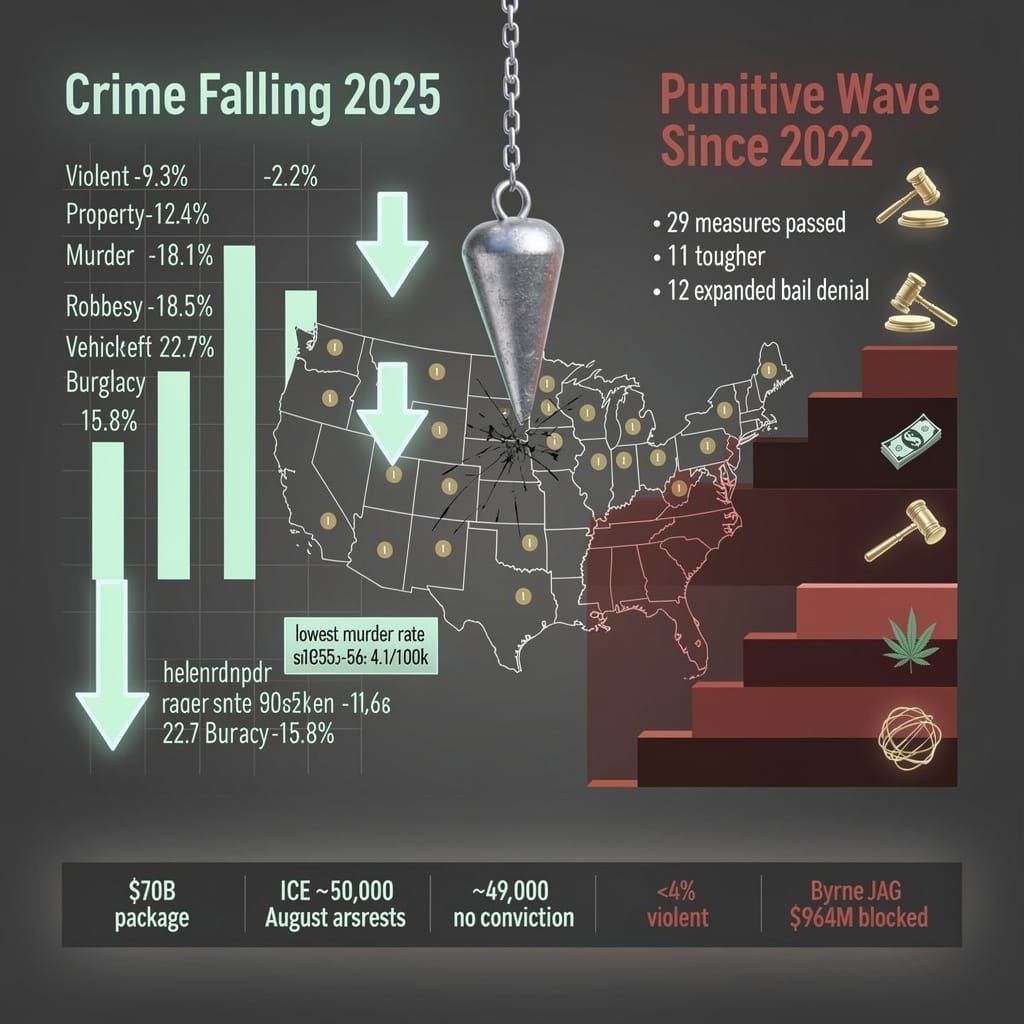
The FBI clocked violent crime falling 9.3% in 2025 — the biggest one-year drop since 1936. That's roughly 9 fewer violent crimes per 100,000 people. 📉⚖️ Yet nine states, eleven ballot questions on Nov. 3 are tightening bail, fentanyl, and trafficking penalties. Indiana, Louisiana, and Tennessee are set to let more people sit in jail before conviction. Question: if violent crime was already sliding before these measures passed, what exactly are we voting to fix?
Here's a statistic that should make you feel safe, or at least safer: the FBI just clocked violent crime in the United States falling 9.3% in 2025. That's the largest single-year drop since the agency's national estimates began in 1936. Property crime dropped even more, down 12.4%. The numbers get almost embarrassingly good: murder down 18.1%, robbery off 18.5%, the murder rate touching its lowest since 1955-56 at 4.1 per 100,000. Federal investigators confirmed the trend again in August, with mid-2026 homicides still sliding—and noted the declines began before January 2025, which is a detail the White House never seems to put on a podium.
So naturally, the menu of fixes heading to voters on November 3rd reads like a crackdown cookbook. Nine states, eleven measures, all vying to make the justice system meaner. Because if there's one thing that screams "the problem is solved," it's a fresh batch of harsher penalties—right?
The Great Bail Backlash
The centerpiece of this year's ballot season is cash bail, and the warden's key is swinging hard. Indiana, Louisiana, and Tennessee all have measures on the table to tighten pretrial release—meaning more people sit in jail before they're ever convicted of anything. The Feds are clearly into it, too: in June, the House Judiciary Committee waved through the Cashless Bail Reporting Act, which would make the Attorney General publish an annual roll call of every jurisdiction daring to let violent suspects out without cash. Plenty of witnesses sung the praises of recidivism stats.
In fact, Congress didn't stop at reporting. On July 23rd, the House approved the No Federal Funds for Cashless Bail Act, blocking federal money from any jurisdiction that restricts cash bail for serious crimes. Denying Byrne JAG grants—$964M budgeted for FY2026—puts a mortgage on judicial leniency. That's not a fluke either: since 2022, sixteen statewide criminal justice measures have nudged decisively punitive; twelve of them expanded the circumstances in which a judge can deny bail outright. To put that in perspective, from 2012 to 2020 the momentum ran the other way—measures reducing penalties outnumbered tougher ones 11 to 5. The pendulum, it appears, has snapped its chain.
Fentanyl, Trafficking, and a Nod to Marsy
Fentanyl offenses and human trafficking are getting the heavy-hammer treatment too, with stiffer penalties on offer and, in some states, a life imprisonment ceiling dangled for traffickers. Tennessee is also weighing a Marshal(l)-style expansion of victim constitutional protections—giving crime victims explicit rights, a model that's spread through several states over the past decade.
Never mind that crime is already falling faster than a politician's approval rating in a corruption scandal. Motor vehicle theft alone cratered 22.7% last year, and burglary fell another 15.8%. The dip even survived a spike in roadside immigration checks, which isn't nothing.
The Marijuana Plot Twist
The drug-policy weirdness peaks on cannabis. Massachusetts is weighing a repeal of its legal-market structure, while Idaho—of course it's Idaho—is mulling a measure to hand marijuana regulation to its legislature rather than let locals set the rules. So on one ballot we're toying with unwinding legalization, and on another we're letting lawmakers who've never touched the plant decide its fate.
The Washington Tailwind
None of this is happening in a vacuum. The Trump administration has directed federal agencies to lean in on state and local law enforcement, expand prison capacity, and chase down immigration and crime priorities with a level of enthusiasm that tells statehouses exactly which way the wind blows. And the machinery is funded: a $70 billion bipartisan package passed in June made ICE the wealthiest law enforcement agency on the planet, financing new "turnkey" detention facilities and a $17 million San Antonio warehouse contract. The payoff has been record-breaking in a very specific way—ICE officers arrested roughly 50,000 people in August, matching July's peak, and DHS is calling it the highest monthly total in its history. Nearly 49,000 of those arrestees had no criminal conviction; fewer than 4% had prior violent convictions. The White House is even taking credit for declines in D.C. and Memphis tied to National Guard deployments—even though the FBI's own data shows the drop sweeping every population bucket, independent of any single administration. But when the Feds start cheering for severity, more than a few legislators get the memo.
That federal pressure may help explain why the trend flipped so abruptly. Since 2022, 29 statewide criminal justice measures have been approved; 11 of them made things tougher.
What It Actually Means
Here's the tension nobody on the campaign trail wants to admit: the punitive wave is rolling in precisely as crime stats are improving. That's not necessarily a contradiction—maybe deterrence works, maybe the numbers lag—but it does raise an awkward question.
If the problem was already shrinking before any of these measures pass, and if the August arrest surge is mostly netting people with no conviction at all, what exactly are we voting to fix?
The likeliest outcome is a patchwork: some states tighten further, others hold the line, and a few quietly keep experimenting. Either way, by the time the returns roll in on November 3rd, roughly a hundred million Americans will have had a say on how much their justice system should sting. The reporting suggests the fine print decides who walks and who waits—and right now, the fine print is getting awfully long.

Comments ()