Brazil bans fixed-odds betting nationwide
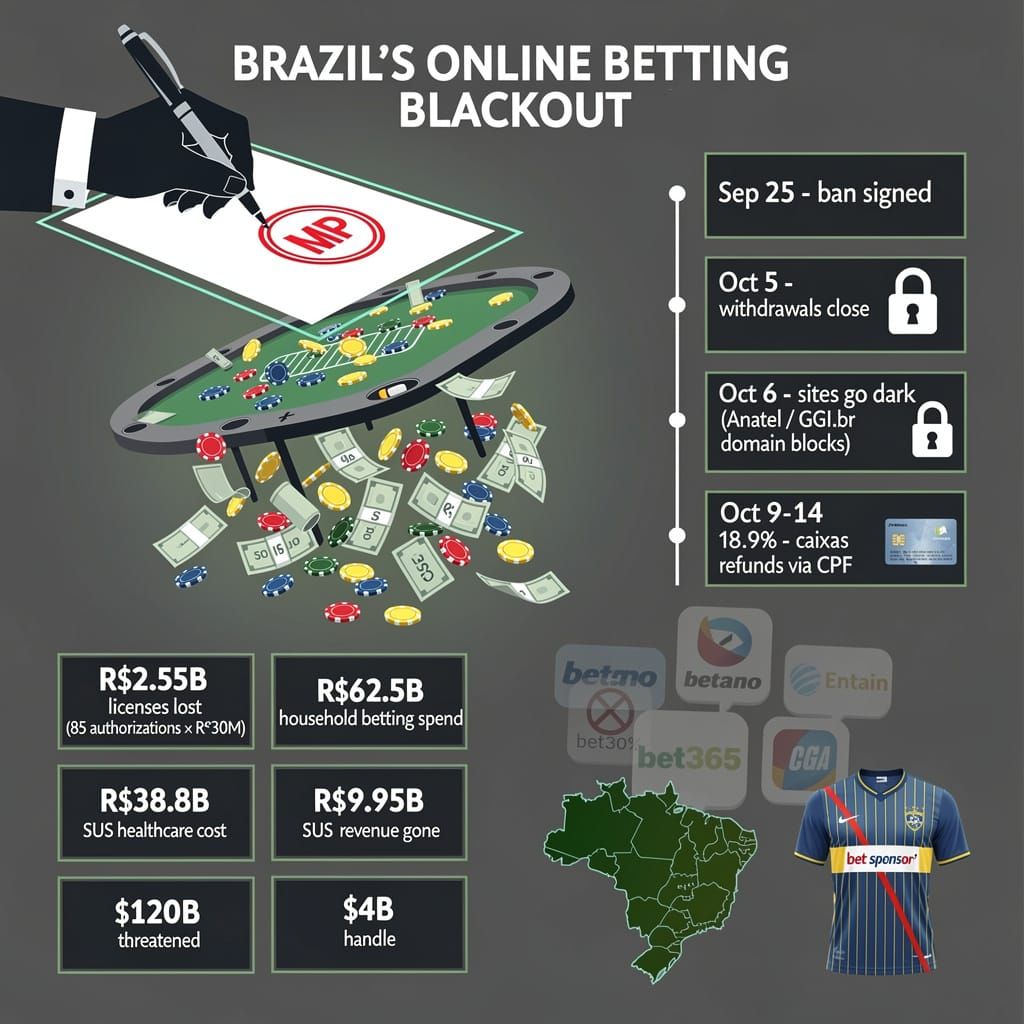
R$62.5 billion a year — that's how much Brazilians spent on betting (0.68% of family GNI), and it just got banned overnight. ⚖️ Lula's provisional measure kills fixed-odds wagering nationwide, canceling 85 licenses worth ~R$2.55 billion with zero refunds for operators. Platforms go dark October 6; bettors have until then to withdraw. The house always wins — unless the house is the federal government. Politics in the mix: the ban lands 9 days before a tied election, and Congress must ratify it within 120 days or it expires. Operators are already fighting at the STF. Regulated betting in Brazil: reckless safety net or overdue guardrail? 🇧🇷
Brazilian President Luiz Inácio Lula da Silva has done what no failed accumulator bet ever could: he wiped the board clean. On September 25, 2026, Lula signed a provisional measure (medida provisória) banning fixed-odds betting nationwide — sports betting and online casino alike — reversing the very regulatory framework his own government erected in December 2023 (Law 14,790). Lula likened the activity to "cancer" and framed the ban as essential to federal health.
Officially, the move is about protecting Brazilian families from gambling-linked debt. Unofficially, the timing is, shall we say, loaded. The measure lands nine days before the October 4 general election, with Lula locked in a statistical tie with Senator Flávio Bolsonaro. Coincidence? The Diário Oficial da União prints what it prints — though the announcement was telegraphed a week earlier via a Ministry of Finance invitation to an euphemistically titled "Economic Measures" event. Everyone showed up for the toast and got a eulogy instead.
What actually happens, and when
Let's separate the announced from the effective, because this timeline matters.
- Immediate (upon publication): new customer deposits are barred across all licensed betting platforms. Banks are likewise prohibited from processing betting-related transactions.
- By 11:59 PM, October 5: bettors must withdraw their own funds.
- Midnight, October 6: all licensed betting sites and apps go dark. Anatel and the internet governance committee (CGI.br) have been instructed to block betting domains. State and district lottery concessions for fixed-quota games are likewise extinguished within 30 days.
- October 7–8: operators must compile individualized balances tied to each bettor's CPF tax ID.
- October 9–14: state lender Caixa Econômica Federal processes direct refunds, including for customers who failed to withdraw.
No, operators do not get to keep the money, the licenses, or the sunk costs. Speaking of which: roughly 85 federal betting authorizations, each costing operators around 30 million reais — about R$2.55 billion in total — are terminated with no fee reimbursement. The Central Bank had flagged betting as a "central element" in household debt pressure, and the arithmetic is stark: debt payments hit 28.9% of household income in June, and betting accounted for R$62.5 billion in annual household expenditure (about 0.68% of family GNI), a R$4.7 billion monthly net transfer over the October 2024–March 2026 window. Finance Minister Dario Durigan delivered the termination news personally, and the sector's lawyers have taken note that 35 auctions were deemed precarious, granting no acquired rights. The "Desenrola 3.0" companion program, aimed at restructuring up to R$150 billion in family debt, does nothing for the corporate balance sheets.
The transmission path to your operator
Foreign heavyweights including Betano, bet365, and Entain now sit on dead Brazilian balance sheets, their capital committed to licensing and local build-outs evaporating alongside the house edge. The market that attracted roughly R$37 billion in retained post-prize revenue last year and a sports-betting handle near $4 billion annually is, overnight, a compliance graveyard. Licensed operators were generating R$9.95 billion (~$1.9 billion) in federal taxes in 2025 — gone. Meanwhile, an estimated R$38.8 billion in annual gambling-related healthcare costs reportedly burdens the public health system (SUS) — the government's headline justification.
Several nuances deserve your wary attention. Congress must ratify the measure within 120 days, so this is a provisional ban, not a settled one — if Congress fails to act, the ban expires. Full criminal penalties apply for unauthorized platforms that keep operating regardless. And the path here was telegraphed: in August, Congresswoman Caroline De Toni had already introduced Bill No. 5,153/2026 (fines up to R$2 billion and 2–5 years in prison), and the finance ministry had suspended 14 licensed sites on August 13 for failing to transmit data to the mandatory Sigap system. The government hints at more to come: operator liability for gambling harms and SUS funding mechanisms.
The industry groups ANJL and IBJR are already in court — ANJL has broken its cooperation agreement with Sportradar for match-manipulation monitoring, on the theory that there's little point monitoring markets that no longer exist, and is pursuing relief at the STF. Industry warnings of compensation claims stretch to R$120 billion.
Watch, and don't bet on it
So what's actually settled versus open? The shutdown is real and immediate. What remains open: whether Congress ratifies, amends, or rejects the measure within the window; whether the courts stay it before October 6; and what, if anything, happens to the football ecosystem — five major Série A clubs carry betting sponsors worth over R$1 billion combined in 2025, so expect some very quiet dressing rooms.
Three observable conditions worth tracking: congressional action before the 120-day clock expires, any judicial injunction out of ANJL's legal challenge, and whether Anatel's domain blocks hold against a user base of millions of low-income Brazilians who may simply migrate to offshore sites. The house always wins — unless the house is the federal government, in which case everyone loses their deposits. This is reporting, not a recommendation to short the industry or fix the upcoming Série A match; draw whatever conclusions you like, just don't wager on them.
Comments ()