Election Day Arrives With Lawyer Teams Ready
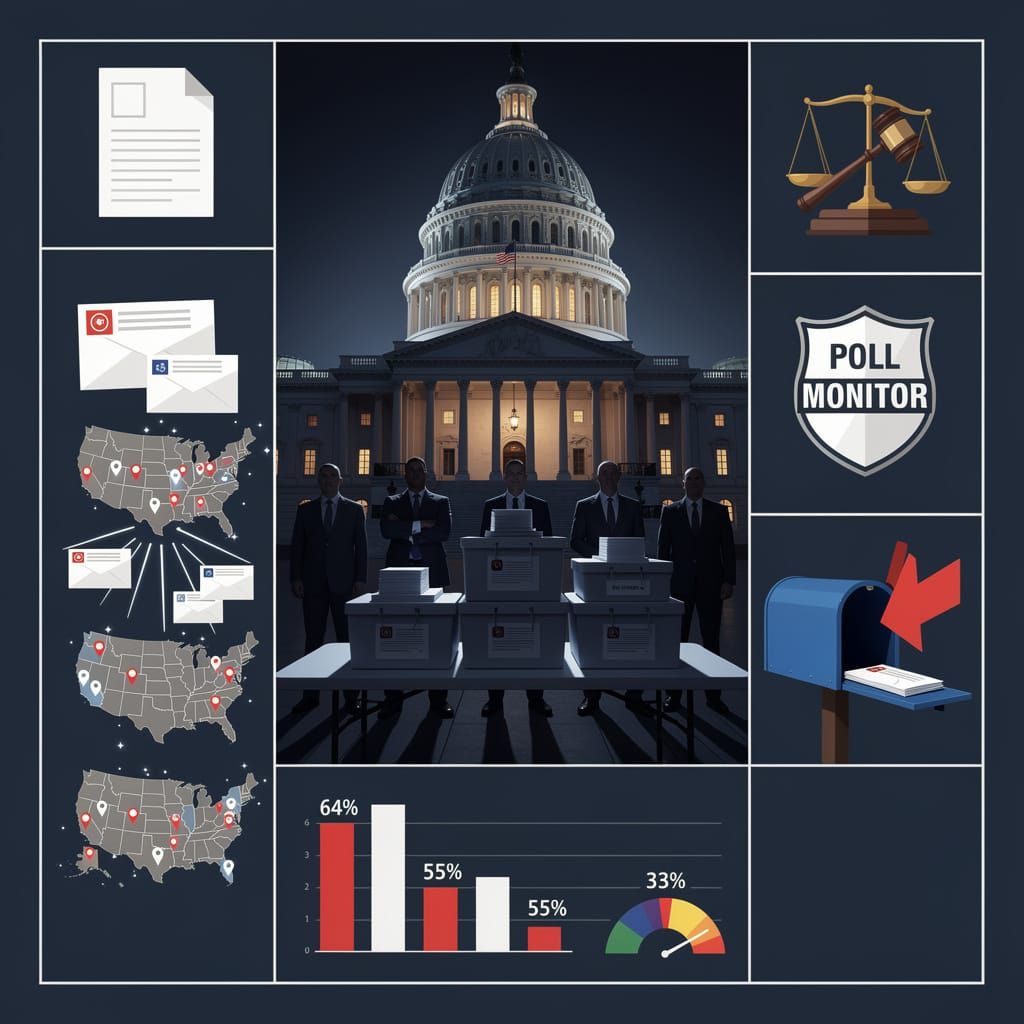
US voter confidence in fair elections fell from 64% in 2022 to 55% this summer—the sharpest warning sign yet. ⚖️🗳️ States are pre-writing court filings and recruiting poll monitors as federal probes reach 29 states and D.C. But judges keep blocking key orders, and the race for Nov 3 could finish in courthouses, not precincts. How confident are you that your state's count stays clean?
Forget the campaign ads. For election officials across the country right now, the real November 2026 playbook isn't about turnout—it's about contingency plans for the moment federal agents walk into a polling place.
A new kind of election prep
Nevada Secretary of State Cisco Aguilar has been busy drafting what he calls "Mad Libs" style legal filings—template documents with blanks to be filled in on the fly, ready for an emergency court filing the moment—not if, but when—trouble starts. This is the state of American election administration in 2026: pre-writing lawsuits like you'd pre-write an evacuation plan.
And they have reason for it. The Fulton County raid wasn't a one-off. FBI agents seized hundreds of 2020 ballots and record boxes from the Election Hub in Union City, Georgia—the fourth such federal probe since January. The operation followed Trump's June 23 announcement linking his actions to "election theft," and by July 2, the FBI had redirected intelligence assets to intensify those audits while opening a separate probe into Milwaukee's election using a top intelligence official. It didn't stop at Georgia: DOJ subpoenas also came down on Michigan, Arizona, Detroit, Utah, and Puerto Rico.
Oh, and Utah? On September 10, the DOJ's Civil Rights Division opened an investigation into Lt. Gov. Deidre Henderson herself—a conservative Republican—for allegedly failing to hand over voting records going back 22 months. The letter leaned on the Civil Rights Act of 1960, NVRA, and HAVA. Henderson's response on social media was essentially: "Wait, what?" But the feds have since fired letters to 29 states and D.C. demanding preservation of the 2024 records, complete with threats about spoliation of evidence. Arizona's Calli Jones and Minnesota's Cassondra Knudson confirmed compliance.
Then the courts pushed back. On July 7 and 8, Judge William M. Ray dismissed the federal grand jury subpoena targeting roughly 3,000 Georgia election workers' private data, citing expired statutory limits and privacy concerns. And the FBI's own July 13 outcome was telling: after a seven-week audit using the Accurint database, it quietly fired two Atlanta-based analysts and released no findings—because, as insiders admitted, there were no actionable irregularities to claim.
The legal front lines
Democratic attorneys general, led in part by Colorado's Phil Weiser, have filed over 125 lawsuits challenging various administration actions, with Weiser recruiting 10,000 volunteer poll monitors. Not everyone's convinced the pressure is even about results. On July 7, AG Harmeet Dhillon threatened criminal prosecution against officials in Michigan, Nevada, and Utah for "retaining noncitizen voters"—and Henderson refused to comply, citing prior court rulings.
Judge Indira Talwani keeps popping up like a stubborn lawn ornament. Her June 25 ruling blocked Trump's executive order creating centralized "State Citizenship Lists" and giving USPS authority to refuse mail-in ballots, an injunction covering 24 jurisdictions. But the story didn't end there. On August 25, after SCOTUS let part of the order proceed, Talwani ruled that USPS "feigned complete compliance" while advancing a rule that would limit ballots to "verified voters." Days later she paused key portions of that USPS rule entirely, calling the compliance timeline "impossible" and flagging the "overwhelming risk of disenfranchisement." The administration keeps appealing. Talwani keeps blocking. You could set a watch by it.
What the experts actually fear
Strip away the noise and the operational concern is startlingly specific: ballot seizure authority, immigration officer presence at polls, and aggressive registration purges could collectively slow the entire voting and counting process. A few bad rulings and a state's results slip from "certified" into "disputed."
The polls show the damage. Gallup's tracking shows voter confidence down—and it's not a subtle dip. Nationwide confidence in fair election conduct slid from 64% in 2022 to 55% this summer, while Gallup's separate July measure put American pride at a historic low of 33%. The ACLU's case isn't the point at stake. The point is that every jurisdiction is now budgeting time and money for litigation that used to be reserved for recounts.
Why this one's different
Here's the uncomfortable bottom line. We may reach November 3 with the machinery of election administration working exactly as designed—and still be weeks away from knowing who actually won, because the counting will be happening in courthouses as much as in precincts. If multiple states face simultaneous federal challenges on election night, courts could get swamped, with different circuits handing down conflicting rulings while ballots sit uncounted.
The lawyers have their filing templates ready, and this time they've got a few favorable rulings in the bank. Let's hope the judges keep up—because the feds have shown they won't stop asking.
Comments ()