Carney's Liberal Majority Faces Burning US Trade War This Fall
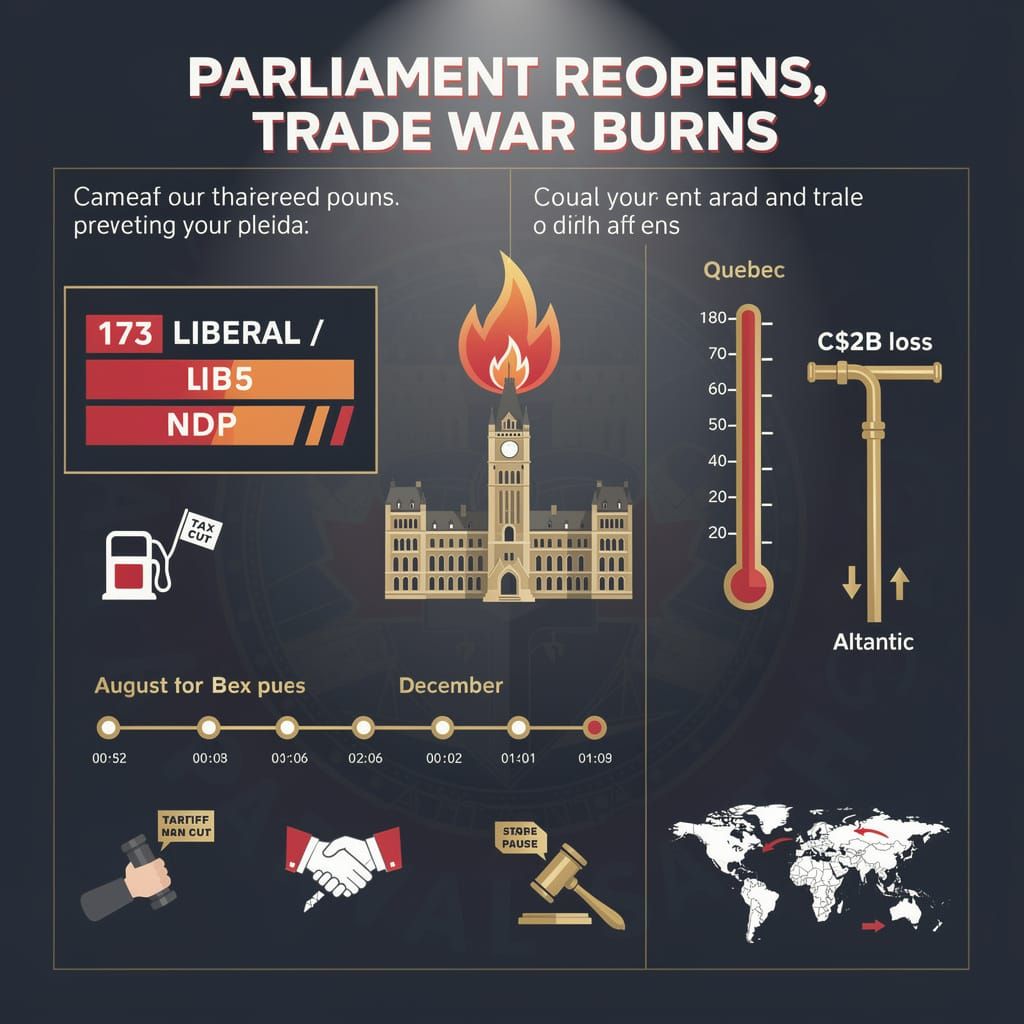
Canada's Liberals hold 173 seats—a majority built on by-elections and floor-crossers, not a mandate. 📉 The fall agenda is a defensive crouch: fuel excise relief for Canadians, tariffs on steel and autos from Washington, and a labor bill that could sideline strikes via Article 107. Quebec alone faces ~C$2 billion in annual tariff losses by 2028. Is this governing-by-survival wearing a statesman's suit, or real strategy for the US trade storm? What's your read?
So Parliament is back from its summer nap, and what have we walked into? A trade war that's gone from "tense" to "telenovela," a Liberal government strutting around with a shiny new majority, and—natch—a bill aimed at the petty cash drawer (fuel taxes) while Canada stares down the barrel of Trump's tariff threats. Also, the PM apparently caught a case of the giggles after a few by-election wins and is now dangling "US midterm seats" as if they're an IKEA shipping upgrade. More on that below.
The 173-Seat Swagger
Let's get the math out of the way. Mark Carney's Liberals now hold 173 seats—a majority carved less from a landslide mandate and more from by-election luck and a few floor-crossers. The NDP, meanwhile, has been gutted down to five MPs in Ottawa. Five. And there are at least six vacant seats cycling toward by-elections—including the trio of Chicoutimi–Le Fjord, Beaches–East York, and North Vancouver–Capilano where the government just swept clean. That means we're about three press releases away from another round of "surprising" upsets.
But here's the part nobody's saying out loud: a majority doesn't mean Carney won the argument. It means the opposition is down to a whisper, and the "centerpiece" of the fall sitting—per government House leader Steven MacKinnon—is a grab bag of economic measures with a South-of-the-border punchline attached.
And the confidence? Oh, it's flowing. After that clean sweep, Carney reportedly called himself "unusually empowered" and took a swing at his critics as "Republican Red." He also predicted his party would target three additional "US midterm seats"—because apparently the man's now treating Alabama's 4th district as a wing of the Liberal Party of Canada. Someone get this man a map.
A Tax Break So Hot It Might Cover the Burn
Finance Minister François-Philippe Champagne is trotting out a fresh bill to extend the excise tax relief on fuel. Fun, right? A little pocketbook kick while the U.S. threatens tariffs on steel and autos by year-end. The optics are almost too tidy: hand Canadians a tax break on the left, blame the Americans for the rising cost of everything on the right.
The actual reality: Inflation relief is a bandage, not a reset button. Remember that August trade deal that was supposed to save us? Depends which Tuesday you're counting. On August 17, Trump announced a last-minute pause on those 50% tariffs on $20 billion of Canadian imports—less than two hours before they were set to bite, no less—turning the "crisis" into a three-day reprieve. By late August, Canada suspended talks on the 21st, and by that Thursday USTR Jamieson Greer was out there mourning the "best deal in the world" Canada allegedly walked away from, claiming Ottawa kept moving the goalposts and demanding fresh concessions on steel, aluminum, autos, and lumber. Simmer down, Greer—you're the one who set the table. Either way, December 31 is the real deadline, and this "negotiation round" has flamed out so many times it should get its own reality-show spinoff. So this fuel relief is less an economic strategy and more a defensive crouch. Meanwhile, Quebec's economy is projected to lose about C$2 billion annually by 2028 on those tariffs—and that's before we talk about the province's own little fiscal soap opera, where a 49.7-billion-dollar infrastructure deficit and an auditor-general's audit-turned-alarm bell are making everyone in Quebec City sweat. But hey—gas is a couple bucks cheaper.
Meanwhile, Labor Gets the Strap
Here's where it gets spicy. Tucked inside the "economic resilience" push is a big labor-law bill courtesy of MacKinnon, Labour Minister Patty Hajdu, and Canada-U.S. Trade Minister Dominic LeBlanc. The pitch: streamline collective bargaining, "reduce government interference," reach social agreements faster.
The fine print, per union leaders: potential invocation of Article 107 of the Canadian Labour Code—the nuclear option that can effectively sideline strikes in the name of "national interest." Translation: the government gets to pick when workers get to exercise their leverage. The Carney crew wants to dress it up as the "Building Canada Strong Act," with "guardrails" and mediator involvement—ooh, professional. But the Canadian Labour Congress and United Steelworkers are already lining up judicial reviews, and if you remember the Air Canada flight attendants getting hauled back to the cockpit by exactly this mechanism, you'll forgive the skepticism. Nothing says "pro-worker" like quietly barring the strike button during a trade crisis, amirite?
So, What's the Actual Plan?
Allow me to sketch the playbook as currently detectable:
- Befriend literally anyone who isn't the United States: Carney's been barnstorming Strasbourg and New York, trying to diversify trade partners faster than you can say "IKEA furniture instructions."
- Talk pipeline, loudly now: Oh look, Danielle Smith and Carney formally announced a transcontinental pipeline back on July 3, ~1 million barrels a day shipping Alberta crude to BC's West Coast ports for Asian markets, complete with a "national interest" designation and regulator-skip included. Funny how that materialized the instant the majority showed up.
- Poke the bear gently: Keep offering softer trade language while Trump keeps waving steel tariffs—and occasionally pausing them six hours before they bite.
The Honest Read
This isn't a comeback story—it's a governing-by-survival story. The majority is real, but it's propped up by defections and by-election sweeps, not converts. The fuel tax relief is a nice headline, but it doesn't fix the structural problem: Canada's biggest trading partner is actively hostile, the August deal collapsed (twice, depending on your calendar), and the fall agenda is essentially one giant "please don't hurt us" campaign dressed in business-casual.
Carney wants you to believe this is statesmanship. Watch the by-elections, watch the pipeline, keep one eye on Article 107, and maybe check what ridings exist outside Canada's borders before making election promises about them. That's where the actual plot lives—the rest is just parliamentary theater with a nice font.
Comments ()